Showing posts with label Amazigh Culture. Show all posts

Sunday, June 17, 2018

The Lone Woman Playing a Man’s Game


Brietta Hague reports on an ancient and little known Moroccan sport - Mata - and the lone woman who has chosen to compete

Photo credit: Angels Melange

A hundred horsemen are preparing for battle. Six tribes from Northern Morocco have gathered in the village of Zniyed for a game that dates back 800 years.

Mata is a display of manhood as much as it is a game. Tribesmen, riding bareback, fight for possession of a female idol, using force if they have to. In past years, some have even used knives.

Traditionally, the rider who crosses the finish line with the idol won the hand of the most beautiful woman in his tribe.

But today the men no longer take a woman as a prize, they compete against one - Zohra Sidki - the only woman to have taken the field for Mata.

Zohra Sidki

Before the race, riders head to pay their respects at the mountain-top tomb of Moulay Abdeslam, the saint who first started Mata.

The Sufi saint is said to have brought the game home from central Asia in the 13th century.

During his travels, he witnessed “buzkashi” — an Afghan sport still popular today where riders vie to put a goat or calf corpse into a goal.

Buzkashi itself was brought across the central steppe to Persia by Mongol hordes.

The sport took hold in north Africa and mixed with local beliefs, becoming something uniquely Moroccan.

When the saint’s direct descendants, the Baraka family, revived the game, they faced a common cultural conundrum: how to honour a historic tradition steeped in patriarchal attitudes that many now find unacceptable.

See Brietta Hague's full report here: Mata Festival 

SHARE THIS!

Monday, May 21, 2018

14th International Festival of Amazigh Culture at Fès - Report


14th International Festival of Amazigh Culture at Fès called to strengthen the values of social justice and freedom

The curtain fell last Sunday on the fourteenth edition of the International Festival of Amazigh Culture in Fez. Organized under the High Patronage of His Majesty King Mohammed VI by the Association Fes Saiss and the Center South North in partnership with the Region Fes-Meknes, this edition was marked by the vibrant homage paid to the great writer Tahar Ben Jelloun and by a series of tributes to several figures of the Amazigh song.

During the debates, which brought together 30 speakers included Moulay Driss Alaoui Mdaghri, Mohamed Kabbaj, Nouzha Skalli, Hassan Aourid, Fatima Sadiqi, Jean-Marie Cimon, Juliane Tauchnitz ... the speakers emphasised the impact of multiculturalism in general and Amazigh culture in particular on modernity, democracy and sustainable development. "This congress shed light on the contribution of minority culture to the Islamic world and called for multiculturalism to be a lever for economic, social and cultural development," says Moha Ennaji, director of the festival. And to add that the congress has examined ways to promote democratic culture in the countries of North Africa. During the debates, Participants noted the important role of Amazigh intangible heritage and cultural diversity and their contributions to the culture of peace. Unanimous, academics like Mohamed Arji (University of Fes), Abdallah Boumalek (IRCAM), Abdelouahad Mabrour (University of El Jadida), Ali Fertahi (Mly Slimane University), Mohamed Chtatou (International University of Rabat) and Driss Bouyahya (University Moulay Ismail, Meknes), reviewed the evolution over the years of Amazigh cultural action and its different phases of transformation.

A dozen concerts at the historical site of Bab Makina set the tone for a colourful event! The varied programming attracted lovers of Amazigh and popular music.

Dounia Batma
The great artist Aicha Maya and the Faisal orchestra gave great concerts on the prestigious opening stage of the Festival. The second evening featured the great artists Fatima Tachtoukt, Sami Ray, and the group Ahidous Oulmès. For the Sunday closing, the Catalan band Marea Flamenca, the great artist Houssa 46 and the star of the Moroccan song Dounia Batma performed in marvellous concerts with their unique talents. The festival was pleased to honour the latter singers.

The International Forum, another strong aspect of the festival, it was a platform to discuss the Amazigh culture and the future of democracy in North Africa. The discussions focused on the importance of democratic culture and intercultural dialogue for human development, peace and social cohesion.

In parallel, theater, writing, and painting workshops, as well as poetry readings, art and book exhibitions and Amazigh carpet exhibitions were on the program.

Tahar Ben Jelloun, "the man of the year"

During the festival, the organizers paid a warm tribute to the writer Tahar Ben Jelloun. Born in Fez, the winner of the Goncourt prize (in 1987 for "La Nuit Sacrée") was chosen "man of the year" by the Amazigh festival. In a testimony, Mohamed Kabbaj, founder of the Association Fes-Saïss, returned on the paths crossed with Ben Jelloun. "Although we are both native of the medina of Fez, a few hundred meters, I have known you through your writings, novels, and articles," Kabbaj said. Prix ​​Goncourt in 1987 for "La nuit sacrée" (translated into 43 languages), Tahar Ben Jelloun is the glory of Moroccan writing: Arabization made him leave his post of teacher of philosophy in 1971, but opened him an international career. He is the most translated French writer in the world. He is the author of fifty books, poetry and novels. Writer elected member of the academy Goncourt (since 2008), he is the author of many novels including "Harrouda", "The scars of the sun", "The reclusions solitary", "The prayer of the absent" ... until to "A country on the nerves" and "Punishment".

Among the big names, writers, poets, and journalists who participated in this festival: Driss Mdaghri Alaoui (Morocco), Nouzha Skalli, Hassan Aourid (Morocco), Jean-Marie Simon (France), Noha Bakr (Egypt), Johan Goud ( Holland), Tarik Mira (Algeria), Juliane Tauchnitz (Germany), Mino Vianello (Italy), Youssouf Amine Elalamy (Morocco) and many others!

In the end, the 14th edition of the festival released the following recommendations:
1) Emphasise the central role of the Amazigh language and culture as vectors of universal values of democratic culture and living together.
2) Strengthen respect for gender equality and the preservation of social integration.
3) Sensitize individuals, especially young people through education, to the values of democracy, modernity and peace.
4) Encourage democratic culture in the family, school, community and cities, at local and national levels.
5) Encourage self-criticism and critical thinking, and work on mentalities as a way to prevent conflict.
6) Separate religion from politics, and consolidate the separation of powers.
7) Strengthen the values of social justice and freedom, and strengthen cooperation among North African countries to achieve democracy and sustainable development.

SHARE THIS!

Thursday, April 19, 2018

Fez International Festival of Amazigh culture - Full Programme


The 14th Fez International Festival of Amazigh culture on the 11th, 12th and 13th of May. It is a rare chance to learn more about Amazigh (Berber) culture


The festival features an international forum as well as concerts at Bab Makina

Concerts: BAB MAKINA 21:30 - 00:00

FRIDAY 11th MAY 2018
- AHIDOUS OULMES (Morocco)
-AICHA MAYA (Morocco)
-ORCHESTRA FAISAL (Morocco)

SATURDAY 12th MAY 2018
- CARISHTO GROUP (Italy)
- SAMI RAY (Morocco)
- FATIMA TACHTOUKT (Morocco)

SUNDAY 13th MAY 2018
- MAREA FLAMENCA GROUP (Catalogna, Spain)
- HOUSSA 46 (Morocco)
- DOUNIA BATMA (Morocco)


INTERNATIONAL FORUM

Forum Venue: Mérinides hotel       11-13 MAY 2018

Amazigh Culture and the Future of Democracy in North Africa

Program of the Forum
Friday 11 May
16:30 Arrival of participants
17:00: Opening of the Forum and the Festival
-Speech by the President of the Fes-Saiss Association
-Speech by the President of South North Center and the President of the Festival
-Speech by the honorary President of the Festival
-Speech by the President of the BMCE Foundation
-Speech by the President of the Fez-Meknes Region
-Speech by the Wali of Fez-Meknes
-Other Speeches
17:30 Tribute to the distinguished Moroccan writer Tahar Ben Jelloun
Testimonies: Mohammed Kabbaj, Nouzha Skalli, Abderrahman Tenkoul
18 :15 Inaugural speech: Amazigh Culture and democracy
Hassan Aourid
Moderator: Moha Ennaji
18 :30 Reception and Exhibitions Tour

Saturday 12 May
Morning
9 :00 – 12 :00
Room 2
Parallel Session: Workshop on Tifinagh Alphabet
By Amina Majdoub (General Inspector of the Amazigh language)
9 :00 - 10 :30
Room 1
First Session: The Amazigh Cultural Movement: review and prospects
Moderator: Fatima Sadiqi (INLAC, Morocco)
Speakers : Mohamed Arji (University of Fez), Abdallah Boumalek (IRCAM), Abdelouahad Mabrour (University of El Jadida), Ali Fertahi (University of Beni Mellal), Mohamed Chtatou (International University of Rabat), Driss Bouyahya (University of Meknes)
10 :30– 11 :00 Coffee break
11:00– 1 3:30
Room 2
Parallel Session: Workshop "Life and death of a book, from writing to oblivion"
Hosted by Jean-Marie Simon (French writer)
Room 1
11 :00 – 12 :30
Second Session : Amazighity, citizenship and democratic culture
Moderator: Omar Marrakechi (Fes Sais Assocation)
Speakers : Tarik Mira (Algeria), Moha Ennaji (INLAC, Fez), Driss Maghraoui (Al-Akhawayn University), Maria-Angels Roque (IE Med, Spain), George Joffé (Cambridge University, U.K), Filippo Bignami (University of Southern Switzerland- SUPSI)
12:30 – 13 :30
-Presentation of the general dictionary of the Amazigh language by Meftaha Ameur (IRCAM)
-Presentation of the novel "Funny Spring" by its author Youssouf Amine Elalamy
Moderator: Juliane Tauchnitz (University of Leipzig)

Saturday 12 May
Afternoon
15 :00 – 16 :30
Room 1
Third Session : Amazigh Culture, democracy and Literature
Moderator: Johan Goud (University of Utrecht)
Speakers : Jilali Saib (Morocco), Alberto Tonini (University of Florence), Abdelkader Benali (Amsterdam), Bouthaina Ben Kridis (University of Carthage), Juliane Tauchnitz (University of Leipzig), Hamid Bahri (City University of New York)
16:30 – 17 :00 Coffee break
Room 1
17:00 – 18 :00
Poetry reading: Saida Khiari, Bassou Oujebbour, Hammou Khalla, Mohamed Akouray
Moderator: Mohammed Moubtassime (University of Fez)
Room 2
17:00 – 18 :30
Parallel Session: Painting Workshop
Supervised by Khadija Madani Alaoui (University of Fez) and Tarek Sadki (University of Fez)

Sunday 13 May
Morning
9 :00 – 10 :30
Room 2
Parallel Session: Clown theatre for children (8 years plus)
By Annick Renault (France)
9 :00 – 10 :30
Room 1
Fourth Session : Amazigh Culture and Women’s Movement
Moderator: Fouad Saa (University of Fes)
Speakers : Loubna Amhair (Morocco), Aziza Ouguir (Morocco), Enza Palamara (François Rabelais University, Tours), Jean-Marie Simon (France), Fatima Sadiqi (INLAC, Morocco), Mohamed Taifi (United States)
10 :30 – 11:00 Coffee break
11 :00 – 12 :30
Room 1
Fifth Session : Amazigh Culture, Multiculturalism and Democracy after the "Arab Spring"
Moderator: Mohamed Bokbot (Dean of the Faculty of Letters, University of Fez)
Speakers : Diederik Vandewalle (Dartmouth College), Johan Goud (University of Utrecht), Noha Bakr (Egypt), Madina Touré (University of Nouakchott), Rachid Raha (The Amazigh World), Mino Vianello (University of Rome)
12:30 – 13 :00 -Photos Exhibitions "Ait Séghrouchen, Hommes Libres" by Michel Rissoan (France) : Commented by Jean-Marie Simon
Moderator: Mohand Rguig (Faculty of Letters, University of Fez)
13 :00 Recommendations and closing

Sunday 13 may
Afternoon
17 :00 – 19 :00 Guided Tour of the Medina (optional)

Commentators:
Souad Slaoui—El Hassan Hjiej-- Driss Rhomari--Rachid Elouardy--Kebir Sandi--Mohyiddine Benlakhdar--Khadija Hassala-- Mohammed Yachoulti--Fouad Saa--Fatima Hnini--Said Gafaiti--Mohand Rguig--Abdelmounaim Azzouzi--Abdeslam Jamai --Mustapha Aouine-- Kamal Elaissaoui-- Mounia Slighwa -- Karima Nour El Aissaoui—Assia Bouayad --Ahmed Falah

Photos Exhibitions by Michel Rissoan (France) OFFICIAL PHOTOGRAPHER OF THE FESTIVAL
Paints Exhibitions by Khadija Madani Alaoui and Tarik Sadki


SHARE THIS!

Friday, January 12, 2018

Happy Yennayer - The Amazigh New Year


Today is the Amazigh New Year - Happy Yennayer to our readers 
Morocco does not list Yennayer as an official holiday - but Algeria does.

While the majority of Moroccans forget its existence, a section of the population including the Imazighens, is already active in the preparations for the celebration of this new year based on an agrarian calendar.


SHARE THIS!

Friday, December 29, 2017

Fifteenth International Nomads Festival


The International Nomad Festival (22 - 24 March) was first staged in 2003 and is based in the small Moroccan village of M'hamid El Ghizlane, some 60 kilometres south of Zagora in the Draa Valley. Entry to the festival is free


SHARE THIS!

Thursday, December 28, 2017

January 12th - Yennayer - Amazigh New Year


Yennayer, the celebration of the Amazigh (Berber) new year will take place on January 12th. 2018. The day heralds in the year 2968


Yennayer is a word composed of two Amazigh words; yen (yan) which means number 1 and ayer (ayur) which means month. So yennayer means the first month.

It was Ammar Negadi who created a Berber calendar in 1980, based on a landmark event in the history of the Amazigh people, an undeniable historical fact to make it the zero point of the calendar. His choice fell on the year 950 BC, which corresponds to the date when the Berber king Sheshonq I (also spelled Chichnaq or Chichneq) was enthroned Pharaoh of Egypt and founded the XXIInd Dynasty which reigned over Egypt until the year 715 BC. This Berber king had managed to unify Egypt and then invade Palestine. It is said of him that he seized the treasures of the Temple of Solomon in Jerusalem in 926 BC. This date is mentioned in the Bible and would be, therefore, the first date of Berber history on a written support. King Sheshonq is mentioned in the Bible under the name of Sésaq and Shishaq (שִׁישַׁק) in ancient Hebrew.

And the Algerians are joining the party

Algerian President Abdelaziz Bouteflika announced Wednesday his decision to consecrate Yennayer, the Amazigh New Year, as a paid holiday on January 12, 2018.

It was a long-standing claim of the Amazigh movement, both in Morocco and Algeria. The new year, Yennayer, is celebrated every year on January 12, and this will be for the first time in the history of our neighbours to the East.

The announcement was made by the Algerian Head of State Wednesday at the meeting of the Council of Ministers. "In presenting its best wishes to the Algerian people on the eve of the year 2018, President Abdelaziz Bouteflika announced his decision to devote Yennayer day off work and paid as of January 12, the government being responsible for making the appropriate arrangements for this effect, "said a statement issued after the Council.

"This measure, like all those already taken to benefit our national identity in its triple Islamic, Arab and Amazigh component, will strengthen national unity and stability, while multiple internal and regional challenges challenge us," added President Bouteflika. , which "urged the government to spare no effort to generalize the teaching and use of Tamazight, in accordance with the letter and the spirit of the Constitution." The President of the Republic has also instructed the government to accelerate the preparation of the draft organic law for the creation of an Algerian Academy of the Amazigh language, "the statement said.

SHARE THIS!

Tuesday, December 26, 2017

Amazigh Tattoos - A Fading Tradition?


One of the most frequently asked questions received by The View From Fez concerns the Amazigh (Berber) tradition of tattooing. Although tattoos are most often seen on older women, they are making a comeback among younger women


For the more conservative Arab members of society the tattoo is said to be prohibited in the Qur’an, yet despite this, tattooing has survived for centuries in the Islamic societies of North Africa.

According to the opinion of Moroccan religious scholars  interviewed in the 1920s, getting a tattoo was strictly “forbidden” since the seat of the tattoo caused injury; the pigment, impregnated with blood, remained under the wounds thus rendering the body imperfect in the eyes of Allah. Furthermore, they claimed that a tattoo was an obstacle preventing water from penetrating the skin during the ritual ablutions of purification: one of the five fundamental precepts of Islam.

However, Moroccan women considered certain tattoos as legitimate. The popular religious doctrine of Hadith, the collection of sayings of the prophet Mohammad that constitute a major source of guidance for Muslims after the Qur’an, claims that ghemaza (tattoo between the eyebrows) and siyâla (tattoo on the chin) are traditional. For example, early 20th century literature has recorded that tattoo existed in Arabia at the time of the Prophet Mohammed: “All women were tattooed and Lalla Fatima Zahra, the daughter of Mohammed, very probably wore the siyâla, which is attributed to her in Moroccan belief.” Even women living today sometimes say, “Fatima gave this [siyâla] to us,” or “Tasnida D-Lalla Fatima Zahra,” this tattoo is “dedicated to Lady Fatima Zahra.”

Tasnida D-Lalla Fatima Zahra,”

Within the Amazigh communities of North Africa, the practice of tattooing dates back to pre-Islamic times and the technique of tattooing existed since the Neolithic.  They were far more than simply body adornment, having far deeper levels of significance which vary from tribe to tribe.

While the most visible tattoos are on the cheeks or chin, where it might indicate marital status or tribal affiliation, tattooing was not restricted to the face.  As a protective talisman, tattoos retain elements of atavistic animism: a belief that supernatural energy (baraka) resides in all things. Amazigh tattoo designs hold the sacred energy of baraka which can be used to deal with the darker forces of life, to cure illnesses and to protect oneself against spirits called jnoun (singular: jinn). Oftentimes Amazigh tattoos were placed near body orifices (eyes, mouth, nose, navel, vagina) or surfaces believed to be vulnerable to the machinations of evil. For example, tattoos usually marked the feet to protect women from jnoun who attempted to enter the body through the earth. Other designs on the ankles, hands, and face were believed to protect individuals from the evil eye. Thus, it is not surprising that many Amazigh tattoos carry the tag of jedwel or “talisman.”


It is widely believed that one can escape the power of the jnoun by plunging an iron knife into the ground. The use of an iron needle in tattooing is thought to have a similar effect and will protect the individual.

The most common Amazigh term for tattoo is oucham (“to mark”). Tattoos were traditional or l-qayda (“custom”) and some motifs were rooted in the ancient Amazighalphabet known as Tifinagh. The Tifinagh is a figurative alphabet derived from tools used in agriculture, sea products, and constellations. Upon examining the list of extant letters, more than a dozen Amazigh tattoo motifs are common to the alphabet and these symbols generally appear on the chins of Amazigh women as siyâla.

The motifs widely recognised in the Amazigh tattoos are divided between a few categories, mainly vegetal motifs, such as the olive tree, which represents strength because of its Amazigh name azemmur, related to the term tazmat (strength); wheat, which is a display of life (because of its sheath) and death (because of the seeds being in the ground); or seeds, which are a reference to masculinity, they represent manhood and are a symbol for life and fertility; and metal objects, which make the allusion to the blacksmith, such as the hammer, which represents power, natural forces and creative power. It is a very important instrument for the blacksmith because it enables him to change the iron into various shapes; the anchor, symbolising solidity, continuity, faithfulness, balance and lucidity; the axe, which is a sharp instrument and represents anger and destruction – however, since it attacks evil forces, it is a positive symbol, associated with the lightning and rain (therefore fertility); and the arrow, a cosmic projection associated with lightning, which represents male energy and fertility.
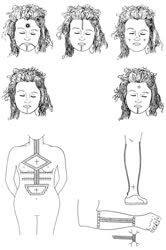
Tattoos of the Rif Amazigh of Morocco, ca. 1930


But not all Amazigh tattoos were literal in this sense. In the early 20th century, the Rif Amazigh women of Morocco, among others, practiced tattooing as a prerequisite for marriage. When a girl was certain that she was to be married and when all arrangements for her wedding had been made, her family called in an old woman of the same awar, or sociological family, who was expert in the indelible art. If no such woman was available, one was called in from outside and if the tattooist was related to the client no fee was paid.

Next, the old tattooist began preparing her liquid tattoo pigment of lampblack and juice squeezed from the leaves of broad (fava) beans. According to Amazigh scholar Pierre Bourdieu, broad beans (ajedjig) embodied multiple referents for the Amazigh. Firstly, dried broad beans were male symbols akin to human bones. Secondly, "being a desiccated seed which, after burial in the damp womb of nature, it swells and comes up again, more numerous, in spring," the broad bean also symbolised the refuge of the soul awaiting resurrection.

This transition to a new life would be filled with discovery, but more importantly it would be marked by transformation; since after the tattooing the girl would become a woman, a sexual being who was accorded a new status that had the potential to bring her greater social recognition and fulfilment via the sanctity of motherhood. Amazigh women, as the centre of the family’s sacred identity and guardians of the family’s honour and reputation, were situated within a socio-moral universe that affirmed their importance in everyday society. They were responsible for all magical practices intended to safeguard life (e.g rites against the evil eye), and those designed to maintain the life of their children for which they were responsible - as well as the generative powers of which they are the bearers.


For those interest in discovering more about Amazigh tattooing, note that the The Dar Bellarj Foundation in Marrakech are holding an exhibition "Engraved Woman" until October 31, 2018.

This exhibition explores the tradition of tattooing. Often considered a taboo, the tradition of tattooing in Morocco is linked to a very old pre-Islamic rite. It is "mainly associated with Amazigh culture, whose function is as much ornamental as prophylactic, identity and medicinal," said a statement by Dar Bellarj. And to add that although proscribed by Islam, the practice has long endured, thanks to its symbolic strength in the field of the sacred. At a time when it seems more and more threatened, five young Maghreb artists worked on this controversial heritage and questioned him, each with his medium, his approach, his eyes, to avoid fatal amnesia.

In this exhibition, we find the work of Moulay Youssef El Kahfai, Noureddine Tilsaghani and Wassim Ghozlani, accompanied during their creative residency in Dar Bellarj of two young laureates of the Graduate School of Visual Arts in Marrakech: Maha Mouidine (graphic designer) and Marouane Bahrar (photographer).

Each of the points of view of these artists are intertwined and dialogue in the space of Dar Bellarj, next to a collection of the Berber museum of original photographs of tattooed women, loaned by the Majorelle Foundation, by Jean Besancenot, in Morocco, at early twentieth century.
In addition to the exhibition, meetings, conferences, workshops with artists and craftsmen, film screenings in the presence of the filmmakers allow to continue the mission of the Dar Bellarj foundation: to enhance the Moroccan heritage by the look and feel gesture of contemporary artists.

Created by the Swiss patrons Susanna Biedermann and Max Aliot at Riad Dar Bellarj in Marrakech, the Dar Bellarj Foundation for Culture in Morocco aims to enhance the Moroccan architectural and artistic heritage, and contribute to the influence of the living culture of Morocco. Morocco. Open to all, the Dar Bellarj Foundation offers throughout the year a program of events and cultural activities articulated around four major axes: the enhancement of tangible and intangible heritage of Morocco; support for artistic creation and crafts; the research ; the transmission. Dar Bellarj has already hosted exhibitions on earthen architecture, plaster art, embroidery of today's Morocco, Al Halqa or the "Nomadic Trace".


SHARE THIS!
Tuesday, December 12, 2017

Amazigh Festival in Meknes


The 5th edition of the Amazigh (Berber) New Year Festival (2968) will take place from 26 to 28 January in Meknes, under the theme "The dialogue of cultures and the question of identity"


Initiated by the Centre for Shared Memory for Democracy and Peace, the event aims to strengthen cultural customs related to the Amazigh New Year celebration and to discuss issues of identity and common memory. On the menu of this festival, musical evenings dedicated to the celebration of the values ​​of cohabitation, social justice and solidarity and respect for difference.

SHARE THIS!

Wednesday, August 23, 2017

Morocco's Ahidous Festival 2017


The 17th edition of the National Festival of Ahidous will take place from 25 to 27 August. The organisers say that the aim of this event is to "preserve and publicise this musical heritage that connects the past with the present and reflects one of the many facets of Moroccan culture"

Ahidous is one of the most important collective dances of Amazigh (Berber) society. It is also a means of allowing the group to express the emotion shared by the individuals and above all to highlight the  culture and the beauty of its nature. As an art rooted in the Amazigh culture, the Ahidous is a means of communication between the individuals of the group and an expression of the collective spirit and solidarity among the Amazigh tribes.

The movements of this dance, being collective, is a trampling, a tremor that spreads, interspersed with undulations that recall the movement caused by the winds on the corn. By the ease of his dancers and the repetitiveness of the rhythms that accompany them, the Ahidous testifies to a remarkable sense of choreography.

Some 45 folklore troops from different mountainous regions of the Middle Atlas will participate in the festival in the small locality of Ain Leuh (province of Ifrane). Initiated by the association Taymate of the arts of the Atlas, in collaboration with the Ministry of Culture, the festival aims to create a space for exchanges and meetings between poets, artists and researchers specialized in Amazigh culture.

This year, tributes will be paid to a number of Amazigh artists, including Fatima Amarech, Hassan Bouykifi, Hassan Charki and Mbarek Oussidi.

A very popular event, since its first edition in 2000, the National Festival of Ahidous has gained momentum and has taken a leading place on the list of festivals organised by the Ministry of Culture.

SHARE THIS!

Thursday, August 17, 2017

Taragalte Festival - 27, 28, 29th of October 2017


A Festival Under The Stars
(Click on images to enlarge)

Taragalte is a 3 day festival in Zagora. A very different festival under the stars in the desert of south Morocco. This festival is a celebration of nomadic heritage and world music. The festival will also host the 4th edition of the Peace Caravan -  promoting peace and tolerance in the Sahara and Sahel. You can relax in the dunes, listen to music, poetry, dance under the moon and enjoy art or participate in workshops about the fragile environment of the desert.


 Find out more about this year at http://www.taragalte.org

SHARE THIS!

Wednesday, August 16, 2017

Escape the Heat in Fez - Head to the Hills


If you have been sweltering in Fez there are a growing number of places up in the foothills of the Middle Atlas where you can chill out. The View From Fez team recently visited Dar El Mandar, just 35 minutes from Fez

This beautifully designed Amazigh dwelling is nestled in the hills overlooking the Fez-Sais plain with a view of Fez.  It is an ideal place for families or groups to stay overnight or visit with a day pass that includes use of the pristine pool and a delicious lunch.

Dar El Mandar was created by Jaoued Saidi and his wife Samira who have put years of thought and planning into creating a place of beauty that combines both contemporary and traditional Amazigh (Berber) styles.


For cooler times, the main house has a roaring fire in the large open-plan lounge and dining area. There is choice of a large dining table or a less formal table on the terrace outside.


The food is traditional, beautifully prepared and ranges from simple tagines to more elaborate menus if arranged in advance.

The bread and cakes are all cooked on-site in a traditional Amazigh oven. For those interested, a traditional bread making course is available.

Traditional Amazigh bread-making with Khadija

What is remarkable about the Dar El Mandar experience is the variety of areas, each with a totally different ambiance. Sitting beside the pool sipping a cool rosé, or with a group of friends eating lunch in the outdoor dining room, or (our favourite) chilling out in one of the the traditional Amazigh tents.

Room with a view - outdoor dining

The Amazigh tents are ideal for simply relaxing, reading a book or having a siesta. Looking out over the landscape it is easy to see why Game of Thrones used the tents as a template for the Dothraki tents. Khal Drogo slumping on a banquette would not look out of place.

The perfect chill out spot

At the end of the day the bedrooms are inviting, tastefully decorated and with very comfortable beds. If you want to stay overnight it is important to book well ahead as Dar El Mandar has only three (air-conditioned) bedrooms.


Photo credits: Sandy McCutcheon, Suzanna Clarke - Click on images to enlarge

DETAILS

Douar Lahricha Bni Mellala, Kandar Sidi Khiar Caïdat Aït Youssi, Sefrou, Morocco.
00 212 676 141 335
darelmandarfes.com

SHARE THIS!

Saturday, August 05, 2017

Mohamed Choukri to Feature at Twiza Festival


The 13th edition of the Twiza Festival will take place from the 10th to the 13th of August in the city of Tangier

According to a statement from the Foundation of the Mediterranean Festival of Amazigh Culture in Tangier, this edition, which will be devoted to the role of intellectuals, will be marked by the participation of several major names from the world of culture and arts, both Moroccan and foreign.


The organisers of the event say a tribute will be paid to the Egyptian writer Nawal Saadawi, who will be the guest of honour of the festival in addition to meetings with journalist Abdel Bari Atwan, researchers Ahmed Assid, Mohamed Boudhan, Rachid Alhahi, Boudriss Belaid and Ahmed Zahed.

The festival will also include sessions on the writer Mohamed Choukri and the Spanish writer Juan Goytisolo.

On the artistic side, the organisers announce several musical evenings of the Moroccan repertoire.

SHARE THIS!

Monday, July 17, 2017

Amazigh Cultural Festival Ends on a High Note

The International Festival of Amazigh Culture closed last night with an over capacity crowd jammed into the beautiful Bab Makina venue

Participants at the Festival's forum sessions that we spoke with during last night's concert were united in judging the Festival a huge success, with lively debates and thought provoking addresses.

Congratulations are due to the Festival organisers; in particular Fatima Sadiqi and Moha Ennaji.

Moha Ennaji at last night's concert

First up at the final concert was the dynamic powerhouse Hadda Ouakki, who was greeted warmly by the audience and delivered her set with her four dancers with gusto. It was pure Amazigh and showed just how alive the ancient culture is today.

Hadda Ouakki

Next up was Laura Conti, who was welcomed back to the Festival. She first performed at the Festival back in 2015. With a great voice and the skills of an actor she inhabited the music and received a rapturous response from the audience.

Laura Conti in full flight

Conti's songs were skilful arrangements by guitar maestro Maurizio Verna, whose performance gave her the space to bring the songs alive.

The three piece group Eivadòr (Golden River) is named after the old Caravanserai name for the Orco River, famous for the extraction of gold.

Guitar maestro Maurizio Verna,

The final performance was from a crowd favourite, Abdelhafid Douzi. The singer and actor, now in his thirties, appeared on stage and the crowd surged forward, past security to the front of the stage. The sea of waving arms, smart phones and cameras held aloft made glimpsing the singer a little difficult and photography impossible, but the music told the story and the crowd rewarded Douzi with a tsunami of applause.

Halfway through the concert there was a large crowd locked out

The only criticism of the evening was the Festival's underestimation of the size of the crowd. Numbers were so great that the doors of Bab Makina had to be shut to prevent the hundreds still waiting outside to enter. Not only is overcrowding unpleasant, causing many people to stand for the duration, but it raises serious safety issues.


Despite those problems, the Festival was judged an overwhelming success and showed just how tangible "intangible cultural heritage" can be.

Photos & Video; Sandy McCutcheon

SHARE THIS!

Saturday, July 15, 2017

Amazigh Festival Tackles Big Questions

There is a fascinating array of academic experts participating in the International Festival of Amazigh Culture and today they showed that they weren't backing away from contentious issues
Michael Willis identified the antagonism between Islamists and Amazigh movement

The day started with an address by Maatti Kabbal from the l’Institut du Monde Arabe in Paris. His topic was "A Critique of Extreme Reason."

This was followed by a panel discussion on Amazigh Culture in North Africa, with Jilali Saib from the University of Mohammed V in Rabat, Amazigh activist Meryam Demnati from the Observatory of Amazigh Rights in Rabat., Madina Touré from Nouakchot University in Mauritania and Slimane Douih from the Sidi Mohamed Ben Abdellah University in Fez.

"Don't forget our African heritage"- Slimane Douih 

Slimane Douih, who comes from the area of the Moroccan Sahara, made the point that while much of the discussion centres around the common belief that majority of North Africa's population is believed to be Amazigh in origin, but, due to Arabisation most ethnic Amazigh identify as Arabised Amazigh. Douih challenged this by pointing out that much of the rock art and cave paintings point to a very strong African element. He made the point that while much of Amazigh culture and history is now recognised, that the African component is totally ignored. He also pointed out that his study of the Saharan Hassani language is not an Arabic language but rather linked to Amazigh. Likewise social customs and dance, show a particularly strong African rather than Arabic influence.

After a coffee break and much discussion, came a presentation by Michael Willis (Oxford University) on the topic; Enemies Allies or Competitors? Islamist-Amazigh Movement Relations in Morocco and Algeria. Willis started by saying that following the arrival of the Arabs in the 7th century, there has been a strong belief that Morocco and Algeria are Arab cultures. He pointed out that Islamists and Amazigh view each other as a threat. From the Islamist perspective pluralism is a threat to Islam and that, at root, the movement is post-colonial secularism.

On the other hand, the Amazigh movement sees a different kind of colonialism; saying that Arabisation, in the form of dress, customs and language, is being promoted by various Arab countries outside the Maghreb.

Willis says, that while there is antagonism between the two groups, there have been moves to build bridges. Much of this has come from the state who have a desire to use the Amazigh movement as a bulwark against Islamism. In the process, he claims, many Amazigh activists have been coopted by state institutions. During the recent tensions in the Riff region there was a coming together of the Islamists and Amazigh, though, as Willis points out, the Hirak movement is a social one rather that simply Amazigh or Islamist.

Long time Amazigh Activist Meryam Demnati

Speaking with The View From Fez, Meryam Demnati agreed and pointed out that it was a common problem with the mass media who see things in simplistic terms.

One irony Willis highlighted, was that when Morocco's Islamist PJD party came to power it was presented with the task of implementing the Amazigh policies enshrined in the new constitution - policies that they had been fighting against.

The conference winds up tomorrow after another full day of discussion. It is very much worth attending.


SHARE THIS!

Amazigh Festival Opens in Fez


The 13th edition of the International Festival of Amazigh Culture opened last night at the Hotel Merinides. A capacity crowd were welcomed by Festival Director, Moha Ennaji

Before the inaugural address, the Festival paid homage to three notable Moroccans; Mohammed Kabbaj, ex-president of Esprit de Fes and the Fes-Sais Association, Emeritus Professor Ahmed El Khamliche and the Belgian-Moroccan writer Issa Ait Belize.

The inaugural address was delivered by the French writer Hubert Haddad, who spoke about "Le tissage des langues" - "the weaving of languages".

The Festival has an intriguing display of Amazigh art

The large audience was truly international and multicultural, with participants and visitors from around the world. The Festival had anticipated this and thoughtfully provided instant translations via headphones.

In the audience, The View From Fez spoke with Lebanese writer and journalist,  General Nizar Abdelkader (pictured left), who said this was his third visit to Morocco and his second as a participant in the Festival.

Abdelkader specialises in writing on international politics and is the author of many books on the subject. "I have always been fascinated by politics', he said, "at the moment I am watching close the developments in Iran. They dream of rebuilding the Persian Empire."

Nizar Abdelkader will be speaking at a forum on Multiculturalism, Multilingualism and Extremism at 18.05 today. On the same panel will be Belkacem Boumedini and Nebia Dadoua Hadria, both from Algeria. Also on the panel is one of the organisers of the Festival, Fatima Sidiqi.

Academic and Festival orgaiser, Fatima Sadiqi

The Festival continues until Sunday at the Merinides Hotel, with evening concerts at Bab Makina. Tonight (Saturday) the concert will feature the group Ahidous Tahla, Hassan Berkani and Ibtissam Tiskat.


SHARE THIS!