Sunday, May 19, 2013

Travel Writing About Morocco ~ The UK Independent almost gets it right

Over the years The View from Fez has run an occasional series on travel writing about Morocco. We have given bouquets to the best and brickbats to the worst. It's been a while since our last travel writing story as a majority of travel stories lately have been well researched and written. 

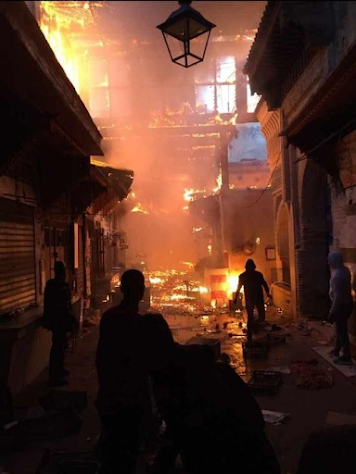
A small part of the massive Fez Medina

However, this week we came across a piece on Fez by Stephen Bayley from the UK Independent. It is certainly well written, however, at times pedantic. Stephen's piece has all the hallmarks of an embedded journalist. His reflections, while sitting with a "large glass of Celliers de Meknes syrah and a view of the kasbah" - are amusing, if not always accurate. He starts off with a bold assertion about the name of the city...

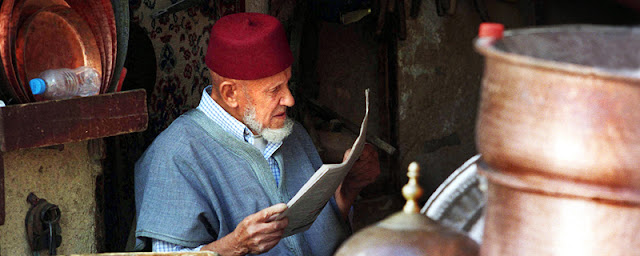
It's Fès, not Fez. The latter is a hat of Turkish production, a dark red truncated cone with a tassel, not much favoured by the locals, despite what some guidebooks tell you. And Fassi is what the citizens of Morocco's fifth city call themselves. The confusion with the name is one of several misunderstandings about this astonishing place. Nineteenth-century orientalists, French expeditionary soldiers, drugged-up Americans of the Beat Generation (who enjoyed a cannabis jam known as majoun, taken internally) all knew Fès, but it has not secured a place in popular imagination in the same way as Marrakech.

For the record, the name of the city is Fes or Fez (Arabic: فاس‎ Moroccan Arabic: [fɛs], Berber: Fas,). If you are French you can write it Fès. The point is that as a transliteration from the Arabic, you can take your pick. As a local photographer put it, "Fes, Fez or Fas, we don't mind - jeeb laz ou l'caz - come for something good, or just leave!"

Access was always a problem: the erratic rail link from Tangier and Casablanca was an impediment to all but the intrepid, then British Airways failed to make a service from Gatwick work. Now a twice-weekly flight by Ryanair from Stansted gives us all the chance to be an explorer.

It is obviously a long time since the intrepid Stephen Bayley travelled by train to Fez. The services between Tangier and Casablanca are inexpensive and go almost hourly. There are also good (CTM) bus services and if you feel like a treat, a trip from Casa to Fez by car is available for around 1,500 dirhams. Ryanair is not the only airline and flights from a number of European cities make coming to Fez, either directly, or via Casablanca a low cost trip.

Part of the huge slipper souk in Fez

This is not a city abandoned to the fey pleasures of frivolous European travellers. Instead, it teems and squirms: urgent but polite, and elegant while often rough. The souk combines filth and mystery with the medieval sense which only a sweating Satanic blacksmith in a carbonised vault and a man next door specialising in severed goats' hoofs can bring. Even lawyers sit in cubbyholes in the souk.

It is this orientalist view where the writing gets carried away. For a start the Medina of Fez contains many souks (markets) - slipper souks, vegetable souks, ceramic souks, leather souks and so on - and "filth and mystery" are in the eye of the beholder. Rubbish collection in Fez is on a daily basis, which few cities in Britain or Europe can claim. And few of the lawyers I know would appreciate their offices being described as "cubbyholes"!

Fès food is an anomaly. There is a weird mismatch between what's abundantly available in the souk and what appears on menus. The souk teems with sellers of herbs, spices, fried fish, lemons, escargots, goat, tripe and artichokes, but restaurant menus are repetitive. Boiled salads – including nerveless cauliflower – are served in miniature tagines they were evidently not cooked in. Insipid grey "chicken in sauce" appears everywhere. I looked in vain for harira (the ethnic soup) or méchoui (a whole cooked lamb) or any sense of freshness and precision in the cooking. Solemnly, our guide said, summoning-up unhappy memories of things ill-digested past: "In Fès, one does not eat fish." Still, smells memorably define the souk. Lemon verbena is an insistent presence, but so too is donkey.

This is perhaps the strangest observation in Stephen's piece. That he couldn't find harira is a mystery as is his failure to find fabulous food. Maybe he needed to escape from his guide and the up-market restaurants and check out the food stalls and street food cafes. While many of the so called "palace restaurants" serve up the kind of tourist fare he mentions for coach loads of package holiday tourists, there are wonderful alternatives both in the Medina and the Ville Nouvelle.

One of the many food souks

That someone actually told him that "In Fès, one does not eat fish", is beyond belief. Not only are the fish markets stocked with wonderful fresh fish, but there are also local treats like the fresh trout from the Atlas mountains, John Dory fillet tagine with saffron and lemon confit, lobster, spider crab and the famous Oualidia oysters.

Fresh fish in Fez

Always there is music half-heard through walls. And the lingering memory of wondering if I have ever felt more clean than after the hammam. We soon learnt that the medina is not as un-navigable as they say. After a day you can find your way and there are no risks, apart from the chance acquisition of a carpet.

But you have doubts. Why, when mint tea is so popular, has no one made a teapot which pours efficiently? Most times, the liquor escapes more readily from the loose-fitting lid than the congested spout. And what is the psychology of a modernising country which insists on making Berber slippers, camel saddles, leather accessories, djellabas and carpets which no one ever willingly buys?
One does feel sorry for Stephen and his loose-fitting teapot, his lack of harira and the fact he didn't understand why people buy djellabas, carpets and slippers. About 90% of the goods produced in the Medina are bought by Moroccans, many of whom (whose teapot lids fit better) do like to wear slippers and djellabas. The Fez Medina is a living, working Medina with thousands of artisans producing goods which are consumed. That a camel saddle might look like an exotic addition to someone's European apartment, does not mean it's not needed on a camel.

You can read the full text of Stephen Bayley's piece here: Keep it under your hat, but Fès is for real

Other travel writing stories
SHARE THIS!
Print Friendly and PDF

Saturday, May 18, 2013

The Majlis Trio in Fez


France's Majlis Trio hold their first Moroccan concert at Riad Zany
Thibaut Rocheron (percussion) Léo Fabre-Cartier (oud) and Aline Haelberg (violin) 
Friday night in Fez saw a large crowd turn up to Riad Zany for another concert. This time it was the premier performance in Morocco of the Majlis Trio. Rain had been threatened, but thankfully the night remained pleasantly warm and dry.

Provide the music and Moroccans will dance!

The rich repertoire of traditional oriental music from Turkey, Greece, Syria, Egypt, Azerbaïdjan and Arab-Andalusian music from the Maghreb was enthusiastically received by both Moroccans and visitors from France, Australia, America, Poland and The Gambia. It was also pleasing to see several on the ball guest house owners bringing their clients for the evening.

As promised the music was accessible and enthralling with splendid performances by all three musicians. A good sound balance and the near perfect acoustics of the riad ensured that even the most subtle grace notes were crystal clear and not lost beneath the percussion.

Seated on chairs, carpets and cushions, the fifty or so visitors were treated to mint tea and an array of chocolate confections and cakes. As an Australian visitor put it, "To witness such fine music in such a beautiful setting was the highlight of my overseas holiday".  Polish members of the audience had brought along Polish translations of A House in Fez, for Riad Zany's owner, Suzanna Clarke to sign.

A section of the audience enjoying the concert


If you missed the concert, the popularity of the trio is such that a second concert will be held at Fez Cafe on Sunday (May19) with an entry fee of 30 dirhams per person.

Reservation for dining is essential
Le Jardin des Biehn
13 Akbat Sbaa Douh
30110 - Fez Medina - Morocco
Port: 00212 (0) 664647679
mail: contact@jardindesbiehn.com

SHARE THIS!
Print Friendly and PDF

Thursday, May 16, 2013

Friday Night in Fez ~ A Musical Treat

A reminder that tomorrow (Friday March 17) at 8 PM, a musical treat is on offer at Riad Zany in the Fez Medina. The Majlis Trio, from France, will be performing a selection of their rich repertoire of traditional oriental music from Turkey, Greece, Syria, Egypt, Azerbaïdjan and Arab-Andalusian music from the Maghreb.


This is a rare chance to experience a wide range of music in a beautiful setting. Léo Fabre-Cartier (pictured left) and fellow musicians, Aline Haelberg (Pictured above - violin and alto)  and Thibaut Rocheron (percussion), from France will be giving their first concert in Morocco. They have appeared together many times in France as the Majlis Trio.

Leo says that because the music the Majlis Trio plays draws on very different styles, the points of rhythmic and melodic convergence mean that they are "accessible to people from different cultures".

If you are unsure of how to get to Riad Zany, then see the information below about where and when to meet a guide.

Information

What: Concert by the Majlis Trio from France
When: Friday May 17 at 8 PM
Where: Riad Zany, 5 Derb Ronda, Laayoune, near the R'Cif vegetable souk.
Pick up: Cinema Amal at 7.50 PM (please be on time!)
Cost: Donation for the musicians
More info: 06 72765657 or theviewfromfez@gmail.com

UPDATE: The popularity of the trio is such that a second concert will be held at Fez Cafe on Sunday (May19) with an entry fee of 30 dirhams per person.

After the concert Fez Cafe is putting on a special menu for 220 Dirhams with the chef delivering a tasty menu.

SHARE THIS!
Print Friendly and PDF

Wednesday, May 15, 2013

The Vinyl Record Shops of Casablanca

The View from Fez was intrigued by a recent Guardian Weekly reader's letter about the old record stores of Casablanca. A year ago we went on a simmilar search and found what was probably the same shop. 

Vinyl records are a rarity these days and many are collectors' items. The shop we discovered held a treasure trove of recordings from the golden age of Egyptian music. Artists such as Umm Kulthum, Abd al-Halim Hafiz, Farid al-Atrash, etc., as well as some of the foundational Moroccan musicians from the mid-twentieth century, artists like Nass al-Ghiwane, Jil Jilala, Hamid al-Zahir, and many other folk, shaabi, Malhun, and Andalusian musicians. Most of the stock here has never been played!


The records are pristine, some with slightly faded covers or a bit of mold from siting untouched for thirty plus years. The beautiful dark hardwood displays give this place the feel of a museum, while accentuating the vivid and colourful artwork of these rare gems. The prices are extremely reasonable, however if you are a collector be warned it is easy to spend money here.


This is what Guardian Weekly reader, Helena Cantone, had to say...

Walking through the decaying streets of Casablanca with my head held high to admire the colonial architecture, I stumble upon a dusty record shop on the corner of Boulevard de Paris and Abderrahman Sehraoui. At the back of the shop sits an old man. I greet him with salam aleikum and begin to browse the stacks of vinyl records bursting out of the glass cabinets and hanging from the ceiling on strings.

My eye catches a few favourites: The Isaac Hayes Movement released in 1970; Uprising by Bob Marley and the Wailers (1980); Michael Jackson's Thriller (1982), For Once in my Life by Stevie Wonder (1968); Fela Kuti; Italian pop singers Mina and Lucio Battisti, which surprised me; and many of Egypt's very best including Umm Kulthum, Mohammed Abdel Wahab, Abdel Halim Hafez and Sayed Darwish.

At a loss for what to pick, I ask the owner for his advice and Monsieur Gam begins to tell me his life story.

Of Berber origin, Gam was born in Agadir in the 1940s and migrated to Casablanca with his family at the age of six. His love of comics and the cinema introduced him to music. He began selling things on the street then worked as a bus driver until he saved enough money to open up a record shop in 1970, going on to produce records under his label Disques Gam.

He shows me a black-and-white picture taken in 1966 of a handsome young black man with dark sunglasses and a leather jacket and says with a laugh: "Marlon Brando!" I say he looks more like Clark Gable with his striking yet elegant features. He takes this as a compliment and tells me how he knows all the great films and actors of the golden age of cinema, and reels off a list of famous stars, directors and films.

Now aged 70, Gam has lived a full life. His four children have done well and his eldest is a doctor in Canada.

I ask him how business is today. Gam says Moroccans no longer buy vinyl and he relies mainly on foreigners. "First there were lots of record shops and cinemas in Casa, but now many have closed down. My shop is one of the very few record shops left in the city ... Life passes by so quickly," he says with a smile as we say goodbye.


SHARE THIS!
Print Friendly and PDF