Showing posts with label Gardens. Show all posts

Friday, October 06, 2017

Musée Yves Saint Laurent Marrakech to Open Soon


The newly built Musée Yves Saint Laurent Marrakech will open its doors to the public at the end of October with over 4,000 sqm of museum spaces including major exhibition halls, conservation areas, an auditorium and a library
Yves Saint Laurent, Place Djemaa El Fna, (photo © Reginald Gray)

Olivier Marty and Karl Fournier from Studio KO designed the new Musée Yves Saint Laurent in Marrakech (mYSLm), which  is located on Rue Yves Saint Laurent.

The museum is dedicated to the work of the great couturier, and it will conserve a part of the collection belonging to the Fondation Pierre Bergé–Yves Saint Laurent. The entire collection includes 5,000 articles of clothing and 15,000 haute couture accessories, as well as tens of thousands of drawings.

The facade of the building appears as an intersection of cubes with a lace-like covering of bricks, creating patterns that recall the weft and warp of fabric. As with the lining of a couture jacket, the interior is radically different: velvety, smooth and radiant.

The magnificent Jardin Majorelle

Close to the Jardin Majorelle, acquired by Yves Saint Laurent and Pierre Bergé in 1980, the new building covers 4,000 sqm, featuring a 400 sqm permanent exhibition space designed by Christophe Martin, showcasing the fashion work of Yves Saint Laurent. More than just a museum, the mYSLm will include a temporary exhibition space, a research library with over 6,000 volumes, a 150-seat auditorium, a bookstore and a terrace café with interiors designed by Yves Taralon.

The landscaped areas have been designed by garden designer Madison Cox on a surface of 180 square meters reflect the wide diversity of plants cultivated in the country. Sourced locally from specialist plant nurseries in the Marrakech region, they include varieties native to Morocco as well as those introduced centuries ago and well-adapted to the particular climatic conditions of this desert city. Pink Trumpet Vine (Podranea riscasdiana) cascades down into the square, blue and green glazed tiled patio off the entrance to the museum’s interior, creating a cool and refreshing ambience that contrasts with the hot climate of Marrakech.

An intersection of cubes with a lace-like covering of bricks creates patterns that recall the weft and warp of fabric
A large rectangular-shaped reflecting pool lined with zelliges (Moroccan glazed tiles) outside Le Studio Café provides another relaxing and tranquil setting for visitors. It is surrounded with luxuriant, large-leaved plants such as Papyrus, Giant Strelizia, Monstera, and Philodendron that create a jungle-like Henri Rousseau atmosphere. Originally native to Mexico but commonly found throughout Morocco since their introduction to the country centuries ago, Barbary Figs or prickly pears (Opuntiaspp) are extensively planted towards the exit of the museum, where visitors can enjoy their unique shapes and diversity of colour and form.

INFO: museum Architects: Studio KO – Olivier Marty, Karl Fournier Scenography: Christophe Martin Landscape design: Madison Cox Interior design Le Studio Café: Yves Taralon Main contractor: Bymaro Area: 4,000 sqm (400 sqm exhibition hall; 700 sqm conservation area; 120 sqm temporary exhibition hall; 110 sqm café; 180 sqm garden) Completion: 2017

SHARE THIS!

Tuesday, May 13, 2014

The Gardens of Fez - a Prologue


The opening of the exhibition GARDENSOFFEZ Prologue will be held at the Institute Francais in Fez on May 16th

GARDENSOFFEZ is a project about gardens and their affiliations in the medina of Fez in Morocco. The project is construed around encounters and stories of its inhabitants during my visits to Fez, where I took part in the artist-in-residence program of the French Institute. The exhibition gives an impression of this community based work with a publication and a look into the process of a film in the making.


Fez was once known for her abundance of green spaces, where the gardens not just created a miniature landscape, but depicted a culture of living together, thanks to a special relation of the city with water. The city is built along a river, in a valley filled with springs. Until 30 years ago, garden plots and orchards formed a green belt around the city walls. In the labyrinth of the Medina high walls enclosed the gardens of palaces and riads, and the rooftops were filled with medicinal plants and herbs.

During the last 50 years, because of reasons such as modernisation, pollution, privatisation of the water system, lack of awareness and general economic decline, many gardens of the Medina disappeared. Gardens and their special position in everyday life seem to slowly vanish. However, because these developments took place in a relative short period of time, memories and stories are much alive.

What gardens there are are still used in different ways. In spring, Melhoun musicians perform in riad gardens, friends meet in the park Jnan Sbil, and on Fridays and Sundays families go for a picnic in the surrounding hills.


According to project director, Heidi Vogels (pictured above) , the documentary will show the gardens through the stories of people of Fez - "the film shows the garden as a miniature of countless landscapes: imaginary spaces of memory, poetry and thought that interweave with the spaces of the city." For more info:  Gardens of Fez - Prologue

Everyone is welcome.

SHARE THIS!
Print Friendly and PDF

Sunday, January 26, 2014

Yoga Workshop in Fez Next Weekend


It's time to get moving again - stretch those limbs to banish the winter blues. A yoga workshop will be held on Saturday and Sunday February 1 & 2 at Jardin des Biehn
The yoga instructor is Rima Toutain, originally from Bangalore in India and now based in Rabat. The method she teaches is Satyananda yoga, named after the late Satyananda Saraswati, a guru and yoga teacher who founded the International Yoga Fellowship in 1956 and the Bihar School of Yoga in 1963. He wrote over 80 books on yoga methods. His practice attempts to integrate physical, psychological and spiritual aspects.

The workshop will be held between 9 am - 12 pm, and 3 pm - 5 pm next Saturday and Sunday. As well as exercises for the body, it will also incorporate breathing and vocal exercises and meditation.

The cost for the weekend is 1,200 dh. Places for the workshop are limited, so those who wish to participate will need to book very soon and pay a deposit of 600 dh.

When: February 1 & 2 
Where: Le Jardin des Biehn, 13 Akbat Sbaa, Douh, Fes Medina. 
Contact: +212 (0) 66 46 47 679 or +212 (0) 53 57 41 036 or contact@jardindesbiehn.com 
Website: www.jardindesbiehn
Cost: 1,200 dh

SHARE THIS!
Print Friendly and PDF

Sunday, October 13, 2013

Help Fund Documentary on the Gardens of Fez


Gardens of Fez is a 60 minute documentary about the gardens of Fez in Morocco. In the words of the filmmaker, Heidi Vogels, the documentary will show the gardens through the stories of people of Fez - "the film shows the garden as a miniature of countless landscapes: imaginary spaces of memory, poetry and thought that interweave with the spaces of the city."

Heidi Vogels is a visual artist based in Amsterdam. Working in research based projects in photography and video, she has investigated gardens and urban landscape in many international art projects in The Netherlands, Germany, Spain and Korea, in collaboration with architects, curators and artists.

Heidi Vogels


The Gardens of Fez - some background

Fez was once renown for her abundance of green spaces, where the gardens not just created a miniature landscape, but depicted a culture of living together, thanks to a special relation of the city with water. The city is build along a river, in a valley filled with springs. Until 30 years ago, garden plots and orchards formed a green belt around the city walls. In the labyrinth of the Medina high walls enclosed the gardens of palaces and riads, and the rooftops were filled with medicinal plants and herbs.

During the last 50 years, because of reasons such as modernisation, pollution, privatisation of the water system, lack of awareness and general economical decline, many gardens of the Medina disappeared. Gardens and their special position in everyday life seem to slowly vanish. However, because these developments took place in a relative short period of time, memories and stories are much alive.

What gardens there are are still used in different ways. In spring, Melhoun musicians perform in riad gardens, friends meet in the park Jnan Sbil, and on Fridays and Sundays families go for a picnic in the surrounding hills. However,

The film opens with a scene on a rooftop in the Medina. It is the end of the day, the sun is about to set and we look out over rooftops and terraces. There are three people on the terrace who seem to be preparing a theatre play. They are rehearsing dialogues. From this rooftop the documentary sets off for a journey through a labyrinth of alleyways: the oldest, biggest and best preserved medina of the Arab world that once enclosed many gardens. The opening scene emphasises the aspect of the garden that is to create an imaginary space. As the first space that we create is through language, through our imagination and thought.

The film loosely blends captured images of the city spaces, park and gardens, with portraits and stories of ten people whose lives are closely connected with the gardens of the city. From a gardener in his home with his family, to an architect who renovated the city park, from the park technician who never leaves the park, to a blind student in philosophy. Some characters are connected to each other in different situations, some are not. The connecting elements are the different dimensions of nature in the Medina. While the film meanders along private and public spaces, the gardens of Fez form an imaginative and contemporary landscape: a bocage through which patches of time, reality and fiction appear and disappear.


Help fund the documentary

The film aims to look at the gardens of the medina and their affiliations, to recollect and enhance an intricate web of social and cultural relations in a visual and poetic play of encounter and narration. Exactly now, before these spaces and their memories and stories will be forgotten.

Furthermore, the documentary feeds into the discussion concerning green spaces in Fez and in urban spaces in general, and aims to reach a wide audience: local, regional and international at film festivals world wide.

The documentary is the direct result of an artistic research which Heidi Vogels initiated in Fez in October 2011, exactly two years ago. Ever since, the project found support in the people of Fez who contributed in their time and friendship. Next to that there were contributions in kind by partners in Fez (Culture Vultures Fez, Institute Francais Fez) and financially by the Dutch Culture funds: AFK, Prins Bernhard Cultuur Fonds, Step Beyond and Roberto Cimetti Fund.

For the shooting of the documentary in Fez October 11 - 31, 2013, there is still a need to raise 2000 Euro to complete the budget. The shooting will take place in Fez, October 11 - 31 with a small team consisting director Heidi Vogels, camera, Benito Strangio, sound, Marjo Postma, and assistant Omar Daroudi. Camera: C300, light: natural.

To support the making of the documentary please visit http://www.kisskissbankbank.com/gardens-of-fez?ref=recent and give generously!

The View from Fez is a supporter

SHARE THIS!
Print Friendly and PDF

Sunday, September 08, 2013

A Quiet Stroll in the Gardens of Fez


With the cooler weather making outdoor life enjoyable again, it is time to take a wander through the delightful Jnane Sbil Gardins 

The Jnane Sbil gardens on the north-western edge of the medina were always a favourite place for Fassis, where lovers and retired people could while away the hours among the palms, eucalyptus, weeping willows, citrus trees and bamboo. The park was opened to the public by Moulay Hassan in the 19th century. Two rivers - the Oued Fes with its water wheel - and the Oued Jawahir (river of pearls) flowed through the garden and there were three cafes. On the western edge near Bab Makina, the Nouria Cafe is still open and is a very pleasant place for tea or lunch. A broken-down waterwheel is still visible from the cafe.

But over the years, the gardens fell into disrepair and became not such a good place to go. Then, few years ago, ADER (the Agency for the Dedensification and Rehabilitation of the Fes Medina) was tasked with renovating the Borj and the walls surrounding the gardens. The Borj is now a museum of the natural environment and attracts lots of school groups, and the walls have been completed. Once again the gardens are a delight.

The Borj is now a museum 

Photographs: Suzanna Clarke 

SHARE THIS!
Print Friendly and PDF

Wednesday, June 06, 2012

Silence Between the Songs - Enchanted Gardens of Fez


Silence Between the Songs is the first Fez Open Gardens event to be held in the Medina during the Fes Festival.

Opening on Friday June 8, the three gardens that are part of the event can be viewed daily until June 17.


"We're creating a trail between the gardens, with green flower symbols painted on the cobbles to indicate the route," says Robert Johnstone, whose beautiful garden in the ruin at Riad Idrissy can be viewed daily from noon until 8pm. Cold drinks are also on offer, so visitors can sit and enjoy the relaxed ambiance.

Robert Johnstone

The other gardens in the scheme are Jardin des Biehn, which is a short walk away, and opens from 10am to 10pm, and Fes et Gestes, which is open from 1.30pm to 4pm.


"Each garden is very different," says Johnstone, who has been a keen gardener since he lived in London.

Jardin des Biehn is based on traditional Islamic forms, with water channels intersecting the garden, and fountains at one end. It was formerly the summer palace of a pasha who housed his concubines and slaves there. Now a boutique hotel, the rooms all open onto the lovely garden, which features roses, irises, large trees and a variety of edible herbs.

Fes et Gestes is a colonial house, which is now a chambre d'hote. It has four equal garden beds, with a grand fountain in the centre.

As for the garden in the ruins at Riad Idrissy, Johnstone describes it as "half garden, half allotment".
In it he grows gardenias, a jacaranda, papyrus, and a mix of edibles that are used in the riad's kitchen, such as verbena, mint, chillies, sorrel, rosemary, parsley and tomatoes.

Part of the delightful "Garden in the Ruins" at Riad Idrissy

"(Artist) Margaret Lanzetta is designing tablecloths for us to use during the event," he says. Lanzetta's work is particularly appropriate as much of it is based on organic patterns.

(See our story on Margaret Lanzetta here)

"We hope to develop this into a bigger event every year, along the lines of the Cordoba Patio Festival, where every spring people open their houses and tourism soars," says Johnstone.

For all information on the Fès Festival visit here

(Photos and story - Suzanna Clarke)
(Brochure design: Mike Lilley)
SHARE THIS!

Sunday, March 13, 2011

A walk in the park, Fez-style


While The View from Fez reported that the Jnan Sbil gardens were officially opened by Princess Lalla Hasnae back in June last year (see the story here), it wasn't until a month ago that the gardens were opened to the public after several years of restoration. This report from Helen Ranger. Photographs by Sandy McCutcheon.


The public, both Fassis and tourists alike, are flocking these ancient gardens, situated just outside the medina to the west of Place Boujloud. They provide a welcome green lung for the city. The tranquil atmosphere is enhanced by a lake and streams, with a working waterwheel and several fountains.


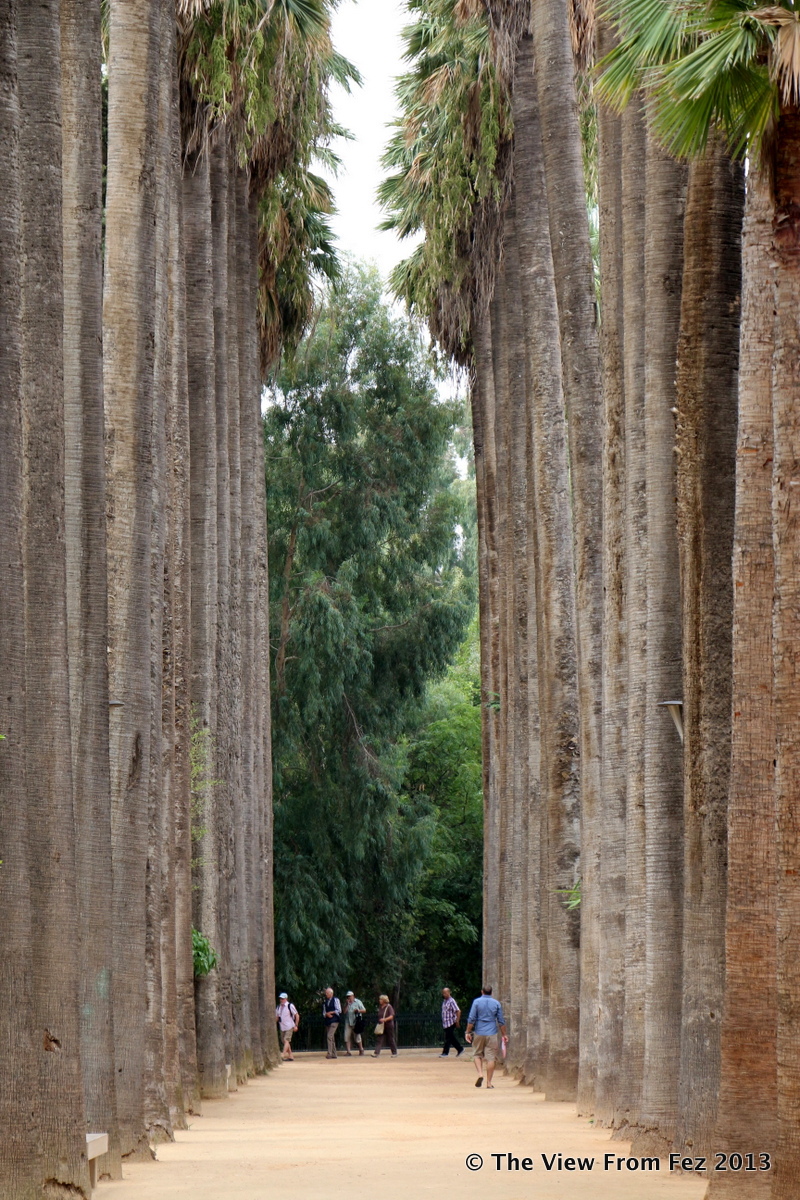
Some of the plants are original, such as the grand avenue of magnificent palm trees, while other beds are newly planted with indigenous plant material.


And it's not just people enjoying the park; we spotted several butterflies and other insects, as well as colourful birds.


The Jnan Sbil gardens are open from 10h00 to 17h00 daily except Mondays.

Friday, June 11, 2010

Morocco's Royal family in Fez


Photographing Princess Lalla Salma's arrival at the opening of the Fes Festival of World Sacred Music is restricted. However, there are official photographers, and The View from Fez is delighted to bring you photographs of the event.


The Princess was accompanied to the Festival by Bernadette Chirac, the former first lady of France (on the left), and Princess Norodom Bhopa Devi of Cambodia, sister to the king of Cambodia and choreographer of the Royal Cambodian Ballet who performed on the opening night.


Princess Lalla Salma greets Nadia Benjelloun, Director of the Fez Encounters


OPENING OF JNAN SBIL GARDENS

In other Moroccan royal news, Princess Lalla Hasnae (sister to HM King Mohamed VI) opened the Jnan Sbil gardens in Fez on Monday.

The people of Fez have long awaited the opening of these gardens on the edge of the medina, which have been closed for renovation for several years.

Princess Lalla Hasnae is President of the Mohamed VI Foundation for the Protection of the Environment. Accompanied by several government ministers and local officials including the Wali of Fez, Mohamed Rharrabi, the Princess cut the ribbon and then toured the gardens with children from various local schools.


The View from Fez has, as yet, been unable to establish opening times of the gardens, but will keep you posted.


Saturday, August 09, 2008

Jnan Sbil update


The gates are open ... but you can't go in. Not yet, anyway.

The Jnan Sbil gardens on the north-western edge of the medina were always a favourite place for Fassis, where lovers and retired people could while away the hours among the palms, eucalyptus, weeping willows, citrus trees and bamboo. The park was opened to the public by Moulay Hassan in the 19th century. Two rivers - the Oued Fes with its water wheel - and the Oued Jawahir (river of pearls) flowed through the garden and there were three cafes. On the western edge near Bab Makina, the Nouria Cafe is still open and is a very pleasant place for tea or lunch. A broken-down waterwheel is still visible from the cafe.

But over the years, the gardens fell into disrepair and became not such a good place to go. A few years ago, ADER (the Agency for the Dedensification and Rehabilitation of the Fes Medina) was tasked with renovating the Borj and the walls surrounding the gardens. The Borj is now a museum of the natural environment and attracts lots of school groups, and the walls have been completed.


Renovated garden walls

The Mohamed VI Foundation for the Environment is now tackling the renovation of the gardens themselves. Directed by architect Rachid Haloui, this demanding project consists of three or four separate parts. The first two parts are expected to be completed by the end of October this year. These comprise the Andalous garden and the bamboo sections which are the oldest plantings of the garden and the most interesting. M Haloui reports that it has been extremely difficult to cope with the lack of water these days, even for the existing plants.

It doesn't look like the gardens will be open any time soon, but The View from Fez is looking forward to having the city's green lung restored and open for the public's enjoyment.

the central layout so far ...


photo credits: Helen Ranger


Tags:

Thursday, June 19, 2008

Medina flowers


Some time ago, Fez Riads took on the task of transforming a drab medina square into a garden. The project is now complete.

Kissariat Sanhaji before ...

The traditional guesthouses that are represented on the Fez Riads website donate 2% of their guests' accommodation bill to finance projects in the medina. The guests are happy to know that some of their money is going towards such projects, and the guesthouses feel that they are making a contribution to the community in which they operate.

... and after

Ricky Martin has been responsible for composting and replenishing the concrete flower boxes with earth, and planting the bushes and trees. Ricky has a wonderful rooftop garden of his own at his house in Asilah and friends who saw it encouraged him to offer his talents for their own terraces. He now has several projects on the go and some very happy clients. Contact The View from Fez if you'd like to know more.

Ricky Martin

People who live around Kissariat Sanhaji are delighted with their new garden and sit out in the evenings to admire it. They are also fiercely protective of the plants and keen to water the garden. The next part of the project is to provide a lockable tap outside the barber's shop so that shopowners are not inconvenienced when the plants need watering.


Fez Riads thanks all the guesthouses for their generosity.

Tags: