Showing posts with label Internet. Show all posts

Thursday, September 07, 2017

54 African countries united under single domain name


It is now possible to own an Internet address or domain name with the .africa (dot africa) extension and already more than 8000 brands and companies as well as individuals, have registered for the .africa Internet address


54 African countries are now united under a single domain name that extends to the entire continent and is seen as  one of the most important initiatives of Africa in the last twenty years.

Organisations, including banks and media companies currently register domain names .africa.

dotAfrica (.africa) is the new generic Top Level Domain (gTLD) for the African continent. It is an opportunity to forge a unique online identity which will associate your products, services and/or information with the continent and people of Africa.

According to Lucky Masilela, CEO of ZACR, the non-profit corporation which administers the new domain .africa, "Continental and international leading brands are adopting domain names with the extension .africa because they realise the importance of being associated with the bright future for Africa. Initiatives like .africa help leverage new technologies to solve old problems. The .africa extension is unique because it gives Africans a sense of pride very important to encourage them to make every effort for the good of the continent and of themselves."


Domain names with the extension .africa are now available and everyone can register: http://Registry.africa/registrars .

SHARE THIS!

Saturday, November 05, 2016

Official! Morocco's VoIP Ban Ends


Morocco's telecommunications operators have been instructed to proceed with the restoration of all VoIP services and telephony across their fixed and mobile networks

According to the National Telecommunications Regulatory Agency (ANRT), "this decision comes after the assessment by the ANRT of the  evolution, at both national and international levels, of the situation of the telecommunications markets and regulatory context, firstly, and, given the requirements of harmonious development of the sector, to the benefit of users on the other."

The ANRT says it will ensure consumers benefit from the best technological developments, in harmony with the requirements of development of the sector and Telcos in compliance with the regulations.

This is not only good news, but a win for commonsense and the people.

SHARE THIS!

Wednesday, October 26, 2016

Telco Turmoil as CEO is Fired

Yesterday, on The View From Fez, we speculated on the fallout from the VoIP ban fiasco and wrote "the ARNT management has been damaged by the ineptitude of their handling of the issue. If so, as one Moroccan commentator put it, "there may well be a reshuffling of the deck chairs". It appears that is already taking place
Azzedine El Mountassir Billahet, DG ANRT (left) and Mr. Ahizoune, president of Morocco Telecom (right)

Yesterday, (Tuesday, October 25, 2016) the head of the National Telecom Regulatory Agency (ANRT), Azzedine El Mountassir Billah was fired. The cause, according to informed sources, were numerous breaches of the rules of good management which were found by the auditors.

However, Moroccan media point out that his dismissal is probably due to a number of factors and that it is a "curious time for a dismissal".

Azzedine El Mountassir Billah, 59, was director of the ANRT for 8 years.

Moroccan telecoms have been in turmoil for several years and Azzedine El Mountassir Billah was at the forefront of several prominent disputes, particularly over the issue of to equable treatment for all telcos in the Kingdom.

Morocco Telecom, in which the state still holds a large share, still controls more than 95% of the market, including broadband internet (ADSL). Azzedine El Mountassir Billah focused on unbundling and giving access to the local infrastructure for fixed lines.

Access to network infrastructure to other telecom operators has been a legal requirement since 2007. However, nine years on, the ANRT has been criticising Morocco Telecom for obstructing it.

The battle between the ANRT and Morocco Telecom over unbundling recently heated up with the release on September 26th, and published on October 20th in the Official Bulletin, of a warning by the Agency to Morocco Telecom. The warning points out Morocco Telecom's "partial failure to fulfil its specific regulatory obligations as operator with significant power on the wholesale market for access to infrastructure".

It is natural, therefore that much of the Moroccan press sees the ANRT CEO's dismissal as the end result of the confrontation between the boss of the ANRT and Maroc Telecom's Mr. Ahizoune.

The news site, usinenouvelle.com/ also points to the fact that the ANRT earlier this year approved the ban in Morocco of IP voice services (VoIP), making it impossible to Moroccan access (except to go through a VPN) Skype, Viber or Whatsapp, resulting in widespread anger. In the legislative elections some parties including WFP (which finished second) promised to reverse the ban. But the news site suggests that the lifting of the ban is only for the duration of COP22 (7-18 November) to allow foreign delegates to communicate.


SHARE THIS!

Monday, October 24, 2016

Morocco Withdraws Unpopular VoIP Blocking


Right from the beginning of the ban by Morocco's National Telecommunications Regulatory Agency (ARNT) of VoIP services such as WhatsApp and Skype, it was clear that it was a ban that couldn't be sustained in the face of public anger. Then, when it was disclosed that the Kingdom had lost at least 320 million dollars (see our story here) due to the ban, the ARNT reversed the blocking. However, instead of publishing an apology or even a simple press release, the ban was quietly reversed. But is it only a temporary lifting?


As Morocco World News reported, the ban was instituted in January on the grounds that free IP-based calling services weren’t licensed to operate as telecom entities in Morocco. The ARNT's’s undisclosed turnaround comes after disgruntled Moroccans expressed their disapproval of the decision, launching campaigns calling on citizens to boycott the three main Moroccan telecommunications agencies: Maroc Telecom, Meditel and INWI. One Moroccan national even went to court to battle the ARNT’s authority to ban these services.

Observers say that the thousands of Moroccans who resorted to VPNs (virtual private networks) to avoid the ARNT’s restriction should not ditch them just yet.

Despite the campaigns by Moroccan citizens and international criticism, some presume that the ban was temporarily lifted as a result of the fast-approaching COP 22 conference taking place in Marrakech in November, and may even be reinstated after the conference ends. COP 22 proceedings will draw government officials, representatives of UN bodies and agencies, intergovernmental and non-governmental organisations and media personnel to the kingdom, many of whom will be relying on VoIP services.

The other scenario is that the ARNT management has been damaged by the ineptitude of their handling of the issue. If so, as one Moroccan commentator put it "there may well be a reshuffling of the deck chairs".

SHARE THIS!

Friday, October 21, 2016

Free Wi-Fi at Moroccan Railway Stations

The Moroccan National Office of Railways (ONCF) issued a statement this week announcing that it intends to install free Wi-Fi connections in all railway stations across the Kingdom
The Casa Port Station has free Wi-Fi now

For the last 5 years the ONCF has been running a test period of "Hot Spot ONCF".

However, while the new Wi-Fi Network is set to cover even the most remote train stations across the country, the introduction will be a "gradual process".

To connect: no software has to be downloaded, no password. Just select the network called "ONCF," fill out a short form and the connection is established automatically.


It is intended that internet connection will also be made available onboard trains on the main railway networks.

SHARE THIS!

Thursday, October 20, 2016

Morocco Pays the Price for VOIP Blocking


The Moroccan economy has lost $320 million as a direct result of the government’s decision made in January of this year to restrict VoIP service. The revelation is part of a new report by the American Centre for Technological Innovation at the Brookings Institution

Blocking calls via VoIP (Voice over IP) was instituted in early January by the national telecommunications networks Agency (ANRT). The telecom watchdog had justified the decision by explaining that "the delivery of all telephone traffic to the end customer can be assured by public telecommunications network operators. (...) The regulatory provisions governing the provision of telephony services (VoIP or other) are clear and those services can be provided only by holders of telecommunications licenses operators ".

Unsurprisingly the blockage had caused an outcry, many users highlighting the negative impacts for those wishing to join their families abroad, or for entrepreneurs who work remotely or with international clients and who used to use these applications to move their business calls cheaply.

This latest, study conducted by the director of the Centre for Technology Innovation at the Brookings Institution, a think -tank based in Washington, justifies the public anger by showing just how much the country has lost.

In the report, Darrell M. West, founding director of the Washington DC-based nonprofit public policy organisation and the report’s writer, analyses the worldwide economic loss due to internet shutdowns in certain countries. West estimates the total loss of revenue at $2.4 billion last year, alone.

According to reports in The Huffington Post and Morocco World News, the author of the study says that he took into consideration the size of the country's GDP (based on 2016 projections of the Boston Consulting Group), the duration of the disturbance (182 days in the case of Morocco or the first six months of blocking), and percentage of the population affected by this cut. He also examined whether blocking concerned the entire Internet, only the mobile internet, or specific applications and services such as social media, research platforms, video or messaging. He also compiled information on the rate of subscription to a mobile subscription in each country.

In looking at the economic impact of blocking specific applications and services, the author relied on a study by two economists from MIT in 2013 on the use of free services like Google, Facebook, Twitter, YouTube, and WhatsApp Wikipedia in the United States, and found that the use of these applications was a contribution of 0.23% to the national GDP.

"Since these services have increased significantly since 2013, the impact could well be higher in today's economy," said the author of the study.


While the UN adopted, in July, a resolution condemning the restrictions on access to information on the internet and calling to guarantee the human rights online, the author of the study believes that the partial or total blockage of the internet or certain services "separates people from their families, their friends, and their livelihoods, undermines economic growth, hindering the start-up ecosystem, threatens stability social interrupting economic activity."

According to the same report, the economy most affected is India’s with $968 million lost, followed by Saudi Arabia with $465 million, Morocco with $320 million, Iraq with $209 million, and the Republic of the Congo $72 million in estimated losses.

While Moroccans continue to express their dismay at the decision and have launched a campaign calling on citizens to boycott the three main telecommunications triumvirate of Morocco including Maroc Telecom, Meditel, and INWI, a majority have turned to Virtual Private Networks which avoid the blocking.

The Administrative Court of Rabat held a hearing on Tuesday into a case filed by a Moroccan citizen against ANRT’s decision to restrict the use of VoIP.

SHARE THIS!

Saturday, September 24, 2016

Politics May Solve Free Voice Call Ban in Morocco

Moroccan citizens have been angry at the blocking of VoIP calls on the internet and see a ray of hope in the upcoming elections.  Ilyas El Omari, the leader of the Party of Authenticity (PAM) has promised to restore WhatsApp in Morocco if his party wins the legislative elections

Ilyas El Omari, "I will restore WhatsApp in Morocco"

The legislative elections scheduled to take place on October 7.

At a news conference last week, El Omari, secretary general of PAM, promised that if his party is elected and he becomes the head of government, Moroccan citizens will be able to make calls on WhatsApp.

According to a report carried by Morocco World News, El Omari did not provide any detail how he would keep his promise to restore phone service for WhatsApp, nor did he mention unblocking Skype, Viber, Facebook Messenger and all the other VoIP-based communication systems.

There was anger in Morocco since the beginning of this year when the major telecom providers colluded in blocking VoIP-based systems.

It turned out to be a relatively useless exercise as Moroccans quickly adapted to this loss by downloading various alternatives such as VPN (Virtual Private Networks) or using IP-altering programs like Hotspot Shield.

Despite the public anger and citizens' ability to avoid the blocking, Maroc Telecom, Inwi, and Meditel have refused to reverse their decision.

The Justice and Development Party is currently the ruling party since forming a coalition in November 2011. PJD advocates Islamism and Islamic democracy - they have been criticised for not opposing the VoIP blocking.

PAM, said El Omari in a recent interview with al Horra, stands “for the separation of religion from politics. If that means secularism, then we are secular. We stand for the concept of civil state, not a religious one,” El Omari said.

If PAM are elected, Moroccans citizens and business people, hope to be reconnected to the rest of the world on WhatsApp and the other VoIP systems.

SHARE THIS!

Wednesday, September 14, 2016

Google Duo Now Blocked in Morocco


Google Duo works on iOS as well as Android and offers unlimited free video calling to anyone using the same app on their device. However, since its release, Google Duo has been blocked in Morocco

Duo is a video chat mobile app developed by Google was announced at Google I/O on May 18, 2016 alongside Allo, an instant messaging app. Duo launched in the United States on August 16, 2016 and globally a few days later. Duo quickly climbed to the number one free app on Google Play within two days of its initial release

It worked in Morocco for the first month before the National Telecommunications Regulatory Agency (ANRT) found a way of blocking it. It took the ANRT some time as the app uses a slightly different technology from the other VoIP apps - Skype, Viber and WhatsApp.

Alaa-Eddine Kaddouri, software architect and entrepreneur in the information and communications technology explained to Telquel.ma that it was technically "a little more complicated to block such communications,"  however he said that it was "quite possible".

Unfortunately for the ANRT, Moroccans took only a few days after its blocking of VoIP services to discover ways around the blockage by using a VPN.

The use of a VPN (Virtual Private Network) creates a tunnel on the network and overrides the limitations established by the ANRT. To use a mobile VPN, is extremely simple. Once downloaded and installed, VPN apps automatically configure the VPN. Once connected to a network, users place a call normally, whether you are connected over 3G / 4G or WiFi. The most sophisticated of the VPN apps have the ability to disguise the fact that they are a VPN and are therefore undetectable.

SHARE THIS!

Monday, August 29, 2016

One Moroccan in Two is Connected to the Internet

According to the annual report of the National Regulatory Agency for Telecommunications at the end of 2015, Morocco had 14.5 million internet subscribers, an increase of 45% in one year. About one Moroccan out of two is connected to the internet. In late June 2016, the number of Internet subscribers in Morocco was $ 14.89 million (32.2% up from the end of June 2015)

The number of Moroccans with web subscription to jumped 150% between 2013 and 2015 and 675% since the beginning of this decade. The proportion of the Moroccan population having internet access has reached 42.75% at end-2015, against just over 15% in 2013 and nearly 7% at the beginning of this decade. In late June 2016, penetration rate has reached 43.98%.

Mobile Internet dominates the internet in Morocco with more than 92% connectivity by 2015, about 13.34 million subscribers "up 48.5% compared to 9 million subscribers recorded at the end of 2014.

In late June 2016, the mobile internet customer base in Morocco has amounted to 13.69 million subscribers, an increase of 34.4% year on year, but only 2.62% compared to December 2015.

Mobile telephony in Morocco has reached 43.08 million subscriptions at the end of 2015, down -2.33% year on year. This is the first decline recorded since 2005.

Meanwhile, the average revenue per mobile minute (ARPM "Average Revenue Per Minute") declined by 16% in 2015 to 0.27 dirhams tax per minute, against 0.32 dirhams at the end of 2014, despite an increase of + 10 % of outgoing voice traffic of mobile telephony, which reached 52.87 billion minutes last year.

"Morocco is the country's cheapest Arab area for downloading a volume of 1 GB of data," says the ARNT in a statement - but that increases the pressure on the margins of telecom operators.

In late June, Morocco Telecom, the market leader, had 18.147 million subscribers to mobile telephony in the Kingdom (43.79%), ahead of Meditel (Orange Group) with 31.8% and Inwi (Wana Corporate), with 24.41%.


ANRT’s latest annual report shows that, for the fifth consecutive year, landline phone usage had experienced a steady decline.

According to the ANRT, Morocco’s National Telecommunications Agency, sales of landline phones had peaked in 2010, when an estimated 3.74 million people had landlines in their homes. Since then, this statistic has been on a significant decline.

ANRT’s annual report shows that in 2014, 2.49 million people had landline phones and in 2015, that number went down to 2.22 million.

“This shows a change in consumer habits, with a progressive shift from landline to mobile usage due to the many advantages of total mobility,” said the ANRT.

Just this last June, the number of landline users had dropped down to 2.13 million, with Maroc Telecom dominating 71.24% of the market (Wana controls 26.73% while Medi Telecom controls a mere 2.03%).

The number of mobile phone subscribers reached 43.08 million, a high number in comparison to the landline’s 2.13 million.

It is also important to note the role of the Internet in this equation. With an annual growth of 45% since 2015, the Internet boasts 14.5 millions of users in Morocco. Since many online services allow users to replicate the experience of a phone call, this also contributes to the decline of landline phone usage.

This decline is expected to continue, given the increasing mobile/wireless nature of technology.

SHARE THIS!

Friday, July 29, 2016

Has Morocco's VoIP Problem Ended?

... or is it just a temporary reprieve?
For the last two days VoIP calls, including WhatsApp, FaceTime, Skype and Viber, have been working again in Morocco when connecting through a Wi-Fi network

Since the afternoon of 27 July, calls through IP (VoIP) using major mobile application are running again. Tel Quel magazine reported that it had tested the functionality of the different applications, repeatedly and say that it is now possible to make voice and video calls from Morocco via these services.

Since January 2016 the National Telecommunications Regulatory Agency (ANRT) had born the brunt of the anger over blocking. It's move, which appears to have been financially motivated, caused  a backlash from Moroccans abroad and at home. Thankfully, a majority of Moroccans soon found technological ways to bypass the blocking and have been able to contact their families without problems.

The ANRT has not commented on  the new situation, their communication department only saying that "there is nothing new since January".  The major telephone companies also say they have not been notified of the changed situation. While this could be a face-saving retreat without fanfare, there is certainly no assurance that the return to normal will continue.

While the free calls work well with a WiFi connection, when the connection is via cellular data networks (3G and 4G), calls still do not work.

This return to normal communications, while possibly only partial, came a day after the publication by the ANRT of the latest figures for the consumption of telecommunications in Morocco. "At the end of Q2 of 2016, the price of mobile communications declined by an annual rate of 23%. At the same time the average bill per Internet customer increased by 4%".   The title of the release was "Mobile Internet stimulates the growth of Internet subscribers".

SHARE THIS!

Friday, June 24, 2016

Morocco's Telco Agency Forces Meditel to Stop Unlimited Calls Offer


Following on from the public outrage over the National Telecommunications Regulatory Agency (ANRT) attempting to close down free VoIP calls on Skype, WhatsApp and Viber, the agency has set itself on another collision course with the public. The ANRT has ordered the Morocco's second biggest telecom provider to stop offering unlimited calls on its networks. This has many asking who is calling the shots within the ANRT

A source within Meditel says the unlimited calls will stop in early June.

This month Meditel has suspended its offer to a third of its customers during this month and will do the same for the rest of its subscribers during the next two months.

What astounds the public and telco experts is that the directive of the ANRT has been implemented by Meditel to the detriment of thousands of customers who had signed contracts in good faith to receive unlimited calls to all the telco's networks.

While no explanation was provided by Meditel on the reasons for its compliance to the request of the ANRT, experts believe that pressure was exerted in this direction by the operators competitors who sit on the board of the regulatory agency. If this is true then it is time to examine who sits on the ANRT board and resolve any conflicts of interest. It is interesting that another competitor, Maroc Telecom is now offering unlimited calls to fixed line phones through its MTBox Fibre network.

The ANRT's attempt to stop VoIP calls has failed to stop free Internet calls as hundreds of thousands of Moroccans, here and overseas, found technological ways around the blockage.


Maroc Telecom's optical fibre or "Fibre To The Home" has been rolled out and is now available in all major cities of Morocco.

After a successful experimental phase in pilot districts in Casablanca and Rabat, Morocco Telecom now provides service in all major cities of the Kingdom. Two speeds are available: 50 and 100 Mbps. Customers have the choice between an optical fibre access alone or one integrated with MTBox. MTBox Fibre allows unlimited calls to national fixed lines as well as 5 or 10 hours of free calls to national mobiles.

SHARE THIS!

Thursday, June 09, 2016

Morocco's Internet Freedom Battle Continues


At the same time as Moroccans find ways of avoiding the ban on Skype, WhatsApp and FaceBook Live, a new decree, published in the official government bulletin issued June 8, reveals an attempt to create a new legal framework for the blocking of VoIP by the National Telecommunications Regulatory Agency (ANRT). It details the procedures to follow in case of litigation, and information on anti-competitive practices


Developed by the Minister of Industry, Trade, Investment and the Digital Economy, this decree is intended to clarify the definition of anti-competitive practices in the field of telecommunications. To do so, it refers directly to the definition given by the law on free pricing and competition which prohibits actions that have "as their object or may have the effect of preventing, restricting or distorting competition, abuse by a company or group of companies."

In addition to the anti-competitive practices the decree also provides powers to the ANRT, allowing it to "direct the concerned to end such practices". The ANRT may also instruct a company on "commitments" by them, to end anticompetitive practices in a predetermined period of time.

In January 2016, the ANRT issued an official statement saying that applications like WhatsApp, Facebook Live or Skype are "unfair competition" to telecom operators. The agency justified the VoIP blocking explaining that "the delivery of all telephone traffic to the end customer can not be provided by public telecommunications network operators, under the conditions set by the specifications of licenses which they are beneficiaries."


The anger of the Moroccan Internet community and Moroccans living abroad has been loud and clear.  Blocking VoIP sparked indignant reactions from Moroccan consumers, united under the keyword sharp #OPEUnlike.  The blocking has been denounced as  " a serious violation of freedom of Internet users. "

A majority of Moroccan Internet users have found a way around this blockage via a VPN (Virtual Private Network).  While there are rumours of a banning of VPN services, it is technologically unlikely as the more sophisticated VPN services are undetectable as VPNs.

The national magazine TelQuel asked Abedlhak Mazini,  a specialist lawyer who was part of the team that designed the law back in 1996, if the article could be interpreted as a specific ban on the use of a VPN. "I can assure you that during the drafting of Law 24-96 in 1996, we never thought we would be impacting on the Internet in Morocco".

Legal experts say that the ANRT decisions are "challengeable in court by any association that has the funds to do so."


SHARE THIS!

Friday, May 20, 2016

New Moves in Morocco's VOIP Battle


Morocco's telecommunications watchdog, the National Agency of Telecommunications Regulation (ANRT), remains under fire for casting itself in the role of an Internet policeman. The decision to attempt to block VOIP (Voice Over Internet Protocol) calls on WhatsApp, Skype, Viber and Facebook, has made it very unpopular and now a lawyer has decided to take the regulator to court


The lawyer, Mourad Zaibouh, says there is a "legal vacuum" in the legislation and, "there is no law that prohibits the use of free telephone applications."

At the same time AVAAZ, an internationally respected activist NGO with 44 million members in 190 countries, has joined the fray over the blocking of online games. "Morocco Telecom has just blocked online games in Morocco. Moroccan Gamers require immediate release of the online game of all media, "said AVAAZ.

"The problem is serious! Moroccan professional players who wear the Moroccan flag in international tournaments are also deprived of online access to all the games," says the NGO.

AVAAZ has around 240,000 members in Morocco.

Sources, including Morocco World News are reporting that despite the fact that no official statement has been made about the situation, Moroccan online gamers have been unable to logon to their online games as usual.

An online petition was launched earlier today asking for the immediate release of online games. After only a few hours, the petition was signed by 7304 people. The blockage has caused outraged reactions on social media.

"All the kids now have VPNs"

However, most Moroccans have opted for the use of VPNs (Virtual Private Networks) on smartphones, laptops and tablets and continue to use Skype, WhatsApp and Facebook.

"Everyone knows how to get around the blocks," says Yusseff, a 22 year-old gamer from Boujloud in Fez, who competes under the Moroccan flag in international gaming tournaments. "And, on the street, all the kids now have VPNs."

SHARE THIS!

Friday, April 22, 2016

Morocco's Quiet Youth Revolution - Opinion


There is a change taking place amongst the young people of Morocco.  The high acceptance rate of new technologies is leading to attitude changes that will have a lasting and positive effect on the country. Ibn Warraq reports...

According to the annual survey of the ANRT (the National Telecommunications Regulatory Agency) one in every two Moroccans has a smartphone. This take-up rate is even higher among younger people, particularly in the major metropolitan areas. The survey shows that there were an estimated 15 million in 2015 on top of which 66.5% of households now have access to the Internet.

The access to the internet and smartphones is having a profound effect on the social behaviour of young people, giving them a freedom to communicate with their peers in a way earlier generations could not. This is particularly true of relationships between young men and women. It is no longer possible to control social interactions as in the past. FaceBook, WhatsApp and Skype mean that the role of the chaperone is defunct. For young Moroccan women, organising a date or simply texting has opened the way for direct communication away of the controlling eyes of parents or extended family.


The access to information via the Internet is opening up the world and its possibilities. While there are those who see this freedom of information as potentially causing problems, for many it is a source of inspiration.

According to many more conservative Moroccans, these new-found freedoms come at price and potentially undermine traditional values. Others say that with the new freedom to communicate young people are quickly becoming adept at managing their own affairs.

Young Moroccans have shown themselves to be fast at adapting to the new social freedoms and use their online networks to share information. Recently, when the major telecom providers attempted to block VOIP calls, the social networks quickly spread the word on how to bypass the restrictions and within days almost every teenager was able to continue to use their calling and messaging services.


At the same time as social and communication freedoms are taking place there are attitudinal changes amongst young people, with an overwhelming majority of Moroccan students declaring themselves secular

Assabah News is carrying a report on a survey of Moroccan students that shows Moroccan students are a secular majority who believe think that religion should remain in the private sphere.

75.6% of surveyed students think that religion should not be taught in school and must remain a personal matter. 15.6% believe that religion promotes good conduct while only a very small minority, 4.5%, think that religion should be involved in politics.

The study also reveals that an overwhelming majority (95%) of Moroccan students want more foreign languages ​​offered at school because they believe that improved command of languages ​​is crucial for the employment market.

According to the Assabah News story the study was produced by the Ministry of Education in partnership with the Moroccan Student group. The sample group comprised 5200 students from both public and private schools.

The result is seen as being accurate and showed little change since the last Education Ministry survey back in 2012 which showed that a similar majority of students were describing themselves as secular.

A recent comparative study of young, educated, professional and urban women in Morocco and women of Moroccan origin in France, examining attitudinal changes and discerning cultural trends showed that exposure to global trends, coupled with high education standards showed that young, educated, professional and urban women in Morocco and women of Moroccan origin in France share significant values. These include their conceptions of Islam being marked by a desire for personal interpretation.

Rural Morocco is slower to change

The large proportion of unmarried women in their late twenties and early thirties in both samples indicated a strong desire for self-realisation and determination at the cost of early marriage or marriage altogether.

In a society strongly shaped by the values of Islam and by traditional Arab views concerning honour, modesty, and gender, the speed at which changes are taking place varies widely between rural and urban communities. The social, sexual and behavioural attitudes of young people in Casablanca, Rabat, Marrakech or Tangier are far removed from the strongly-differentiated gender roles in the villages of the Atlas Mountains or the Saharan fringes.

This is a quiet, non-violent revolution and while the societal impacts over the next decades maybe hard to predict, one thing is certain, Pandora's box has been opened and can not be closed.


SHARE THIS!

Print Friendly and PDF

Monday, February 29, 2016

Skype Blocking Tarnishes Maroc Web Awards

In another sign of the anger over Skype blocking, the Maroc Web Awards were thrown into chaos when participants withdrew in protest against Morocco’s telecom providers

The story on Morocco World News will cause further embarrassment for the telecom providers who have blocked VOIP calls without providing an alternative. To make matters worse, the providers are the contest's sponsors. Ironically, the Maroc Web Awards are considered the biggest competition involving the creative talent of youth in the MENA region. Its goal is to promote digital arts and creativity.

Writing for the prestigious news website, Youssef Igrouane, reports that amid the acute indignation over the bans on Skype, WhatsApp, Viber, and Facebook, most participants in the annual Maroc Web Awards (MWA) are withdrawing due to the suspension VoiP services.  The Telcos made the suspension effective on Friday.

The participants announced their withdrawal on Facebook, expressing their dismay towards the telecommunications triumvirate, which they say regard their consumers as “sheep.”.

Bilal Aljouhari, a Moroccan YouTuber who was a MWA nominee in the “Personality of the Year” category, announced his withdrawal on Facebook on Saturday. “I can’t participate in a competition that is sponsored by companies that does not care for its consumers, and because of the their decision to ban VoiP services. This is some sort of sick joke,” he said.

After Aljouhari, the withdrawals just kept coming. Marouane Lamharzi Alaoui, a Moroccan engineer, Carte.ma’s CEO, and nominee for the “Video of the Year,” also announced his withdrawal on Facebook. He was nominated for his epic video entitled “From Sahara to the Sky.”

Marouane Lamharzi Alaoui

Alaoui apologised to his voters and organisers for not proceeding with the competition.

The engineer also suggested launching a campaign to file a lawsuit against the regulator ANRT, stating that the ban of the VoiP services is “illegal.”

Social media users launched a campaign to express their anger at the decision to block VoiP services by disliking the official pages of the telecom companies on Facebook.

24 hours after the campaign was launched, the number of the telco's fans have been greatly reduced.

The number of Maroc Telecom’s fans decreased by 163, 674 likes, Inwi by 137,364 likes, and Meditel by 528,415 likes.


With the mounting backlash against the telcos, it will be interesting to see how they, or the regulator ANRT, react. Will they simply try and tough it out, or will they realise that this is a fight that does them no credit.

SHARE THIS!
Print Friendly and PDF

Sunday, February 28, 2016

Anger Grows Over Call Blocking in Morocco

This weekend saw Moroccan telcos extend the blocking of VOIP (Skype, Viber, WhatsApp) calls from phones to Wifi connections. The result was that around the world thousands of expat Moroccans were unable to contact their families back in Morocco

Moroccans living in Europe, America and Australasia were understandably angry and have been using social media to call for the government to quickly fix the problem and amend the laws effecting VOIP calls..

The anger spread to Moroccans throughout the Kingdom who were also unable to use Viber or Skype to talk to each other.

While the Telcos - Maroc Telecom, Meditel and Inwi - are indulging in blame shifting, saying the problem is the fault of the regulator, Morocco’s National Agency for Telecommunications Networks, for their part the regulator claims the choking of calls is “in accordance with the law, and that regulations governing the provision of telephone services (VoIP or other) are clear and those services can be provided only by holders of telecommunications licenses operators.”

 It seems to have escaped them that none of the Telcos at the heart of the mess offer any such service.


The situation is proving to be an embarrassment for Morocco, which in so many other areas is embracing new technology. However, this step backwards, fuelled by the desire for increased revenue by the telcos, is the thing that needs to be blocked - not Viber, Whatsapp and Skype.

SHARE THIS!
Print Friendly and PDF

Friday, February 26, 2016

Morocco's Raw Deal With Netflix

When it comes to Netflix, not all countries are equal. According to research done by Exstreamist, vast disparities exist in the television and film streaming services offerings around the world, with Morocco at the very bottom of the heap

Morocco is the worst country in world for Netflix subscribers

Netflix in Morocco only offers 157 different TV shows and films compared to Netflix’s No. 1 country, the United States, which offers  5,750.

Considering Moroccan users pay $7.99 per month for Netflix’s basic service, the same amount American subscribers pay, Moroccans are definitely getting a worse deal.

Of course, this problem isn’t exactly Netflix’s fault. “Ridiculously complicated content ownership rights have made consistent distribution a logistical nightmare for Netflix, who would of course love to offer everyone around the world the same streaming library,” the report by Exstreamist said.


Although Morocco finishes dead last on the ranking, Iraq is the only country in the Arab world to even make it into the top 40, with 2,029 titles available. That’s still much less than half of the amount available in the United States.

Netflix may now be available in every country in the world – except for China, North Korea, Syria and Crimea due to U.S. government restrictions – but the service offered is definitely not created equal and as far as Morocco is concerned deserves a total thumbs-down.

In Fez, nobody seems particularly perturbed . As, Lahcen, a film-buff ,says,"Netflix? Why bother? You can download most things for free anyway."


Top 10 ranking for the Arab world
Iraq (2,029 titles)
Lebanon, Kuwait and Bahrain (1,768)
Yemen (1,767)
United Arab Emirates (1,764)
Qatar (1,647)
Libya (1,443)
Tunisia (1,408)
Oman (1,360)
Jordan (597)
Egypt (594)

You can view the full report along with the complete global ranking on Extstreamist’s website.

SHARE THIS!
Print Friendly and PDF

Friday, January 08, 2016

Anger Grows Over Free Internet Call Blocking

The move to block Whatsapp, Skype and Viber services in Morocco has evoked an angry reaction from users both in Morocco and around the world. If the National Agency of Telecommunications Regulation (ANRT) or the telecoms thought that they would get away with it without a fight, they badly misjudged the issue. It is widely believed that the decision will have a negative impact on Moroccan society and business


In many areas Morocco has embraced smart technology and alternative energy production. Yet in the field of telecommunication, the blocking of VoIP services is a retrograde step which will impact on Morocco's international image and competitiveness. Here are some of the reasons.

VoIP is an essential part of many businesses

VoIP, or Voice over Internet Protocol, is a method for taking analog audio signals and turning them into digital data that can be transmitted over the Internet. Basically, using VoIP allows you to make calls using software on your computer, or hardware connecting your phone to the internet, to make calls over the internet (to the phone numbers you would usually call) at an extremely reduced cost to that you would have otherwise paid, or in some cases, for free.

Because of the bandwidth efficiency and low costs that VoIP technology can provide, businesses are migrating from traditional copper-wire telephone systems to VoIP systems to reduce their monthly phone costs. A early as 2008, 80% of all new Private Branch Exchange (PBX) lines installed internationally were VoIP.

VoIP solutions aimed at businesses have evolved into unified communications services that treat all communications—phone calls, faxes, voice mail, e-mail, Web conferences, and more—as discrete units that can all be delivered via any means and to any handset, including cellphones. Two kinds of competitors are competing in this space: one set is focused on VoIP for medium to large enterprises, while another is targeting the small-to-medium business (SMB) market.

VoIP allows both voice and data communications to be run over a single network, which can significantly reduce infrastructure costs. Using VoIP is smart business and a country such as Morocco should be embracing this and future technologies, not attempting to force people back to the past.

Users have already purchased bandwidth

Users have been quick to point out that having purchased bandwidth from a provider (Meditel, Maroc Telecom or Inwi) they should be free to use that bandwidth as they please. The "so-called" free calls have in fact been paid for.

The social impacts

VoIP calls on Viber, Whatsapp and Skype are essential for the poorer members of society, who can not afford fixed-line rentals. A huge number of Moroccans use VoIP for staying in touch with relatives both in Morocco and overseas.

Clearer audio communications for people who are hard of hearing is now possible with VoIP services. Two thirds of the frequencies in which the human ear is most sensitive, and 80 percent of the frequencies in which speech occurs, are beyond the capabilities of the public switched telephone networks. VoIP improves video communications for people whose primary mode off communication is sign language.

For sign language VoIP is essential

VoIP services are now regularly used by medical and veterinary professionals for assisting in diagnosis and treatment of patients in remote areas. In such cases VoIP services can mean the difference between life and death.

Another driving force toward VoIP adoption for healthcare organisations is the need for a way to process the hundreds of patient calls received each day. By utilising VoIP and contact centre services, hospitals and doctors offices can process multiple calls at the same time and sort them on a priority basis. VoIP also is now being used to aid communication between doctors and patients by linking them to translators.

The use of Skype for doctors is critical

Education

The use of Skype in education is now recognised universally. In Morocco is it a common teaching resource, particularly in language centres, where it is employed to give students interaction with teachers and native speakers of the languages being taught.

There are now thousands of university courses where on line tutoring and oral examinations use Skype.

Skype in the classroom
Security

The USA takes security seriously and now depends on VoIP in a number of key areas:

The U.S. Commerce Department switched to VoIP for a better emergency broadcast system. Commerce Department VoIP phones allow officials to deliver targeted warnings in an emergency by department — a reverse 9-1-1. And because they are also able to deliver the warnings in text and with flashing lights, even deaf users can be warned.

The US Department of Defence is using VoIP in Iraq and Afghanistan to move communication onto their own more secure networks and for rapid deployment to be more nimble and mobile in times of war. DoD has more than 130 VoIP networks worldwide and is considering a transition agency-wide. The Defence Information Systems Agency’s (DISA) move to VoIP allows them to migrate voice traffic from a network managed by a private company to a private network under total Defence Department control.

The US military has rolled out a VoIP network for the Iraqi police that uses a satellite-based network. This is the only fully functioning Iraqi national command and control network. The VoIP phones and VSAT network were the fastest way to get a network up and running after the toppling of Saddam Hussein by Coalition forces. This VoIP/VSAT network is expected to be used by Iraqi security personnel in various jobs. It enabled calls to be encrypted for secure communications.

The Environmental Protection Agency is using VoIP for its Disaster Recovery Centre. In an emergency, VoIP lets you relocate phones on the fly. EPA chose VoIP as a cost-efficient disaster recovery system. They needed voice and data at a remote Disaster Recovery Centre. They found that deploying VoIP in a normally unmanned building was more cost effective — because implementing a separate voice and data network was expensive and would rarely be used — but it also allowed users to relocate phones on any data network.


The Government in Herndon, VA is using a VoIP system that enables them to broadcast the face of a missing child on all phones.

The Navy has implemented VoIP on all of its active aircraft carriers. VoIP is also supporting a new US Naval Network Operations Centre.

For Arizona’s state agencies, moving from antiquated phone systems to a converged voice over IP network wasn’t merely a good idea, it was the law. They did it to save taxpayer money, of course. But along the way, the state discovered that a converged network not only increases efficiency, it can also boost security. With the old system, fire or police departments who responded to a 911 call, had no way to pinpoint the office from which the call was made. Now their VoIP system automatically identifies the extension, room number and floor, and then notifies capitol security personnel via cell phone or pager

The blame game 

For their part the telcos are now shifting the blame and anger away from themselves by claiming the decision to block VoIP calls was the fault of the ANRT. In a statement on January the 6th the CEO of Morocco Telecom, Abdeslam Ahizoune, ducked the issue and apportioned blame to the ANRT, saying that it was the ANRT which is causing the blockage, and not operators.

The National Agency of Telecommunications Regulation (ANRT) has finally reacted by publishing a statement on January the 7th. The controller invokes the "shortfall" in revenue of operators to explain the recent unexplained blocking service based on VoIP. How one arrives at a "shortfall" given the telecom providers profits is not explained.

For the ANRT, these applications "do not fulfil all the requirements to be in compliance with current regulations," thus justifying that "their suspension is part of the compliance of operators with their obligations obligations under the licenses they hold."

What can the ANRT and Telcos learn from this fiasco?

The ANRT needs to have a serious look at the future of communications, rather than try and remain locked into old technology. The benefits for Moroccan society, the government, business and the telecommunications industry are obvious. Morocco, which is so forward thinking on issues of alternative energy, needs to come to terms with the use of VoIP over any network from any location.

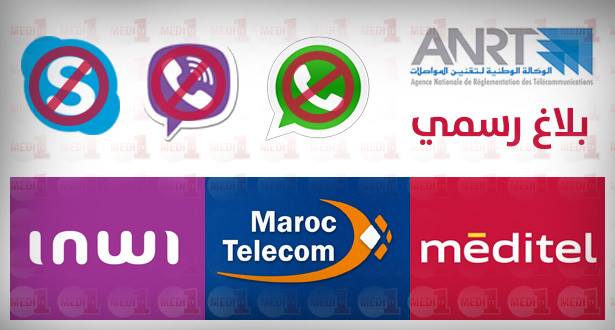
And until the ANRT and the telcos come up with their own free VoIP service, they should step back and revoke all limitations on what are now essential providers of VoIP - Skype, Whatsapp and Viber.


SHARE THIS!
Print Friendly and PDF

Tuesday, January 05, 2016

Are Free Internet Calls Being Blocked In Morocco?


Have Whatsapp, Viber and Skype been partially blocked in Morocco? At a time of the year when thousands of people are phoning their relatives around the world many in Morocco have found VoIP applications blocked. The users accuse telecom operators, Morocco Telecom, Meditel and Inwi

Free calls via the Internet are now a standard way of communicating with applications such as Facetime, Whatsapp, Viber and Skype. However, the proliferation of smartphones and free calls has had a significant impact on telecom revenue from traditional calls. It becomes cheaper for the user to use such services "VoIP" than traditional calls.

For several days over the holiday season many internet users were surprised at not being able to use their free applications.


According to Telquel magazine, this is not the first time that operators have been accused of illegally blocking access to these free services. In August 2014, the Ecofin agency reported blockage by Morocco Telecom, of multiple applications: "For two weeks, subscribers of Morocco Telecom complained of not being able to access the VoIP application Viber. Nothing works, either with a 3G or ADSL connection." In 2012, there was also a period of time when Viber and Skype applications were blocked for several days.

Tested by Telquel.ma, the three operators had blocked access to these applications. With Meditel, Morocco Telecom or  Inwi Telquel found it impossible to make a call using Whatsapp. Calls via a wifi connection only worked partially.

The blocking may have only been temporary as when The View from Fez made a Viber call between Morocco and Australia there was no problem. However, other reports say that 3G and 4G users are now blocked from all VoIP calls and that those using Wifi connections will also be totally blocked in the next couple of months.

When Telquel called Morocco Telecom, Inwi and Meditel, none of the operators wished to answer their questions.

Whatever the reasons, the move is at odds with accepted practice and will result in justifiable anger at the telcos.

SHARE THIS!
Print Friendly and PDF

Tuesday, August 25, 2015

Wifi in Morocco - lowest cost in the Arab World


A recent report from Arab Advisors Group places Morocco at the top of all the Arab countries as the country where the price of ADSL is the lowest. But, as visitors to Morocco will discover, there are also many free Wifi hotspots  

The Arab Advisors Group study is based on the rates offered in July 2015 for a minimum 4 Mbps connection.

The annual cost of ADSL in Morocco is a little over 1000 dirhams ($145 Australian dollars, $104 USD) compared to Sudan at the other end of the scale where prices exceed the 20,000 dirhams per year ($2,900 AUD, 2,081 USD).

The study analysed data from 19 Arab countries - Algeria, Bahrain, Egypt, Iraq, Jordan, Kuwait, Lebanon, Libya, Mauritania, Morocco, Oman, Palestine, Qatar, Saudi Arabia, Sudan, Syria, Tunisia, UAE Arab Emirates and Yemen.


Recent Free Wifi Tests

The M'dina Bus, in Casablanca has run a three week test period for its Wi-Fi bus service. The test started on Monday, August 3, on three lines (7, 23 and 25).

Tests earlier in the year failed and it is hoped that problems will be sorted with the advent of 4G. The first test phase was inconclusive with slow connection speed being the major problem.

"Now with 4G coverage browsing speed is more interesting" says Moulay Youssef El Idrissi Ouedghri, director of Human Resources at the M'dina Bus. The experience should be extended to other bus routes in the coming month.

Besides the M'dina Bus Company some public areas in Casablanca are equipped with free Wi-Fi connections.


Many of the Moroccan Railway stations now offer free Wifi, but it is not always operational. Testing it in Fez, we found there were some days when, although there was a Wifi signal there was no connectivity to the Internet.

Most reliable are the new Casa Port train station in Casablanca and the two main Rabat stations.

The Mohammed V airport in Casablanca has had Wi-Fi and unlimited broadband since June 15. Connection is free from computer, tablet or smart phone. When tested a number of times by The View From Fez  it was not always functioning

According to the National Office of Airports it is intended that the free service be extended to airports in Marrakech, Rabat, Tangier Fez, Agadir and Oujda.

Royal Air Maroc flights will soon introduce an in-flight connectivity system which will enable onboard Wi-Fi services. Royal Air Maroc says its entire fleet will be equipped with a Wi-Fi service by the beginning of 2016.

In April Casablanca announced the launch of a free Wi-Fi in several public areas. In addition to the Casa Port train station, the service is supposed to be already operational in some pilot areas such as the park of the Arab League and the Nevada site, Hassan II University, Place Mohammed V, the esplanade of the Hassan II Mosque, the Rue du Prince Moulay Abdallah, Derb Ghalef and Maarif Twin Centre.

In Fez there are now a good number of cafes or restaurants in the Medina offering free Wifi.

Operated by Maroc Telecom. Internet services started as a test in November 2002 before it was launched in October 2003 and it is now one of the most technologically advanced Internet services on the African continent.

SHARE THIS!
Print Friendly and PDF