Showing posts with label Sufi Festival. Show all posts

Friday, October 26, 2018

Fez Festival of Sufi Culture - Day Seven Review

After a confusing start to the night, brought about by a weather induced change of venue, the Fez Festival of Sufi Culture continued to deliver another great evening


A change of venue for the evening concert left a lot of non-French speaking visitors stranded. In the confusion some claimed it was to be held at the Prefecture Hall in Batha (the logical alternative) but by early evening some Americans said they believed it was still on at Bab Al Makina. Finally it became clear that the concert was not on in the Medina at all, but, as visiting tourist described,"out of walking distance somewhere in the Ville Nouvelle"! There appears to have been little attempt to communicate the news to non-French speaking patrons - no email, no tweet on Twitter. Eventually we found the venue location on the Festival Facebook page.

Ali Keeler in fine form

The venue turned out to be at the Seat of the Commune de Fez at Champs de Course, a place that few taxi drivers seemed to know. After a couple of false starts The View From Fez team arrived to find the venue packed to the rafters with local Moroccans keen to hear Marouane Hajji.

Marouane Hajji

The performance had two distinct groups - a group of Fez musicians including two backing singers for Marouane and on the other side the Firdaus Ensemble with Ali Keeler.

Ali Keeler is no stranger to Fez, having delighted audiences at festivals in 2014, 2015 and 2017. Like many of his performances in the past the night was a medley of their most popular songs - and not just their favourites, but the audience's as well.


The opening set from the Firdaus Ensemble captured the audience with its uptempo Andalusian flavour. Then it was the turn of Marouane Hajji. Although still young, Marouane is something of a superstar for the local people and once again he didn't disappoint. His vocal range has improved over the years and his musical gymnastics had the large audience clapping along.

A Celtic moment with an Irish low whistle

The attention then turned back to Ali Keeler and Firdaus, who obligingly gave a great performance of what is almost their signature tune - a Celtic air - complete with Irish whistle and the haunting uilleann pipes, the characteristic national bagpipe of Ireland. The air suddenly switched to a jig and with the unmistakable Arabic vocals, the audience lapped it up, with some women in the audience breaking into a traditional ululation!

There was also some beautiful cello playing by Salma Vives who was born in Elche near Alicante in 1983 and started learning the cello at seven.

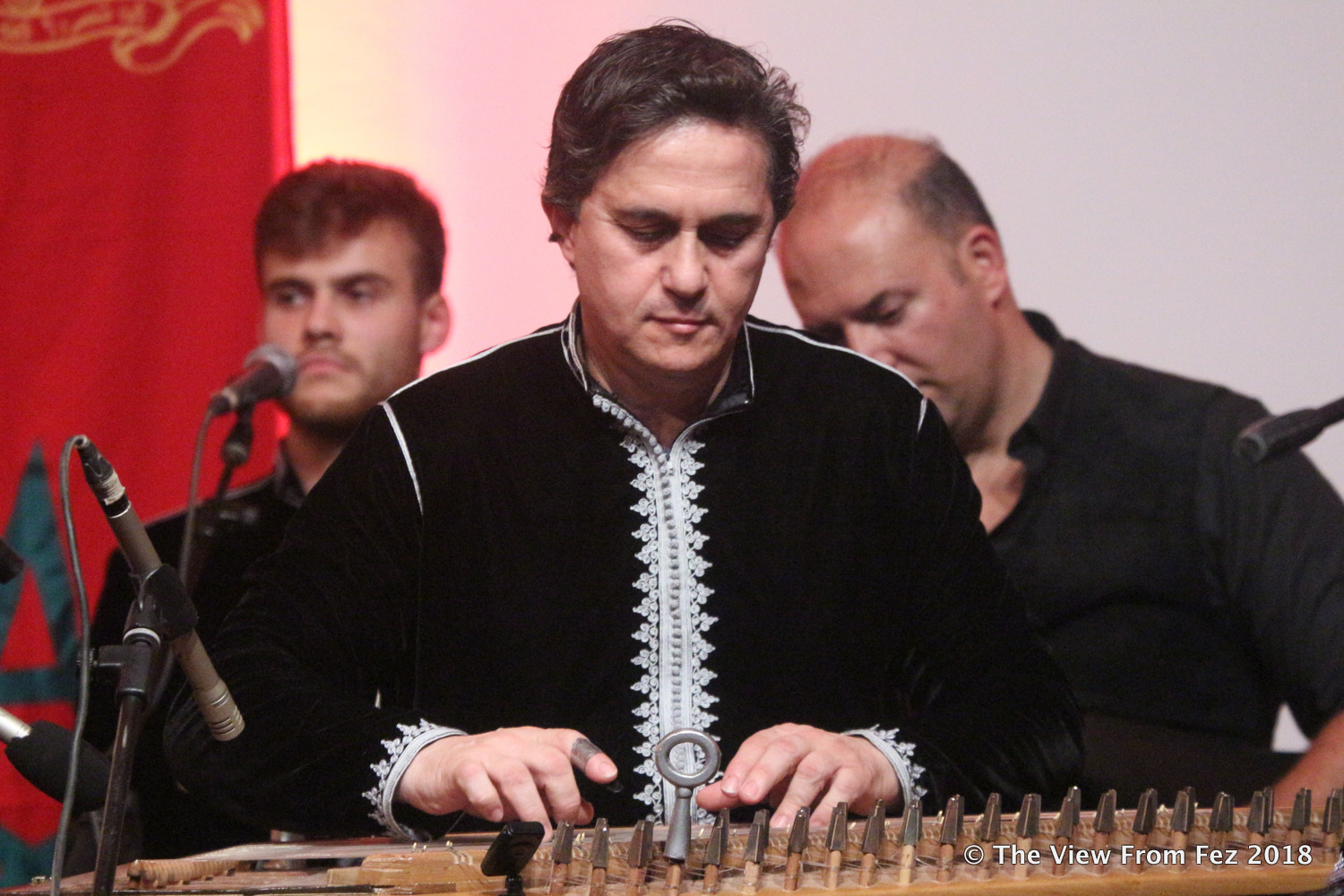
Qanun player Yusuf El Mezghildi.

Another standout performer was the Qanun player Yusuf El Mezghildi. He was born in Tetouan, Morocco in 1962. From the age of 5, he attended the Sufi gatherings at the Zawiya Kittaniya. The percussionist Omar Benlamlih not only contributed percussion but also some fine singing. He was born in Casablanca in 1980 to a family of musicians and singers within the Sufi tradition, originally from Fez.

It was a night of joy and celebration as outside, the rain tumbled down. Despite problems finding the venue, it was certainly worth the trip.


SEE ALSO OUR REVIEW OF YESTERDAY'S AFTERNOON THEATRE PERFORMANCE HERE

Tomorrow at the Festival
10 - 12 at the Salle de la Prefecture: Round table wrap up
20.30 at Commune de Fez: Festival closing ceremony and Derviches
Festival Weather:
Mostly cloudy, top of 21 Celsius and rain.

Buy a ticket online " Ticket Sales"


The View From Fez is an official Festival Media Partner

SHARE THIS!

Thursday, October 25, 2018

Fez Festival of Sufi Culture - Day Six Review


Abdallah al-Wazzani and the Tariqa Wazzaniya took the audience on another trip to the heart of Sufism with this evenings session of samaa
Abdallah al-Wazzani

The Tariqa of Jazulite origin (Shadhilite), was founded by Moulay Abdellah Chrif in Ouezzane. The Zawiya Wazzaniya was also called "Dar Dmana" (the house of guarantee or protection) because, in addition to being a spiritual centre, one could find shelter there.

It all began with a Sufi tale

The tariqa began chanting and moving slowly down the entrance road to the venue, with Abdallah al-Wazzani  at their head. Once in place he introduced the tariqa, and, wasting no time, they burst into song.

Feeling the joy!

With only 11 performers in the group, the volume of sound was less than some expected, though it was also the case that a couple of men in the group were having microphone problems. Nevertheless, there was a passion in the performance that had the locals clapping and swaying along to a familiar repertoire, knowing that they were in safe hands.

There was a sense of joy about the performance which had even those with little knowledge of Sufism, smiling throughout.

SEE ALSO OUR REVIEW OF THE AFTERNOON THEATRE PERFORMANCE HERE

Tomorrow at the Festival
10 - 12 at the Salle de la Prefecture: Spirituality and Human Rights
16.30 - 18.30 at the Salle de la Prefecture: Sufism and Coaching
20.30 at Bab Al Makina: Ali Keeler and Marouane Hajji
Festival Weather:
Mostly cloudy, top of 26 and evening showers

Buy a ticket online " Ticket Sales"


The View From Fez is an official Festival Media Partner


SHARE THIS!

Soufie, Mon Amour - Performance

An afternoon performance by Actor Hassan El Jaï, with music provided by Haroun Teboul, took place before a packed audience at the French Institute's Dar Batha

Actor Hassan El Jaï was accompanied by Haroun Teboul on Ney, Oûd and Tambûr. We follow the journey of Shams Tabrizi, the famous wandering dervish of the 13th century, to the city of Konya. In the footsteps of the spiritual master of Rûmi, and through his encounters with various fascinating protagonists; the public is invited to walk an initiatory path, at the end of which love is revealed to be both the ultimate reason and purpose.

Sufi, My Love, is a theatrical adaptation of the bestseller by Elif Shafak, a Turkish-British novelist, essayist, academic, public speaker and women's rights activist.

Haroun Teboul

Hassan El Jaï is an actor, director, coach and teacher who cites among his sources of inspiration the great classical playwrights Shakespeare or Molière, but it is especially in Sufism and its great mystics that he finds his greatest inspiration. Among them are Al Ghazali, Al Junayd or Shams de Tabriz. "These great men have very clearly stated things that I already felt, a certain vision of authentic Sufism, far from today's, which is too often diluted and betrayed."

The novel, Sufi, My Love, which has sold more than half a million copies, introduced the world audience to the story of the Sufi Jalaluddîne Rûmi and his meeting with his spiritual master, Shams de Tabriz, and love correspondence between an American Jewish housewife and a modern Sufi living in Amsterdam.

Hassan El Jaï's mercurial switching between characters was impressive

But the plot did not please Hassan El Jaï, "For me, his background and the way in which the story was articulated are not consistent with what I knew about Sufism, Rûmi and Shams." Elif Shafak, as a writer, has fictionalised a lot of things, which are not consistent with this real story."

The actor had a desire to transmit to the public a more authentic vision. "I used part of the plot and some of the characters present, to rewrite the story and make it more faithful to the message of the 40 rules of love as reported by Rumi, as well as to the historical Sufism from which they emanate. I wanted to make this story a reminder that love, listening, compassion, gentleness, fraternity and light are at the heart of the message of Islam."


Hassan El Jaï has a strong stage presence and his mercurial switching between characters was impressive. One moment he was sweet, soft and almost feminine and the next he was demonic and aggressive. He is a master of his art and it takes little imagination to see him playing Hamlet or Othello. As a one-man-show it was a brilliant performance without a single false note. The musical accompaniment by Haroun Teboul provided a subtle background without ever intruding.


The View From Fez is an official Festival Media Partner

SHARE THIS!

Wednesday, October 24, 2018

Fez Festival of Sufi Culture - Day Five Review


The Tariqa Rissouniya are based in Chefchaouen and have a repertoire of Andalusian and sacred song. The tariqa probably has the youngest membership of any of the groups performing at the Festival

On a beautiful night under a full moon in the Jnan Sbil gardens, the group first set up in a straight line and then, minutes before they were due to start, changed their seating plan, probably so that the audience on all four sides had a better view. The stage crew made the change quickly and efficiently and the concert started only a few minutes late.

A group member doing the introduction

The introduction in Arabic to the tariqa was performed by a group member, followed by Faouzi Skali doing so in French.


One unusual aspect of the Tariqa Rissouniya is their inclusion of modern electronic instruments and the fact that (as was observed last festival), they appear to be musicians first and Sufi second.


Last year they had seven singers and seven musicians (violin, oud, keyboard, ney and percussionists). This year they were down one member to six singers. But the resulting dikr and samaa was expertly performed, much to the appreciation of the audience.

The Tariqa Rissouniya come across as an extremely well drilled team of musicians, albeit lacking the strong spiritual force that is at the heart of some of the older Sufi groups such as the Boutchichiyya, Issawa or Hamadcha.

Some superb solo singing

However they have some fine singers and are slowly gathering a respectable following.

In the audience the Sufi presence was everywhere

Tomorrow at the Festival
15h - 17h Performance by Hassan El Jaï and Haroun Teboul at Dar Batha
20.30 Tariqa Wazzaniya at Jnan Sbil Gardens
Tomorrows Weather:
Sunny and 29 degrees Celsius.

Buy a ticket online " Ticket Sales"


The View From Fez is an official Festival Media Partner

SHARE THIS!

Tuesday, October 23, 2018

Fez Festival of Sufi Culture - Day Four Review

The Tuesday night concert with the Tariqa Sharqawiya on Wednesday offered the public a genuine evening of dhikr and religious songs - in a high-octane performance.

Compared to the groups performing on the previous nights, The Sharqawiya are a very small group of only eight members. But, while small in numbers , they are big on impact.

They entered chanting and then took their seats as Festival President, Faouzi Skali did the introductions.  Their seating arrangement was interesting as they sat facing each other on four sides.

After starting their performance is a restrained low-key style, they soon broke loose and with the addition of a beat-box and increased the tempo and volume. Along with the surge of energy came a surge of joy that the audience responded too with pleasure.

The beat box repainted since their 2017 performance when it was dark green.

The Sharqawiya have a colourful history which includes the story of their zawiya  being destroyed by the Sultan in 1786 because it was thought to be harbouring "bandits and outlaws"! By the 19th Century they had regained their power and the Sharqawiya, based at Boujad near Tadla, held sway in the Middle Atlas.

The group leader 

There is always something wild and infectious about a Shaqawiya performance and as in previous years when they were a festival favourite, it proved to be so again.

It didn't take long for both regular devotees and visitors to get out of their seats and become involved.  The intense energy they created was shared.  It was raw and untamed and exactly what many people had come to Fez to experience. It was a pity that it was such a small audience, but it was one that left the evening, knowing they had been part of something special.

Tomorrow at the Festival
10h – 12h: Table ronde : « Soufisme et Art contemporain »
15h- 17h : Table ronde :« Ibn Abbad Ar-Roundi et le modèle de la spiritualité maroco-andalouse »
20h00 :Tariqa Rissouniya
Tomorrows Weather:
Sunny and 27 degrees Celsius.

Buy a ticket online " Ticket Sales"


The View From Fez is an official Festival Media Partner


SHARE THIS!

Monday, October 22, 2018

Fez Festival of Sufi Culture - Day Three Review


The Round Table subject was El Andalouse a crucible of mystical encounters and the influence of d'Ibn Abbad. The audience was noticeably smaller for the first morning session. This is often the case when visitors return home after attending the weekend events.

The outstanding contribution came from Françoise Atlan who, much to the delight of the audience, was urged by Faouzi Skali to illustrate her remarks on the importance of Andalusian music, by singing. Thankfully, she agreed.

Unaccompanied and without a microphone, her bell-like voice, as light as a whisper, drifted around the Bouananiya Medersa like a gliding butterfly. It gave the audience a few moments of sheer beauty.

 Françoise Atlan

Evening Concert - Frédéric Ferney and Leli Anwar followed by the Tariqa Sqalliya

The first half of the evening was a marathon poetry reading by Frédéric Ferney and Leili Anwar. The piece was beautifully performed but according to some in the audience, a little too long.

The second half began with the Tariqa Sqalliya chanting off stage before Haj Bennani lead the  procession into the performance area. Like the Boutichichiya from the previous night, the Sqalliya are a purely vocal group, performing without instruments. They have fine voices amongst them and began their dhiker and samaa at a gentle pace, which soon warmed up.


The Sqalli chorfas of Fez are the descendants of the venerated Saint Moulay Ahmed Sqalli. The zawiya Moulay Ahmed Skalli was founded in the 17th century and today it is still a place where dhiker and samaa are regularly practiced. These sessions often give rise to ecstatic dances called spiritual drunkenness or Khamria.

A Sufi Selfie

Tomorrow at the Festival

10am - 12: Round Table - Thinking the spiritual
4.30 - 6.30 Round Table - Sufism Today
8.30 Concert at Jnan Sbil - Tariqa Sharqawiya
Tomorrow's Weather:
Possible showers and top temperature of 24 degrees Celsius. 13 at night.

Buy a ticket online " Ticket Sales"


The View From Fez is an official Festival Media Partner

SHARE THIS!

Sunday, October 21, 2018

Fez Festival of Sufi Culture - Day Two Review


The evening concert was from the Tariqa Boutchichiya
The first Round Table of the Fez Festival of Sufi Culture was attended by just over one hundred people at the Medersa Bouananiya. The topic was Sufism: a paradigm for Civilisation


The standout speaker at the morning Round Table discussion was the Franco-Tunisian scientist Inès Safi. Born in 1967, Inès Safi is a  researcher at the French National Center for Scientific Research in Theoretical Physics.

Inès Safi

Inès Safi is an impressive women with wide interests and outside of academia is involved in a renewed reflection on the relationship between science (the philosophy of quantum mechanics) and religion. Her other main interest involve the place of women in Islam and inter-religious dialogue. Her work centres on an integral vision imbued with Sufism. In a male professional environment, Inès Safi's profile is surprising. And if Islam is frequently criticised for having a complicated relationship to rationality ... and to women, then Inès proves that one can be a woman, a Muslim, and achieve the  pinnacle of scientific research - without denying anything of her faith.

The afternoon round table was on Sufism and the Feminine.


The panel itself was proof enough that Sufism benefits from the presence and input of women.  The powerful lineup included (among others) Salamatou Sow a sociolinguist and anthropologist from Niger and who works on the Fulfulde language. Singer Françoise Atlan, Others on the panel were, Leila Anvar, Carole Latifa Ameer and the impressive Franco-Tunisian scientist Inès Safi.

Leila Anvar and Salamatou Sow
Carole Latifa Ameer and Françoise Atlan

Once again there was no available translator or even programme notes for English speakers. A Swedish couple from Malmo pointed out to The View from Fez, that even a little English would have been a great benefit. "Don't they understand that for most Europeans and Scandinavians, English is our second language."

Evening Concert - Tariqa Boutchichiya


The Boutchichiyya Brotherhood are from the small town of Mardagh, near Berkane, in north-eastern Morocco and has become an important pilgrimage destination. The sheikh is Sidi Hamza el Qadiri el Boutchichi and the brotherhood is active in many countries, particularly in the UK.

The Boutchichiyya are an offshoot of the Qadiriyya tariqa, one of the oldest Sufi orders, which was brought to Morocco (initially to Fez) by the descendants of the two sons of ‘Abd al-Qadir in the 16th Century. The Boutchichiyya take their name from the 18th Century sheikh Sidi Ali al-Boutchichi, a Qadiri who was given the title “al-boutchichi” because he used to serve “cracked wheat” (bou tchich) to the poor who came to his zawiya.

.The Brotherhood of the Samaa Qadirya Boutchichiya performs a sacred music, and produces a spiritual state "where celestial music becomes audible," says Moroccan musicologist Abdelfettah Benmoussa. "It combines the primordial sound and the absolute divine word. Through the practice of Samaa, it becomes possible to experience the depths of being in universal harmony".


The Tariqa Boutchichiya have been at the forefront of a genuine revival of Sufism. Sidi Hamza Qadiri Boutchich, descendant of Moulay Abdelqader Aj Jilani, is a "Living Master" of the contemporary teachings of Sufism. The Brotherhood produced this revival under the leadership of Sheikh Al Haj Al Sid 'Abbas, then his son and successor Sidi Hamza. This renewal is distinguished by its ability to adapt to the changing socio-cultural contexts of our time.

The Brotherhood are a purely vocal group and the Boutichichiya are blessed with some extraordinary voices. Among the various munshid (soloists) in the group, there were a number of virtuosic singers.

The music differs from most Moroccan forms in that there are interesting hints of the eastern-Arabic macam modal system in their music. At different times different munshid would take solo parts, called mawwal, a form of improvised singing where they use poetry and improvise melodic passages using words that they have written in front of them. All the singers had a great command of the macam and mawwal.


The power of the samaâ was evident from the first note they sang - the familiar refrain of La illaha illah Allah (there is no god but God) - through until the last. While many in the large audience sang along, others simply swayed in time, internalising the moment. The harmony singing was a delight and the presence of so many talented young followers suggests that the Boutichichiya will continue to thrive for years to come.

For first time visitors to the festival, here are some background on Sufi music from Philip Murphy, anthropologist and music-ethnologist at the University of California

Sufism is very focussed on the prophet Mohammed. Muslims are also, but Sufism tends to prophet centred. A lot of the poetry in samaâ is about the prophet, for example, al-Burda – the name means 'poem of the mantle' or 'of the cloak'. It was written in the 11th century by Imam al-Busiri and forms part of a vast body of literature in praise of the Prophet that emerged from an Islamic culture where seeking knowledge of him was encouraged.

In writing al-Burda, or Qasida Burda, Imam Al-Busiri acknowledges the shortcomings of describing the Prophet in the poem itself.
He is like the sun, small to the eye when seen from afar,But when glimpsed close up. It dazzles and overwhelms.al-Burda
The word tariqa in the name of a group, such as Tariqa Qadiriyyaq Boutchichiya, literally means ‘the way’. In this context it means the Sufi way, literally a path, a road, which, when applied to Sufism will relate to a specific order, but they think of it as the way to God. A lot of Sufis will say there are many paths, and this is our path.

Much of what is performed is known as samaà - a form of Sufi music, and the literal translation from Arabic is audition, to listen or to hear, but with spiritual connotations. It also refers to a ritual taking place in the zawiya, Arabic for the corner of a Sufi house or meeting place, which could be attached to a Mosque, and which would indicate that the original samaâ used to meet in a corner.


Samaà is something that happens in the zawiya but is now becoming part of these cultural festivals. As Faouzi Skali explained, the evening was one of community prayer, not a performance. This is what adds intensity to the experience as it is never really a performance for outsiders, more for the Sufi’s themselves, but has now become a staged thing that has entered the world music market and festival circuits. It seems that it is a very personal celebration between the group themselves but it has also taken on the modern role as a public performance of what they do. There are some differences, for example with the Moroccan-Andalusian style there will usually be some kind of orchestra, but in the zawiya the typical way of doing it is without instruments, so it’s often just vocalising.

The samaâ isn’t really considered singing, it’s more melodic vocalising. It has been called chant, but it can be translated in different ways. The word is inshad in Arabic, which can be translated as chant or melodic vocalising, it’s distinct from singing, which has other connotations. To our ears it is very melodic and the melodic rules, the ways that you develop melody, are similar for both, but it has to do with place, time and the role of music, it’s so very difficult to give an exact definition.
A blind eye is better than a blind heart - Kharaqani
Tomorrow at the Festival
10am - 12 at Medersa Bouananiya - Round Table - El Andalouse a crucible of mystical encounters and the influence of d'Ibn Abbad
4.30 to 6.30 Medersa Bouananiya - The Mausoleums of Timbuctu
8.30pm Jnan Sbil Gardens - Leila Anvar with mystic poetry followed by Tariqa Sqalliya
Festival weather tomorrow. Fine with a top of 28 degrees Celsius. Night temp - 16 degrees

Buy a ticket online " Ticket Sales"


The View From Fez is a Festival Media Partner

SHARE THIS!