Showing posts with label Andalusian. Show all posts

Monday, May 15, 2017

Songhai – Andalusian gypsy to Mandinka - Review


Toumani Diabaté - all smiles for Fez

At its peak in the 15th and 16th centuries, the Songhai Empire, based in the Sahel region and including - among many others - the territories of modern day Mali, Mauretania, Niger, Nigeria and Senegal, was one of the largest states in the history of Africa. Its rise coincided with the fall of Al Andalus. One might imagine, therefore, that a collaboration between Malian and Spanish flamenco musicians might draw a geographical and historical line from Spain down to the Niger basin, passing directly through Morocco.

Juan Carmona

The Songhai Project, a musical experiment begun in London between Malian kora maestro Toumani Diabaté and flamenco musicians from the band Ketama in 1987, is so much more than the sum of its extremely talented parts. And so much broader than a journey from North to South (or vice versa). As Toumani explained, Songhai is about "breaking down borders." In thirty years, he claimed, he has neither learned Spanish, nor have his Spanish colleagues learned French, because they don't need to; they communicate through their music.

José Miguel Carmona

Apparently the original members (Diabaté and the Carmona brothers) have not played together since 1987 when the two Songhai albums (released in 1988 and 1994) were recorded. But that communication is still strong and has infected the newer members of the project. Whether singing a trilingual call and response, improvising a jazzy number or jamming between the kora and Spanish guitar, the artists had a constant connection.

The talented backing singers

The set opened with a flamenco number, featuring José Miguel Carmona on guitar alongside a Spanish vocalist. Then the double bass of Javier Colina, a further guitar (played by Juan Carmona) and a percussionist joined the stage for a mellower, jazzier number as the vocalist also became a percussionist. The first track with the whole ensemble (adding the Malian contingent to the mix - three vocalists plus Toumani Diabaté on kora) had a distinctly Afro-Cuban beat, featuring the five beat rhythm common to the salsa and son of the Caribbean as well as to the music of their African heritage. In fact, had the vocalists not been wearing traditional Malian costume, they movements would have suggested they were the backing singers in a Cuban timba band. This Afro-Cuban heritage will be further explored by Aziz Sahmaoui on Saturday at the Jnane Sbil.


At Bab Makina tonight, this was only the first inkling that we were in for a real adventure which would take us not only from the Iberian Peninsula down through North Africa through the Sahara, but also over the Atlantic and back again. We were treated to a bluesy track reminiscent of the desert blues of Tinariwen, pieces where the tinkling kora shone out like a waterfall, while in others the flamenco guitar was centre stage.

Javier Colina - his double bass produced the sound of a guembri

In another still, Diabaté and Carmona had a battle, kora vs. guitar, the tempo increasing in pace until neither could pluck any faster. A slower ballad, Diabaté told us, was a tribute to the Fes audience, as it had been written by none other than Ahmad al-Tijani. If most of the audience had missed that reference, they could not ignore the first piece of the encore, as Colina turned his double bass into a guembri to play a popular gnaoua song. After that, the audience was on their feet for the final flamenco/salsa crossover number and the band left the stage to shouts of "otra" and "encore".

Music so infectious a crew member was up and dancing
A 30 year reunion - for nostalgia's sake!

Review and photographs: Lynn Houmdi

SHARE THIS!

Wednesday, January 11, 2017

Andalusian Music in Fez

Andalusian Music Concert - Friday, January 13 at 7:30 PM - Leader Taieb Ouazzani Chahdi

ALIF Riad, 6 Derb Drissi, Batha

Organised by the ALC-ALIF Music Club & the Fez International Artists’ Gathering

SHARE THIS!

Thursday, April 02, 2015

Anass Habib to give Concerts and Workshops in Fez


One of the most talented singers and musicians in the Maghreb, Anass Habib, is set to hold a series of workshops and concerts in Fez. Anass has an extraordinary repertoire in a range of languages, including many Arabic dialects, in Syriac (Aramaic), in old Greek, French, Spanish and English


Anass Habib will be in Fez from the 19th to the 26th of April 2015 running a pilot for his project workshops and concerts in Fez Riads. He will give workshops of classical and Andalousian Arabic music from the Middle-East as well as some Aramaic songs from the early churches of Lebanon, Syria and Palestine and some Sephardic romances.

Anass Habib was born in 1980 and his singing ambitions showed at the early age of 5, when he sang classical Arabic melodies together with his family. At the age of 12, Anass gave his first solo concert in Fez.

Anass lived in Syria for two years, where he studied medieval and pre-medieval songs of the churches of the middle east in Arabic, Aramaic and Greek languages. He took lessons from the composer Said Qoteb (Damascus), and the singers Safouan Abed and Ahmed Kaddah (both from Aleppo).

Anass Habib ~ One of the most beautiful Arabic voices

After a few years of studying back in his home city Fez, Anass decided to give his knowledge and skills another major ‘boost’: he went to Lebanon, where he worked for three months on techniques of singing, Aramaic and Byzantine repertories with the great singer and teacher Ghada Shbeir.

In 2013, Anass continued his studies in Paris with the amazing singer Sister Marie Keyrouz. All these travels and studies made Anass what he is today: a very versatile singer of ancient and classical Arabic music, and a specialist in the field of Aramaic and very old Christian chant.

Being a singer yourself is difficult enough but Anass is rare in that he is able to pass this knowledge and skills to others. In 2013 and 2014 Anass went to study in Lyon (France) at the CEFEDEM institute where he graduated and he obtained his French (state) diplome of Music Teacher: Traditional Chant and Percussion.

Anass has performed in Morocco, Syria, Lebanon, Turkey, France, the Netherlands, Poland, South Africa and Tunesia.

His voice is considered as one of the most beautiful Arabic voices, with his ability of going from the deep and warm low tones in the bariton range (Anass’ primary range) all the way to the high tenor voice to express emotions and devotion. His repertory goes through a lot of countries and civilisations. From the great Lebanese diva Fairouz to the Egyptian Oum Kalthoum, from the Syrian Sabah Fakhri to the Lebanese Marcel Khalife, from Sufi poems to Maronite (old Christian) melodies and medieval Sephardic Andalusian songs.


SHARE THIS!
Print Friendly and PDF

Thursday, March 05, 2015

Andalusian Music Festival - Great, But Needs Better Publicity

The National Festival of Andalusian music being held in Fez, celebrates its 20th anniversary this year. However, what should be a major cultural event misses out through lack of publicity 
Many residents and visitors to Fez have been unaware that the festival was on.  It closes on Saturday (7th). No press releases were sent out and information in English for tourists has been unavailable.


Guest house and Riad owners told The View from Fez that they had many clients who would attend "if information had been made available, particularly in English". Other festivals such as the Fes Festival of World Sacred Music, the Festival of Amazigh Culture and the Fes Festival of Sufi Culture have all learned how important pre-publicity is and their marketing has improved their audience numbers. The Andalusian music organisers need to follow their lead,

The festival, initiated by the city of Fès, takes place under the theme "The Moroccan Andalusian music: an authentic Arab heritage." This year the festival had major participation by the Arab Academy of Music, an institution born of the Arab League, which works for the protection and development of music in the Arab countries.

Essaïd Ben Amar Amrani ~ "celebrate Moroccan Andalusian music"

"Most of this edition, which ends on March 7, aims to ensure the spread of this music," says Essaïd Ben Amar Amrani, head of the cultural division and international relations in Fez. "It is a chance to celebrate Moroccan Andalusian music, absorb it, to learn about its features, discover its strengths and thus participate in its diffusion through the Arab world."

Being held at the Cultural complex Al Houria, the palace Al Manbhi or at the Great Hall of Fez Medina, orchestras in the program this year include the Orchestra of Chefchaouen, the Andalusian Orchestra of Casablanca and Al Assala from Meknes.

The festival began on Wednesday, with the Orchestra Mohamed Amine Dobbi of Rabat, the Conservatory Orchestra of Fez, the Labrihi Orchestra of Fez, the Mohamed Otmani Orchestra of Fez and the Orchestra Mohamed Laarbi Tamsamani of Tetouan.

Mohamed Otmani Orchestra of Fez

Three orchestras will close the festival on Saturday March 7, the Orchestra of the Rawafid Association of Tangier, the Arab Orchestra of Andalusian music of Fez and the Orchestra Abdelkarim Rais Fez all in the Great Hall of the Fez Medina.

The program of this edition also includes masterclass courses for the benefit of Andalusian music lovers, and scientific meetings on poetry and the music of this ancestral heritage.

Morocco’s classical music originated from the Arab-Andalusian tradition. It is said that Andalusian classical music evolved in the 9th century in the Emirate of Cordoba (Al-Andalus) which was ruled by the Moors. The outstanding Iraqi musician from Baghdad Abu Hassan Ali Ben Nafi, known as Ziryâb, (“Le Merle or “The Blackbird”) is credited with its invention. It is said that Ziryâb fled Baghdad in the 9th century following rumours spread by his teacher, Ishaq al-Mawsili, who became jealous of his success.

SHARE THIS!
Print Friendly and PDF

Monday, February 09, 2015

Andalusian Music Concert in Fez ~ Free Entry


SHARE THIS!
Print Friendly and PDF

Thursday, October 16, 2014

Free Concert in Fez: Andalusian Music

Shams al Andalous are giving a free concert on Wednesday night at 7.30 at ALIF Riad


To see a clip of Shams al Andalous CLICK HERE. 

SHARE THIS!
Print Friendly and PDF

Thursday, August 28, 2014

Ronda and the Legacy of Islam in Spain


The links between the Medina of Ronda and that of Fez go back a long way. From the 13th to the 15th century Ronda was the most resplendent medina in the Kingdom of Granada. It was the last Islamic stronghold in the region and, though much has faded from historical memory, there is a street in the Fez Medina that carries the name Derb Ronda and where refugees from the brutal last struggles on the Iberian Peninsula began to rebuild their lives in Morocco

Ronda ~ the sunset of Moorish Spain

The city of Ronda (Izna Rand Onda in Arabic), about 100 kilometres west of the city of Malaga in Andalusia, is now home to a population of around 35,000. The Islamic influence can still be seen in the narrow winding streets of the medina-like historic city, and in several significant buildings. These include the Arab baths, or Banõs Arabes, at the base of the hill.

The "New Bridge" links the city of Ronda

The baths or hammam are the Muslim adaptation of Roman baths. Those in Ronda were constructed between the 13th and 14th centuries. As is typical of Islamic baths, they have three main rooms - hot, temperate and cold. Whereas the Romans traditionally immersed themselves in pools, the Muslim baths were steam rooms with small pools for collecting water for washing.

The preserved remains of the once fabulous hammam of Ronda

Traditional waterwheel

The baths were often in close proximity to the city gates, as they served both a social and religious function. Visitors to the city would normally wash before entering the main city. In the case of Ronda the baths were next to the Bridge Gate (which no longer exists).

The other reason for the siting of the baths was the need for a supply of water. Being situated beside a river was of primary importance, but it was also necessary to be able to distribute the water. To do this a huge water-wheel was constructed that raised the water to the level of the baths, from where it went to a wood-fired boiler and to a tank for storing cold water. Under floor heating in the room next to the boiler kept the paving hot enough to produce steam for the baths.

Lighting was achieved by small holes in the domed ceiling supported by cruciform pillars and arches.

Ronda ~ a short history


After the disintegration of the caliphate of Córdoba, Ronda became the capital of a small kingdom ruled by the Berber Banu Ifran, the taifa of Ronda. During this period Ronda received most of its Islamic architectural heritage. In 1065 Ronda was conquered by the taifa of Seville led by Abbad II al-Mu'tadid. Both the poet Salih ben Sharif al-Rundi (1204–1285) and the Sufi scholar Ibn Abbad al-Rundi (1333–1390) were born in Ronda.

The Islamic domination of Ronda ended in 1485, when it was conquered by the Marquis of Cádiz after a brief siege. Subsequently, most of the city's old edifices were renewed or adapted to Christian roles.

The cliffs of Ronda were ideally suited to defence 

The Spanish Inquisitions affected the Muslims living in Spain greatly. Shortly after 1492, when the last outpost of Muslim presence in the Iberian Peninsula, Granada, was conquered, the Spanish decreed that all Muslims and Jews must either vacate the peninsula without their belongings or convert to Christianity. Many people overtly converted to keep their possessions, while secretly practised their religion. Muslims who converted only overtly were called Moriscos. Moriscos were required to wear upon their caps and turbans a blue crescent, which brought upon them taunts and violence of a fanatical population. Traveling without a permit meant a death sentence. This systematic suppression forced the Muslims to seek refuge in mountainous regions of southern Andalusia; Ronda was one such refuge.

On May 25, 1566 Philip II decreed the use of the Arabic language (written or spoken) illegal, doors to homes to remain open on Fridays to verify that no Muslim Friday prayers were conducted, and heavy taxation on Moriscos trades. This led to several rebellions, one of them in Ronda under the leadership of Al-Fihrey.


After a bloody and vicious battle, the Spanish forces advanced, while the Moriscos forces retreated. While the Spanish forces were busy with collecting loot left behind from the retreating army, the Moriscos army launched a surprise counterattack. This forced the Spanish forces to flee, except for Alfonso a few soldiers he was able to gather around him. Alfonso, badly wounded, was able to escape with two-hundred of his soldiers to an area shielded with two large rocky areas. Al-Fihrey and his men followed Alfonso until they found him. At this point both leaders prepared for a head-to-head combat. Their almost insane stubbornness, strength, and will-power is shown by their war of words. As Al-Fihrey approach, Alfonso shouted to him: “If you thought that you found an easy prey, know that I am Don Alfonso de Aguilar.” Al-Fihrey answered him: “If you are Don Alfonso, know that I am Al-Fihrey.” A few minutes later Al-Fihrey struck down Alfonso.

Al-Fihrey’s soldiers continued to hunt down Alfonso’s soldiers until the next morning. Every Spanish solider found was killed and no prisoners were taken. After a ferocious battle, Al-Fihrey's insurgent army was able to defeat the Spanish army sent to suppress them under the leadership of Alfonso de Aguilar. So violent was the retribution that no Spanish soldier captured was spared his life, including Alfonso himself. This prompted Phillip II to order the massacre of all Moriscos in Ronda. Those few who survived were sold into slavery.

The streets of the historic city resemble those in a medina

This systematic method of ethnic cleansing continued until 1609. It is estimated that this exodus led to the expulsion of half million people. From 1492 to 1609, it is estimated that a three million people have been expelled from Andalucia and an unknown number of people have been killed in Inquisitions and battles of 1499 and Rebellion of Alpujarras of 1568. As for the rebellion`s leader, Muhammad ibn Abouh, he was caught and his head was left hanging on one of Granada`s doors for 30 years.

Ronda continued to decline economically and politically until the 19th century. In the 19th century, the New Bridge was built which connected the old city of Ronda and the new Christian city, which were previously separated by a large valley. A new bullring was also built.

Today, Ronda is a popular tourist site. Some of the older Muslim sites still stand, including the Arab Public baths, Palace of the Arabian King, Arab Walls and City Gates, and St. Sebastian's Minaret. This last site, St. Sebastian`s Minaret, was formerly a small tower belonging to one of the mosques in Ronda and later was used as a bell tower for the church of St. Sebastian, which no longer exists. The foundations of the tower date back to the 14th century. It was declared a historical monument in 1931.

For further information on Ronda CLICK HERE

Story: Sandy McCutcheon  Photos: Suzanna Clarke

SHARE THIS!
Print Friendly and PDF

Sunday, February 23, 2014

New Book Club in Fez Explores Andalusian Heritage


Andalusian Links book club is starting for those interested in exploring the historical and cultural links between Morocco and Spain - evidenced by the Andalusian heritage shared on both sides of the Mediterranean

Amin Maalouf, whose work will be covered by the new Andalusian Links book club

Founders of the new book club, Zainab Cheema and Cristina Soto Bechet, invite you to come along and discover the fascinating legacy of Andalusian culture and how "Spain of the three religions"produced an intellectual, cultural and artistic flowering that is still admired today.

Andalusian Links book club members will select one book to read for each monthly meeting, which will serve as the basis for discussion.

Cristina says, "As well as exploring this legacy, we will learn how these cross-cultural intersections are reflected in Spain and Morocco's contemporary social and political issues. We plan to invite featured speakers, musicians, and artists to present to the group from their expertise; and to supplement the readings with documentaries and other multimedia sources."

Zainab Cheema
 The first book will be French Lebanese novelist and poet Amin Maalouf's On Identity, which showcases some of the key ideas that the club will explore in the Andalusian context: how identity is shaped in the cross hairs of conflict and cultural plurality

.Zainab Cheema and Cristina Soto Bechet are both residents of Fez who are fascinated with life in the old medina. Discussions of their common interests have inspired them to delve deeper into this subject.

As a Fulbright student from the University of Texas at Austin, Zainab explores the lyrics and poetry that Andalusian exiles brought with them to the Maghreb following the Spanish Reconquista.


Cristina Soto Bechet


Cristina is a community organizer from San Diego, who has been teaching the English language in Spain and Morocco over the past 7 years. She traces her roots to a Spain deeply influenced by Arabic culture.

The meetings will be held in English, on the last Wednesday of each month, at a location yet to be decided. Participants who are willing to contribute to an engaged, intellectually stimulating dialogue are invited.

If you are interested in participating in Andalusian Links, please send an email to andalusianlinks@gmail.com for further information.


SHARE THIS!
Print Friendly and PDF

Friday, January 31, 2014

The 19th Fez Festival of Andalusian Music ~ February 21 - March 1 2014


The 19th Fez Festival of Andalusian music will be held from 21 February to 1 March under the banner "Heritage, Authenticity and Renewal."

The annual project is produced by the urban district council of Fez. It is a great opportunity to experience wonderful Andalusian music performed by top orchestras and musical groups.

This year the organisers promise that... " the sumptuous riads and other mythical places of our spiritual capital will vibrate to the rhythms and sounds of the great masters of Andalusian music from Fez, Meknes, Rabat, Salé, Casablanca, Tangier and Tetouan."


The opening performance is expected to be given by the Balabile orchestra fro Rabat, under the direction of Abdelkrim Aamarti and the Assala group from Meknes, led by artist Mohamed Ouarti.

To close the festival the organizers have scheduled the famous troupe Brihi Fez, led by Anas El Attar, and the Institute of Tetouan edited by Mehdi Chaâchouâ.

The Brihi Ensemble
Brihi Fez are a group not to be missed. This famous Moroccan Andalusian group is named after the musician and bandleader Muhammad al-Brihi. When al-Brihi died in 1940, `Abd al-Karim al-Rayyis took over leadership of al-Brihi’s group and named it after him. Under `Abd al-Karim the Brihi Ensemble became one of the most famous groups in Morocco. After his death in 1996 the present leader of the group, Anis al-`Attar, took over and he continues to lead one of the most important and active ensembles who perform Moroccan Andalusian music.
Brihi Ensemble - photos Philip Murphy
The Brihi Ensemble's contributions normally include a wide variety of poems set to Andalusian rhythms and melodies. They are also known for their playing of rare pieces including works such as the complete first movement from a suite of songs called Nubat Raml al-Maya. According to one of the ensemble’s lute players, Muhammad al-Farris, all their performances are considered samā` wa madīḥ because the poetry focuses on praising the Prophet Muhammad, and prayers to God.

Other Festival Events

In addition to the musical side, the event includes art exhibitions and writings on Andalusian music, books that focus on different historical and artistic aspects and debates, led by professors and specialists in the area. Several conferences are also on the menu, such as those dealing with the history and masters of Andalusian music in Fez. For Fez Council, these activities aim to perpetuate this highly authentic musical art that came as a result of mutual influences between the Maghreb, Andalusia and the East. The festival hopes to consolidate Andalusian music's place among the list of Moroccan heritage events.

SHARE THIS!
Print Friendly and PDF

Monday, October 21, 2013

Andalusian Music Concert in Fez on Tuesday


On Tuesday, October 22 at 7:00pm, there will be an Andalusian music concert at the ALIF Riad


This is a great opportunity to experience one of Morocco’s best and most famous traditional music performed by a talented young group Shams Al Andalous led by Hamza El Fasiki

The concert is free and open to all ALIF/ALC students and the general public and refreshments will be served!

SHARE THIS!
Print Friendly and PDF

Thursday, June 13, 2013

Axivil Aljamía from Spain ~ Tripping Back to the Middle Ages at Fes Festival


Axivil Aljamía - Spain

Felipe Sánchez Mascuñano - lute, arrangements and artistic direction
Israel Paz - flamenco cantor
Javier Aguirre - viola
Wafir S. Gibril - percussion and oud
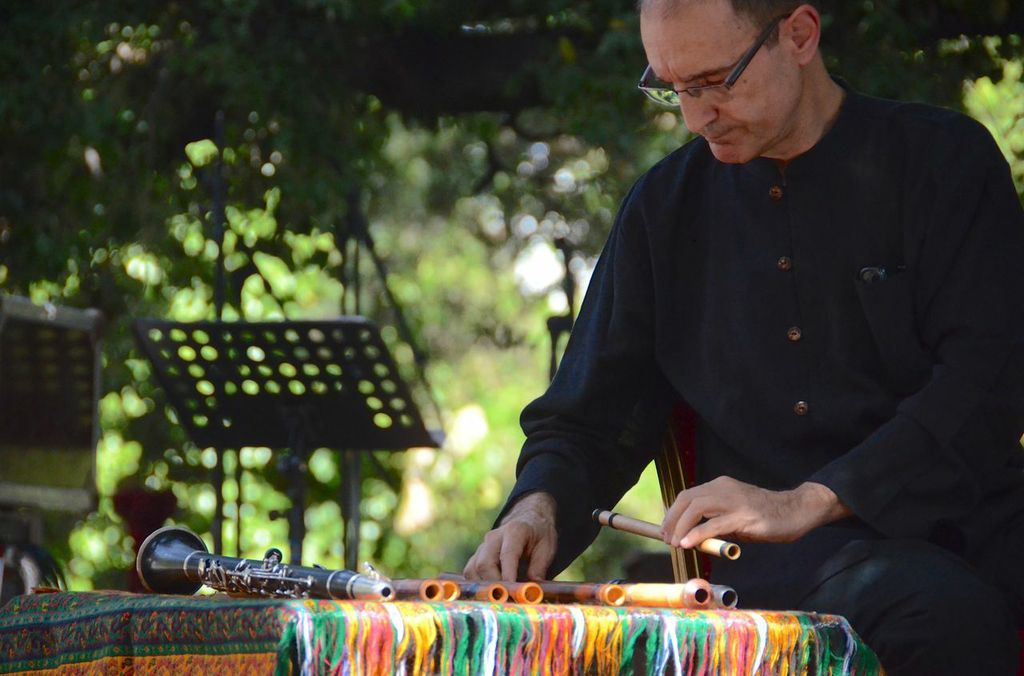
Javier Paxariño - wind instruments
Jota Martinez - zanfona (hurdy-gurdy)
David Mayoral – percussion

There’s never a bad Moor/good Christian nor a bad Christian/good Moor ~ Moorish saying


Perfume Mudéjar is an evocation of the music of the Muslim Moorish communities who stayed in Andalusia until the 17th century. Until the conquest of Granada in 1492, Islamic culture had been present in the Iberian peninsula for eight centuries, in the kingdoms and the caliphates known as Al Andalus.

Felipe Mascuñano's remarkable approach is to interweave the cultures of one territory but of different times, and to play the music of the 15th century with the sensitivity of a gypsy cante jondo. In the prodigious voice of the flamenco cantaor Pedro Sanz, he has found the essence of the Moorish culture.

This ensemble is named after the composer Jucejj Axivil who accompanied the infanta Juan de Aragon on a journey in August 1352 between Huesca and Zaragoza, and entertained him with his vihuela de péñola (playing his lute).

The Concert

There’s nothing like a wheezing, buzzing hurdy gurdy to transport you aurally to the Middle Ages. Although this was but one instrument of many played by the six musicians that make up Axivil Aljamia, it was this distinctive sound that told us most what the group was setting out to achieve.

Jota Martinez - zanfona
Felipe Sánchez Mascuñano

Artistic director, Felipe Sánchez Mascuñano, who also plays a mean lute, aims to interweave the cultures of one territory but of different times. The result is music from the 15th century played with the sensitivity of a gypsy cante jondo.

 Israel Paz lets it all out

Sitting centre stage with three musicians either side was flamenco cantor Israel Paz in a shiny grey suit and patent leather shoes. This was flamenco predating the guitar but the lack of whatever drama that instrument might have brought to the music was made up for by Paz’s massive dose of passion. He exerted himself to produce a powerful sound, his face reddening alarmingly at times, contorted as though in pain. He’d stretch his fingers out then grip his chest, a display that in any other context would be accompanied by floods of tears. There were many such emotional displays in this performance , every one followed by cheers from the audience and the musicians either side of him patting him gently on the back, partly in congratulation, partly as though checking he was okay.

Javier Paxariño 

The band was a multi-talented bunch. Javier Paxariño played seven wind instruments which also lent a medieval tone to the performance. In fact everyone played more than their principal instrument, the percussionist, Wafir S. Gibril, turning his hand to the lute with bells strapped to his ankle, the cellist singing harmonies with Paz and even delighting the audience with a deep, rich solo.

Wafir S. Gibril

Gibril got the most out of his frame drum from a metallic sound near the rim to a deep thud in centre, muting it when necessary by swiftly gliding his fingers across it.

Paz - agony or ecstasy?

Paz clapped though many instrumental moments, keeping time with a syncopated beat and the point at which they all looked happiest was when they were all using their hands that way together.

This concert was not to everyone's liking with one audience member saying about Paz ..."his voice and delivery came across like a toddler who's screamed himself hoarse having a tantrum in the supermarket over sweets he can't have!" A more general criticism was that there was little verbal engagement in any language with the audience and although the ensemble  knew their music they seemed unsure of the program. There was an awkward moment nearly two hours in when Mascuñano just said ‘Merci’ and got ready to leave the stage.

The group stood until cheers convinced them to do an encore. Festival artistic director Alain Weber who appeared concerned the venue might not be cleared in time for the next performance popped up to the microphone and approved ‘un petit encore’ which was duly performed to everyone’s delight.

Text: Stephanie Clifford-Smith
Photographs: Vanessa Bonnin

Fes Festival Fringe program
Fes Festival Medina Map
Fes Festival Food! 
Fes Festival Site

SHARE THIS!
Print Friendly and PDF