Showing posts with label Fes Festival 2016. Show all posts

Sunday, May 15, 2016

Fes Festival 2016 - The Wrap


The 22nd edition of the Fes Festival of World Sacred Music is over and as is our tradition at The View From Fez, our team takes a look back and reflects on the festival

Festival Artistic Director Alain Weber made some brave choices

Reviewer and photographer Hedd Thomas

This was my first time to the Fes Festival of World Sacred. In fact, it was also my first time in Morocco and my first time in Africa. I came with few expectations.

Obviously the weather affected the festival and it was disappointing to see the lack of organisation and communication from the organisers about any contingency plans. I bumped into a number of people who’d come from afar and paid good money for tickets or passes only to find themselves wondering aimlessly around the Medina for a venue that had been changed for a concert that had been postponed. I’m a fan of Uzbek music and was looking forward to hearing Yulduz Turdieva on Tuesday night but, unannounced, she was replaced. The organisers need to get to grips with modern modes of communication.

For a festival ostensibly celebrating female musicians, there was a conspicuous lack of women other than solo or backing singers. From the orchestras of Ramzi Aburedwan, Mohammed Briouel and the Cairo Opera House at Bab al-Makina to the smaller ensembles accompanying Sahar Mohammadi, Christine Salem, Maria Mazzotta, Rageshri Das, Lamar, Ariana Vafadari and Samira Saïd, literally every single instrumentalist was a man. At the same time, those ensembles made up entirely of women - namely Ingie, Agraw and the Jiangsu Women’s National Orchestra - were marketed as unique not because of their music but because - sacrebleu! - they were all women. Whether the issue is principally cultural, socio-economic or simply musical, I can’t say; but the fact that it doesn’t appear to even be an issue for festival organisers worth redressing or at least addressing through one badly-timed forum session is telling.

Mukkadas Mijit on opening night

The music was, on the whole, exceptional. I relished in the Indian fare, especially Rageshri Das’ intimate ghazals at Dar Adiyel and gnawi Mehdi Nassouli’s collaboration with Parvathy Baul. At her press conference, she talked elegantly about the need to move to the music, that only through dancing does the breath, body and soul synchronise without the mind and ego getting in the way. After Mukkadas Mijit and Imebiet Tegegne’s mesmerising moves on the opening night, I would have liked to experience more of the same throughout the week, as well as more space for audiences to join in. Appreciating music, and especially sacred music, is best done either though silent, concentrated listening or though somatic submission. Too few seemed interested in the former and too few were given space for the latter.

Ragashri Das

Most of the music came from Muslim-majority countries and regions, which gave me a great opportunity to hear the Maqam in all its historical and regional variations. More explanations would have helped, especially in English when only French was provided, and towards the end I did hear myself muttering, “Another day, another ney…” But there was just enough from elsewhere - Brazil, Réunion, Italy - to provide respite. All in all, I had a brilliant, eye-opening time. The many problems of the festival organisation - weather-proofing, communication, ill-timed forum discussions, lack of English language - were counterbalanced by some beautiful, memorable moments. Shukran Fez.


Reviewer and photographer Faith Barker

I had been interested to see whether the management change last year would have changed things at the Fes Festival. We’ve complained enough about the organisation elsewhere for it to be clear that plus ça change, plus c’est la même chose. If anything the disorganisation was worse because of the wet weather, although I thought the Batha prefecture hall was a great substitute venue.

The programme for me was not as enticing as when I was here in 2014, but I did see some amazing acts: OY’s performance at Batha wasn’t right for the time of day but their wonky, otherworldly music has inspired me to get tickets to their show in London next week; the indomitable Christine Salem and her drummers defied the rain and lit up the Jnan Sbil gardens; and Parvathy Baul’s turn in the opening ceremony stole the show for me. These artists all happened to be female, in keeping with the theme of Founding Women, but the theme was a bit confusing and not consistently drawn out in festival and forum events.

Parvathy Baul stole the show

The Sufi nights are some of my favourite events at the festival, so it was a shame that two were cancelled due to rain. But as always it was a great place for people from the Medina to come together, old and young alike. It unfortunately was not that well publicised to foreign festival-goers, with the information only appearing on the website two days after they had started. This lack of information affected several other events in the festival, including the free app walk exploring the history of Fez’s waterways and its traditional music.

The Fes festival will always have a certain magic because of the charm of the city itself. But it can’t rely on this alone to keep going – either the festival needs to move to September when it clashes with Ramadan, or they need to find better venues for rain. A temporary covering for Bab al-Makina is a possibility, and would improve the festival as well as adding a new concert venue in Fez which could be used all year round. They also need to move fully into the 21st century and use all their social media channels to communicate  - in English as well as French. The festival attracts a high calibre of artists; it has balanced free events with ticketed ones, responding well to criticism that it is too elitist; visitors discover a fascinating city as well as a varied and interesting programme. If it can get the communication right, it has an assured future as one of the most beloved and important world music festivals in the world.

Reviewer and photographer Lynn Sheppard

Lynn Sheppard & Rayyan
The theme for this year's festival was Founding Women, however, repeatedly in speeches, on the festival website and elsewhere the only founding woman mentioned was Fatima el Fihiri, founder of the Al Karaouine. A less limiting and more encompassing theme could have been "Celebrating Women" or similar.

My favourite concert was a woman, although not one of the big stars pictured on this year's poster. I loved the impressive Virginia Rodrigues' concert in Jnan Sibil. I also like the emphasis on India and am intrigued to see which country will be in the spotlight next year. Overall, compared to last year, there were fewer acts in the programme that I already knew and but also fewer discoveries of new favourites for me in 2016.

I was sad to see the Batha Museum lost as a venue, but Jnan Sibil was a worthy alternative, as long as the weather was fine. It was a pity that the entire gardens were shut for the concerts - if the security cordon were moved a little closer to the concert area, the gardens would have remained accessible to all. The Prefecture Hall was a much improved venue compared to last year. The lack of contingency venues is a point previously and frequently made.

The impressive Virginia Rodrigues

There was a distinct lack of clear communication when contingencies had to be made. The Festival would do well to use its social media feeds more consistently to keep festival-goers informed of last minute changes. The number of changes and the inconsistent communication of them between the website, printed programme and reality caused a number of festival regulars to comment to me that they thought the organisation was the "worst in 22 years".

Unfortunately, due to the venue change and a time change which meant it clashed with concerts, I was not able to attend any more of the Forum sessions this year than the first day. I have written here before of my opinion regarding the accessibility of the Forum.

This years forum sessions were a major disapointment

This year, there was no translation, meaning only Francophone attendees needed to bother making the trip to the Jnane Palace Hotel. One English festival-goer told me she had always attended the Forum and felt that the inclusion of the Forum in the Festival pass added significant value to her attendance at the festival. However, she wasn't willing to miss concerts to attend the Forum and when she learned of the lack of translation she realised it would have been a wasted journey anyway. When the President of the Spirit of Fes Foundation doesn't even introduce himself before he speaks, it is easy to interpret the Forum as a closed members club, not interested in attracting new audiences or developing new debates. So much the pity.

To conclude, the bad weather and poor contingency planning and communication meant that, for me, the 22nd Fes Festival of Sacred Music was not the best edition I have attended. With a new team at the helm, we hope next year will be bigger and better than ever before.

Photographer and Editor Sandy McCutcheon

2016 was a difficult year because of possibly the worst weather the festival has ever seen.

While previous festivals have had some very heavy downpours, the rain this year arrived with cold temperatures and an uncharacteristic persistence. In some way this may be a good thing and prompt the festival organisers to have much better contingency plans. While the lack of a "plan B' was an obvious flaw, it could have been ameliorated by the festival having better communication systems, particularly in the social media.

The failure to use the festival's twitter account  (@fesfestival) to alert patrons to changes of venues or cancellations, is particularly odd. A quick check of their Twitter account shows that they last used it 370 days ago! Yet, this was the year when updates of information was particularly necessary. Problems such as incorrect information on the festival website, or their Facebook page, could easily have been fixed with a tweet or two.  Instead, there were small "communique" posters in some places - which a majority of patrons never saw.

Twitter or a smartphone App would have been a better solution

An appropriate response to the communication problem would be to have a smartphone App which festival goers could download. Along with updates, alerts and venue information it could contain maps and other essential information - in English.

Praise deserves to be paid to the technical staff, particularly sound engineer Chris Ekers and his team, for the extra work involved in last minute changing of venues. Sound in most venues was good, apart from Dar Tazi where the Sufi Nights were held.

OY - a brave choice that paid off

No festival programme can ever satisfy all patrons, but this year Alain Weber's opening night and the Indian events were a standout. The inclusion of OY was a brave decision that paid off and became a festival favourite for those lucky enough to have caught their concert. Other performances worth mentioning are Imebiet Tegegne, from Ethiopia and Sahar Mohammadi.


The mesmerising Imebiet Tegegne

Many who had been looking forward to seeing Oumou Sangaré after the disappointment of her being rained out last year, were shaking their heads at the bad luck that saw her cancelled once again. The weather was unkind and at one stage three or the five women on the festival banner were either cancelled or rescheduled - something beyond the control of the festival. 

Two cancellations and one postponement due to rain or equipment not arriving on time

The final Sufi Night concert with the Fez Hamadcha was a boisterous affair, with security and police needed to keep control of an over-full venue. This should not have surprised them as the Hamadcha are the most popular and exciting tariqa in Fez.

The View From Fez Team shukran to...  

Rachida El Jokh
Press Officer Fatima-Zohra Hamidi,  Meriam Sqali and Amine El Youssefi at the Festival office. Sound Engineer Chris Ekers for providing background on the festival's technical workings, Helen Ranger for hot hints, tips and translations. Hassan Zemmouri for his detailed knowledge of who's who in Fez.

Working at covering the entire festival is a time consuming task. Most nights the VFF team were working to 3 am and are in debt to Rachida El Jokh (and her mother) for keeping them fuelled up for the long nights.
"Rachida was a genie who kept making great food appear."  - Hedd Thomas. 
Without the constant availability of great Moroccan food and endless pots of coffee and tea, the crew would have been far less able to cope with the long hours. Rachida also performed marathon babysitting sessions "Without her it wouldn't have been possible for me to do my work." - Lynn Sheppard. 


Shukran l' kulchi


SHARE THIS!

Fes Festival Sufi Night #8 - Fez Hamadcha - Review


Dar Tazi was packed well before 11 for the final night, the Hamadcha from Fez. Every year mqaddem Abderrahim Amrani’s group draws crowds of medina-dwellers who know he will provide an evening which combines lively performance with a deep understanding of Moroccan cultural heritage and the poetry used by the Hamadcha - Faith Barker reports...

mqaddem Abderrahim Amrani

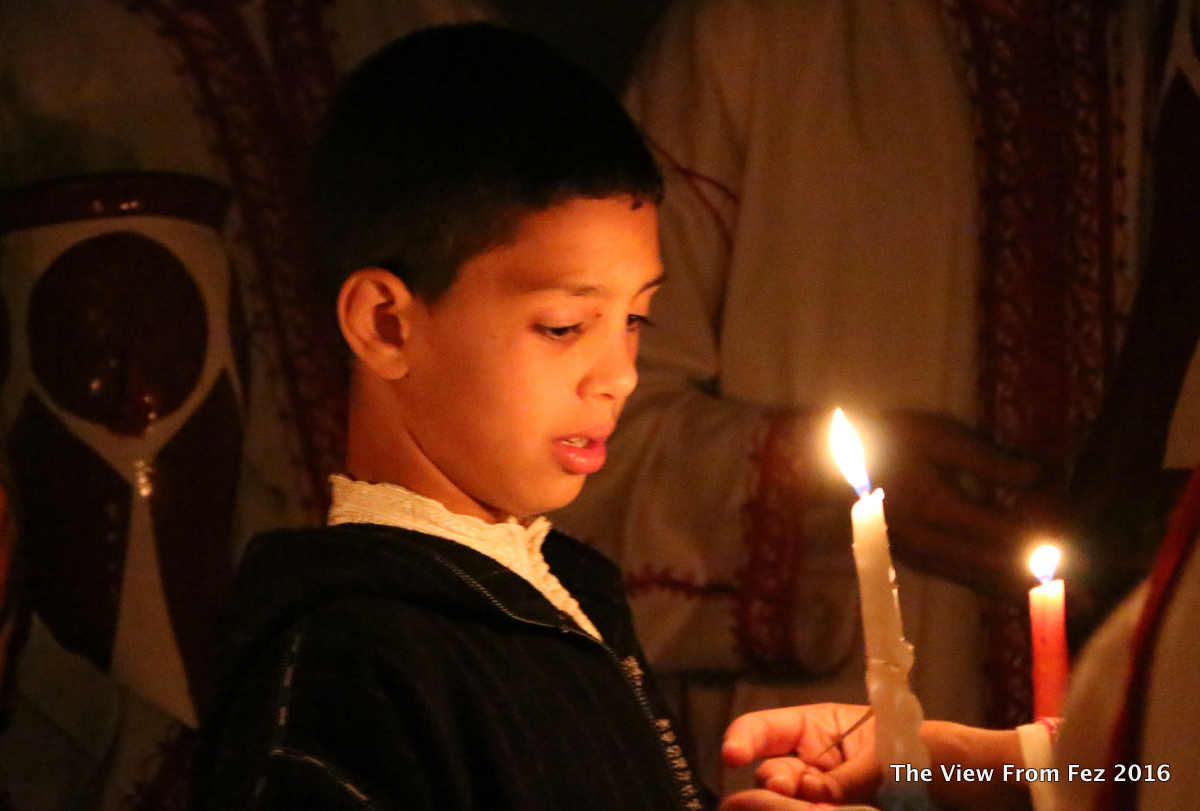
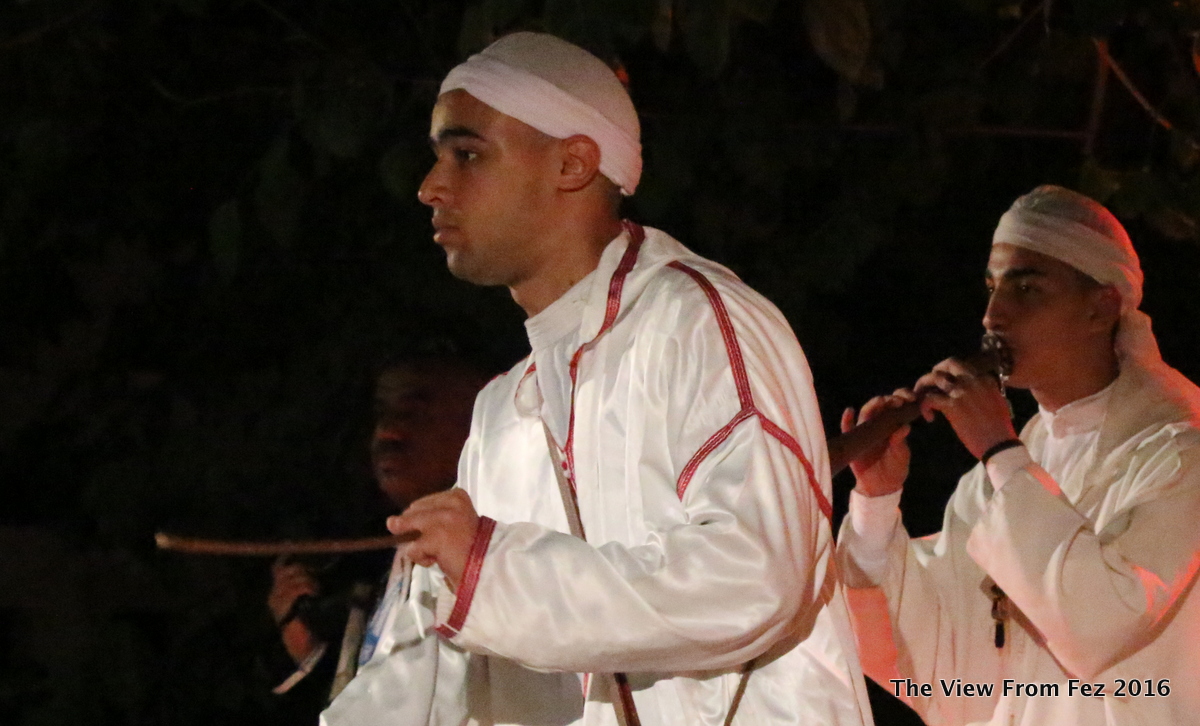
The group entered holding candles and doing the hadra, as they would in a lila. The hadra of the Hamadcha has a distinctive, almost jazzy beat, and is a part of the ritual where people can trance from the feeling of hal, divine ecstasy. The musicians assembled in a line onstage, some beating the large clay gwel drums, and with the players of the ghaita, a piercing oboe-like instrument, behind them. Others joined hands and rocked back and forth in the rolling dance of the hadra. Mustafa Khalili, a well-known actor in Morocco from years gone by and a devotee of Hamadcha, came forward and faced off with the mqaddem, rocking and leaping from side to side.

The Hamadcha entered by candlelight 
Mustafa Khalili

The crowd reached a fever pitch until Abderrahim Amrani brought the hadra to a close with a wave of his arms. The musicians settled into their places – tonight they were cross-legged on cushions rather than sat on chairs, creating an atmosphere closer to that of a lila in a house. Full disclosure: I spent a year doing research and performing with the group. In that year, Abderrahim began teaching local teenage boys the tradition, and it was heartening to see that several of them had stayed with him, grown up and become true Hamdoushis.

Mohammed Soussi

The group sang the aroubiyat, an opening section for the ritual, and Mohammed Soussi, a celebrated malhoun singer and friend of Abderrahim, sang some mawwal before the group went into the songs with the guembri, a three-stringed guitar-like instrument used by the Hamadsha and gnawa. Unfortunately, these slower sections were disappointing because of the sound quality – somehow they could not provide microphones for all the singers so their voices were unevenly amplified, and the guembri was inaudible – and because Abderrahim sang very little, preferring to give the limelight to other mqaddems he had invited from other cities in Morocco.

Mohammad Semlali - drumming and singing

Things picked up when they went into some Issawa songs, led very capably by Mohammad Semlali. In his early twenties and the son of an Issawa mqaddem, Semlali has a beautiful voice and a sense of showmanship. He got the audience to sing along with the well-known songs, encouraging them to get louder. The cries of the zaghrit, the exclamation of “salam ala rassoul allah”, rang out and the vast crowd cheered and danced as the unmistakeable noise of the ghaita started up again when the Hamadcha went back into the hadra.

There is no minimum age for being an Hamadcha devotee


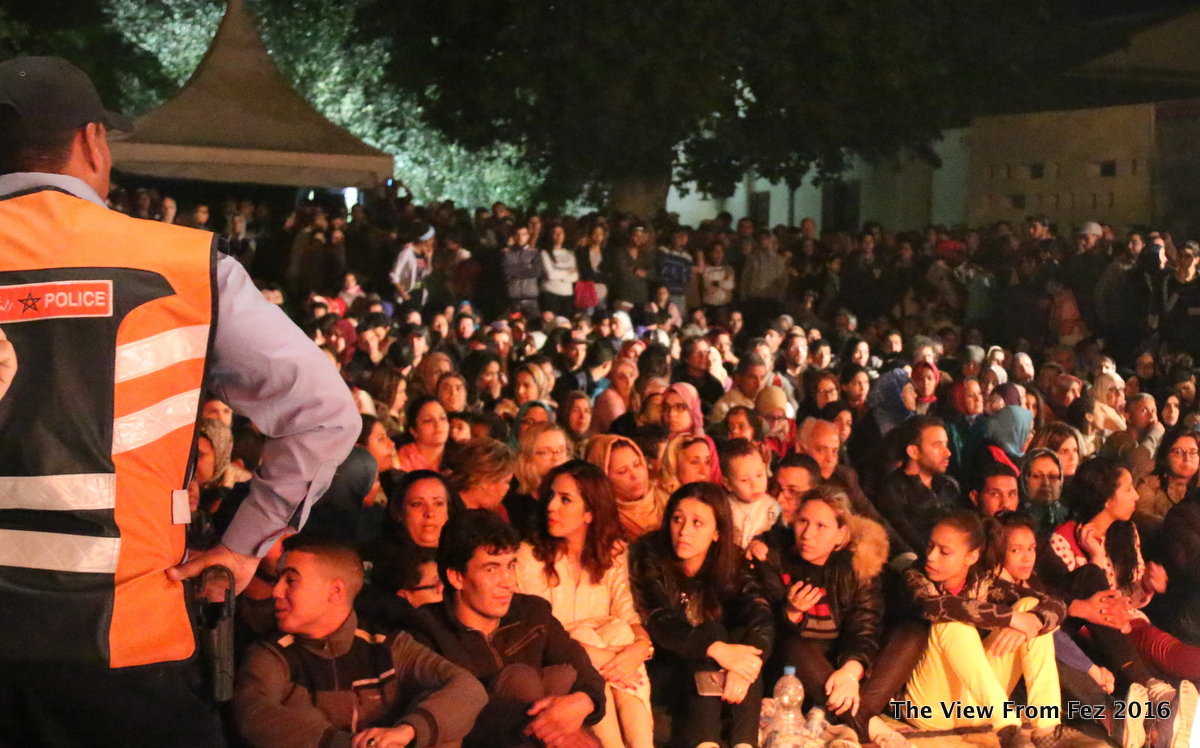
Dar Tazi’s security, beefed up by a large number of police officers, was visibly anxious. The Hamadcha evenings are known for getting a bit out of hand, and the place was so full that the audience had spread right down to the back of the stage. But security made the situation worse by trying to force the Hamadcha to cut their performance short by half an hour. The crowd were having none of it and got to their feet, demanding Abderrahim’s signature song, Aicha. Abderrahim implored the crowd to stay under control, “because there are foreigners and old women here,” and launched into his version of a song for Aicha. He uses a melody from gnawa and has changed the words to be about the queen of the spirits. Chaos ensued, with several young women falling into violent trance. One girl at the front of the stage was holding on to two policemen as she whipped her hair up and down, at one point getting to her hands and knees on the ground.


The performance ended at one as it was supposed to, and it is to be hoped that the security will be better prepared for the Hamadcha next year. The sound might have been terrible, some of the voices ropier than other tariqas, but their performance is an experience which is a highlight of the festival every year.

Review: Faith Barker. Photographs: Sandy McCutcheon


SHARE THIS!

Saturday, May 14, 2016

Fes Festival Day #9 - Review


The final day of the Fez Festival of World Sacred Music was a mixture of totally different styles of music. Contemporary Music from Yom, Arab pop from Samira Saïd and a wildly exuberant Sufi performance from the Fez Hamadcha. Add in the sunshine and it became a perfectly fine way to close the festival

Samira Saïd still going strong

Yom – The Silence of Exodus - Review by Lynn Sheppard


Yom took the stage at Jnan Sbil and introduced his band members: Farid D on cello, Claude Tchamitchian on double bass and Bijan Chemirani on percussion. He explained that the concert they would give today, The Silence of Exodus, was his own composition and would be performed without a break as one single piece.


The Silence of Exodus is based on the story of the exodus of the Jews from Egypt. It was billed in the festival programme as dealing with "the universal confrontation of the human being with his existential solitude through all types of exodus." Anyone in the sparse crowd attending the concert who had not read this would frankly have found it hard to understand the meaning of the music.


It began with solemn, sad, jarring chords on the double bass, which were joined by Yom's clarinet adding a wistful, longing feeling. As the percussion was introduced, the sense was of walking or marching, but again this impression was influenced by having read the synopsis.


Reflecting the central role of the instrument in Jewish music, Yom barely stopped - his clarinet was present throughout almost all of the 70 minute piece. Although our surroundings in the lush and well-watered gardens were far from the barren desert traversed by the Jews, today's sweltering heat seemed to multiply the feeling of unease generated by the discordant music, replicating the discomfort of exile.

This was a challenging piece of music - the more upbeat, jazzy sections didn't last long and it was clearly intended to be provocative. Nonetheless, the talent and stamina of the musicians was remarkable and when our uncomfortable journey came to an end the audience rose to its feet in admiration and awe. One British festival-goer said "I loved it!"; Thomas, from Spain was moved, saying it was "masterly".

Review and photographs: Lynn Sheppard


Samira Saïd – Moroccan Singing Star - Review Hedd Thomas


The final concert at Bab al-Makina saw Morocco’s very own pop sensation Samira Saïd perform to an expectant audience of old and young. The former might remember her best from her 1980 Eurovision Song Contest entry ‘Bitaqap Khub’, which earned Morocco a measly sept pointe on their first and only attempt. Despite this, it launched her career, which has gone from strength to strength, earning her a whole host of international awards. The younger ones here tonight might have been more familiar with her latest albums, Ayza Aeesh and Mazal, which take Arab pop to uncharted territories of commercialism. She has been lauded and lambasted in almost equal measure for thrusting Arab music into the pop-for-profit arena of 21st century music. The question would be, who would she please tonight? Which half of the audience would be wishing they were instead watching the final of the 2016 Eurovision, which, by coincidence, was happening at exactly the same time?


Bass has been missing in much of the Arab music this week but not so with Saïd, her bass guitarist dishing up a feast of funky riffs. Some stylish snare drumming and a little Latin flair on the congas gave her second song a fresh feel, forcing most people in the central stalls to their feet, phones and babies in hand. Security was tight, and they had to deal with scrums for empty seats and complaints about others standing in their way, so it was a relief to see sense and fun prevail, with most taking a “if you can’t beat them, join them” approach and getting up to dance.


Many of Saïd’s songs continued with this Latin layer sandwiched between the Arab pop, with Cuban jazz twinkling across the piano keys and the conga player switching every now and then to the bongos. After the earlier relief of the bass guitar, though, it was pumped up to too much of a good thing, his previously lucid vibrations now amplified into a messy sine wave soup. Samira’s soulful singing wowed the crowd, who sung along to ‘Ah Bahabek’s repeating line of “Ya Habibi” and delighted in singing whole chorus when she turned her microphone towards them. Yoi-yoi calls came from pockets of women in the cheaper seats, which visibly moved the honoured Moroccan. Many foreign festival pass holders admitted that the performance surpassed their expectations.

Date night in Fez

Leaving the Bab al-Makina while the music was still playing, it was clear just how young this audience was. Groups of boys and girls, teenagers and students, all huddled at the back of the palace chatting, laughing, determined to have a good time. Some looked around for friends, some for potential partners, some seemed to be on dates. Walking to the concert earlier, it seemed a shame that an artist with seemingly little to do with sacred music should be closing this festival, and ticketed at a price beyond what most of her adoring fans could afford. It felt like it should have been a free concert at the Bab Boujloud. But this was a chance to dress up, a chance to buy your fancy a ticket, a chance to impress and be a little grown up. It suddenly felt like this was a fitting event in a fitting venue, a fitting tribute to our young Fessi hosts, and that Samira Said was helping these young people to navigate their way through their confusing, changing world. Maybe with the right ears and an open heart, all music can be sacred music.

Review and photographs: Hedd Thomas


The View From Fez is a Fes Festival official media partner

See our Fes Festival reports:
Opening Night Review
Day Two Review
Sufi Night One Review
Day Three Review
Day Four Review
Sufi Night Two Review
Day Five Review
Sufi Night Five Review
Day Six Review 
Sufi Night Six Review
Day Seven Review
Sufi Night Seven Review
Sufi Night Eight Review

SHARE THIS!

Fez Festival Day #8 - Review

Saturday at the Fes Festival was all about great voices - Brazil's Virginia Rodrigues in the gardens, the tribute to Oum Kelthoum at Bab al Makina and Reda Taliyani drawing a huge crowd to the Boujloud Square. And along the way there was some very inventive instrumentation - a bloogle resonator!

Virginia Rodrigues – Brazil's Celestial Voice - Review by Lynn Sheppard


Virginia Rodrigues' band opened their afternoon performance appropriately with a song summery-sounding track which seemed to celebrate the improvement in the weather. Upbeat and sunny, it circulated around the audience like the light breeze which blew through the palms of Jnan Sibil and heralded the arrival on stage of Ms Rodrigues herself.


Before taking the microphone, she sprinkled the stage with holy water, presumably to appease the orixás (gods), who are as part of Rodrigues' heritage and upbringing as the Protestant and Catholic churches where she first learned to sing. From a poor, Afro-Cuban background, Virginia Rodrigues did not grow up in the kind of environment where opportunities are plentiful. Nonetheless, she was discovered by Caetano Veloso, Brazilian composer, singer, musician, writer and political activist and is now in a position to travel the world sharing her repertoire and her incredible voice.


Rodrigues' repertoire ranges across many genres. Some tracks sounded choral, like they wouldn't be out of place in a church, while others had a more festive, samba beat. Some, like the second track of her set, sounded more jazzy or drew on the famous Brazilian bossa nova rhythms. But the passion and emotion of the lyrics, not to mention the incredible range of her voice, immediately set Ms Rodrigues apart from vocalists of the easy listening variety, even for those of us who don't understand Portuguese.

Today's concert was an opportunity to showcase Rodrigues' new album, Mama Kalunga, which was released just last month. The album tracks were arranged by the three musicians on stage with her today: Bernardo Bosisio (guitar), Lura Ranevsky (cello) and Marco Lobo (percussion). The set also drew on her other four albums and showcased each of the musicians' talents as well as Rodrigues' vocals and her unusual grunts and gasps.


Many of the tracks were based around a huge range of traditional and less traditional percussion sounds, created from shells, bells, plastic tubing, a plastic bottle, a birdsong whistle and the distinctly more recognisable drums and tambourine. One track featured percussionist Marco Lobo wearing ankle bells and playing a berimbau (a single stringed percussion instrument resembling a bow) opposite Rodrigues in a kind of duel on stage.


Although Rodrigues began the set with more solemn and melancholic songs, as the concert continued, the mood lifted. With the fantastic weather and in the lush green setting of the Jnan Sibil gardens, it was impossible not to be joyous and once the vocalist introduced a samba from her native Bahia, several members of the audience - the young and young at heart - were on their feet dancing.


By the end of the set, Rodrigues was dazzling us all not only with her voice but with her smile. She would have brought a ray of sunshine to Fez, no matter the weather. She seemed to be energised by the enthusiasm of the crowd and began lift her skirts and wiggle her hips around the stage. At the end of more than 1.5 hours on stage, she shimmied off, only to be called back for an encore, which she granted with an absolutely stunning accapella spiritual track. And with that, our journey to Brazil was over and the crowd dispersed through the gardens into the medina of Fez.

Review and photographs: Lynn Sheppard


Tribute to Oum Kelthoum - Review by Hedd Thomas


The penultimate concert at Bab al-Makina saw a tribute to the “Star of the East,” Oum Kelthoum, performed by the Kawkab El Sharq Ensemble of the Cairo Opera Orchestra. Founded in 2014, the sixteen-man orchestra and four female singers perform every first Thursday of the month at the Opera House, just as the Arab World’s most famous singer did for many decades, but in Fez this Friday night they found themselves in the different environment of a cold and windy open-air stage. The compares promised “a journey of emotion” and thanked the huge audience for coming to the concert despite “the whims of the weather,” this being the first of the festival to see every seat allocated to sponsors taken


Dressed in natty black tie and with visibly slick, oiled-back hair, the members of the orchestra walked on stage to muted applause. By contrast, the conductor wore a straight tie and sported a grade one shave. A half-size mock up of the Bab al-Makina itself illuminated the facade, deep space stars, galaxies and nebula gorgeously but somewhat contradictorily beamed above the crenelation alongside a bright full moon. Needless to say, this bore little resemblance to reality tonight.


The orchestra struck up with an instrumental number, its rather tinny sound in need of deeper strings. Suddenly slowing, a keyboard solo emerged, its processed sound like a cross between a musical box and a computer game. It can only be hoped that a real piano is used in the opera house. Curiously for an institution of that type, their best players were those playing traditional Arab instruments: the oud and kanun player ended this opening piece with virtuosic delicacy, and the doumbek (goblet drum) player’s blistering solo in a later piece brought the oversized house down with clapping, in-seat dancing and even ululations from the thrilled throng.


The first of four singers entered, whose names were regrettably not announced or published, and after an introduction on the kanun to introduce the song’s tonality she proceeded to sing long, drawn-out syllables, milking almost every one for all their worth. Her voice was slightly husky and her presentation a little coy as smoke billowed up from back stage. The second song was a much darker affair that she sung from her chest at the bottom of her register while the lone cello and double bass upped the ante against the orchestra’s earlier tinny tone. The wind picked up and it blew through the microphones, seeming to take away with it much of the music’s momentum. A lengthy and lethargic section followed, which finally picked up towards the end, her trills and microtonal turns earning a rapturous applause.


Other singers took different approaches. Wearing a pink dress though not holding Oum Kelthoum’s trademark scarf, one had a voice that was powerful and rounded, if a little unfocused, and she sang with her emotions on full display. By their very nature, songs can be appreciated in full only by those who understand the text, preferably also with an appreciation for its context. The contrast between the locals and visitors tonight was stark, with the former clapping and singing along while many of the latter left early, intrigued, if not captivated, by what they heard.


Tomorrow (Saturday) at the festival 

Jardin Jnan Sbil - 4.30 pm - Yom – The Silence of Exodus

Bab Al Makina - 9,00 pm - Samira Saïd – Moroccan Singing Star

Boujloud Square: 10.00 pm - Ba-jloud – Aminux

Dar Tazi Sufi Nights 23h00: The Fez Hamadcha Sufi Brotherhood

Thursday's weather: Mostly sunny. Some cloud and a cold night. High of 22 degrees Celsius and a low of 9.


The View From Fez is a Fes Festival official media partner

See our Fes Festival reports:
Opening Night Review
Day Two Review
Sufi Night One Review
Day Three Review
Day Four Review
Sufi Night Two Review
Day Five Review
Sufi Night Five Review
Day Six Review 
Sufi Night Six Review
Day Seven Review

Previews
Samira Saïd Preview
Sufi Nights & Boujloud Concerts

SHARE THIS!