Showing posts with label Fes Festival. Show all posts

Sunday, May 15, 2016

Fes Festival Sufi Night #8 - Fez Hamadcha - Review


Dar Tazi was packed well before 11 for the final night, the Hamadcha from Fez. Every year mqaddem Abderrahim Amrani’s group draws crowds of medina-dwellers who know he will provide an evening which combines lively performance with a deep understanding of Moroccan cultural heritage and the poetry used by the Hamadcha - Faith Barker reports...

mqaddem Abderrahim Amrani

The group entered holding candles and doing the hadra, as they would in a lila. The hadra of the Hamadcha has a distinctive, almost jazzy beat, and is a part of the ritual where people can trance from the feeling of hal, divine ecstasy. The musicians assembled in a line onstage, some beating the large clay gwel drums, and with the players of the ghaita, a piercing oboe-like instrument, behind them. Others joined hands and rocked back and forth in the rolling dance of the hadra. Mustafa Khalili, a well-known actor in Morocco from years gone by and a devotee of Hamadcha, came forward and faced off with the mqaddem, rocking and leaping from side to side.
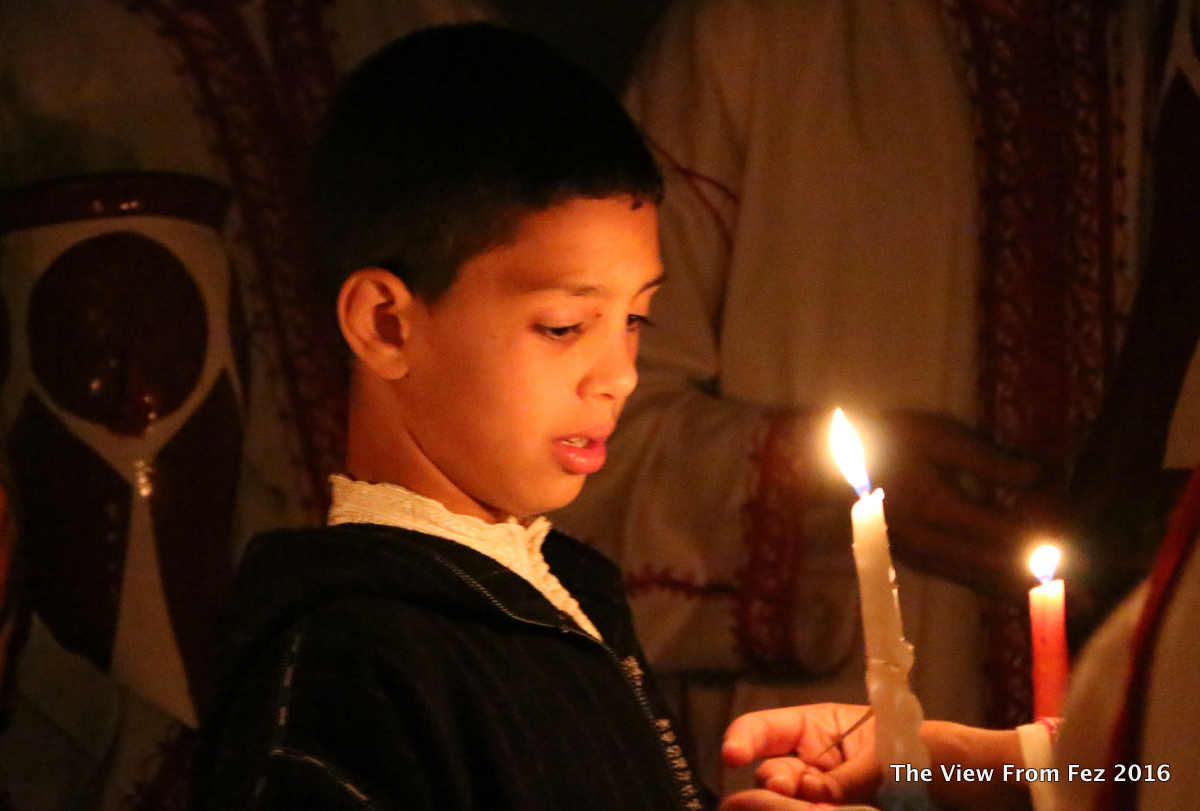
The Hamadcha entered by candlelight 
Mustafa Khalili

The crowd reached a fever pitch until Abderrahim Amrani brought the hadra to a close with a wave of his arms. The musicians settled into their places – tonight they were cross-legged on cushions rather than sat on chairs, creating an atmosphere closer to that of a lila in a house. Full disclosure: I spent a year doing research and performing with the group. In that year, Abderrahim began teaching local teenage boys the tradition, and it was heartening to see that several of them had stayed with him, grown up and become true Hamdoushis.

Mohammed Soussi

The group sang the aroubiyat, an opening section for the ritual, and Mohammed Soussi, a celebrated malhoun singer and friend of Abderrahim, sang some mawwal before the group went into the songs with the guembri, a three-stringed guitar-like instrument used by the Hamadsha and gnawa. Unfortunately, these slower sections were disappointing because of the sound quality – somehow they could not provide microphones for all the singers so their voices were unevenly amplified, and the guembri was inaudible – and because Abderrahim sang very little, preferring to give the limelight to other mqaddems he had invited from other cities in Morocco.
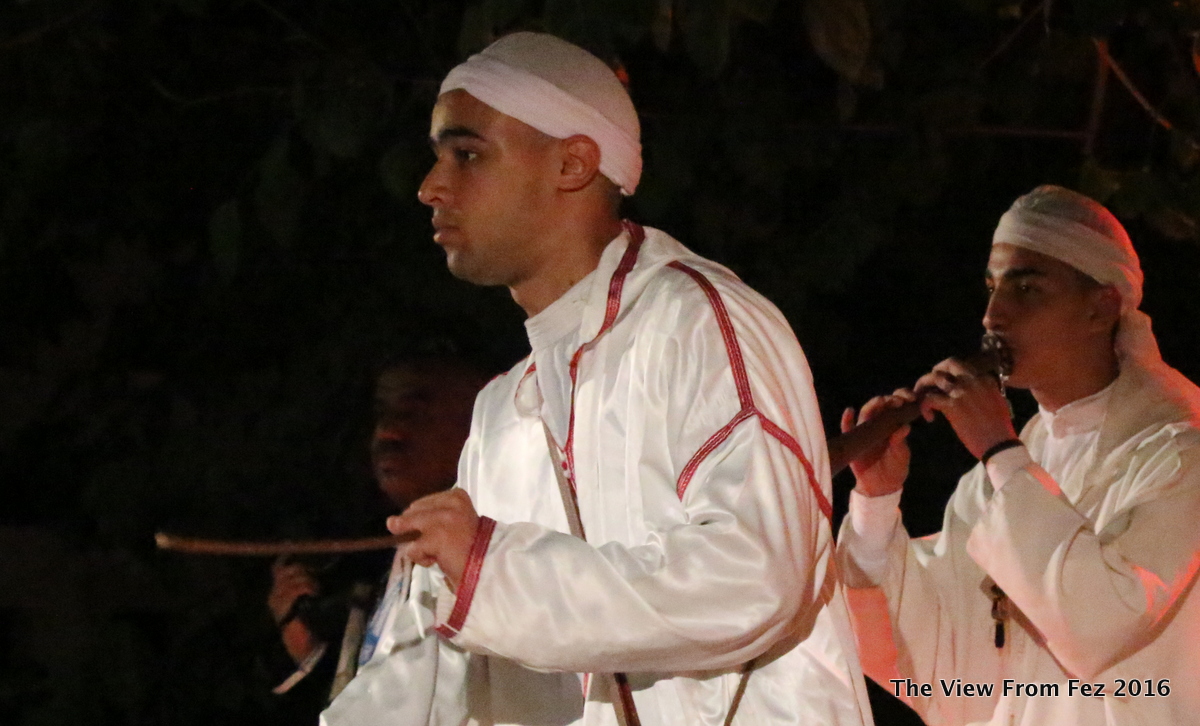
Mohammad Semlali - drumming and singing

Things picked up when they went into some Issawa songs, led very capably by Mohammad Semlali. In his early twenties and the son of an Issawa mqaddem, Semlali has a beautiful voice and a sense of showmanship. He got the audience to sing along with the well-known songs, encouraging them to get louder. The cries of the zaghrit, the exclamation of “salam ala rassoul allah”, rang out and the vast crowd cheered and danced as the unmistakeable noise of the ghaita started up again when the Hamadcha went back into the hadra.

There is no minimum age for being an Hamadcha devotee


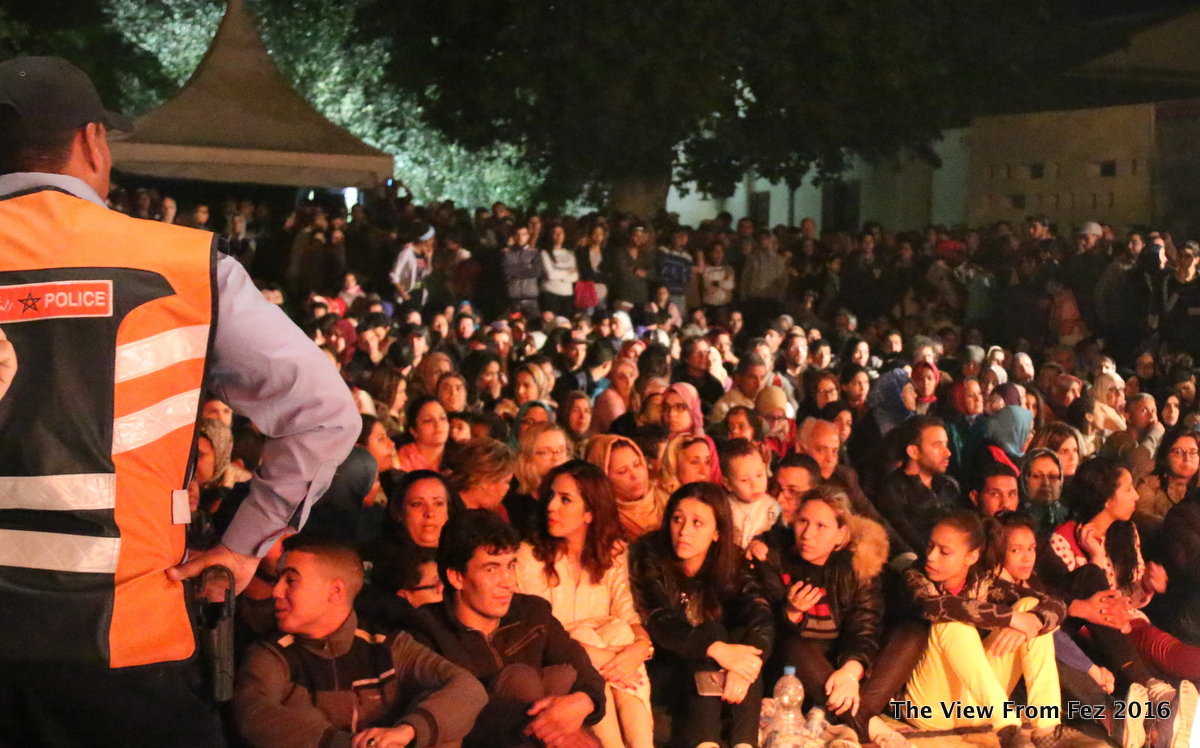
Dar Tazi’s security, beefed up by a large number of police officers, was visibly anxious. The Hamadcha evenings are known for getting a bit out of hand, and the place was so full that the audience had spread right down to the back of the stage. But security made the situation worse by trying to force the Hamadcha to cut their performance short by half an hour. The crowd were having none of it and got to their feet, demanding Abderrahim’s signature song, Aicha. Abderrahim implored the crowd to stay under control, “because there are foreigners and old women here,” and launched into his version of a song for Aicha. He uses a melody from gnawa and has changed the words to be about the queen of the spirits. Chaos ensued, with several young women falling into violent trance. One girl at the front of the stage was holding on to two policemen as she whipped her hair up and down, at one point getting to her hands and knees on the ground.


The performance ended at one as it was supposed to, and it is to be hoped that the security will be better prepared for the Hamadcha next year. The sound might have been terrible, some of the voices ropier than other tariqas, but their performance is an experience which is a highlight of the festival every year.

Review: Faith Barker. Photographs: Sandy McCutcheon


SHARE THIS!

Saturday, August 22, 2015

Fes Festival of World Sacred Music - May 6 to 14 2016


2016 will see the 22nd edition of the Fes Festival of World Sacred Music. Intending visitors have been waiting, keen to know the dates so that they can make travel and accommodation bookings. Now the waiting is over. According to a festival insider the festival will start on Friday May 6 and run through until Saturday May 14


Festival fans have been emailing The View From Fez asking for the dates, aware that the best riads in the Fez Medina will book out very quickly. While first time visitors often opt for hotels in the new city, those in the know seek out rooms in the Medina so as to be immersed in the spirit of the festival.

If you are intending to come to Fez for the Festival - book now!

The May dates will hopefully mean that the temperatures are moderate, though there could be occasional showers during the festival.


This 22nd edition will be the second for Festival Director Tajeddine Baddou, who described his role last year as "an exploratory mission". Tajeddine Baddou, previously a Moroccan Ambassador to the former Czechoslovakia, Canada, Austria and Italy, only took over as director 4 months before the 21st edition, but impressed festival goers and the media with his warmth and openness.

Mr Baddou has had events organisation experience before - in 1999 he was in charge of the Year of Morocco, showcasing the country through more than 400 international events.

One of the biggest challenges, says Mr Baddour is that, "We have a lack of sites in Fez to stage concerts. When the weather is good, Bab Makina can have a real magic, with the magnificent walls and the birds flying overhead. But the acoustics are not good, and in wet weather it's not possible to cover it."

There simply isn't an alternative venue in Fez that will hold an audience of thousands. It's something, Mr Baddou says, that the team will be trying to address.

Another aspect that will be a focus is an increasing move towards using English during the Festival. "Because we have a lot of English visitors," he says. Last year, at his instigation, opening night introductions were given first in Moroccan Arabic and then in English, before French. It was a step in the right direction given the large numbers of English speakers and those whose second language is English rather than French

Festival Director Tajeddine Baddou

As a Fes Festival Media Partner, The View From Fez, will once again have a team of photographers, reporters and musicologists providing the most extensive English language coverage of the entire festival

The Fes Festival of Sufi Culture is expected to be held in April but the dates have yet to be announced.

Relive last year's magic! See all our Fes Festival 2015 reviews
Fes Festival Opening Night
Fes Festival Day Two 
Fes Festival Day Three
Fes Festival Day Four
Fes Festival Day Five
Fes Festival Day Six
Fes Festival Day Seven
Fes Festival Day Eight
Fes Festival Day Nine


The View From Fez is an official media partner of the Fes Festival of World Sacred Music

SHARE THIS!
Print Friendly and PDF

Saturday, October 04, 2014

Former Fes Festival Director Speaks

This week director Faouzi Skali broke his silence on his departure as director of the Spirit of Fes Foundation and the Fes Festival of World Sacred Music
Time to pack up the chairs: Faouzi Skali leaves the Fes Festival. Photo: Suzanna Clarke

Mr Skali said that after more than 20 years at the helm, it was time to move on, "The real reason alone, is the natural feeling that with the Twentieth Edition of the Festival and era has drawn to a close. To me, it's the first phase of this adventure, which is without limit. The Festival has become part of the memory and heritage of Fez and Morocco."

The new team running the Festival is President Abderrafih Zouitene and Director Ambassador Tajeddine Baddou. Mr Skali described the ambassador as,"A dear friend and long-time man of culture who has already achieved many great projects." Ali Benmakhlouf is now Director of the Fez Forum, the morning talk sessions which aims to build bridges between Eastern and Western cultures.

Mr Skali founded the Fes Festival of World Sacred Music in 1994, as a counter to the “clash of civilisations” rhetoric underpinning the first Gulf War. And in 2007, he initiated the annual Fes Festival of Sufi Culture.

Born in Fez in 1953, Mr Skali has a Ph.D. in anthropology, ethnology and religious science from the Sorbonne. At age 23, after reading the stories of Rumi, he became fascinated by Sufism and a year later met and became a disciple of Sidi Hamza al Qadiri al Boutchichi. Last year he was awarded the French Chevalier (Knight) de la Legion d'Honneur.

Mr Skali says Fez history and culture offers “the artistic, the spiritual and poetic; all this richness in architecture and music...It’s very important for a person like me to do something to transmit (those values) to a new generation...Sufism has this perfume of spirituality that you can share.”

"Today more than ever, we see the importance of Sufi dimension, which is the heart of Moroccan society. It is a bulwark against extremism. There is a need to bear witness in the world...It requires an approach which is beyond purely security: it is a battle of ideas."

Apart from a brief period a few years ago when Mr Skali stepped down amid rumours of significant problems in the organisation,  Mr Skali has been involved in the management of the Festival with former President Mohamed Kabbaj. He said this week that, "The foundation of collective endeavour involves a certain degree of organisational complexity. Nothing like this is immune from tensions, conflicts, differences of approaches and visions."

Mr Skali recalls "his deep respect and friendship Mohamed Kabbaj, who always agreed with courage
to take risks when he thought the result was worth it...Kabbaj has always impressed me with his sense of responsibility and commitment." When Mr Kabbaj decided to retire from his post, Mr Skali felt it was a natural time for him to move on.

"Like any project with a significant cultural significance, this festival is to survive beyond the people," Mr Skali said. "The perpetuation of this Festival is primarily a responsibility that requires alertness. It is in this context that I have left the festival management...After more than 20 years of organizing, which is epic, I feel that a cycle has been completed...I am always ready to contribute at any level whatsoever if a need is expressed."

Mr Skali's successor, Director Ambassador Tajeddine Baddou (pictured right), has had a long career as a diplomat. Born in Meknes in 1943, Mr Baddou was Morocco's ambassador to Italy between 2003 and 2008 and has had an active involvement in many cultural organisations. He indicated a desire to expand the Fes Festival to reactivate the festival of culinary arts, to create a festival of crafts, and other events that will enhance the potential of the region. He said he also wishes to have a greater degree of youth integration with the activities of the Foundation.

SHARE THIS!
Print Friendly and PDF

Monday, June 16, 2014

Fes Festival Venue Change


Tonights performance by St Ephraim's Choir at Dar Mokri switched to Sidi ben Youssef school


It is only two minutes from Dar Mokri and signs are in place.

SHARE THIS!
Print Friendly and PDF

Wednesday, June 13, 2012

Fes Forums - Visions of the Bird of Wonder


This afternoon, in the cool of an air conditioned conference room at Palais Jamaï, Michael Barry gave a presentation on his book, Visions of the Bird of Wonder, reports Vivian Nguyen.

Alpine swift above Fez

Visions of the Bird of Wonder is co-authored with French professor, Leili Anvar, who was not present for the lecture.

The book focuses on how the image of the bird has travelled across religious and figurative borders, and is based on the work of Shaykh Fari Attâr's Canticle of the Birds to Saint Francis of Assisi's Canticle of the World's Creatures.

Barry, (pictured, left), who is American-born and French-educated, is a professor in Persian at Princeton University. He presented images from the book in a slideshow, while explaining the bird's significance in a series of Persian miniature paintings.

He first explained how the image of the bird in Persian texts was linked to the Christian tradition, but also to the Buddhist and Hindu religions as well.

Barry also put a few myths to rest in regard to the Taliban's ban on girls attending school by showing images featuring schoolgirls in 18th century Afghanistan. Contrary to popular opinion, he also emphasised that the images were important to Muslim culture not only in Asia, but also in the Shia tradition which is dominant in Iran, as well as the orthodox Sunni Islamic tradition as well.

One of the major points that Barry made focused on how the bird represents the soul's aspiration to move to and be closer to God. Additionally, its ability for flight represents the soul's desire to aspire to a higher sense of self.

This sentiment of the bird is a universal one, he said. The bird also adopted a male and female form in Barry's work, representing different aspects of divinity. Often, the bird represented the female form.

Overall, Barry wowed his audience with erudition and beauty, and kept the crowd spellbound for two hours. Outside on the terrace of the Palais Jamaï, the birds did not seem to be listening to the lecture, but rather, were singing.

Barry's lecture was a great example of how the Festival is not just about music or debates, but also serves as a great site for art exhibitions and history, showcasing beauty in all its forms in the Muslim world.


For more information about the lecture, please visit www.fesfestival.com.

Waddick Doyle contributed to this report.

SHARE THIS!

Friday, November 25, 2011

Tribute to a Friend of the Fez Sacred Music Festival

The sad news from Barcelona yesterday was that the superb Catalan soprano, Monserrat Figueras, passed away at the age of 69. For the last year she had been struggling with an unnamed illness.
Monserrat Figueras: photo Suzanna Clarke


Monserrat Figueras was born and grew up in a musical family in Barcelona. For the last forty years she and her husband, the viola da gamba master and conductor Jordi Savall, introduced generations of listeners to music that spanned many centuries and lands, from the Middle East to Latin America. In pursuit of their shared artistic vision, the duo founded three ensembles: Hesprion XX (now called Hesprion XXI), La Capella Reial de Catalunya and Le Concert des Nations.

Figueras and Savall at the Batha Museum: Photo Suzanna Clarke

Audiences at the Fes Festival of World Sacred Music will remember Figueras and Savall delivering some of the most outstanding concerts the festival has witnessed. Back in 2006, Monserrat’s authoritative interpretations of medieval, Renaissance and Baroque music demonstrated why she had become world famous. At the concert at the Batha Museum she delivered a powerful and flawless performance. Her ability to switch between languages, (Berber, Arabic and ancient Spanish dialects, to name just a few), with seeming ease, and her mastery of ancient singing techniques never became technical, but rather a springboard for her own personal style.

Figueras and Savall returned to the festival in 2010 to present Jerusalem - la ville des deux paix, in which their music retraced 3,200 years of the history of the sacred city. It was a major work with around 25 people on stage, including soloists from the Capella Reial de Catalunya and invited musicians from Europe, the Near East and the Maghreb. Montserrat Figueras, Jordi Savall and their Ensemble Hesperion XXI delivered what Jordi described as, "a magical journey outside of time, of Sufi music and Hebrew lamentations". The concert was one of that year's highlights.

Figueras recorded more than 70 albums, and the couple established their own record label, Alia Vox. She was named an officer of France's Order of Arts and Letters in 2003; in 2008 she and her husband were named "Artists for Peace" by UNESCO. In recent years, their artistic family has come to include their children. Their son Ferran, is a talented theorbo player and singer, and their daughter Arianna is an excellent harpist and singer with a striking resemblance to her mother.

The View from Fez extends its condolences to Jordi Savall and his family.


SHARE THIS!

Sunday, June 05, 2011

Death of Dimi Mint Abba


The View from Fez was saddened to learn of the death of Dimi Mint Abba, one of Mauritania's most beloved musicians. She was 52.


Abba's brother, Ahmed Abba, said she died on Saturday in a hospital in Rabat after suffering a brain hemmorhage there two weeks ago during a tour. She performed at the Fes Festival of World Sacred Music in 2002.

Nicknamed the "Diva of the Desert," Abba was well-known on the world music circuit and beloved in her native Mauritania. Abba belonged to the "Iggawin" troubadour tradition, singing ancient poems and epics set to music. She had a melodic, hypnotic voice and played a traditional Mauritanian string instrument called the ardin.