For visitors to Fez, there are a range of well known destinations for day trips. But if you wish to avoid the crowds at Volubilis or Azrou, then head to Bhalil
The real name of Bhalil is
Bahau El-Lail which translates as the
Night's Glory (Arabic: البهاليل). It is an intriguing Amazigh (Berber) town some six kilometres from Sefrou and a 40 minute drive from Fez.
Notable for its unique cave houses located in the old part of the village, Bhalil also has eclectically coloured homes, linked together by a network of bridges.
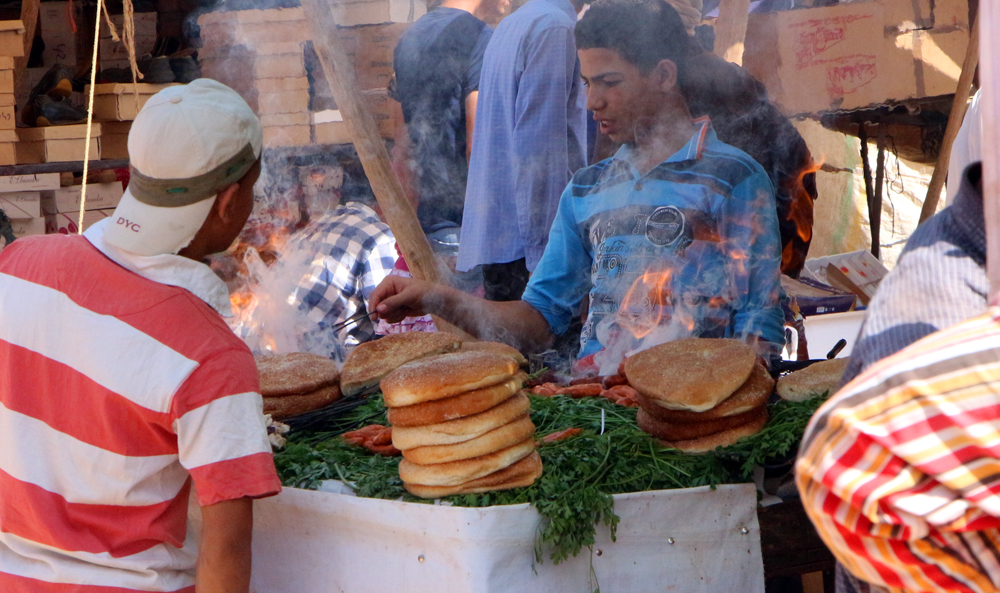
The town is famous for its production of jellaba buttons produced by the village women. It is also known for its olive oil production, and traditional bread ovens.
Six years ago a Fez local, Kamal Chaoui, and his wife Béatrice moved to Bhalil and renovated a traditional house. Along the way Kamal found the time and energy to organise the painting of the local houses and walls. The effect is delightfully photogenic.
For those who would like a quiet retreat for a few days or simply and overnight stay, Kamal's house, Dar Kamal Chaoui, is an easy short walk from the car park.
 |
| Kamal Chaoui is a gracious host with perfect French and good English |
With the help of a local traditional carpenter, Latif, Kamal's house has been sympathetically renovated and is comfortable even in winter having (surprisingly) underfloor heating. In summer, the elevation 982 m (3,222 ft) ensures that that temperatures are pleasant.
The house is tastefully decorated in a simple, restrained way. There are four bedrooms - three doubles and a twin - all with ensuite bathrooms. One has a view of the mountains.
At the top of the house, the terrace makes a perfect place to relax with a drink and take in the stunning views out over the village to the Rif Mountains.
 |
| There are stunning panoramic views from the terrace |
All the woodwork in Dar Kamal Chaoui is the work of a local traditional carpenter Latif. He has a shop in a cave close by and it is worth a visit, being crammed full of a bizarre array of artefacts that range from old vinyl records to ancient alarm clocks! There are also some examples of his wood carvings done in his idiosyncratic naive art style.
 |
| Traditional carpenter and antique collector, Latif |
 |
| Latif's carved wood art |
For those desiring adventure, Kamal organises a variety of treks, ranging from a hike of a couple of hours to eight hours. Most of the treks are an easy stroll, but donkeys are available for children. As well as the treks, there are also optional excursions to destinations such as local souks, and the cedar forests. Lunches, barbecues and meetings with the locals can also be included. (
More details here)
 |
| The painstaking work of making djellaba buttons |
And... long ago, in a village called Bhalil...
Some Amazigh traditions may be fading into history, but Bhalil is one of the places where traditions linger on well into last century and maybe even to today.
Anthropologists record the Berber wedding custom where, after a few months of marriage, a bride will leave her husband and return to her ancestral family home for an entire year. Typically, people from Bhalil marry within the village because the two families will be well known to each other.
For the entire engagement, the female fiancée does not leave the house, and likewise for three days prior to the wedding day, the male fiancé remains in an isolated cave with a few select male companions.
The male fiancé parades through the city on a highly embellished horse to his future home, where his bride is waiting. Celebrations carry on for seven days after the wedding, during which time the bride cannot leave her bed and is not allowed to see anyone but close family; and the groom continues living in the caves. On the seventh day, a final celebration occurs to mark the end of the wedding and the beginning of their daily life as a married couple.
However, after five months, the wife must leave her husband for a year and return to live in her ancestral home. The husband and wife must not see each other for the entire year; throughout this period, the wife is cloistered, but accompanied by an older woman sent by the bride’s husband. After the year, the husband gives his in-laws a variety of gifts (generally livestock and eggs) and the husband and wife return to their daily lives.
Find out more about Dar Kamal Chaoui here
Other day trips here
SHARE THIS!