Showing posts with label Fes Festival 2013. Show all posts

Wednesday, February 26, 2014

Music Lovers Mourn the Passing of Paco de Lucia


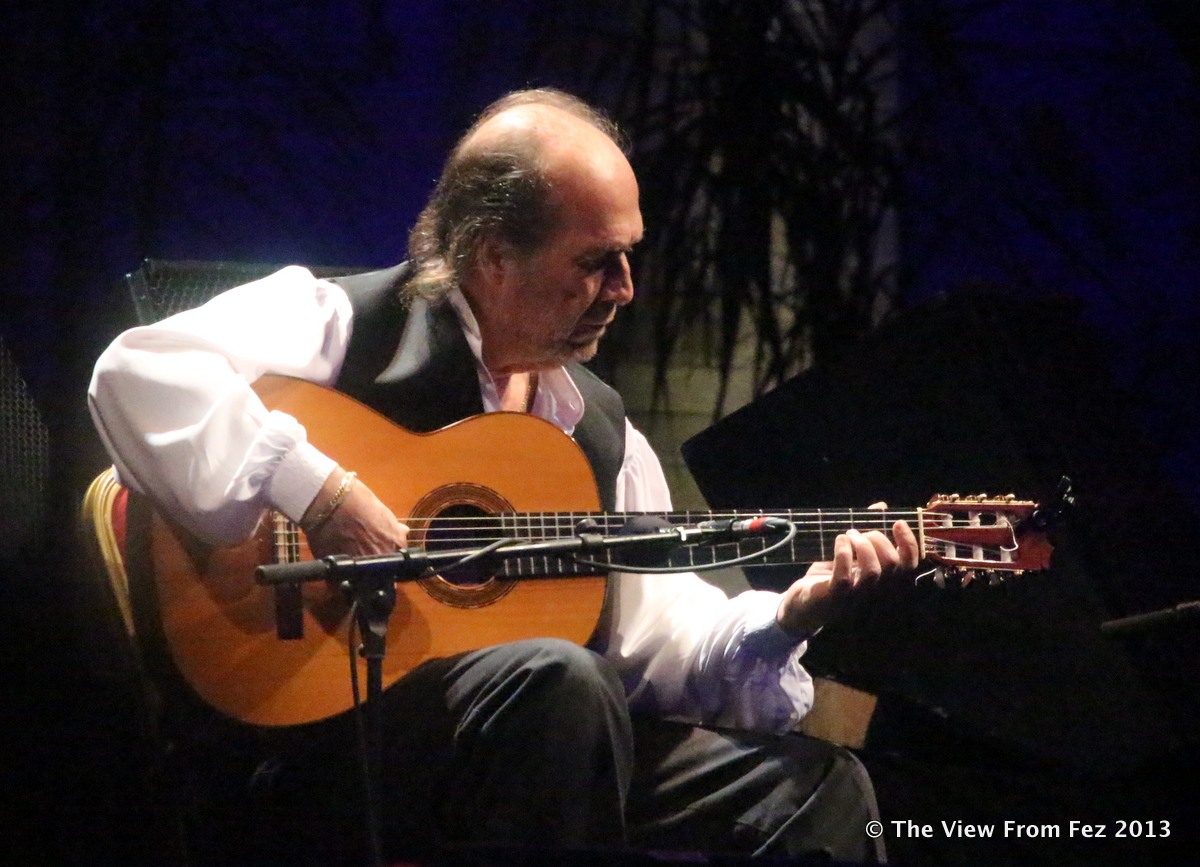
Back on Sunday, June 09, 2013. the Fes Festival of World Sacred Music presented a wonderful concert by Paco de Lucia. Now comes the sad news that the master of the Spanish guitar died in Mexico at the age of 66


Paco de Lucia dazzled audiences with his lightning-speed flamenco rhythms and finger work. Born Dec. 21, 1947, de Lucia — whose real name was Francisco Sanchez Gomez — was best-known for flamenco but also experimented with other genres of music. One of his most famous recordings was Friday Night in San Francisco, recorded with fellow guitarists John McLaughlin and Al Di Meola in 1981.

During the 1960s and 1970s, he formed an extremely popular duo with late flamenco singer legend Camaron de la Isla.

His 1973 rumba Entre Dos Aguas (Between Two Waters) became one of the most popular recordings in Spain.

De Lucia was awarded the Culture Ministry's Fine Arts Gold Medal in 1992 and the prestigious Prince of Asturias prize for the Arts in 2004.

A spokeswoman for the town hall of de Lucia's native Spanish town of Algeciras said de Lucia family members had told them the artist died of a heart attack. She said he began to feel unwell while on a beach in Cancun with his child and died while being taken to a local hospital.


The official spoke on condition of anonymity as town hall regulations do not allow her to be identified publicly

Describing the death as unexpected and premature, Spanish Education and Culture Minister Jose Ignacio Wert said he was "a unique and unrepeatable figure."

Paco de Lucia was an inspiration to many Moroccan musicians including Fez oud and guitar player and coordinator of the ALC-ALIF Music Club, Hamza El Fasiki. who learned his guitar technique by watching video clips of of Paco's playing.

"His guitar has been silenced - he was my teacher, companion in music, a creative inspiration and motivation ... I feel sad" ~ Hamza El Fasiki.

Paco de Lucia signing Hamza's guitar in 2013

Hamza was saddened by Paco's early death. "I followed everything about the way he played - his philosophy, the way sat, His finger action, even the way he cut his nails. He will be sadly missed."

Paco's signature on Hamza's guitar


SHARE THIS!
Print Friendly and PDF

Sunday, October 06, 2013

The Amazigh Language in Education and the Media - Sunday Feature

A majority of Moroccans grow up speaking one of the Amazigh languages and yet it is only relatively recently that Amazigh has gained recognition. In our Sunday Feature, The View from Fez looks at the issue and along the way discovers a new book on the Amazigh language in education and the media


There are an estimated 23 million Amazigh, the majority of whom are Sunni Muslim. The largest populations are in Morocco and Algeria, in addition to smaller numbers in Tunisia, Libya and Egypt. The Amazigh have been living in North Africa for nearly 4,000 years. Some 75 percent of the Moroccan population is Amazigh
In recent years the efforts to promote the Amazigh languages and culture have gained momentum. While Morocco has provided radio coverage for Amazigh speakers for some time, television was a long time coming.

Radio coverage is thankfully diverse with the RTM Chaîne Amazigh catering for Tachelhit, Tamazight and Tarifit speakers.

Tachelhit is spoken in south-west Morocco in an area between Sidi Ifni in the south Agadir in the north and Marrakech and the Draa/Sous valleys in the east. Tamazight is spoken in the Middle Atlas, between Taza, Khemisset, Azilal and Errachidia. Tarifit (or Rifia) is spoken in the Rif area of northern Morocco. A small number of radio programmes are also broadcast in Hassaniya, which is widely spoken in Western Sahara.


In January 2010, after years of delays, Morocco finally launched its first Amazigh language television station.

2010 will be remembered as a breakthrough year for Moroccan parents wanting to name their children with Amazigh names. In April of that year, the Ministry of Interior issued a directive that for the first time defined Amazigh names as meeting the legal prerequisite of being "Moroccan in nature." According to Human Rights Watch, the government directive liberalising Morocco's policy had positive results.

"By explicitly recognising Amazigh names as Moroccan, the government has eased a restriction on the right of parents to choose their children's names," said Sarah Leah Whitson, Middle East and North Africa director at Human Rights Watch. "This move shows greater respect and recognition for Morocco's ethnically and culturally diverse population."
"It was time! This was a victory and revenge for all the parents who were not allowed to give Amazigh names to their children. This circular represented the end of a racist law against all Amazigh, as the banning parents to give the name they wish their child was totally discriminatory." - Mounir Kejji, Amazigh activist
Getting the law changed has been a long and hard struggle that began back in 1996 when Driss Basri, the interior minister at the time and Abdelouahab Ben Mansour chairman of the High Commission of the Civil Registry and historian of the kingdom signed the decree to prevent the use of Amazigh names.

In 2011 the new constitution finally resulted in the inclusion of Amazigh as part of the common heritage of all Moroccans and as an official language of the country. The formalisation of the Amazigh language was officially the culmination of a process initiated in a royal speech of Agadir in October 2001.  It had also been brought about by decades of struggles by grassroots activists and intellectuals.
“For me, the greatest joy is to see that our work helps to bring about a change in Morocco, from denial to recognition of diversity and its sustainable management, and this is the way indicated to democracy" - Ahmed Assid (Amazigh Man of the Year- Idh Yennayer the Amazigh New Year 2962)
Speaking in Rabat at the opening session of a national conference organised by the Royal Institute of Amazigh Culture (IRCAM) on the "formalisation of Tamazight in Moroccan Constitution: what strategies and measures?" the head of government, Abdelilah Benkirane stressed that the government program has highlighted the issue of formalising the Amazigh language.


This year saw the adoption of Amazigh by Microsoft, the launching of Amazigh as a Facebook language and even its adoption by Maroc telecom for use on smartphones.  One of the most moving moments of this years Fes Festival of World Sacred Music was the sight of the tears running down Aïcha Redouane's cheeks as she sang "for the first time in my own language in my own country."


Respected public intellectuals such as Moha Ennaji and Fatima Sadiqi have been at the forefront of the movement to support the growth of Amazigh language and their contributions both in scholarly publications and as the driving force behind the popular Fes Festival of Amazigh Culture, continue to be invaluable. Sadiqi founded the Centre for Studies and Research on Women at the University of Fes. Fatima Sadiqi was appointed by Kufi Annan as a member of the UN Council for Development Policy (E.C.O.S.S.O.C.), and was appointed by the King of Morocco as a member of the Administrative Board of the Royal Institute of Amazigh Culture (IRCAM). And now Moha Ennaji has delivered a new publication that furthers the cause of Amazigh language and culture.

"The Amazigh Language in Education and Media " published by the South North Centre in Fez,  is a valuable contribution to ongoing debates about how best to improve the status of the Amazigh language.

Edited by Moha Ennaji, this 360-page long book includes 20 chapters in Arabic, French, and English by American, European, and Maghrebi researchers. The studies included in this book explore the challenges of the introduction of the Amazigh language in education and media in the Maghreb and Europe.


The publication is a major contribution to the debate on improving the teaching of the Amazigh language and its integration in the media.

The chapters deal with socio-linguistic and educational phenomena in five main areas: evaluation of the results of the teaching of the Amazigh language (programs, textbooks , training of trainers); achievements in language planning and education ( comparison of Moroccan and foreign experience), the impact of media on the Amazigh language in the countries of immigration and of origin , integration of Amazigh in audiovisual media and press,  and the importance of the use of the Amazigh language on the Internet ( review and Prospects ) .

It also aims to address matters relating to the Amazigh language and culture and contribute to the debate on the status of native languages in the North African and European countries.

The book, which offers a comprehensive approach to develop and deepen the teaching of Amazigh language and its use in modern media, however, reveals that the current experiments suffer from many shortcomings and face difficulties related mainly to application of policy and political discourse on the ground. In Europe, except for a small number of higher education institutions , Tamazight is almost nonexistent in the fields of education and in the national media , despite the presence of a large number of communities speaking the Amazigh .

Moha Ennaji is researcher in various areas ranging from language, education, gender , civil society, to migration. Ennaji is an international consultant and visiting professor at Rutgers University in the United States . He is also director of the international journal “Language and Linguistics” appearing since 1998, and Chairman of the South North Center for Intercultural Dialogue and Migration Studies . He is the author of several articles and books , the most recent of which are : Migration and Gender , The Impact on Women Left Behind (Red Sea Press, 2008, in collaboration with F.Sadiqi ) , Multilingualism , Cultural Identity, and Education in Morocco (2005 Springer, New York ) , Women in the Middle East and North Africa (2010, Routledge), Language and Gender in the Mediterranean Region (2008, Mouton de Gruyter , Berlin). The Interconnection of Amazigh and Arab Cultures (2009) and Migration and Cultural Diversity (2007).


SHARE THIS!
Print Friendly and PDF

Sunday, July 07, 2013

Top Festival Director Visits Fez - "It's a complete knockout!"


Bill Hauritz is a much loved Australian festival director and the man behind the huge festival held at Woodford in Queensland every year and which attracts its audience from around the world. With 25 stages, more than 3000 performers and a range of activities that run from forums to folk music, World Music and blues,  dance workshops to instrument making, as well as films and comedy events, the six day festival is the largest in the Southern Hemisphere. On a world tour to "gain perspective", Bill Hauritz dropped into Fez this week - his first experience of Morocco.

Bill Hauritz in The Ruined Garden Café - "The Medina is a complete knockout!"


At present Bill Hauritz is travelling around the globe attending festival related conferences. At this point he has been away from Australia for six weeks and there is still a way to go. The most important reason for the marathon trip, he explains, is to get a fresh perspective and to get away from the daily pressure of work back in Australia.

"Getting a fresh perspective is important. I have been doing the same job for 28 years getting out into the world means I get a feeling for how what we do fits in into the global culture."

When pressed to describe the role he plays in both his own festival in Australia and those he advises he responds, "I would suppose you could call me a cultural activist, keen on promoting culture, or getting it out to ordinary people. Music and art is the conduit for that. I have put together a band of people with similar aims and philosophies and we all come together to create an annual festival."

Bill Hauritz, like many of the great festival directors over the years, is motivated and inspired by ideas. "The Woodford Festival started in 1987 in a small village in Australia. It's key aim was promoting notion that our lore is a key part of developing our national culture. So, if you want to change or add to our culture, then the creation of a festival that celebrates that lore is a way to achieve it."

Hauritz's words contain the same message that we hear from Faouzi Skali the Director of the Fes Festival of World Sacred Music. While the Fes Festival is smaller and younger, the philosophies behind them are remarkably similar. Skali believes Fes Festival of World Sacred Music can inspire and create forces for change through cultural expression. Skali, who founded the festival in 1994, believes "music is the common language of humanity, it has the ability to move us all and this year the festival speaks to valuing change and acceptance." Bill Hauritz would not argue with that.

The Woodford festival started small, with 900 people attending the event.After eight years the festival had grown too large for the village and so the organisers purchased 200 hectares of land in a beautiful valley at Woodford, north of Brisbane. The festival has been held there annually for the last 19 years. This year will be the 28th. The festival runs for six days and normally attracts around 130,000 people.

The Amphitheatre at Woodford - just one of twenty-five stages

This year Bill Hauritz was invited to take part in the third Indian Ocean Music Association conference: For the third consecutive year, IOMMA, the Indian Ocean Music Market Association), was held from June 4-6, 2013 on Reunion Island. This music market event in the Indian Ocean was an opportunity to meet and talk to artists and professionals of the Indian Ocean area and those from America, Asia, Australia, and Europe. The event program is a series of meetings in the form of conferences and workshops, face-to-face business meetings, and four island evening concerts.

From Reunion Hauritz travelled to Cape Town for a week of meetings, then Cairo and on to Amsterdam for a few days before attending a festival in Ireland. Then it was off to the UK for meetings in London and then as a guest of the Glastonbury Festival. After seeing the Rolling Stones performance at Glastonbury it was onto a plane to Morocco as a guest of The View from Fez.

His initial experience of Morocco has been overwhelmingly positive. "It's a wonderful place. It is everything that people told me about ... and more.  The Medina is a complete knockout, absolutely fantastic. The general feel of the place as you walk through the souks is brilliant. I love it."

Najat Aatabou - "world class"

While in Fez, Bill Hauritz was briefed on the Fes Festival of World Sacred Music, The Fez Sufi Festival, The Amazigh Festival and the Volubilis Festiva;.  He also took time to check out the Fes Festival venues and was fulsome in his praise of Bab Al Makina, a walled courtyard with seating for about 4,200 people. The surrounding walls up to 12 meters high create a RT60 reverberation time that measures between three and four seconds. As Fes Festival sound engineer, Chris Ekers has observed in the past "It's certainly a challenging place to do amplified music'.

"The setting is wonderful. We have nothing like that in Australia. A tremendous setting with a great spirit in there. Obviously a difficult venue for the sound engineers, but as far as staging goes - absolutely fantastic. I loved it," Bill Hauritz says .

Bill Hauritz was able to see the opening night performances of the Amazigh Festival and was impressed. "Najat Aatabou was a complete knockout. She is a super-star. If she was in the English speaking world she would be an absolute diva. She had a lovely presence, cheeky with the audience and totally connected with them. A world-class performer".

During his stay in Fez Bill Hauritz expressed the desire to bring Moroccan performers to Australia for the Woodford Festival and discussions have started with a number of Fez Musicians. No details are available at this stage, but there is interest in possibly taking the four Malams (leaders) of Issawa, Hamadcha, Melhoun and Gnawa groups to either the 2014 or 2015 festival.

And for Bill Hauritz the impact of Fez has been a positive one. In his own words  "I'll be back".
To which we can only add - Inshallah!

Check out the Woodford site here.

SHARE THIS!
Print Friendly and PDF

Tuesday, July 02, 2013

The Punk Poetess and Other Sparkling Sacred Music at the Fes Festival


The 2013 Fes Festival of World Sacred Music has come and gone and already people are booking accommodation for next year (June 13 - 21, 2014). The feedback about the 2013 festival has been overwhelmingly positive with many regular festival goers rating it as one of the best ever. Peter Culshaw reflects on the festival
Patti Smith - photo: Suzanna Clarke

“The boy looked at Johnny – he was surrounded by white and blue tiles, in the medina.” Patti Smith was improvising on her classic album Horses in her first, compelling, gig in Morocco. Smith has a history of Moroccan connections: she knew the Tangier-based writer Paul Bowles and plugged into that pre-punk Beat generation, but there were some raised eyebrows as to what exactly she was doing at a “sacred” music festival. “Birdsong is sacred,” she said when challenged on this, surrounded by the twitter of birds at the open courtyard of the Riad Sheherazade where she gave her press conference the day before. "And so is Jimi Hendrix.”

Perhaps it would have been better to ask, What is not sacred music? Certainly most of the music of the Festival was more obviously from a spiritual tradition. Now in its 19th year, it was set up after the first Gulf War as a way to bring differing religious paths together. As an event in a Muslim country it remains a beacon of tolerance and creativity (and an inspiring contrast to the Salafists whose black flags were in the last year taking over Mali and banning music).


Paco de Lucia plugs back into flamenco roots and the fire and passion is back

But the reason Fes has established itself is that it's not just a powerful symbol in one of the Muslim world’s most sacred cities, with exchanges and discussions at the morning Fes Forum in what some have called “a spiritual Davos”, but a world-class music festival.

There were established international stars like guitarist Paco de Lucia, who in his advancing years really gives the impression that he is a total master of his instrument. Virtuosity is secondary to intellect and emotion. Just when things were threatening to get overly jazzy and cerebral, he plugs back into flamenco roots, and the fire and passion is back.

Abeer Nehme - photo: Sandy McCutcheon

More exciting for a music explorer are the gems you would never have come across without Fes. Outstanding this year was Abeer Nehme (pictured above) and her group, who sang Aramaic music from around the fourth century. A Christian living near Beirut, she has lived through conflict (her father was in the army and lost his leg), and she had the courage to tour Iraq in 2008; her voice has a transcendent purity. The Lebanese woman next to me said, “Finally, we have someone who could be on the level of Fairuz." Compliments don’t get much greater.

It was extraordinary how her music seemed to cut through the centuries of layers built up over Christianity, the Victorians and puritans in particular. Singing in the language of Jesus, it was powerful enough that you even got some impression of the sweetness and compassion of early Christianity. It was also sufficient for me to start looking up Antioch, the Maronites, and the early Syrian Church, which sent me off on a historical adventure.

An experiment in transporting an Upper Egypt Sufi ceremony from the village of Deir was also intoxicating – the new thing was to take a film of the village complete with kids and dogs running around under bright lightbulbs in a dusty square, and show it behind the musicians in the confines of the elegant Musée Batha under the famous Barbary Oak tree (somehow that tree with its enfolding branches seems to embody the spirit of the Festival).

Upper Nile Village under the Barbary Oak - photo Sandy McCutcheon

There were curious fringe events, like the film Looking For Muhyiddin, by film-maker Nacer Khemir which took place at 11pm outdoors at Borj Sud on the coldest June night anyone could recall. Two hours in we were wrapped in the carpets, provided for sitting on, to keep warm. The film showed the director criss-crossing countries with his red wheely suitcase meeting people who would shed light on his spiritual guide Muhyiddin (better known as Ibn Arabi) in Oxford, Italy, New York, Damascus and elsewhere. A paradox about this film, with its evocatively shot locations, was that while it was partly about transcending the ego, it was it some ways enormously self-indulgent.

Amongst several talks, the most intriguing and entertainingly delivered was Princeton professor Michael Barry’s look at how Matisse, who spent considerable time in Morocco, was influenced by Islamic painting and the Muslim world. Over mint tea at his hotel the day after, Barry, who had lost friends to the Taliban in Afghanistan, said that one of the outrageous things about the modern discourse on Islam was how the extremists had managed to brand themselves orthodox, whereas the more tolerant forms of Islam seen in places like Morocco, and abundantly represented in Fes for centuries were the true tradition of Islam.

A discussion ensued of a psychological nature – a modern dialectic being that psychotics such as the Islamists have a certainty which gives them strength, while the opposition tend to be neurotics who take a nuanced, less monomaniacal view of the world. It is often these off-agenda meetings and connections, which nearly everyone I spoke to had, that have a ripple-effect in conversations and projects which develop after the Festival ends.

Assala Nasri - photo Suzanna Clarke

Probably the biggest star of the Festival was the Syrian singer Assala Nasri, the closest thing to a real pop star in the Festival. An opponent of the regime in Syria, she filled the 6,000 or so seats in the grand Bab Maqina beyond capacity. The numbers seemed to be in general up this year, and evening concerts at the Musée Batha were also jammed for acts like the life-affirming energy of Algeria’s El Gusto and the more doleful modern fado of Portugal’s Ana Moura.

The director Faouzi Skali and artistic director Alain Weber pulled off a vintage event, full of sparkling music and adventurous programming – from Bhutan folk to Indian classical musicians jamming with baroque musicians to eccentric semi- classical versions of Leonard Cohen and Tom Waits by Rosemary Standley and Dom La Nena as part of the more intimate Nights In the Medina series in the gorgeous Dar Adiyel palace.

Rosemary Standley and Dom La Nena

One collaboration which didn’t entirely come off was the Ladysmith Chicago Gospel Experience; while the presence of feisty young Californian beatboxer Butterscotch was a bold attempt to drag gospel into the 21st century, her beats were banal compared to the rich complexity on offer elsewhere and I suspect showing off is not a particularly sacred attribute. Patti Smith, in that sense, on the last night was more spiritual – if you mean a connection to a larger energy, genuine communion with an audience and a certain damaged, compassionate humility.

Peter Culshaw's book on Manu Chao is published by Serpent's Tail
Follow Peter Culshaw on Twitter

SHARE THIS!
Print Friendly and PDF

Wednesday, June 19, 2013

Fes Festival of World Sacred Music 2013 ~ The Wrap Up


The 19th edition of the Fes Festival of World Sacred Music is over.  Here is a retrospective look at what many are describing as one of the best festivals so far. Picking favourites and highlights is often a difficult task, but this year audiences and reviewers alike had very similar choices.


The opening night spectacle (see review here) was the presentation of the premiere of Love Is My Religion, which is best described as Andalusia recreated through poetry, dance and music. It was everything an opening night performance should be and one of the best to date.

The performance, directed by Andrés Marín, featured more than thirty Arabo-Andalusian, Sufi, Amazigh and Spanish flamenco artists and included: Andrés Marín, dance, Carmen Linares, vocals, Amina Alaoui, vocals, Cherifa, vocals and Samira Kaderi, vocals. The music co-ordination was by Aziz Al Achab.

Right from the beginning, with the Andres Marin's display of passionate flamenco, the audience knew they were in for something special. Marin, unaccompanied, moved across the stage, taut and birdlike. Soon he was joined by a haunting clarinet until the piece built ultimately to include ouds, drums and cellos. He moved with core muscles braced and back arched, his heels mimicking the clatter of horse’s hooves.


However, the highlight for many was the appearance of Amazigh singer Cherifa (pictured above). As she entered the stage, flanked by Arab artist Bahaa Ronda and Spanish singer Carmen Linares, some of the crowd broke into ululations of appreciation. Cherifa opened her mouth and the energy in the air crackled, her deeply evocative voice raising goosebumps on one’s skin. Cherifa's command of her art produced an eerily primal sound that seemed both ancient and timeless.

Sufi Nights with the Hamadcha Brotherhood

Along with Cherifa's opening night performance the most widely talked about concerts were those by Paco de Lucía, the Mongolian Sardinian Fusion, El Gusto, Fado singer Ana Moura and Patti Smith. Among the local Moroccans, the Assala Nasri's concert was a huge hit. At the Sufi Nights at Dar Tazi, the local Hamadcha Brotherhood were overwhelming favourites.

The free concerts in the Festival in the City series was again extremely popular, with favourites being (unsurprisingly) the Hamadcha and Dj ClicK and, Nass L'Ghiwan and Hamid el Kasri.


Paco de Lucía's appearance was a highlight in many ways, not just the maestro's extraordinarily passionate guitar work, but also due to the superb performances by singer Juan Rafael Cortés Santiago, known as Duquende and flamenco dancer Antonio Fernández Montoya, known as “Farruco”. (See review here)


There were many performances at the festival this year that combined music from different traditions. Some, like the Indian/baroque concert were only mildly successful, but the standout was the afternoon at the Batha museum that featured the polyphonic work of the Sardinian Cuncordu E Tenore de Orosei and diphonic Mongolian khöömii chanting from singers Ts Tsogtgerel and Nergui Ganzorig of Mongolia.

At first glance the pairing looked like a recipe for disaster, but the reality was wonderful. It was, as one reviewer put it, as if the tectonic plates had shifted. Asia's Altai and Gobi Desert crashed into the mountains of Sardinia, producing a culture shock with Fez at the epicentre.

The Mongolians remarkable ability to depict landscape was matched by the Sardinians. The Mongolians evoked the sound of horses galloping over the windswept steppes while the Sardinians polyphony took the audience soaring over peaks, plateaus and into valleys. Their crystal clear harmonies combined to produce a soudscape greater than its individual parts. Then, when they came together in a huddle, the Mongolian overtone chanting became the solid drone base for a new landscape of steppes and, somewhere in the musical distance, the mountain peaks. Unforgettable. (See review here)


Probably one of ther most poignant moments in the festival was when, with a tear running down her cheek, Aïcha Redouane sang (pictured above) for the first time in her own language (Amazigh) in her own country.

And then, of course there was the triumph that was Patti. (See our review here)


Behind the Scenes

The programming of this festival was seen by most people as being an extremely good mix of music and culture with virtually no exceptions. The Nights in the Medina evenings worked well apart from the usual complaints about the bad sight-lines at Dar Mokri. Hopefully a better venue can be found for the next festival.  Security and signage was more than adequate.

The Sufi Nights were very well attended as were the Festival in the City events.

A village in the Upper Nile comes to life at Batha

Congratulations to Festival Director Faouzi Skali and Artistic Director Alain Weber. Weber also deserves congratulations for his production of the extraordinary performance of "At the Heart of the Nile" by Sheikh Hamid Hossein Ahmad and Sheikh Ghanan from the village of Deir in the Upper Nile.

Alain Weber
Faouzi Skali 

The pre-festival organisation this year was far better organised, with information available well in advance. For most journalists the often last minute confusion over press passes was gone, replaced with a smooth and efficient system. Later in the festival some members of the press did experience a few problems. However, tribute has to be paid to Spirit of Fes Foundation Press Officer Eziza Sid'Ahmed.

Set against this good preparatory work was the once again over zealous attitude of security personnel who seemed to have little appreciation that the international journalists had a job to do and that their reporting is a key to the success of future festivals.  It may be worthwhile for the festival organisers to consider doing what many other festivals do and hold "friendliness" training sessions for security so that their attitude is more about how they can help you rather than hinder.

Another source of complaint was the location of the media centre. Having it out at the Zalagh Parc Hotel far from where people were gathered for concerts, was simply wrong. Hopefully the same mistake will not be repeated next year. Having a press centre either at or near Dar Tazi would be far more logical.

The overbooking of venues needs urgent attention as the crush of people at both major venues was on several evenings,way over capacity to the point where the situation was potentially dangerous. The availability of hundreds of cheap "sponsors' tickets" being sold outside the Bab Al Makina also needs curtailing.

Thanks to Helen Ranger, the English language translations on line were of immense value to visitors and journalists alike. However, the festival still needs to come to terms with the fact that English is either the first or second language of a large number of visitors to the festival and that handing out information in French alone is of limited value. As a Swedish visitor told The View from Fez, "We don't expect a Swedish translation, but English is our second language and if the festival expects to be appreciated it must provide far more material in English."

At one event half the audience left after discovering that no English translator was on hand.

At the forum sessions at the Batha Museum, the English language translators were a mixed bunch. Some did a superb job while others were barely comprehensible.

Gurus of lighting and sound Christophe Olivier and Chris Ekers 

This year the lighting and sound were in the capable hands of Christophe Olivier and Chris Ekers respectively whose sterling work enhanced all the concerts. Each year the technical demands of musicians grow in complexity and as Chris Ekers pointed out they are now at the upper limits of what their equipment can deliver. In one case this year an extra monitor desk was needed to be brought in for El Gusto.

Chris Ekers made the observation that the festival has become more mainstream. His highlights? "Mongolians and Sardinians, the Upper Nile Egyptians were fabulous. Assri was good but commercial and walked off stage at the end and the band had to come to a grinding halt! Plano at the last Batha concert was superb. The fact so many concerts were fusions of cultures is a good sign. Ana Moura had a fabulous voice but not great stagecraft."

The View from Fez Team have their say

This year The View from Fez was fortunate to have to services of a talented team of writers and photographers: Vanessa Bonnin, Suzanna Clarke, Natasha Christov, Gabe Monson, Stephanie Clifford-Smith, Nouri Verghese, and Inga Meladze.

Stephanie Clifford-Smith

As a first time visitor to the festival the overall experience has been great. The standard of the acts was remarkable and the sound at every venue spot on. Highlights included the lovely fado singer Ana Moura in the Musee Bartha, the venue dimly lit to emulate a fado house. The final concert, Patti Smith, at the Bab al Makina was brilliant because, fan or not, she’s an icon who performed graciously and gave it her all.

Ana Moura

Many performances were sheer fun for both audiences and performers and these were favourites. Coubane Mint Ely Warakane from Mauritania and Lo Còr de la Plana from Marseilles spring immediately to mind but off the scale in the fun stakes was the Ladysmith Chicago Gospel Experience. Nothing’s going to get this atheist turning to God but, Jesus, that style of Christian worship is a blast!


Lowlights can mostly be tracked to festival admin and over zealous security. A scheduling clash saw quite a few people walk out of the Samira Kadiri concert to get to their next gig, the mini exodus beyond awkward in a venue as small as Dar Mokri.

Cameramen yakking at the Musee Batha during the Upper Nile Sufi night made it impossible for those at the back to hear the act. And security thinking their job was to make it as tough as possible to get into venues for the first few nights of the festival was frankly a pain. But, hey, on balance the gripes were small potatoes in the eight days that were a fabulous Fez festival.

Natasha Christov

Flamenco sensation Andres Marin and Moroccan singer Cherifa, both performing at the Opening Concert, were definite Festival highlights; Marin's precision in the execution of complex flamenco movements was astounding, and Cherifa's earthy vocals simply incomparable. Anthropologically, Syrian popstar Assala Nasri's concert at an overbooked Bab Al Makina was eye-opening, with glamoured-up locals arriving in droves to belt out Nasri's hits.

Andres Marin

One major gripe at this year's Festival was its embarrassingly poor organisation. Overbooked venues left ticket-holders unable to attend, time and venue changes barely publicised left performers without an audience, and disorganised security meant attendees were at times confined to an area only to be banished from it.

In addition, it is worth mentioning the lack of world focus at this "world music" festival. Concert synopses, workshop lectures and major press conferences were all in French, ostracising a large contingent of foreign visitors and locals (the two main languages spoken in Fes are Darija and Fusha).

Thankfully, the free concerts were another story. A definite highlight was southern Moroccan group Tariqa Hassania had the audience on their feet dancing, clapping and singing to the world language; music.

Gabe Monson

Writing and photographing the free evening concerts at Place Boujloud led to some different perspectives than in my previous media role at the Fes Festival, recording sound.

I began to pay more attention to what I saw, as well as what I heard. Tired from late nights and deadlines I became more sensitive to how the environment of the events, as well as the music, could invigorate or irritate, inspire or sooth.

Hamid el Kasri

My week was bookended with invigoration. Firstly by the warmth of Mauritanian griot (storyteller) Coumbane Mint Ely Warakane at the Batha Museum, supported by her ‘blue birds from heaven’ singers and sensitive male musicians. Finally, by the brilliantly arranged high energy Gnawa-jazz fusion group led by Karim Ziad and Hamid Kasri at Place Boujloud.

Batha Museum itself was a soothing highlight, particularly one restorative afternoon mid-Festival, lying under the ancient wood and cascading foliage of its centrepiece tree drifting to the delicate music of Fado singer Ana Moura’s band.

Lebanese chanteuse Abeer Nehme was inspiringly graceful both in voice and manner; Ali Alaoui’s Andalucian orchestra inspired smiles and dance.

What was irritating to me may have been wonderful for others, so I’ll leave those bits of grit behind and instead congratulate the often unsung heroes of events- the sound and lighting crews. Their work in the challenging space of Boujloud was outstanding; clearly mixing diverse instruments and creatively shaping tableaux of shifting colour, texture and movement within the cavernous stage.

Vanessa Bonnin

There were many highlights for me this year, and they all stemmed from the brave and innovative collaborations between musicians and performers.

It seemed that every second performance was a premiere, or a new fusion that brought together diverse styles that when combined produced something even greater than the sum of their parts.

The first time this grabbed me was the Sardinian tenors singing with the Mongolians - a delightful and joyous performance. Then, the addition of a stupendous young flamenco dancer to the Paco de Lucia show - de Lucia was a marvel but it was Farruco who we were all still talking about a week later.

Mind blowing gospel!

Birds on a Wire - the new collaboration between Rosemary Standley and Dom La Nena - was another marvellous performance infused with talent and humour, and then the feel-good tour de force of the Ladysmith Chicago Gospel experience who blew my mind with their energy and enthusiasm.

Patti Smith in Fez - the ultimate concert

Patti Smith's concert was the ultimate for me - a full-on rock concert in Fes! - but again, it was the collaboration between her and the audience that made this performance so special. The crowd plays a huge role in the success of a show and this was poignantly demonstrated when the people of Fes stood up and responded to Patti's powerful call for freedom.

Thanks to our guest contributors Inga Meladze and Nouri Verghese who covered the Sufi Nights

The next Fes Festival of World Sacred Music will be held between June 13 to 21, 2014. Let us know who you would like to see perform.
We hope to see you there.


Photographs: Suzanna Clarke, Vanessa Bonnin, Gabe Monson, Natasha Christov, Inga Meladze, Sandy McCutcheon

The View from Fez is an official Media Partner of the Fes Festival of World Sacred Music


SHARE THIS!

Print Friendly and PDF

Saturday, June 15, 2013

Patti Power to the People: Closing Concert of Fes Festival of World Sacred Music 2013


Patti Smith Rocks Bab Al Makina in Fez

"My first concert in Morocco"

“That will be one of my great memories of being here in Fes, the continuous song of the birds.”

The birds had heard Patti Smith, as a crescent moon rose thousands of alpine swifts were wheeling and circling over Bab al Makina, like a swirl of feathered confetti. A lone falcon swooped over the stage, symbolic of the spirited lone huntress of freedom who was to step onto it shortly thereafter.

Patti took to the stage for her opening number Dancing Barefoot, the lyrics of which were to set the tone of the evening: “some strange music draws me in, it makes me come up like some heroine.” This was the subtle beginning of Patti’s call to arms, the first stirring of the uprising that was to follow.

Redondo Beach came next, and then the first track from her new album Banga, called April Fool. The lyrics, like many of Patti’s songs, were a strange fit for a festival of sacred music in Fes, one of Morocco’s most spiritual and conservative cities.

We'll burn all of our poems
Add to God's debris
We'll pray to all of our saints
Icons of mystery
We'll tramp through the mire
When our souls feel dead
With laughter we'll inspire
Then back to life again

After this song, she began to spin slowly like a whirling dervish, her long hair plaited into dreadlocks fanning outwards. Her attire was her classic punk rock look – faded black jeans, white t-shirt with holes, black waistcoat and jacket, black beanie and heavy metallic leather boots.


She sang another song from the new album – Fuji-San – but in a nod to where she was and perhaps in acknowledgment of the incongruity of her performing at a festival with a religious slant, added the lyrics “the spirit of a dervish, whirling into infinity.”

This was the mark of an experienced performer. Not only the deliberate slow spinning before the song – which was noted – but the tailoring of her songs to the local audience.

At this point there was a glitch with the video projection on the screens that flanked the stage. In the time it took to restore the live feed, and in a hugely ironic gesture of bad taste, the logo of Royal Air Maroc was projected onto the screens. For someone so anti-corporate (she sung later in the concert “the dark forces of government bending to corporations”) she would have hated it had she noticed.

In another nod to local sensibilities she declared “we dedicate this next little song to the poet Rumi,” as she launched into Mosiac.

This was a song that she had talked about in her press conference of the previous day, saying it had some Moroccan influence and was “a Sufi style song merged with rock and roll.”


Patti was beginning to warm up and at this point she removed her beanie and tossed it to the drummer before moving on to the most poignant moment of the evening.

“Today is a very special day for me, it is the birthday of my late brother Todd,” she said.

The word ‘late’ was lost on some of the crowd who began to sing ‘Happy Birthday’ at which Patti laughed and continued, “he died in 1994 but his spirit is here with us tonight. Happy birthday Toddy.”

She began Ghost Dance, with the lyrics ‘we shall live again’ having especially strong meaning for her as she remembered her lost brother.

“Shake out the ghost!” she proclaimed, shaking her hands and imploring the crowd to do the same.


“This next song is dedicated to all the poets in history, the poets who did not write, the poets of the future, all the poets,” she said as she picked up her guitar and began Beneath the Southern Cross, a song whose lyrics really show why she is described as the poetess of punk.

Oh
to be
not anyone
gone
this maze of being
skin
oh
to cry
not any cry
so mournful that
the dove just laughs
the steadfast gasps

oh
to owe
not anyone
nothing
to be
not here
but here
forsaking
equatorial bliss
who walked through
the callow mist
dressed in scraps
who walked
the curve of the world
whose bone scraped
whose flesh unfurled
who grieves not
anyone gone
to greet lame
the inspired sky
amazed to stumble
where gods get lost
beneath
the southern cross


The musicians began to really amp up at this point as Patti paced the stage with her guitar, drawing out clanging riffs and heavy drums causing the crowd to whoop with their hands in the air.

Patti then introduced the band – guitarists Jack Petruzzelli and Tony Shanahan, drummer Jay Dee Daugherty and bassist Lenny Kaye.

A reflective moment sitting on the edge of the stage

This was her cue to hand over to her band and as she bowed out and sat on the edge of the stage Lenny Kaye took over, saying “this is dedicated to all the fans of Le Rock Garage!”

While her musicians launched into a heavy punk rock number, Patti jumped off the stage and in front of the sponsors all sitting placidly in the front row. More enthusiastic concert-goers surged forward from the wings and she began to dance surrounded by a circle of fans.

This was a turning point in the concert, inspired by Patti reaching out to her fans and the truly head-banging guitar coming from the stage, a crowd gathered in the front and began to dance frenetically.


Back on stage and moving into Ain’t it Strange, Patti’s performance went up several notches, moving her arms like she was trying to pull the notes out of Lenny Kaye’s bass and bowing down to the mastery of her musicians.

“Transcend, transcending it!” she roared, spitting onto the stage to the amusement and shock of the Moroccan men in the front. This was a woman like none they had come across, a woman with attitude, who rocked, and spat, like a man.

“I MOVE in another dimension!” she declared, strutting and growling. And she truly does.


The introduction to Peaceable Kingdom was another acknowledgement of Morocco: “Today we took a walk and we saw the beautiful declaration of independence of Morocco, written in the blood of your country men. This declaration should be written for all the people of the world. Return to nature, return to the world!”

Her delivery was another reminder of her inner poet, with the lyrics simply spoken with backing music.

Maybe one day we'll be strong enough
To build it back again
Build the peaceable kingdom
Back again

She finished the song by adding “the people have the power, it is decreed. The people rule.”

And the people heard her. As she launched into Pissing in a River the security guards decided it was time for people to retake their seats. They obviously hadn’t been listening or hadn’t reckoned on the effect that Patti’s cry of “the people rule” would have on the crowd.


Standing firm in solidarity, there was a determination not to comply. And collectively the group in front of the stage, inspired by her words, decided to stage a ‘60s style sit-in. They didn’t stay seated for long however, as Patti began her best known hit Because the Night. The music and lyrics could not be ignored and after a couple of verses the crowd jumped to their feet again declaring with rebellious passion “Because the night belongs to us!”

Some improvised poetry was up next, as Patti undertook her most significant lyrical change to the song Land.

“The boy was in the hallway drinking a glass of tea
From the other end of the hallway a rhythm was generating
It was a long hallway of blue and white tiles, blue of the city, blue of the sky
The fragrance of mint wafted around him and he felt. That He. Could. Do. Anything!”


As she sang HORSES, HORSES, HORSES people began pogo-ing with fists in the air and it became a proper, old school rock concert, the likes of which Fes has never seen.

Patti sang to the crowd with her arms outstretched “I’m dreaming of complete freedom unfettered by things, like a bird in the sky” and then continued her Fes-inspired improvisation: “He was deep within the medina and he could smell the herbs, the herbs all around him, he could hear the sound of the gnawa, he could hear the sound of those in prayer, and it was beautiful.”

The song moved straight into Gloria and Patti again demonstrated her gift for infusing her performance with genuine feeling as she approached the edge of stage, leaned on the shoulders of the security guards and reached for the hand of a young girl. “All children are beautiful and we were all once children,” she had said the previous day.

Then came her most controversial lyric, said with emphatic feeling: “Jesus died for someone’s sins. BUT. NOT. MINE.”

“This is our first concert in Morocco!” she enthused as they left the stage. The crowd were not satisfied however and repeated chants of ‘Patti, Patti, Patti’ brought them back out for a rollicking three-song encore.


Summertime Blues was first up, and her moves prompted a man in the audience next to me to say “she may be in her 60s but she can still rock!”

As if she heard him, they moved onto the rocking title track of her new album, Banga.

She has said previously “Banga is a dog in The Master and Margarita (by Mikhail Bulgakov) who loyally sat with his master for 2000 years on the edge of heaven while his master waited to speak to Jesus Christ. I thought that any dog who waited for 2000 years deserved a song. People ask me, what’s Banga about? It’s not about anything really, it’s just an absurd kind of song. It’s our anthem, it means nothing except that we’re all together.”

And all together we were, enthusiastically singing along with Patti as she mimicked the sound of the electric guitar ‘woaw woaw woaw woaw’, then we all howled and barked like dogs, Lenny Kaye playing on stage with his tongue out, panting, and his hands like a dog begging. “Say BANGA!”


The final song, People have the Power, was as appropriate to the mood she had inspired as it was potent, given the residual feeling in Morocco still simmering under the surface in the wake of the Arab Spring.

The power to dream / to rule
to wrestle the world from fools
it's decreed the people rule
LISTEN
I believe everything we dream
can come to pass through our union
we can turn the world around
we can turn the earth's revolution
we have the power
People have the power…

An expat resident chose this moment to throw his customized Moroccan hat to Patti on stage, who, seeing the metallic CND sign on it, obviously approved and pocketed the gift.

“Dream to vote, to live, to love,” she commanded the crowd.

And her last message was “This is the sacred music festival. Remember that all life is sacred, all people are sacred. Be healthy, be strong, be free.” With that, she left the stage for the last time and in her wake left a group of people newly invigorated by their desire to be free.

"Power belongs to the people" - and the crowd erupted
Audience reaction:

Alfred, who’s hat Patti so approved of was delighted.
“I think she picked it up because there was the symbol of peace on it, she saw the symbol and she got it, she just GOT it – it was so nice to give it to her, I’m so happy. The concert was just great.

“It was incredible, beautiful, wonderful, she IS rock!”
Selma, Fes

“At the end, the people ruled over the corporations – the area at the front of the stage was a sponsors area and they asked us to move but we stood up and stood strong for the love of the music,Hassan, Fes

“I thought she was wonderful and I loved the fact that she adapted the songs for here. I wonder if everyone understood the words of her last song though, if you listen to it, it’s a wonderful message but quite severe and not for this culture who is bound by religion and government. I have so much respect for her.” Stephen, Fes/USA

Text: Vanessa Bonnin
Photographs: Suzanna Clarke 

Patti Smith Press Conference
Fes Festival Fringe program
Fes Festival Medina Map
Fes Festival Food! 
Fes Festival Site

The View from Fez is an official media partner of the Fes Festival of World Sacred Music

SHARE THIS!
Print Friendly and PDF