Saturday, February 04, 2006

Moroccan Egret Deaths: unlikelihood of bird flu


The epidemiological probe carried out following the death of a number of cattle egrets in the Dait Roumi lake in the central town of Khemisset show the absence of bird flu, according to the director of livestock farming in the Ministry of Agriculture, Hamid Benazzou.

Mr Benazzou said that the deaths could be the result of the cold wave that Morocco witnesses at present, affirming that the clinical investigations made on-site revealed that mortalities touched only the cattle egrets, (Bubulcus ibis)- a non-migrating wild bird.

The investigation carried out in the surrounding farms established that the health situation of poultry is normal and that no anomaly was documented, he assured, adding that samples from the dead birds, as well as from living farm chicken were sent to national veterinary laboratories for analysis.

The French-speaking "Al-Bayane" daily reported on Friday that "120 plowing birds perished on January 21 in the Dait Roumi lake."

Sources from the Agriculture minister discarded the hypothesis of bird flu, arguing that the disease would have claimed the lives of the hundred of bird species living in the area, not uniquely cattle egrets.

However, the High Commissioner for Waters, Forests and the Fight against Desertifcation, Abdeladim Lhafi, said on Friday that the deaths of some 336 birds was.... "likely due to a collective intoxication. We are in a scenario that shows mass poisoning. It's the period when we use weed killers and phytosanitary products"

Tags:

Mohammed Cartoon Crisis Escalates

Irish Newspaper defends Mohammed cartoon decision

The Dublin based tabloid, The Star is the latest media organisation to show the caricature of Mohammad wearing a turban shaped like a bomb, and today was forced to defended its decision to publish a controversial cartoon which has offended Muslims across the world. The paper claimed it printed the image to defend freedom of the press and to explain to its readers what had sparked the controversy.

Columnist Joe O’Shea, who wrote an article accompanying the cartoon, said: "We wanted to give our half a million readers a chance to actually see this infamous cartoon. There has been a huge international story about it but not a lot of people have seen it. We thought it would be a good idea to make a stand for freedom of the press and democratic rights. We thought our readers deserved to see this infamous cartoon."

O’Shea admitted that some of his newspaper’s readers may be offended or hurt by the cartoon, but added, "All religions are entitled to respect but in a secular society in which we live, religious dogma should not be allowed to override the most basic principle that we have – freedom of speech.Islam should be at least strong enough to allow debate about what is going on in the religion and what is going on in the wider world. While we respect Islam and we would hate to inflame passions in this any further, we think it has gone beyond the issue of the cartoons and has become a much wider story and people have a right to see what kick-started this whole international affair. The reaction from the Muslim world has been totally over the top and it is only damaging Muslim interests."

O’Shea denied that the lives of Irish aid workers in the Middle East would be under threat by The Star’s actions. "We are, in truth, a very small part of this huge international story. I think all Westerners in the Middle East seem to be under threat in any case from the total over-reaction to what has gone on."

A spokesman for Irish Foreign Affairs Minister Dermot Ahern said that the minister fundamentally believed in democracy and freedom of speech. "Editors are entitled to publish what they want, but in expressing these rights, it must also be recognised that not everybody in the world would necessarily share Western points of view. We must all be tolerant and respectful of other religion."

The BBC, Channel 4 and ITV – as well as several European newspapers – have re-run the cartoons, although no British newspapers have published them.


Further afield the furore was escalating to the point that the European Union took the extraordinary step of asking the help of the Organization of the Islamic Conference (OIC) to overcome the crisis.

Javier Solana, the EU High Representative for the Common Foreign and Security Policy, called OIC Secretary-General Ekmeleddin Ihsanoglu last night and asked help from Ihsanoglu and suggested cooperation to end the crisis. Solana labeled the publishing of the cartoons a misfortune and expressed he is displeased with it, adding that he respects the Muslims and their beliefs.

Solana emphasized he does not want relationships with Muslim countries to be damaged and both agreed to make a joint effort.


However branches of the European media were in a less conciliatory mood. In Germany, Ibrahim Mohamad has written a piece for Deutsche Welle, claiming that the crisis is being used by governments in the Arab world to fan hatred of the West for political purposes. He called the reaction to the Mohammed cartoons "exaggerated".

These people just don't seem to get it, do they? Every time they try and shift the blame for the offence, no matter how sophisticated their language, they add insult to injury. While it is undeniable that both sides are capable of playing politics with the issue - the ordinary people in the Arab world are disgusted by the cartoons. Nobody jokes about the holocaust - neither should they publish cartoons that are known to cause distress. Even the UN is now calling for no further publications.

Here is an excerpt from the rather flimsy German justification for publication:


In more than 25 countries, enraged Muslims took to the streets to protest the caricature. They burned Danish flags and called for a boycott of Danish products. There were even numerous threats, including bomb threats targeting western citizens and diplomatic missions. Some, such as the Kuwaiti Islam scholar Sheik Nasem Almisbah, even called for the death of the cartoonist.

The majority of Arab governments only made matters worse by adding fuel to the fire of angry protestors rather than seeking to calm them. Saudi Arabia, Kuwait and Libya, for instance, recalled their ambassadors to Denmark and demanded a severe punishment for those responsible as well as an official apology from the Danish government.
Such demands show that Arab governments are incapable of understanding the relationship between the state and freedom of expression as it is practiced in Europe. While the right to free speech is anchored in European constitutions and a clear separation between church and state defines daily life, Islam dominates daily life in the Arab world. As a result many Muslims cannot comprehend the differentiation in Europe. They feel personally offended as soon as their religion is presented in a hurtful manner. They also do not understand that politicians in the western world have no direct influence over the media, as is commonly the case in the Arab world.

Calculated reactions

However, the harsh reactions to the cartoon overstep the boundaries of acceptable protests. Even though the Mohammed caricature provokes, it by no means justifies an incitement to murder or a call for boycotts. It is also not reason enough for the Arab world to instrumentalize the protests for political purposes.

Islamist groups are attempting to channel the hatred against the West to bolster their own political influence. Through their apparent solidarity with the wave of protest Arab governments can detract from domestic failure and discredit western calls for reform. Most likely they will also take advantage of the situation to cut back on freedom of the press in their countries.

The editorialist for the Jordanian newspaper al-Shihan was one of the exceptions. In an opinion piece, he provoked readers by asking: "What damages Islam the most: these drawings or pictures showing hostage takers decapitating their victims in front of running cameras, or a suicide bomber who decides to detonate himself at a wedding in Amman?"

Difficult dialogue

Europe -- and Germany in particular-- have gone to great extents in recent years to intensify their dialogue with the Arab and Islamic world. But now the dispute over the cartoon threatens to reverse any progress in bringing the two sides together. It is the view of many Arab commentators that such publications only help the extremist groups who are not interested in interacting with the West. According to Abd Albari Atwan, editor-in-chief of the pan-Arabic newspaper al Quds Al-Arabi, targeted offenses such as the caricature only serve to poison the relationship between Islam and the West. Further publications in other European countries will only widen the rift between the two sides.

Read the entire article here: Arab Protests are Calculated Political Response

  • Link to our earlier coverage: Cartoon Debate Heats Up

  • The right to caricature God?

  • Link to an interesting Danish site offering both sides of the debate freedomofspeech.dk - An open discussion site and information source regarding freedom of speech as it applies to the current situation after the Danish newspaper Jyllandsposten published carciatures of the Islamic prophet Mohammed (pbuh)


  • Tags:

    Friday, February 03, 2006

    Marriage rate up 3.48% in Morocco


    At a time when marriage is in decline in the west, the number of marriage contracts increased by 3.48% between 2004 and 2005. The figures werer given by Morocco's Justice Minister, Mohamed Bouzoubaâ.

    Speaking at the opening ceremony of a meeting on "the Contribution of the Family Code: Assessment of two years of Experience", the minister said the implementation of the new Family Code has had a positive impact and incites to optimism and satisfaction.

    In January 2004, the kingdom introduced important amendments on the family code that enhance women and children rights, and reinforce family ties.
    The minister revealed that consensual divorce increased by 166%, marriage of adult girls by 49% and divorce at the wife’s request by 10%, while polygamy plummeted 7%.


    Tags:

    Marrakech Festival

    The first Dakka Marrakchia Festival (Marrakech's traditional music) opens today in Marrakech. The event celebrates the red city's rhythms and the region's seven saints (Sabaatou Rijal).


    Dakka Marrakchia has been organised by the association of “Asdekaa Nakhil” (Friends of the Palm Trees of Marrakech) and includes the participation of seven musical groups, representing seven neighborhoods of the city, where the region's cultural inheritance has been preserved over centuries. Participating neighborhoods are Bab D'Bagh, Sabtiyyine, Bin Laarassi, the Casbah, Ben Salah, Derb Dabachi and El Moukkaf.

    Activities will open with the distribution of musical instruments used in Dakka Marrakchia in six neighborhoods known for their mastery of this art.

    “This operation aims at reviving the Dakka in these districts and attracting young people to it, in order to ensure the perpetuation and foster the authenticity of this 1,000 year old art,” said Abdellah Ait Baha, president of the organising association.

    The agenda includes a main show given by the seven participating groups in the Royal Theatre. Tribute will be paid to the spiritual father of the Dakka, Baba.

    The festival will also include an exhibition of handicraft products and conferences on traditional arts and folklore, their history and evolution, with the participation of specialists and researchers.

    The closing ceremony will be organised in homage of all those who have preserved the region's musical heritage and transmitted it. They include Omar El Mansour, Abdellahadi, alias "J'Wilika", Boujemâa, alias "Sanguine", and Mohamed Zerrad, alias "Sanya".

    Marrakech is one of the richest cities in terms of history and cultural heritage. In 1985, the city's medina was classified “World Heritage” by UNESCO.

    Tags:

    Confusion over Al Salam tragedy - at least 1000 dead


    Top Al Salam 89. Botttom Al Salam Boccaccio 98


    There is confusion over the identity of the ferry that sank in the Red Sea between the Saudi port of Duba and the Egyptian port of Safaga. About 100 people have been picked up from lifeboats, but it is feared that the death toll will approach 1000.

    At the time Egyptian maritime officials said that it was the Al Salam 89 that disappeared from the radar screens in the Red Sea last night. The vessel was first said to be the Al Salam 98, then it was named as the Al Salam 89, now it is said to be the Al Salam Boccaccio 98.

    There is no vessel Al Salam 98, but the Egyptian company El Salam does operate ferries named Al Salam 89 and Al Salam Boccaccio 98. The Al Salam 89 (top picture) was built as a RoRo cargo vessel in 1978, by Ishikawajima Ship and Chemical Company, in Japan, and converted, by El Salem into a RoRo ferry. The Al Salam Boccaccio 98 (lower picture) was built as a RoRo ferry by Fincantieri, in Italy, in 1969.

    The Boccaccio was last certified by the Italian Classification Society, RINA,in October 2005 and is said to have a capacity of 1100 passengers and 220 cars, not 2500, as has been stated by Farid al-Douadi, the vessels Saudi agent.

    Both the Al Salam 89 and the Al Salam Boccaccio 98 are owned by the Saudi Arabian Al Blagha Group, which has a joint venture, in ferry operations, with the El Salam Shipping Company. The Egyptian company is the engineering and technical operation arm and owns one third of the business, the remaining two thirds are owned by Al Blagha. The ferries run on a daily Red Sea service between Port Safaga, in Egypt and Port Dhuba, in Saudi Arabia. Operations in Dhuba are under the Al Blagha Shipping Agency Division’s flag.

    UPDATE: Red Sea governor Bakr el-Rashidi said 300 people had been rescued and a shipping company executive said the survivors were on their way to Safaga or had arrived.

    The ship, which was carrying 42 vehicles, was of a type that can sink quickly if water enters through one of the doors through which vehicles drive aboard, experts said. That happened with the ferries Herald of Free Enterprise off Belgium in 1987 and Estonia in the Baltic in 1994.

    Most of the passengers were Egyptians working in Saudi Arabia, officials said, but at this time of year many Egyptians are still on their way home from the annual pilgrimage to Mecca.

    There were 1,272 passengers: 1,158 Egyptians, 99 Saudis, six Syrians, four Palestinians, a Canadian, a Yemeni, an Omani, a Sudanese and one person from the United Arab Emirates. The ship had a crew of close to 100.

    The London-based Lloyds Marine Intelligence Service, citing the Egyptian Defence Ministry, said the ship was believed to have sunk about half way across the Red Sea, which is some 120 miles (200 km) wide at that point.

    The Saint Catherine, another ferry travelling the same route overnight in the opposite direction, received a distress message in which the Al Salam captain said his ship was in danger of sinking.

    But coastal stations received no SOS signal from the crew, said a shipping company official. The weather had been very poor overnight on the Saudi side, with heavy winds and rain, he said.

    The small number of survivors recovered so far and the lack of a distress signal received by coast guards suggested that the crew had little time to take emergency measures.

    Most of the passengers are believed to be pilgrims returning from the annual hajj to Mecca, which ended last month.

    RESCUE EFFORT


    The British assault ship HMS Bulwark is going to the aid of passengers who were on board the El Salam Maritime Transport. Although the ferry vanished from radar screens, at 7 pm local time, it was not reported as missing until after it failed to dock in Egypt, some 8 hours later. It was due to arrive at 3am local time, but its radar signature vanished when it was 62 miles from Dubah.

    NOT THE FIRST DISASTER

    Another El Salam Maritime ship, the Pride of Al Salam 95, was lost in the Red Sea, last October, after colliding with a container ship. The vessel had left the Saudi Arabian port of Jeddah on the 16/10/2005 with around 1466 people onboard, mainly Egyptians returning home after performing the Muslim pilgrimage to Mecca. The ferry was awaiting safe passage to enter the port of Suez when she was rammed by the Cypriot registered cargo ship Jebal Ali, which had just cleared the southern part of the Suez Canal. The cargo ship ran into the side of the ferry, tearing a 5m diameter hole in her side in the vicinity of the engine room. Almost all passengers were saved, because the two ships locked together and the ferry remained afloat long enough for the passengers to board the cargo ship. Once the two vessels parted, when the cargo ship went astern, the Pride of Al Salam 95 sank in a few minutes.

    Tags:

    Thursday, February 02, 2006

    The cartoon debate heats up


    At first it was a war of words and images. Offensive cartoons published in a Danish newspaper, Jyllands-Posten. After the first wave of anger swept through the Islamic world and the Danish press and government retreated behind an apology, it appeared that the anger would die down.

    But then some members of the media decided that the issue of free speech was of greater importance than the risk of causing offence. The Germans, Dutch, Norwegians Italians, Spanish, Swiss, Hungarians, Icelanders and French republished the cartoons and what had been a war of words boiled over - off the page and onto the streets.

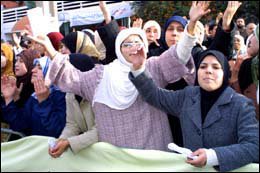
    Palestinian gunmen from the al-Aqsa Martyrs Brigades snatched a German national from his hotel lobby. The German national, 21 year old human rights activist Christopher Kasten, was released shortly afterwards. Demonstrations and flag burnings have taken place in many countries. More are planned. Morocco's Islamic associations will stage a sit-in to deplore the "blasphemous" cartoons.

    In Gaza City, more than 50 Palestinian gunmen stormed the European Union office Thursday and said they were closing it down "until further notice" to protest against the cartoons. At the same time, militants, from the al-Aqsa Martyrs Brigades and the Islamic Jihad, said "We give the three governments (Denmark, Norway and France) a 48-hour ultimatum to officially apologize to Muslims, and if not, every citizen of these three countries would be a target for our fire."

    In Damascus, about 300 Syrians staged a sit-in in front of the Danish embassy in Damascus. The protesters carried banners calling for the boycott of Danish products unless Denmark issued an official apology for the cartoons.

    In Pakistan, Muslims announced plans for natiowide demonstrations for Friday. Publication of the cartoons "is an insult to the entire Muslim Ummah and we must boycott the Danish government politically and economically," said Liaqat Baloch, a central leader of the religio-political party Muttahida Majlis-e-Ammal.

    Diplomatic reaction also took place with several Muslim countries have recalled their ambassadors in outcry of the cartoons. The Norwegian Foreign Ministry said it had closed its consulate on the West Bank for public visits because of the threats, and was considering evacuating staff.

    In Morocco a demonstration will be held on Friday afternoon before the Parliament building in Rabat. Morocco also banned the distribution of the Wednesday edition of the French daily, France Soir, which republished insulting cartoons.

    Meanwhile the editor of the France Soir has been fired for republishing the offensive cartoons of the Prophet.

    "We express our regrets to the Muslim community and all people who were shocked by the publication of the cartoons," Egyptian-born Raymond Lakah, the paper's owner, said. He decided to "remove Jacques Lefranc as managing director of the publication as a powerful sign of respect for the intimate beliefs and convictions of every individual."

    Earlier this week, the Moroccan Supreme Council of Ulemas condemned the publication of the satirical cartoons, deeming it a provocative act against Muslims' feelings.

    French Muslim leaders denounced in unison the reprinting of the cartoons and vowed to take the case to French courts.

    "We call on French Muslims to peacefully protest this aggression on the Prophet of Islam," the French Council for the Muslim Religion (CFCM) said in a statement after a meeting chaired by its head Dalil Boubackeur.

    Boubakeur's call was echoed by Lhaj Thami Breze, the head of the Union of French Islamic Organizations (UOIF), who blasted the provocative and unnecessary publication.

    The Muslim world's two main political bodies, the Organization of the Islamic Conference (OIC) and the Arab League, said they were seeking a UN resolution, backed by possible sanctions, to protect religions in response to the furore.

    Within the Islamic world opinion is divided on only one issue - how to describe the offence that has been caused. Many authorities and commentators have used the word "blasphemy" while others have been more circumspect. And if you thought this was a strictly northern hemisphere event then think again. Imams from as far away from the epicentre weighed in pronouncing that the cartoons were not "blasphemous" and did not require some sort of fatwah - but they were extremely offensive.

    BUT WHAT ABOUT FREE SPEECH?

    What is possibly difficult for the Islamic world to understand is that in the west it is not seen as offensive to make religious figures the subject of ridicule. Religious people may find depictions of Jesus or Buddha, tasteless but very few would condemn their publication. Cartoons in Jewish publications often hold extreme religious teachers in contempt and again, while some might object, it would not cause a major furore.

    Many in the west will see the Islamic reaction as further proof of extremism and simply add it to their arsenal of examples with which to underline their disdain for all things Islamic. This is tragic at a time when the Islamic world is desperately in need of bridges to the non-Islamic world, and not further barricades.


    Another question underlying this debate is a global one. Is their such a thing as a universal sensibility? Is it even desirable? Are all human rights universal? Yet these are not the questions being asked. Free speech is being trumpeted without concern for the consequences. It is pertinent to ask how the Europeans would react to cartoons that ridiculed the Jewish Holocaust

    Despite the anger in the Islamic world, the general tone in Europe is unrepentant. For example, the German government said it won't apologize for German newspapers reprinting controversial cartoons.

    "Why should the government apologize for an act of press freedom?" Interior Minister Wolfgang Schaeuble asked in an interview with daily Die Welt, one of several German papers that reprinted cartoons. "If the government interferes with that, then that's the first step to restrict the freedom of the press."

    On the other side, the Vice-Chairman of the Central Council of Muslims in Germany, Muhhamad Amman Hobin, says he believes in press freedom but certain borders shouldn't be overstepped.

    "Well I hope that it will not lead to an outburst of violence, as it did for instance in the case of Salman Rushdie's book on the Satanic Verses. But I certainly assure that any Muslim who sees these images will feel deeply hurt and deeply disturbed, and will definitely come to the conclusion that this was done on purpose, it was done not to defend the freedom of the press but to spite the Muslims. This is the feelings that the Muslims will have."

    Korsh Becschneider from the Dutch Daily de Volkskrant says his paper also published the cartoons to show readers what the debate was about, but he says it's important for editors to stand together.

    "I think it is important. Like today France Soir also published all the cartoons and published also a cartoon of itself. And the more papers do publish these cartoons, I think the harder it becomes for the critics who act against these papers."

    Roger Koppel from Die Welt he says it's now a matter of freedom of speech.

    "Of course there is one of the core values of how our culture is at stake here. We, in the West, we even subject religious topics to satire and criticism that this is a very important value for us and that we should point it out when we think it's threatened.

    Deputy Editor of France Soir Arnaud Levi: "I understand the argument, but the issue here is how do you conciliate as respect such is due to personal beliefs, to religious beliefs on one hand, and on the other hand seek absolute respect that is due to the freedom of the press. And I think everybody would agree that if exceptions and limits have to be put to freedom of the press and freedom of expression, they have to be of a very restrictive interpretation, and I'm sorry to say that I understand that religious belief might forbid representation of Hemet or Allah or even the human being, but it does not apply to the non-believers."

    In Norway, the chief editor of Norwegian Christian weekly Magazinet, Vebjorn Selbekka, that recently published the caricatures said that he regretted the publication - but not because it offended Moslems.

    "Of course I regret that we have subjected Norwegian citizens to threats, as well as my self and my family. On the other hand, I don't regret exercising my constitutionally protected freedom of speech."

    But this principle was targeted by Egyptian leader Mubarak, who was quoted Thursday as saying that freedom of speech must not be used as an excuse to insult religious beliefs.

    Mubarak cautioned against the escalation of a what was being seen as a campaign against the Prophet of Islam. A Mubarak spokesman, Sulaiman Awad, said Mubarak stressed that the campaign "will have dire repercussions by stoking the sentiments of the Islamic World and Muslim communities in Europe and elsewhere."

    The European claim to the right to publish virtually anything in the name of free speech is simplistic. With all freedoms comes responsibility. Knowing in advance that the publication would cause offence and yet still going ahead and doing so, is not just irresponsible, it is provocative.

    And as a final thought that maybe puts things in perspective. Here is what Ramzy Baroud said in Egypt’s English-language Al-Ahram Weekly.

    "It is discouraging that the collective energy of the Muslim world is consumed punishing a small European country over a drawing, while US military bases infest the heart of the Arab world."

  • GO TO OUR UPDATE: Mohammed Cartoon Crisis Escalates

  • Link to our earlier coverage: The right to caricature God?

  • Link to an interesting Danish site offering both sides of the debate freedomofspeech.dk - An open discussion site and information source regarding freedom of speech as it applies to the current situation after the Danish newspaper Jyllandsposten published carciatures of the Islamic prophet Mohammed (pbuh)


  • Tags:

    Wednesday, February 01, 2006

    Global Voices Moroccan Blog Round Up.

    Yes, football again dominated the Moroccan blogs - hopefully the saddness of Morocco's loss will fade away soon. Afterall, it is only a game, isn't it?

    More important ( and interesting) was the debate about Islam generated by foulla on her wonderful Refusenik blog, where she states:

    ...and as long as those religious persons don’t target their misguided followers with the fervor and the rage they expend on outside critics, the mistake of associating Islam with savage practices will continue.

    Here is the link to the Global Voices site: Weekly Blog round up

    Tags:

    Dar Seffarine, Dar Bennis, Riad Fès and riads to rent in Fez.


    In the last few weeks we have been inundated with emails from people wanting more information about riads and dars to rent in the medina of Fez. While we try and answer every email request as fast as possible, you can take a look at the dars and riads yourself on Helen Ranger's site. We recommend her site because when you make a reservation through her, Helen donates two percent of your accommodation costs to finance micro-projects in a private capacity. In other words, your stay automatically contributes towards the preservation of the Medina.

    It should be noted that The View from Fez has no financial interest in any of these properties and only recommends them because we have inspected them ourselves and find them to be not only wonderful places to stay, but great examples of Moroccan cultural heritage.

  • Link: Fez Riads

  • Tags:

    Moroccan News Briefs - #19

    Moroccan News Briefs published in The View From Fez draw on open source material, contributions from readers, as well as material from Maghreb Arabe Presse (MAP), Morocco Times and official Moroccan Government press releases.

  • The right to caricature God?


  • The fallout from the Danish cartoons scandal shows no sign of abating. Now the French press have weighed in with the claim they have the right to publish what they want. On Wednesday, France Soir newspaper published the Danish cartoons which depict the prophet Mohammed (PBUH), Under the title “Yes, we have the right to caricature God”, the French daily put on its front page the depiction of Prophet Mohammed angry and sitting on a cloud with Buddha, and a Jewish and a Christian God. The caricature shows the Christian God saying “don't complain, Mohammed, we have all been caricatured here.”

    While the Danish paper, which ignited the Arab world's anger, has apologized for causing the “not intended offence” to Muslims, the French daily said it had published the cartoons to show that "religious dogma" had no place in a secular society.

    "The publication of the 12 cartoons in the Danish press has shocked the Muslim world for whom the representation of Allah and his prophet is banned," the newspaper said. "But because no religious dogma can impose its view on a democratic and secular society, France Soir publishes the incriminated cartoons," said the paper.

    France Soir has even gone further. According to the BBC, the paper published an accompanying commentary in which the editor, Serge Faubert, affirmed “I would never apologise for the decision to publish.”

    “Enough lessons from these reactionary bigots!” wrote Faubert.

    "There is nothing in these incriminated cartoons that intends to be racist or denigrate any community as such. Some are funny, others less so. That's it. That is why we have decided to publish them," he added.

    Unlike the Danish attitude, the French editor firmly added "No, we will never apologise for being free to speak, to think and to believe."

    Last Monday, France affirmed its opposition to the principle of boycotting called for by Arab countries against Denmark and Norway, following their publishing of the blasphemous cartoons.

    “We traditionally oppose the boycott principle,” said Denis Simonneau, a deputy spokesperson at the Ministry of Foreign Affairs.

    The French reaction came just after some Danish Muslim groups tried to calm down Arab's anger.

    The Danish government, which declared it would not punish the paper which published the offensive drawings, was subjected to an avalanche of criticism. Boycotts of Danish goods by Muslims took place all over the world.

    Arla Foods, Europe's largest dairy group which is headquartered in Denmark, said it was losing 10 million kroner (£916,000) a day because of the boycott. The world's biggest maker of insulin, Novo Nordisk, has also been hit after pharmacies and hospitals in Saudi Arabia refused to offer its products.

    Seeing that Denmark's position in the crisis threatens the country's interest, the editor-in-chief of Jyllands-Posten apologised on Monday for publishing the satirical caricatures.

    In a statement to "The Honorable Fellow Citizens of the Muslim World", the editor-in-chief, Carsten Juste, said the cartoons "were not in violation of Danish law but they have undoubtedly offended many Muslims, for which we would like to apologize".

    The Danish Premier, Anders Fogh Rasmussen, said earlier that he can not intervene in the newspapers' choice of what they print, but soon changed his position saying: “I personally have such a respect for people's religious feelings that I would not have depicted Mohammed, Jesus or other religious figures in such a manner that would offend other people."

    France, publishing a drawing of Prophet Mohammed's turban as a bomb with a lit fuse and another in which he turns suicide bombers away from heaven saying “we have run out of virgins”, stirred the same burning anger that was more or less quenched by the Danish apologies.

    Paris, known for its strict separation of church and state, has already been subjected to similar protests.

    The European country, where five million Muslims live, issued in 2004 a law that prohibited the wearing of Muslim headscarves, Jewish skullcaps and prominent Christian crosses in secular state schools.

    Muslims all over the world organised demonstrations to condemn the French decision. Mass protests swept 25 countries and declared an international day against the hijab ban.

    The slogans of protestors read “My hijab is my right and my freedom. It gives me the freedom to do what I want.

    In Morocco, the Higher Council of Ulema reacted angrily to the smearing cartoons, saying that they "disparaged the feelings of Muslims, and averted them from their objective of establishing concord, peace and rapprochement values" according to a communiqué of the Council.

    The document, published on Tuesday, says the denunciation of the Council came after consideration of the "intended and non-intended harm included in the cartoons, the persiflage founded on wrong conceptions, and the fallacious association of the person of the noble prophet with despicable deeds that are diametrically opposed to what this prophet preached."

    The Council, a mouthpiece of the local councils of Ulema and of the institutions of Ulema in Morocco, also condemned "the use of the freedom of speech to launch an assault against hundreds of millions of Muslims," who reject the humiliation of any prophet, from Adam to Muhammad, including Moses and Jesus.

    The Council exhorted wise people and decision makers around the world to stay united to champion freedom and the ethical values against irresponsibility and hatred.

    The communiqué underlined that Muslim scholars, who are working in an increasingly tense international environment, find that their task is getting harder to fulfil because of the repeated acts of disrespect towards their sanctities, on top of which is their noble prophet Muhammad (PBUH).

    The higher council, which is presided over by king Mohammed VI, is comprised of 15 members, heads of the thirty regional councils of Ulema, the minister of Islamic affairs, and a secretary general.


  • King Lunches Chefchaoun Projects

  • On Wednesday King Mohammed VI launched the construction of a sports center and the rehabilitation of a large mosque in the northern town of Chefchaoun. The sports center, to cost USD 1.4 million, is designed to promote sports and cultural activities in the town. The latter hosts annually, since 1965, a national festival of poetry, a plastic arts exhibition and a national festival for Andalusian music. The project, to be completed in 12 months, includes a sports stadium, a room for exhibitions and health and administrative facilities.

    The king also launched the rehabilitation of a large mosque that was built in 1471 (969 Hegira). He was briefed afterwards about the rehabilitation of the town’s main square, extending on a 12,800 m2 area.

  • Spanish Visit "Deplorable"

  • Tuesday's visit of the head of the Spanish government, Jose Luis Rodriguez Zapatero to the Spanish-occupied Moroccan northern cities of Sebta and Mellilia is "inappropriate" and "deplorable."

    The statement was made by Morocco's Minister of Communication, Spokesman of the Government, Nabil Benabdellah, who said "it is a visit that we deem inappropriate and that changes nothing in the nature of the problem," adding that "we can only deplore such a move."

    For its part, the Moroccan press was unanimous in condemming the visit as “inappropriate”, claiming that it does not serve the interests of either Morocco and Spain.

    Liberation, mouthpiece of the Moroccan socialist party (USFP) called Spain’s socialists to “consolidate their civilizing dialog policy with their southern neighbors, including Morocco.”

    Al Istiqlal (independence) party daily L’Opinion described the visit as “regrettable,” “inappropriate,” “provocative” and “prejudicial to the feelings of Moroccans.”

  • Swiss Foundation donates funds

  • Two Moroccan associations are to receive funds to pay for their social and job generating projects from the Swiss "Smiling Children Foundation," which has organized, to this end, lately a fund-raising gala in the Swiss city of Geneva.The Casablanca-based "l'Heure Joyeuse" association will get some of the money for its project "Heure Propre" (clean hour) that collects, sorts out and treats industrial waste.

    The project is in a first stage to open a company to reuse printer cartridges that will help create 50 jobs, and in a second stage enlarge the activities of the company to processing other industrial waste.

    The Swiss foundation is also giving some of the money to the "INSAF" association that is running a project to sponsor girl maids to help them get out of the work circle, re-integrate them in their families and enable them to go to school.

    Moroccan ambassador to Switzerland, Mohamed Guedira, said in a message to the gala, the action of "Smiling Children" is contributing to the efforts of the Moroccan civil society to narrow the economic and social disparities that the National Initiative for Human Development (INDH), initiated by King Mohammed VI last May, to fight poverty and exclusion in the north African kingdom, targets to eradicate.

    The gala featured French-Moroccan comedian Jamal Debouz, who, according to organizers, through "his generosity," helped the Swiss foundation reach the goals it set to support the projects in Morocco.

    The foundation mulls launching another project in the Imine Tanout region, some 100 km south of Marrakech, in an olive tree plantation likely to help the youth of the region get jobs. Debouz asked the Ora-Bto designer to make a bottle for the olive oil to be produced in the plantation.

    "Smiling Children" was set up 14 months ago in the wake of the December 2004 Asian Tsunami to help children schooling and create job generating enterprises for impoverished young people.

    It is a non-profit foundation based in Switzerland. Its principal objective is to support or create projects generating employment for human beings in great material, environmental and/or emotional difficulty (refugees, homeless children, orphans, single mothers...), reads the web site of the foundation.

    The foundation's aim is to help those distressed groups of people to support themselves without outside aid. Smiling Children aims at accompanying these people up until the point when they will be of sufficient autonomy to be the sole provider of their physical and social needs.

  • Canadian doctors are volunteering

  • A group of Canadian cardiologists will visit Morocco in March to perform fifty operations on children suffering from cardiac deformities.

    Speaking at a press conference, held Tuesday at Sainte-Justine hospital in Montreal, organizers said a Sainte-Justine hospital team, including twenty medical and paramedical staff, will visit Morocco twice a year.

    This humanitarian mission is part of a cooperation entente signed in March 2005 between the Sainte-Justine hospital, Bonnes Oeuvres du Coeur of Casablanca and Quebec's NGO "Mobilisation Enfants du Monde" (MEM).

    The agreement aims to develop a close cooperation between the Moroccan and Canadian cardiology programs and to support the training of Moroccan medical staff.

    The Moroccan-Canadian partnership will also include training of Moroccan staff in the Canadian hospital, a program of videoconference training and sending materials from Sainte-Justine hospital and its Canadian partners to Morocco.

    Some 300,000 children suffer from cardiac deformities in Morocco. Their health condition requires an expensive treatment that is too expensive for the majority of families. To address this situation ,the “Bonnes Oeuvres du Cœur” association created a clinic that treats impoverished young patients suffering from cardiac deformities in Casablanca.

    Although the Canadian doctors are volunteering for this work, the costs associated to the mission will reach nearly USD 55,000. Mobilisation Enfants du Monde will raise the money to fund this project.

    Tags: