Saturday, July 06, 2013

Fez Amazigh Festival Opens With A Stunning Concert


The Fez Festival of Amazigh Culture is at its 9th Edition and this year has the theme:"Amazigh and Andalusia". The first night of the festival was a triumph, with a concert that rocked Bab Al Makina and a crowd of around 1500. The View from Fez reports...


From the moment the men and women from the small village of Kalaat Mgouna came on stage, the crowd was entranced. The intricate dance moves  of the Ahidous Kalaat Mgouna were performed with consumate ease and when they left the stage after only two songs, the crowd was howling for more.

Najat Aatabou enjoying every minute! 

But the woman the crowd had come to see was Najat Aatabou.

Aatabou took to the stage like a Moroccan Tina Turner, shimmying, striding, twirling and mesmerising the audience who knew every word of every song and joined in with gusto. Her band were superb, laying down solid beats, augmenting her performance without upstaging her.

As a pioneer Moroccan folk artist who appeared in the 1980s, Najat Aatabou's fame transcends the boundaries of her country. Foreign and Moroccan artists use her work, the most important of which are her songs Hadi kedba baina,  Choufi Ghirou and J'en ai marre.

Hedi Kedba Bayna is about a woman whose husband is cheating on her. The title literally means "This lie is obvious" and was sampled by the Chemical Brothers on their song Galvanize. Choufi Ghirou, is about women who are in a relationship with married men, while in Morocco it is illegal to have such a relationship. Yet, despite the moral tone the song was delivered with a sensuality that is rarely seen in Morocco. The crowd lapped it up.


Her songs have evoked social and political discussion in Morocco and improved a lot in the area of feminism. Talking with Moroccan women in the audience, it is obvious that the discussion is on-going. 'She is our heroine,' one woman said. 'She says the things that we can't say.'

Young fans capturing every moment on video

In her own words: 'Through my artistic work, I chose to adopt the path of defending women in all respects... . My artistic works contributed in encouraging some women to break the barrier of the forbidden. Thus, they have the opportunity to express their opinions freely. I am delighted when they tell me that I helped them to achieve that.'

Last night at the Bab Al Makina Najat Aatabou did all of that and had the crowd on their feet dancing and applauding. As visiting internationally acclaimed festival director Bill Hauritz said, 'It was a world class act in an astounding venue!' - it was a triumph.

The Amazigh Festival continues until Sunday.

Photographs and story: Sandy McCutcheon


BAB MAKINA TONIGHT
21 :30 - 23 :30 - Groupe Kwasser (Maroc)
- Fatima Raissi Tihihit Banou

July 7th
PALAIS DES CONGRES
Congrès Mondial sur “Amazighité et Andalousie »
9 :00 - 13 :30 -TRAVAUX DU CONGRES ET DEBATS
-ATELIER DE L'ALPHABET TIFINAGH
- LECTURE DE POESIE

JARDIN LALLA MERYEM
19 :00 - 21 :00 - FLAMINGO (Espagne) : Fès-Andalousie
- Najmat Rif (Maroc)

BAB MAKINA
21 :30 - 23 :30 -Ahidous Tahla
- ABDELAZIZ STATI (Maroc)

SHARE THIS!
Print Friendly and PDF

Friday, July 05, 2013

Atlas Lions on the Come-back Trail?


The Barbary lion (Panthera leo leo), also known as the Atlas lion is a subspecies of lion that became extinct in the wild in the 20th century. Its former habitat range was in North Africa encompassing the region from Morocco to Egypt. And over the last few years there have been growing calls for the reintroduction of the Babrary lion to the wild in Morocco.

What makes this extraordinary is that there are many scientists who believe the lion is extinct. Yet others claim there are 90 lions alive in zoos including 35 in Rabat.


The Moroccan Ministry of Water and Forests had raised the matter in 2000, with the growing awareness of the danger threatening this species.

The reintroduction of the Atlas lions in their natural sphere is deemed a long-term project that would necessitate both significant human and financial efforts to achieve it.

The former popularity of the Barbary Lion as a zoo animal provides the only hope to ever see it again in the wild in North Africa. Many zoos provide mating programmes, which will help to increase the population of the species.


After years of research into the science of the Barbary Lion and stories of surviving examples, WildLink International, in collaboration with Oxford University, launched their ambitious International Barbary Lion Project.

Oxford used the very latest DNA techniques to identify the DNA 'fingerprint' of the Barbary Lion subspecies. Researchers took bone samples from remains of Barbary Lions in museums across Europe. These samples were returned to Oxford University where the science team extracted the DNA sequence which identified the Barbary as a separate subspecies.

Although the Barbary may be extinct, and is certainly extinct in the wild, WildLink International looked to identify a handful of lions in captivity around the world that may be descended from the original Barbary Lion. These descendants were to be tested against the DNA fingerprint and the degree of any hybridization (from crossbreeding) can then be determined. The best candidates were to then enter a selective breeding programme slated to 'breed back' the Barbary Lion. The final phase of the project intended to see the lions released into a National Park in the Atlas Mountains of Morocco.

As of March 2010, two alleged barbary lion cubs have been moved to 'The Texas Zoo' in Victoria, Texas where efforts are being made to preserve the endangered species under the WildLink International conservation programme

In Morocco a protected area of 10,000 hectares has allegedly been defined in a sparsely populated area in order to build this ambitious project.

As recently as last week La Vie Eco was writing that "Moroccan civil society has been mobilized recently in support of the kingdom’s mountain lions". There is reportedly an internet a petition circulating calling for the reintroduction of the atlas lions to their natural environment, which proponents say is Morocco’s Atlas mountains.

The main sources of natural prey for the predators of the Atlas Mountains were Barbary Stag and gazelle. Another particular favorite, and somewhat easier target, were the herds of cows and sheep kept by man. The method of hunting was never documented, but it is believed that they used the same death by strangulation method as do the other big cats of the world.


SHARE THIS!
Print Friendly and PDF

Creative Director for the Jardin Majorelle in Marrakech ~ Stephen di Renza


Stephen di Renza is a man described as having "feline chic". While that may be true, there is a lot more to the man who has just been appointed Creative Director of one of Marrakech's main attractions - the Jardin Majorelle.

Stephen di Renza in Fez

Like most New York intellectuals of his generation, Stephen di Renza studied Derrida and Lyotard as well as Warhol and the punk bands playing at Max’s Kansas City. After a B.A. in film study at NYU, the Philadelphia-born di Renza started out as a photo stylist for Interview magazine, did a stint as an industrial designer, and acted as fashion director for Neiman Marcus and Bergdorf Goodman.

In Paris he made his name as the Artistic Director for Dunhill where his style was described as "chic by subtraction". In Dunhill's Heritage Store di Renza mixed vintage pieces, modern re-editions and contemporary art.

Stephen in Paris   Photo : Vincent Lappartient

A long sojourn in Paris was followed by a move to Fez and the creation of Riad 9 and Resto 7.

Last year Di Renza met entrepreneur Pierre Bergé. "I really respect the people behind the Jardin Majorelle," Stephen says. The respect was obviously mutual and he clearly left a favourable impression with Bergé, who revived the fortunes of the Jardin Majorelle with his late partner Yves St Laurent. Recently di Renza received the job offer as Creative Director of what is one of the top attractions in Marrakech.

For a man with Stephen's considerable talents, it is, as he describes it. "a dream role". "I'm going to be creating all new products made in Morocco," he told The View from Fez. "I'm looking to combine modern Morocco with international savoir faire."

The Majorelle Garden

Majorelle is a twelve-acre botanical garden and artist's landscape garden in Marrakech. It was designed by the expatriate French artist Jacques Majorelle in the 1920s and 1930s, during the colonial period when Morocco was a protectorate of France.

Majorelle Gardens - photo: Suzanna Clarke

Majorelle was the son of the Art Nouveau ébéniste of Nancy, Louis Majorelle. Though Majorelle's gentlemanly Orientalist watercolors are largely forgotten today (many are preserved in the villa's collection), the two and a half acre garden he created is his creative masterpiece. The special shade of bold cobalt blue which he used extensively in the garden and its buildings is named after him, bleu Majorelle — Majorelle Blue.

The garden hosts more than 15 bird species that are endemic to North Africa. It has many fountains, and a notable collection of cacti. It has been open to the public since 1947. Since 1980 the garden has been owned by the late Yves Saint-Laurent and his partner, Pierre Bergé.

After Yves Saint Laurent died in 2008 his ashes were scattered in the Majorelle Garden.

The garden also houses the Islamic Art Museum of Marrakech, whose collection includes North African textiles from Saint-Laurent's personal collection as well as ceramics, jewelry, and paintings by Majorelle.

SHARE THIS!
Print Friendly and PDF

Wednesday, July 03, 2013

Out of the Ruins - The Rise and Rise of The Ruined Garden in Fez

The Ruined Garden café and restaurant in Fez is now open and in a very short space of time the beautiful garden setting has become a favourite haunt for locals and visitors alike.  During the recent Fes Festival they were providing fine food, refreshing drinks and an air of tranquility for up to 90 visitors a day. The View from Fez caught up with the force behind the venture, the affable renaissance man, Robert Johnstone.


Back in September 2010 when Robert Johnstone first saw the space beside Riad Idrissy it was not a pretty sight. In his words, what he saw was "a rubbish dump". Yet, with remarkable foresight, he and his business partner, John Twomey, knew there was something to be uncovered.

"As soon as I saw it cleared," Robert recalls, "I could see the bones of the place. There were 12 broken columns, so we bought 12 big pots to put on them to give a sense of formality."

Formality it might have had, but Robert and John still had no clear vision of what the ruin might become. "Originally John and I didn’t have the idea to make a restaurant; only to offer private dining. The idea was to make the space as beautiful as possible".


The Ruined Garden project brought together all Robert's skills.

"I had always been a gardener, and I trained as a designer at Manchester Metropolitan University doing a degree in 3D design. When I finished my studies, I was given funding by the Craft Council to set up in business in Manchester. I did that for four years, making table top sculptures in resin. During that time I also worked at a French restaurant called Beaujolais. I was the greedy waiter. One day a chef was ill and they asked me to step in, because I was the one who had the most interest in the plates. It was a natural progression because my mother was a chef, so good food and dining was something we always did as a family".

After chefing in Manchester, Robert decided he needed some “front of house” polish, so he moved to London and started working at J.Sheekey – a fish restaurant owned by the owners of The Ivy. When the business was sold and the owners opened The Wolseley  a café-restaurant in the grand European tradition, located in London's Piccadilly, Robert became the Reservations Manager.

 “I wasn’t running things. There were 140 staff and I was the man who said 'yes', or 'no' - very politely.” He worked there for seven years.

Mike Richardson and Robert met as students in Manchester, and have remained friends. And it was at The Ivy  that he and Mike became friends with a regular client,  John Twomey, owner of the popular Ten Bells pub in Spitalfields. This was the point at which all the cast in the drama came together. Richardson would leave to start the now famous Café Clock in Fez and Twomey and Johnstone set out to purchase and develop Riad Idrissy.


When Robert started work on The Ruined Garden he was confronted with a number of challenges, not all of them bureaucratic. On the horticultural front the immediate questions were: how do you get soil here? How do you find a plant that will do well here?

It took a while to visualize the garden. "Garden centres here in Fez are supplied by garden centres in Rabat, so there is only a narrow palate. So I grew a lot from seed; lovage, rue, tomatoes", Robert says. "We are on the edge of hardiness for what I want to grow and the thing that’s different about this climate is that it feels like Spring, but it takes a long while for the nights to warm up".

Najia Elamrani in the outdoor kitchen

The secret treasure behind the cuisine on offer at the Ruined Garden is Najia Elamrani.  Once she was the housekeeper for the riad's former owners but now she works with Robert creating the dishes for the restaurant. "Although most Moroccan women can cook, we are very lucky to find someone who was prepared to be innovative," Robert says. "We have a good relationship. She will make something and ask me, is this good? What should we change?"

Once the garden began to take shape, Robert started running private dinners, but as he explains, "I always wanted to do a café that served Moroccan street food. We’ve adapted that, such as with the “popcorn macoudas”.

popcorn macoudas

There is no cultural preciousness about the food, Robert says. "For example our salada tafya - caramelized onion, apricot, cinnamon and chickpeas - we serve as a starter or with the lamb mechoui."

And then there is the Ruined Garden's extraordinary refreshing take on the bagel -  svenge with smoked salmon and an egg. "I always wanted a smoker, and when we were developing the chimney it seemed like a good opportunity to make one. I noticed (at the place that made the svenge) that sometimes people asked for them to be half-cooked, and wanted to know why. It’s because they take them home and put an egg in them. I  always liked the idea of salmon, carbohydrate, eggs and things".

1,900 year old recipe - Chicken Volubilis - with fresh figs and Moroccan salads
Super-tasty sardines and Moroccan salads

But is it "Moroccan food"? Robert is quick to respond, "We are offering Modern Moroccan food – same ingredients, different treatment".

As the popularity of The Ruined Garden grew, so did the need to have an outdoor kitchen. During the last Fes Festival they opened the 50 seat capacity restaurant and gave the new kitchen a test run. It worked superbly. "It’s been really nice since we’ve opened the restaurant. People staying in the riad want to be in this space. I don’t guide people in any way, but people tend to come down to where there’s a bit of life".

There are also a number of discrete spaces in the garden where those wanting privacy for intimate conversation can relax amidst the beautiful surroundings. Apart from the occasional strolling oud player there is (thankfully) no background music being played.

Just the place for an intimate conversation
 "The Festival was great and the Nights in the Medina were extraordinary. It was as though people were sucked in". But Robert is quick to point out that "that’s only three days a year it will ever be like that. So anything we have ever learned will have been forgotten by next year".

The View from Fez does not believe that for a moment!

Details: 
Open to the public every day except Wednesday from 12 PM to 9.30 PM.
Closed during August.
More info: 
The Ruined Garden
Riad Idrissy 

Text: Sandy McCutcheon
Photographs: Suzanna Clarke

SHARE THIS!
Print Friendly and PDF

AiR Sidi Ali - Artists Respond ~ Exhibition Opening in Fez


Every year, in the week following the Prophet's birthday up to 50 thousand Moroccans descend on a small mountain village of Sidi Ali near Meknes. An exhibition at the French Institute in Fez presents the responses of photographers and artists to experiencing the mousem

Sidi Ali

The pilgrimage or mousem is traditionally an Hamadcha Sufi event but now includes ritual events from a number of groups, most notably the Gnawa and Jilala. These groups work with spirits, helping those who are possessed by saints or spirits to develop and reinforce their lasting relationship, leading to blessings, health, money, or the removal of specific symptoms.

People rent houses and hire groups to host ritual events, and the town is loud, full of these musical activities day in and out. Simultaneously, each group can be hired to take sacrifices down the hill, progressing to either the tomb of Sidi Ali Bin Hamdush (for the Hamadsha) or Lalla Aisha's cave. Pop music blares, competing with these (popular) ritual sounds, and the entire place is inundated with energy.

For the first time this year a number of artists and photographers visited the mousem and this exhibition shows their response to activities in the town. The exhibition, AiR Sidi Ali - Artists Respond, opened this week at the French Institute in Fez.

Rene Kladzyk, Jess Stephens and Vanessa Bonnin

Artists involved in the project included Vanessa Bonnin who had four fine photographs on display. Jess Stephens from Culture Vultures responded to the event with a series of adornments inspired by the rituals and music-based ceremonies at the Moussem.

The other artists include Hollis Bennett, a photographer from Texas, whose work focuses on small groups of people. "He shows their individual intricacies and how they fit into society by standing apart," says Jess.

Rene Kladzyk, a multidisciplinary artist based in Brooklyn, New York, gave a solo performance, CROWNWORC, using sound and movement. It was inspired by the practices of possession and trance at the mousem.

A video installation by Fez based contemporary dancer, Camelia Hakim, calls on her research into Gnaoua ceremonies.

Musicians from Sidi Ali share a joke with Jess Stephens

The exhibition runs until August 31 at the French Institute Gallery in the Ville Nouvelle. For more information: Click here

The Fez Hamadcha 

See a two-part description of the Hamadcha Mousem at Sidi Ali : 
Part One           Part Two 

:
SHARE THIS!
Print Friendly and PDF

Tuesday, July 02, 2013

Ramadan Time Change in Morocco - at a cost of 260 Million Dirhams!


Daylight saving to stop ... and then start again

The wonderfully named "Ministry of Public Modernisation" in Morocco has just confirmed what everyone suspected - Ramadan can not handle daylight saving. Yes, once again during the month of Ramadan Morocco returns to GMT. The Ministry announced today that from from July 7 to August 10 the time will shift back an hour.

This is despite advice that the transition to summer time would have saved 90 megawatts per day and about 262 million dirhams, or consumption of a city like Meknes .


So, from July 7, make a note to turn you clocks and watches back 60 minutes from 3 am. (Just to be clear, 3 am will become 2am!).

It is also important to check your airline flights as several times in the past people have missed flights because either they or the airline was not up to speed on the proclamations from the Ministry of Modernisation.


This strange avoidance of daylight saving during Ramadan was measure, introduced in Morocco in June 2008, after two failed attempts in 1985 and 1989. Daylight saving aims to make energy savings and reduce the time difference between Morocco and its economic partners, mainly European - but somehow the experts have failed to find a way of working within Ramadan! Hopefully someone will figure it out.

SHARE THIS!
Print Friendly and PDF

The Punk Poetess and Other Sparkling Sacred Music at the Fes Festival


The 2013 Fes Festival of World Sacred Music has come and gone and already people are booking accommodation for next year (June 13 - 21, 2014). The feedback about the 2013 festival has been overwhelmingly positive with many regular festival goers rating it as one of the best ever. Peter Culshaw reflects on the festival
Patti Smith - photo: Suzanna Clarke

“The boy looked at Johnny – he was surrounded by white and blue tiles, in the medina.” Patti Smith was improvising on her classic album Horses in her first, compelling, gig in Morocco. Smith has a history of Moroccan connections: she knew the Tangier-based writer Paul Bowles and plugged into that pre-punk Beat generation, but there were some raised eyebrows as to what exactly she was doing at a “sacred” music festival. “Birdsong is sacred,” she said when challenged on this, surrounded by the twitter of birds at the open courtyard of the Riad Sheherazade where she gave her press conference the day before. "And so is Jimi Hendrix.”

Perhaps it would have been better to ask, What is not sacred music? Certainly most of the music of the Festival was more obviously from a spiritual tradition. Now in its 19th year, it was set up after the first Gulf War as a way to bring differing religious paths together. As an event in a Muslim country it remains a beacon of tolerance and creativity (and an inspiring contrast to the Salafists whose black flags were in the last year taking over Mali and banning music).


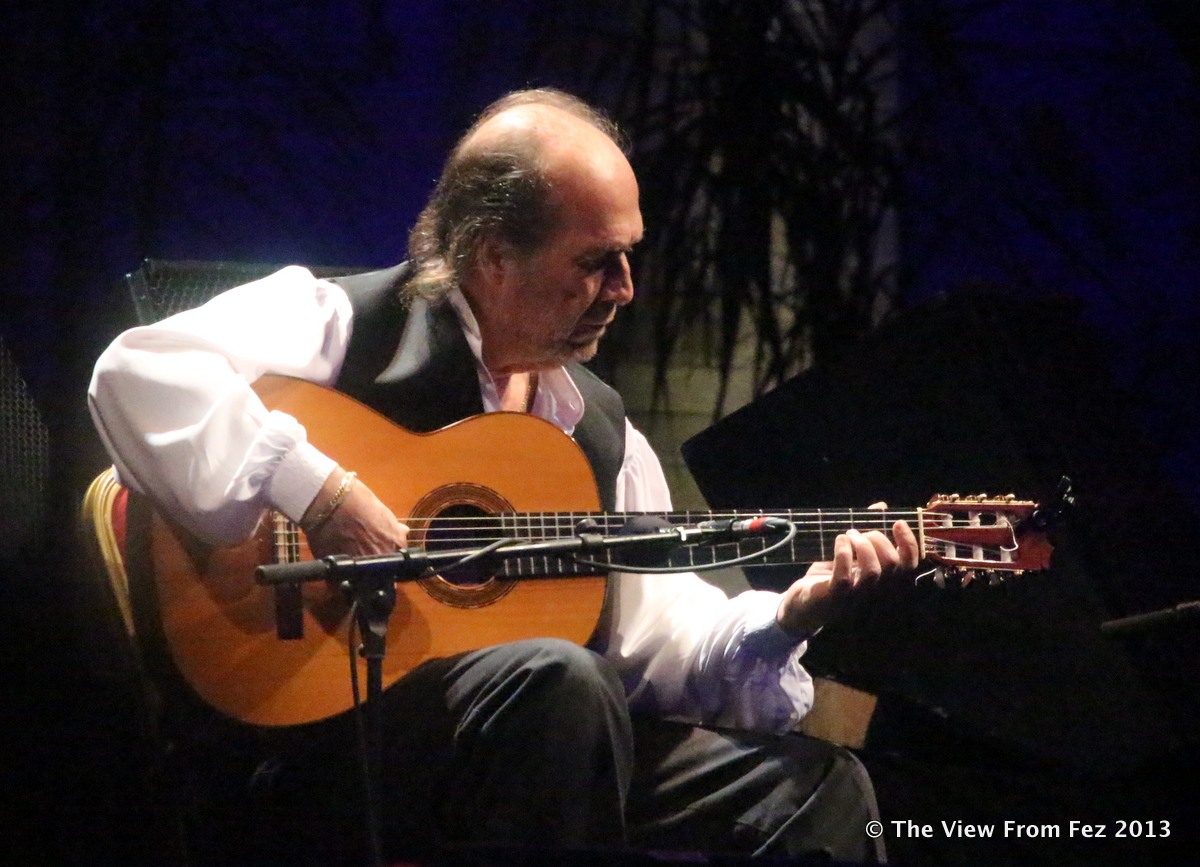
Paco de Lucia plugs back into flamenco roots and the fire and passion is back

But the reason Fes has established itself is that it's not just a powerful symbol in one of the Muslim world’s most sacred cities, with exchanges and discussions at the morning Fes Forum in what some have called “a spiritual Davos”, but a world-class music festival.

There were established international stars like guitarist Paco de Lucia, who in his advancing years really gives the impression that he is a total master of his instrument. Virtuosity is secondary to intellect and emotion. Just when things were threatening to get overly jazzy and cerebral, he plugs back into flamenco roots, and the fire and passion is back.

Abeer Nehme - photo: Sandy McCutcheon

More exciting for a music explorer are the gems you would never have come across without Fes. Outstanding this year was Abeer Nehme (pictured above) and her group, who sang Aramaic music from around the fourth century. A Christian living near Beirut, she has lived through conflict (her father was in the army and lost his leg), and she had the courage to tour Iraq in 2008; her voice has a transcendent purity. The Lebanese woman next to me said, “Finally, we have someone who could be on the level of Fairuz." Compliments don’t get much greater.

It was extraordinary how her music seemed to cut through the centuries of layers built up over Christianity, the Victorians and puritans in particular. Singing in the language of Jesus, it was powerful enough that you even got some impression of the sweetness and compassion of early Christianity. It was also sufficient for me to start looking up Antioch, the Maronites, and the early Syrian Church, which sent me off on a historical adventure.

An experiment in transporting an Upper Egypt Sufi ceremony from the village of Deir was also intoxicating – the new thing was to take a film of the village complete with kids and dogs running around under bright lightbulbs in a dusty square, and show it behind the musicians in the confines of the elegant Musée Batha under the famous Barbary Oak tree (somehow that tree with its enfolding branches seems to embody the spirit of the Festival).

Upper Nile Village under the Barbary Oak - photo Sandy McCutcheon

There were curious fringe events, like the film Looking For Muhyiddin, by film-maker Nacer Khemir which took place at 11pm outdoors at Borj Sud on the coldest June night anyone could recall. Two hours in we were wrapped in the carpets, provided for sitting on, to keep warm. The film showed the director criss-crossing countries with his red wheely suitcase meeting people who would shed light on his spiritual guide Muhyiddin (better known as Ibn Arabi) in Oxford, Italy, New York, Damascus and elsewhere. A paradox about this film, with its evocatively shot locations, was that while it was partly about transcending the ego, it was it some ways enormously self-indulgent.

Amongst several talks, the most intriguing and entertainingly delivered was Princeton professor Michael Barry’s look at how Matisse, who spent considerable time in Morocco, was influenced by Islamic painting and the Muslim world. Over mint tea at his hotel the day after, Barry, who had lost friends to the Taliban in Afghanistan, said that one of the outrageous things about the modern discourse on Islam was how the extremists had managed to brand themselves orthodox, whereas the more tolerant forms of Islam seen in places like Morocco, and abundantly represented in Fes for centuries were the true tradition of Islam.

A discussion ensued of a psychological nature – a modern dialectic being that psychotics such as the Islamists have a certainty which gives them strength, while the opposition tend to be neurotics who take a nuanced, less monomaniacal view of the world. It is often these off-agenda meetings and connections, which nearly everyone I spoke to had, that have a ripple-effect in conversations and projects which develop after the Festival ends.

Assala Nasri - photo Suzanna Clarke

Probably the biggest star of the Festival was the Syrian singer Assala Nasri, the closest thing to a real pop star in the Festival. An opponent of the regime in Syria, she filled the 6,000 or so seats in the grand Bab Maqina beyond capacity. The numbers seemed to be in general up this year, and evening concerts at the Musée Batha were also jammed for acts like the life-affirming energy of Algeria’s El Gusto and the more doleful modern fado of Portugal’s Ana Moura.

The director Faouzi Skali and artistic director Alain Weber pulled off a vintage event, full of sparkling music and adventurous programming – from Bhutan folk to Indian classical musicians jamming with baroque musicians to eccentric semi- classical versions of Leonard Cohen and Tom Waits by Rosemary Standley and Dom La Nena as part of the more intimate Nights In the Medina series in the gorgeous Dar Adiyel palace.

Rosemary Standley and Dom La Nena

One collaboration which didn’t entirely come off was the Ladysmith Chicago Gospel Experience; while the presence of feisty young Californian beatboxer Butterscotch was a bold attempt to drag gospel into the 21st century, her beats were banal compared to the rich complexity on offer elsewhere and I suspect showing off is not a particularly sacred attribute. Patti Smith, in that sense, on the last night was more spiritual – if you mean a connection to a larger energy, genuine communion with an audience and a certain damaged, compassionate humility.

Peter Culshaw's book on Manu Chao is published by Serpent's Tail
Follow Peter Culshaw on Twitter

SHARE THIS!
Print Friendly and PDF

Maroc Telecom Launches Amazigh Voicemail

Up until this week Moroccan operator Maroc Telecom has offered voicemail in Arabic and French. Now the company has announced that customers can now choose to interact with their voicemail and messages in the Amazigh language.  


In its announcement Morocco Telecom said its move reflects the linguistic diversity of the Kingdom, and will improve access to new information technologies and communication. The operator has been selling handsets adapted for Amazigh since February 2011.

At the same time the Moroccan government has said it will adopt a participatory approach to the development of the law on the formalisation of the Amazigh (Berber) language.

Speaking in Rabat at the opening session of a national conference organised by the Royal Institute of Amazigh Culture (IRCAM) on the "formalisation of Tamazight in Moroccan Constitution: what strategies and measures?"  the head of government, Abdelilah Benkirane stressed that the government program has highlighted the issue of formalising the Amazigh language and defines the methods to include the language in the education system and public life.

Abdelilah Benkirane

He added that the 2011 Constitution is a landmark in the consecration of Amazigh, part of the common heritage of all Moroccans, as an official language of the country, stressing that the formalisation of the Amazigh language is culmination of a process initiated since the royal speech of Ajdir in October 2001 brought a new vision about the Moroccan identity.

Abdellatif Manouni, adviser to His Majesty the King has emphasised the importance of this conference will lead to positive results to help define the next steps for the implementation of the constitutional provisions the formalisation of the Amazigh language.


For his part, the president of the IRCAM, Ahmed Boukous, noted the deep meaning of the formalisation of the Amazigh language, adding that the new constitution marked a turning point in the future of the language in Morocco.

Note: The Fez Festival of Amazigh Culture begins July 5th

SHARE THIS!
Print Friendly and PDF

The Moroccan Kaftan - Timeless Fashion


One of the most searched for terms on The View from Fez is the word "kaftan". While fashions come and go with increasing rapidity, there is something so alluring about kaftans that makes them timeless. Youssef Sourgo, writing for Morocco World News, waxes lyrical as he explores the reasons for the Kaftan's popularity


What could be the point in common between Mariah Carey, Hilary Clinton, Asala Nasri, Haifaa Wahbi, Elizabeth Taylor, Diana Haddad and Jennifer Lopez? The answer is that all of these international female celebrities were enchanted by the majestic beauty of the Moroccan attire, the Kaftan.

Syrian super-star Asala Nasri

Alongside all the aforementioned names, innumerable female celebrities from all corners of the world have found a perfect match to their sublimity in the Moroccan Kaftan. Thanks to faithful, taste-refined Moroccan women abroad, who have been ambassadors of the Moroccan elaborate apparel, the Kaftan’s magic has found its path to women’s hearts worldwide.

HH Princess Lalla Salma (centre) 

HH Princess Lalla Salma has also had an unquestionable share in rendering Kaftan every woman’s aspiration abroad. Princess Lala Salma, topping the list of Moroccan female ambassadors of Kaftan, has always elegantly stood out of the crowd, dressed in refined Kaftan designs on a myriad of important ceremonies abroad, ranging from the crowning of a royal figure to an international conference on women’s rights.

It is no coincidence that the traditional Moroccan Kaftan continues to appeal to leading female figures in the world, even to those who have a sophisticated sense of fashion and modernity. The intricate attire, with its dazzling colors, composite designs and refined tissues easily espoused modern trends of fashion, thus astounding both fans of modernity and tradition in clothing.

Who could believe that Beyonce, Mariah Carey and Jennifer Lopez, American’s international diva singers, who have for so long been engrossed in Western trends of fashion, would wind up falling in love with a traditional attire from the other sphere of the earth?

Who could believe that the most beautiful representative stars of the Arab world, the likes of Asala Nasri, Cherine, Ahlam and Diana Hadad would be attracted to the Moroccan attire while their cultures have their own distinctive traditional attires?

Credit has to be given ultimately to the tremendous efforts put into practice by Moroccan traditional designers. Kaftan’s current universal appeal will always be indebted to the professionalism and dedication of thousands of professional, traditional Moroccan designers. Kaftan’s early life kicked off in their romantic, humble shops, where handmade divinities were created.

Amazigh style kaftans

Credit has to be given, also, to all Moroccan women who have favored Kaftan over the myriad of fashion trades sweeping the world every second. Their persistence to keep the Kaftan an attire worn on most significant ceremonies, such marriages, festives and celebrations has kept the Kaftan in the spotlight.

SHARE THIS!
Print Friendly and PDF