Showing posts with label A House in Fez. Show all posts

Thursday, December 26, 2013

Writers' Workshop in March in Morocco


Writer Christina Ammon

From March 10 to 17, American writer and adventurer Christina Ammon will be co-hosting Deep Travel, a writers' workshop in Moulay Idriss and Fez. Here Christina shares her initial experiences of Morocco 

I’ll be the first to say it: I’m an unlikely tour guide.

When I stepped off the ferry in Tangier in December of 2011, I didn’t even want to be in Morocco. How strange: Who wouldn’t jump to experience the Arabian Nights ambiance of Marrakech, to survey the infinite Sahara from atop a camel, and to indulge in savoury lamb tagines?

But as I lugged my suitcase off the boat onto the terminal platform, and looked across the Strait of Gibraltar toward Spain, I felt the pang of exile. I hadn’t arrived on my own terms. My EU visa had expired in Spain and Morocco was the nearest route to an exit stamp. My boyfriend would stay behind to repair our broken camper van. I would go it alone.

As I wandered Tangier’s cobbled medina, it wasn’t the touts and catcalls that bothered me, but the pure, simple fact of loneliness.

Christina at the location of A House in Fez
 I hid in a plush chair at El Minzah, once the watering hole of writers William Burroughs, and lost myself in the book, A House in Fez by Suzanna Clarke. While a jazz pianist played into the evening, I followed Clarke through her struggles to restore the crumbling walls and tile work of her riad in a country foreign to her. By the end of the book, Clarke felt like a friend.

Eventually I ventured back onto Tangier’s streets. What to do? I sat atop a camel and donned a fez for a photograph. I stroked Berber rugs and made faux friendships with guides. I was grateful to a kind waiter who made small chitchat and kindly carried my too-hot glass of mint tea two city blocks to my hotel every evening.

When word came from Spain that the truck was still not fixed, I moved on to Fez. There I sat alone in the cold center room of my hotel-riad and realized: I’d seen pretty mosques, studied zellij fountains, sampled dozens of different olives, but I hadn’t really had a real human connection in two weeks.

This was not the sort of travel that appealed to me.

And so I did something bold: sent an email Suzanna Clarke. I was surprised to get a quick response: An invite to dinner! That evening, over beef kefta I think they sensed my dislocation. When I arrived back to my riad and checked my email, there was an invite for me to stay with them.

I accepted and the next day they situated me in one of the rooms I’d read about in her book. I woke in the morning to sun slanting through the decorative wrought-iron window and a fruit tree so close it seemed I could nearly pluck an orange from bed. Together we wrote through the mornings over cups of spiced coffee, and in the evenings drank Moroccan mint cocktails while their cat purred by the heater. Day after day, I got word that the truck was still not repaired, but it was okay now. I was now wearing babouche slippers and a djellaba and dancing the time away with my new friends.

I ventured into the medina with newfound confidence. Fez’ harrowing network of 9,000 byways seemed less forbidding now, each turn now offering a story. Soon, I was penning articles for Conde Nast, The San Francisco Chronicle and The Oregonian, trying to capture all my discoveries—a charismatic local photographer, a winemaker, a big-hearted donkey veterinarian, a man passionate about the restoration of the medina, and a man who made the most magical spiced coffee.

Workshop hosts Erin Byrne and Christina Ammon

That first visit to Morocco was at the time a strange type of suffering, but ultimately about discovery. I’m happy to return to Morocco on entirely different terms—not to flee an expired visa and a broken-down truck, but to lead a workshop and a tour. This journey will be a special one, a potent one-week distillation of the gems it took me months to find.

Christina Ammon's Deep Travel writers' workshop, co-hosted with writer Erin Byrne and poet Anna Elkins, aims to share the best of what Morocco has to offer in the way of chefs, authors, photographers, and even winemakers in Fez and in Morocco’s most sacred city, Moulay Idriss. Other contributors include writer and photographer Suzanna Clarke, writer Sandy McCutcheon and photographer Omar Chennafi. 

To learn more about the workshop, which runs from March 10 -17, visit: 
http://www.e-byrne.com/workshop.html

SHARE THIS!
Print Friendly and PDF

Saturday, May 18, 2013

The Majlis Trio in Fez


France's Majlis Trio hold their first Moroccan concert at Riad Zany
Thibaut Rocheron (percussion) Léo Fabre-Cartier (oud) and Aline Haelberg (violin) 
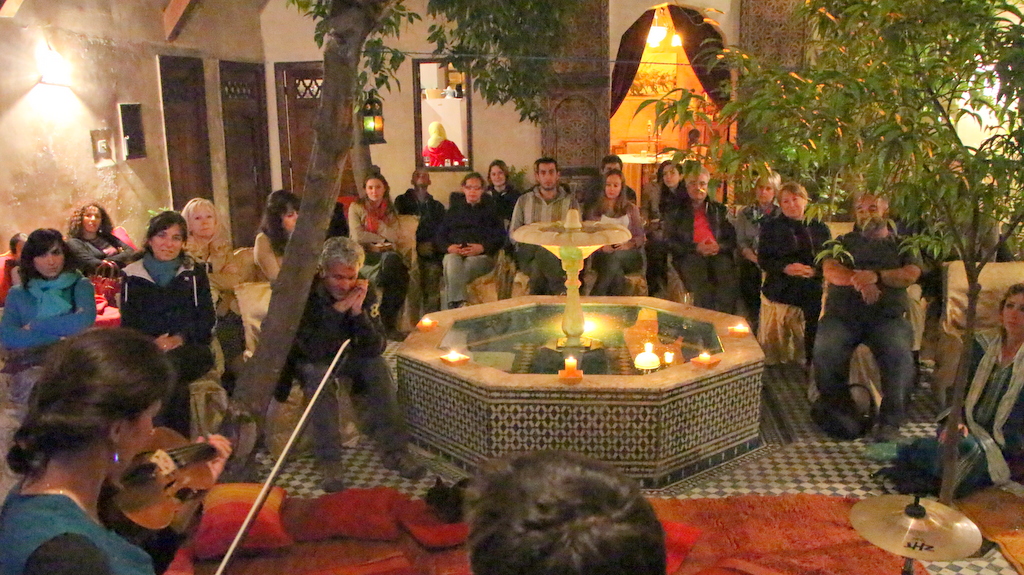
Friday night in Fez saw a large crowd turn up to Riad Zany for another concert. This time it was the premier performance in Morocco of the Majlis Trio. Rain had been threatened, but thankfully the night remained pleasantly warm and dry.

Provide the music and Moroccans will dance!

The rich repertoire of traditional oriental music from Turkey, Greece, Syria, Egypt, Azerbaïdjan and Arab-Andalusian music from the Maghreb was enthusiastically received by both Moroccans and visitors from France, Australia, America, Poland and The Gambia. It was also pleasing to see several on the ball guest house owners bringing their clients for the evening.

As promised the music was accessible and enthralling with splendid performances by all three musicians. A good sound balance and the near perfect acoustics of the riad ensured that even the most subtle grace notes were crystal clear and not lost beneath the percussion.

Seated on chairs, carpets and cushions, the fifty or so visitors were treated to mint tea and an array of chocolate confections and cakes. As an Australian visitor put it, "To witness such fine music in such a beautiful setting was the highlight of my overseas holiday".  Polish members of the audience had brought along Polish translations of A House in Fez, for Riad Zany's owner, Suzanna Clarke to sign.

A section of the audience enjoying the concert


If you missed the concert, the popularity of the trio is such that a second concert will be held at Fez Cafe on Sunday (May19) with an entry fee of 30 dirhams per person.

Reservation for dining is essential
Le Jardin des Biehn
13 Akbat Sbaa Douh
30110 - Fez Medina - Morocco
Port: 00212 (0) 664647679
mail: contact@jardindesbiehn.com

SHARE THIS!
Print Friendly and PDF

Monday, February 25, 2013

The art of living in the Fez Medina - A Public Talk


Join Suzanna Clarke, author of A House in Fez, as she shares her experiences of living in and exploring the Fez Medina – where art, design, architecture, music and ceremony are an integral part of everyday life.
Suzanna has amusing stories to share about her experience of renovating a 300 year old house, as well as offering insights into the history and culture of this rich and vibrant city through words and photographs.

When: Tuesday February 26 at 6.15 PM
Where: ALIF Residence, 28 rue Mohamed Diouri, Ville Nouvelle, Fez.
(Opposite the American Language Center. Ask the security guards.) 


SHARE THIS!
Print Friendly and PDF

Tuesday, July 17, 2012

So, You Want to Restore a House in Fez?

Christina Ammon is a travel writer who recently spent several months in Fez. In a fine article written for Oregonlive, Christina explores the often complex issue of restoration in the Fez Medina. We republish an excerpt, with permission.

photo: Christina Ammon

Restoration in Fez, Morocco, is a balancing act


The 1,200-year-old Medina in Fez, Morocco, may be car-free -- but taking in its exotic sights while hopscotching around donkey droppings is the pedestrian equivalent of distracted driving. I'm overwhelmed: drawn toward a pyramid of bright lemons, repelled by a heap of steamed snails; enamoured of silver teapots, then shocked to come face to face with a severed camel head hooked on a butcher's booth.

I'm on my way to meet David Amster. Although the American expat directs Fez's Arabic Language School, his passion for "old things" puts him squarely amid recent efforts to restore the Medina.

Fès-el-Bali ("Old Fès") was declared a UNESCO world heritage site in 1981. It's easy to see why: Among its 9,500 alleyways are stunning mosques, the world's oldest university and lively souks, or markets. Fès-el-Bali is considered the best-preserved medieval city in the Arab world, the cultural equivalent of an old-growth forest.

But the centuries are taking a toll. As I tread the uneven cobblestone toward Amster's house, I note the ageing physical structure of the Medina. Shop doors are askew. Hand-chiseled tiles called zellij are faded and chipped. Old wooden beams collect the dust of ages. But while in some places the wear and tear adds to the aesthetic, in other places it's precarious: Ceilings bow, and walls fissure. Some structures look downright dangerous and, in fact, are. Houses in the Medina regularly collapse, resulting in fatalities.

More often than not, local residents lack the money to make major repairs. Fortunately, the U.S. Millennium Challenge Corporation and the Moroccan government, working with the local agency ADER-Fès, are helping fund the preservation of the Medina. On a smaller scale, foreigners are restoring riads (traditional houses with courtyards), often turning them into hotels or -- as in Amster's case -- private residences.

But as the overhauls proceed, restorationists confront an important question: How do you usher a medieval town into the 21st century without turning it into a museum for tourists?

I pass a rose water seller, hop a puddle and press against a wall to let a donkey pass before finally arriving at Amster's 250-year-old riad. Inside is the most glorious bachelor pad I've ever seen.

From his courtyard, we gaze up to an open three-tiered structure. Daylight pours through the open roof, highlighting wrought-iron railings and embossed wooden door frames. What the house lacks in basic amenities (like a working kitchen), it makes up in small wonders. A stone wash basin sculpted from a Roman column sits upended on the floor, and a collection of old wooden doors leans against a wall. There are a mortar and pestle, a Sufi money box, an old butter churn and a stone carved toilet seat in the corner.

"I'd offer you a drink," Amster says after our tour. But true to bachelor form, there's nothing in the fridge except a stack of antique textiles. "Keeps the moths off," he explains.

Before we set off to his favorite cafe, I point to a deep fissure over the door. "Not all cracks are evil," he explains. Vertical cracks are stable, whereas horizontal cracks are prone to buckling.

Amster is a purist when it comes to restoration and believes in doing just enough to stabilise the structures and little more. He sees beauty in the Medina's time-ripened walls: the deep stratas of peeling plaster and paint, the weather stains of rainstorms and the crystals that form when lime seeps through and collects on the facade. In Amster's view, a scuff mark left by an overloaded donkey rounding a corner too sharply or a worn-out zellij step in front of a mosque is not a blemish. It's heritage worth preserving. Not everyone agrees.

"In some ways the preservation of the old is an elitist concern," he concedes as we walk toward the cafe. The average Medina housewife would happily swap out her zellij countertop for easy-to-clean tiles and modern accoutrements. Better still, she'd prefer having enough money to move out of the dark Medina to the wide, bright streets of the surrounding Ville Nouvelle, or New City. "Moroccans generally don't think of old and worn as cool," Amster notes.

Read the full article here: Restoration in the Fez Medina

Christina recommends further reading: For a glimpse into Moroccan culture and into challenges and rewards of restoring a Medina riad, A House in Fez by Suzanna Clarke is an enjoyable, fun and rewarding read.


SHARE THIS!

Thursday, July 05, 2012

Latest Additions to ALC Bookshop in Fez

The American Language Center bookshop in the Ville Nouvelle is situated at 2 Ave Ahmed Hiba, (just ask the taxi driver for the "American Centre"). While the shop has text books for the students at the Arabic Language Institute, and carries a range of dictionaries and some books for the Moroccan students learning English, the range of other books is impressive.


There are some handsome photographic books on Moroccan architecture and design,as well as wonderful cookbooks. The shop focuses on books about Morocco such as Edith Wharton's In Morocco, Fatima Mernissi's Dreams of Trespass, Peter Mayne's A Year in Marrakech, Paul Bowles' The Sheltering Sky and some of his short stories, and has some non-fiction by writers such as Fatima Sadiqi. Books written in English by Arab writers are also represented. Thankfully, with the expansion of titles, there is now a Paul (and Jane) Bowles section. There is also an interesting selection of modern fiction that will make perfect reading during the hot weeks ahead.

LATEST ADDITIONS

Ahmad al-Mansur: The Beginnings of Modern Morocco
Author: Mercedes Garcia-Arenal
Publisher: Oneworld
Price: 330 dhs

Sultan Ahmad al-Mansur (1578-1603) was one of the most important rulers in the history of Morocco, which to this day bears the mark of his twenty-five year rule in the sixteenth century. Though famed for his cunning diplomacy in the power struggle over the Mediterranean, and his allegiance with Britain against Spain in the conquest for the newly discovered Americas, he was more than a political and military tactician. A descendent of the Prophet Muhammad himself, al-Mansur was a charismatic religious authority with ambitions to become Caliph and ruler of all Muslims. Spanning four continents, Dr. Garcia-Arenal places this fascinating figure in a context of political intrigue, discovery and military conquest. With insightful analysis, a glossary and a guide to further reading, this book is the ideal introduction to a multifaceted figure that fully deserves the epithet “Maker of the Muslim World”.


 The Arab Spring
Author: Toby Manhire
Publisher: The Guardian
Price: 125 dhs

Spontaneous, unforeseen and contagious, the uprisings of the Arab Spring took everyone – participants included – by surprise. Like revolutions in other times and places, they seemed impossible beforehand and inevitable afterwards. The Guardian has been running, often breathlessly, to follow the story and to explain it ever since. This is a tale of many chapters, told by the journalists, bloggers and citizens who have lived through this incredible time.


The Moroccan Soul: French Education, Colonial Ethnology, and Muslim Resistance, 1912-1956
Author: Spencer D. Segalla
Publisher: Nebraska
Price: 330 dhs

Before French conquest, education played an important role in Moroccan society as a means of cultural reproduction and as a form of cultural capital that defined a person’s social position. Primarily religious and legal in character, the Moroccan educational system did not pursue European educational ideals. Following the French conquest of Morocco, however, the French established a network of colonial schools for Moroccan Muslims designed to further the agendas of the conquerors. The Moroccan Soul examines the history of the French education system in colonial Morocco, the development of French conceptions about the “Moroccan Soul,” and the effect of these ideas on pedagogy, policy making, and politics. Spencer D. Segalla also reveals how the resistance of the colonized shaped the ideas and policies of the school system and how French ideas and policies shaped the strategies and discourse of anticolonial resistance.


Unveiling Traditions: Postcolonial Islam in a Polycentric World
Author: Anouar Majid
Publisher: Duke University Press
Price: 210 dhs

In Unveiling Traditions Anouar Majid issues a challenge to the West to reimagine Islam as a progressive world culture and a participant in the building of a multicultural and more egalitarian world civilization. From within the highly secularized space it inhabits, a space endemically suspicious of religion, the West must find a way, writes Majid, to embrace Islamic societies as partners in building a more inclusive and culturally diverse global community.
“An important book. Coming from a different intellectual perspective, Majid qualifies and expands the ordinary terms of postcolonial discourse and he does so from a genuinely international intellectual position. There are few academics writing today who draw on the cultural and literary range that Majid does here.”—Leila N. Ahmed, author of Women and Gender in Islam.


SHARE THIS!

Thursday, July 07, 2011

The English Language Bookshop - new summer treats


The American Language Center bookshop in the Ville Nouvelle is situated at 2 Ave Ahmed Hiba, (just ask the taxi driver for the "American Centre). In the early weeks the stock was very limited. Thankfully that has all changed. While the shop has text books for the students at the Arabic Language Institute, and carries a range of dictionaries and some books for the Moroccan students learning English, there is now much more.

There are some handsome photographic books on Moroccan architecture and design,as well as wonderful cookbooks. The shop focuses on books about Morocco such as Edith Wharton's In Morocco, Fatima Mernissi's Dreams of Trespass, Peter Mayne's A Year in Marrakech, Paul Bowles' The Sheltering Sky and some of his short stories, and has some non-fiction by writers such as Fatima Sadiqi. Books written in English by Arab writers are also represented. Thankfully, with the expansion of titles, there is now a Paul (and Jane) Bowles section.

There was no modern fiction when the bookshop first opened. That too has changed and we discovered a good selection that will make perfect reading during the hot summer ahead.

Our approach is to have a wide selection of interesting titles, and to have new books coming in on a regular basis ~ David Amster, ALC Director

The bookshop's original policy of having only one copy of each book was simply bad retailing and has now been changed so that there are several copies of the most popular titles such as Tahir Shah's The Caliph's House", and Suzanna Clarke's A House in Fez.

So, next time you are after a good book, this bookshop will certainly have plenty to offer.


Monday, January 11, 2010

A House in Fez ~ Korean edition now available!


After months of waiting, a fabulous translation of Suzanna Clarke's worldwide bestseller "A House in Fez" is now out in a new edition ~ in Korean.

The book, which has been published in several editions in the UK, USA , Australia and New Zealand, is continuing to be a must-read book for those interested in Morocco, Islamic architecture and every day life in the Fez Medina.

There have been a large number of requests for a French and German translation, but so far a translator and publisher remains to be found.

A House in Fez has had a marked inpact on visitor numbers to the Medina, with many guest house owners reporting their clients have read the book. Hopefully now there will be an influx of Koreans!


Sadly, a lot of us do not read Korean with any great fluency, so, if you would like to purchase the English language edition, go here: A House in Fez


Tuesday, August 04, 2009

Fez tops 50 "Best Romantic Getaways".


Now at The View from Fez we are always sceptical about lists that rank tourist destinations, but we had a moment of pleasure when we saw the prestigious Travel & Leisure top 50. Not only Fez at the top - but Fred Sola from Riad Laaroussa must be a very happy man... as you will see.


50 Best Romantic Getaways

1 of 51
"50 Best Romantic Getaways"
Riad Laaroussa

Fez, Morocco

Desert Escape Though often overshadowed by Marrakesh, its fashionable neighbor to the south, this medieval city is the real soul of Morocco. And with new boutique hotels opening in restored riads and dars, Fez is quietly coming into its own. Housed in a 17th-century palace, Riad Laaroussa(doubles from $194, including breakfast) has seven suites with mosaic floors and antique Fassi furniture, all looking out on an orange-tree–shaded courtyard. At Dar Roumana (doubles from $109), a century-old manse on a hillside, you can take Moroccan cooking lessons. The restaurant at Riad Ibn Battouta (dinner for two $88) serves traditional dishes, such as lamb tagine, on a glass-roofed marble patio. Within the city’s crumbling walls, 30,000 artisans fill the streets, brandishing everything from exquisite tiles to handworked leather goods. For a traditional Berber rug, head to Coin Berbère. At the newly opened Arganza, you’ll find shelves of argan oil—derived from a native tree—which is known as “Moroccan liquid gold” for its ability to diminish dry skin and wrinkles.


Tags: blogsherpa, morocco,

Thursday, May 21, 2009

A House in Fez author back in Morocco.


Suzanna Clarke and Mustapha

Suzanna Clarke is back in Fez and the first thing she did was present a copy of her book, A House in Fez, to the man most responsible for the restoration of her riad. Mustapha worked on Riad Zany for over a year as the 'malam' in charge of all stone and brick work. In that time he and Suzanna became firm friends and so for her it was a pleasure to be able to present him with a copy of the book in which he features.


Tags: i

Thursday, December 04, 2008

Fez, Morocco Real Estate: An Ancient City Gets Attention


The online journal Nuwire investor has just written an interesting piece on Fez. The writer is Yemisrach Kifle. Photographs, Suzanna Clarke.

Many people have never heard of Fez, Morocco's fourth largest city after Casablanca, Rabat, and Marrakesh. The medieval town attracts discerning travellers who come looking for a cultural experience found nowhere else. Most tourists revel in what they find and leave with memories of a lifetime. Some continue to be drawn to it, returning over and over, hopelessly charmed by this provocative city. Others simply stay.

"We fell in love with Fez. Walking through the narrow streets of the Medina, where there are no cars but instead donkeys and foot traffic, we felt as though we had been plunged back to the fourteenth century," said Suzanna Clarke, whose book A House in Fez: Building a Life in the Ancient Heart of Morocco details her experience of buying and restoring a 300-year-old home in the ancient medina.

The restored courtyard of the house renovated by Clarke
Restoring old properties is more than an investment for some

Fez is located in the northern part of the country. According to 2004 census, Fez's population is about a million. The city is divided in three distinct parts. Fez el Bali is the oldest section that was founded in 789. Fez Jdid is newer and is where Morocco's, once thriving, Jewish quarter is located. Ville Nouvelle was added at the beginning of the 19th century, during the French colonial days, and is now a bustling, modern commercial center. The city is a UNESCO World Heritage site and is home to Al-Karaouine University, which was founded in 859 and holds the title of the oldest higher institution in the world according to the Guinness World Book of Records.

The population of Fez el Bali, the largest and the oldest of the three Fez sections, hovers at around 300,000 and about 30,000 of those are artisans, according to Clarke. "Everywhere people are making things in tiny workshops—from leather and ironwork to embroidery and ceramics," she said. There are no cars. People use their own two feet or donkeys for transportation. "The city [of Fez] is designed on Islamic principles of social harmony, and each section of the city has its own school, hammam (bath-house), mosque, fountain and bakery."

Fez's 11th century sewer and water system still works and works well, according to Suzanna. The installation of electricity and Internet has left behind unsightly wires snaking over the city’s old walls but has brought much needed modern conveniences. Even so, they fail from time to time, as people cut and take the cables for the valuable copper inside.

Real Estate in Fez, Morocco

Real estate sales activity has declined in Fez in the last year, but prices remain stable

Over the past few years interest in Fez from international investors has increased, according to The Telegraph (U.K.). People who are tired of the high prices in Marrakesh are paying closer attention to the old Moroccan capital. There are many dilapidated palaces, dars (houses built around courtyards) and riads (houses with gardens) available for sale. Many will require extensive restoration to bring them back to their old glories.

"We decided to buy a riad in Fez to immerse ourselves in the culture in a much deeper way than is possible on a holiday and we felt we could make a contribution by preserving a historic house that might otherwise become derelict," said Suzanna Clarke.

Buying and restoring an old property in Fez may sound romantic, but it is not for the faint-hearted. It should not be taken on as short term project, it is not something that can be done from afar, and it requires an unyielding commitment and a sense of humor to retain ones sanity. After all, everyone knows old houses come with problems and it only makes sense that when a home is centuries old, numerous issues have to be resolved during renovation.

"Our house was more than 300 years old, and had last been restored in the late nineteenth century. There were some serious structural problems, such as crumbling walls and rotting beams—many of which we only uncovered after taking the plaster off," said Clarke. Collapsing homes are a big problem in the city because many houses never get the attention they need to remain standing.

Restoration can mean different things to different people. Some owners are not satisfied until they return every aspect of their Fez home back to its original state. Others can be callous, disregarding the historical nature of their new abode; however, because of Fez's World Heritage Status, there are limits to how much liberty owners can take in their renovations. "In restoring a house, I believe there needs to be respect for the historical aspects, balanced by the way it needs to function in order for people to continue to live in it. You can’t live in a museum, but neither should you impose your own fantasy on the nature of the house," said Suzanna. She and her husband decided to put in a modern kitchen and bathroom but in a style that fit the original fashion of their home.

For Suzanna and her husband, restoration meant a lot of research into construction techniques used in the area during Fez's heyday. "We were also very aware of using techniques that were associated with the local region, rather than elsewhere in Morocco," she said. "[We] sought out craftsmen and women who had the necessary level of skill to restore damaged walls, woodwork, plaster and tile work."

Putting together a team of people who understand the restoration needs and know what they are doing can be a major challenge. Sometimes, one must be willing to let things happen in their own time. "Our major problem in this department was with a recalcitrant plumber, who was constantly telling us he couldn’t show up to work as one of his relatives had died. By the end of the process, we estimated he had lost about six or seven family members. Really, he was a most unfortunate fellow," said Clarke.

Making friends with locals whenever possible is also important, and not just becuse they might be your neighbours. Their influence and knowledge can be crucial in emergencies.

"We had to bring all our materials in by donkey or porter, and we occasionally ran into problems such as one day the donkey team was 'kidnapped' by an over-zealous local official, who said we needed to pay a fine. It was the equivalent of having your car towed. Fortunately our building merchant was well connected and managed to get the caid, or mayor, to order him to release them," said Clarke.

Getting used to winning some and losing some against the complicated bureaucracy in Fez can cut down the level of frustration international owners face. For Suzanna and her husband it meant going without an electric oven and a washing machine because they were unable to install an electric supply. "To do so would have required us paying a huge amount of money to become authorized as a business, which we weren't," she explained. The officials couldn't be convinced that Clarke wasn't running a business given her desire for these appliances.

Buying real estate in Fez, Morocco


The Fez real estate market has been much slower than last year, according to Jonathan Green of Fez Restoration, a company that provides purchasing assistance, restoration help and property management services in the old medina. However, prices have remained stable instead of declining like they did in other parts of the world, according to Frederic Sola, owner of Fez Real Estate, a company specializing in Fez properties.

Buyers can expect to spend about $40,000 on unrestored small houses and upwards of $100,000 for nice three to four bedroom homes. Bigger properties that can be used for businesses such as guest houses can go for upwards of $200,000. "[For] restored [property] expect to pay 250 percent of an unrestored [property]," said Green. Most homes fall between $700 to $1000 per a square meter depending location and the current state of the property, according to Fez Real Estate.

There are no restrictions on foreigners buying real estate. "In fact, foreign investment is encouraged. However, it is important to follow the rules about bringing your money into Morocco and registering the purchase with the local authorities, or you may have problems getting your money out again," said Clarke, who also blogs about her experiences at The View from Fez.

It may surprise buyers that most homes in Fez-el-Bali are not sold with a title. Apparently officials in the ancient Medina still use an old system that has assigned scrolls to each property. On the scroll are the names of all past owners.

"The name of the new owners is recorded by an adoul, or scribe. Our scroll is about two meters long and contains hundreds of names," said Clarke. "Houses are often sold when the previous generation dies, and the proceeds are to be split between several off-springs. This can be a long and frustrating process, unless everyone is in agreement," she said. She would know. The deal for the first house Suzanna and her husband wanted to buy fell apart because they couldn't locate all 12 siblings to sign documents.

Looking ahead

"We are optimistic about the future of the real estate [market] in Fez; the city is becoming a destination for internal and external tourism, lots of governmental plans are being made to enhance tourist activities and to smooth the way for the foreign investments," said Sola who also owns Riad Laaroussa, a guest house located in the old medina. Fez may not be as popular as Marrakesh but it sure seems to have caught the attention of international buyers. Whether or not there will be a market for restored homes in this ancient medina remains to be seen.


Tags:

Saturday, November 15, 2008

A House in Fez - in New York!


First we take Manhattan! Yes, it is all happening for Fez in New York this week. Apart from the ongoing celebrations of the 1200th anniversary of the founding of the Medina of Fez, there was a very special book launch hosted by Rachid Maaninou – Director, Moroccan National Tourist Office.

This week saw the launch into the American market of Suzanna Clarke's best seller, A House in Fez. The book has had a phenomenal run of success, with the first hardback edition published by Penguin in Australia, selling out within weeks of publication. Then came the launch in the UK where the book has racked up impressive sales and continues to be on the "must read" list for travellers to Morocco. The inclusion of the book in Lonely Planet's reading lists for Fez and Morocco has further boosted the books status. A new trade paperback edition of A House in Fez has also just been released in Australia in time for Christmas sales.

L-R Kathy Sagan, editor, Suzanna Clarke, author and Louise Burke, publisher of Pocket Books, an imprint of Simon and Schuster in their offices on the Avenue of the Americas.

In the USA, Simon & Schuster bought the publishing rights and have brought out a paperback version which is expected to do particularly well. Speaking from New York to The View from Fez, Suzanna Clarke says the experience has been wonderful. Between the book signings and public appearances she says she has found the time to explore the museums and art galleries. She also spoke highly of the Simon & Schuster team for their friendly and generous hosting of her in New York. "Mind you," Clarke says, "after the streets of the Medina, being driven in a limo in New York is totally surreal ."

Suzanna after signings at Borders at Columbus Circle, New York.

At a special lunch hosted by the Moroccan National Tourist Office, invited members of the media were present including some of the USA's top travel writers; Sandra Ramani – New York Daily News, Condé Nast Traveler, John Oseid, Condé Nast Traveler, Judy Koutsky – Luxury Travel Advisor, Elite Traveler, New York Daily News, TravelAge West, Jeff Heilman – Business Traveler, Corporate Leader, CEO Tomorrow, Michelle Doucette – IgoUgo.com / Travelocity.com, Amy Cortese – New York Times, Daily News, BusinessWeek, Conde Nast Portfolio, Lisa Arcella – Black Elegance, New York Daily News, New York Post, Woman’s Day, Andrea Chambers – Modern Bride and Jenny Miller – Brilliant Magazine. Other guests included Kathy Sagan – Editor, Simon & Schuster, Chris Spring – President, Spring, O’Brien and Nora Brossard – Editorial Director, Spring, O’Brien who recently brought a group of travel writers to Morocco.


To find out more about A House in Fez, please visit the Simon & Schuster website:
For readers in Australia & New Zealand, you can order it from your local bookshop or buy online here.

Tags:

Friday, November 07, 2008

A Fez Medina Challenge.


Today a challenge for visitors to Fez!

So you have visited the Medina, wandered the souqs, seen the historical monuments and fabulous architecture - what to do now? Well, here is a small quest that could be fun. Below are three photographs taken by the well known American travel writer Ellen Clark on her recent visit to Morocco. Have a good look at them and then as you wander the streets and souqs, keep your eyes peeled. If you discover them you will be richly rewarded!

Below each photograph are some hints that may help.

Can you find this man?

Often found on the Talaa K'bira - especially on a sunny day. The man in the photograph will only be too happy to take you and show you something extraordinary. This is probably the hardest challenge of the three. So we suggest you print out the photograph and carry it with you.

Your reward:
will be to see the craft of probably the last straw mat weaver in the Medina. The mats were traditionally used on the floors of mosques but these days have been replaced with plastic ones from China. He also makes straw place-mats for dining tables. The place mats sell for only ten dirhams each.


Can you find this man?

This is the easy one! This man moves fast, is hard to pin down and can be found down a side alley off the Talaa K'bira. He is a student of French literature, speaks great English, is a wonderful conversationalist and has a real gift for making people feel at home in Fez.

Your reward: One of the best cups of coffee in the Medina

Can you find this man?


The man standing at the back of Ellen's photograph can be found in a place with a lot of people beating copper beneath a large tree. His name is Mustapha. He is mentioned in the wonderful Lonely Planet guide, "Fez Encounter".

Your reward: you will have discovered one of the great places to sip a mint tea and people watch! And for those who don't like their mint tea too sweet, Mustapha lets you add your own sugar.

The View from Fez would like to thank Ellen Clark for permission to use her photographs.


Tags:

Thursday, October 30, 2008

Motorbikes in the Fés Medina - readers respond.


Our recent story on bikes in the Medina brought a flood of emails and although we haven't the space to publish them all, we thought a couple were worth sharing.

Jenny from Marrakech says:

It would very good if Fés learns from the mistakes in Marrakech. Here the noise, pollution and danger of mopeds and bikes is a very big problem and our guests most common complaint is about nearly being run over. It would be so easy to ban them here, but nobody seems to understand what a problem it is. Fes should act now while the number of bikes is still small.

Abdulwahed from Fez says:

Most people don't realise that there have already been accidents and some people hurt by motorbikes. The local people do not like them either. The police should fine anyone who is driving a motorbike in the streets. I think pushing them is okay.

Richard from Fez says:

For some years I have been trying to convince local authorities in meetings and by letter (to the pacha, wali, prefecture etc) that the introduction of motorbikes, three-wheelers and 'hondas' will soon destroy the ambience and charm of the mcdina. None of these people have taken the slightest notice. Now, as tourism in Fes returns and wages rise and the bikes become cheaper, the médina in parts is crawling with motorbikes/mopeds.

It appears that those involved in tourism and therefore with most vested interest are those least aware of the problem: they never venture out of the VN and also have absolutely no idea of the current situation in Marrakech, where bikers have become so aggressive that both vistors and locals are starting to shun the médina entirely.

In February this year a higly-placed member of the CRT, during a private meeting with me, called the Chief of Police and asked him about the notices banning motorised vehicles that were supposedly being prepared, to be installed on each main gate of the médina. The response, in front of me, was that these notices had already been placed at Bab Boujloud and Bab el Guissa. Has anyone seen them yet? Was this police official being economic with the actuality? And,if so,why?

The fact is that there are no laws regarding the illegality of motorised vehicles in the médina and if there were, there could be no control other than the occasional acceptance of a note or two, once in a while. No Law & No Control. What to do? Perhaps finding a way to the King is now the only answer. If not somebody's child will be run over and the politicians will make a fuss & do nothing. If there are other forums they should be found, as it is ultimately Morocco which must take responsibilty for the desecration of this extraordinary city.

If another Merc gets into the streets I suggest someone takes the keys and throws them in the tannery vats.


Tags:

Saturday, July 05, 2008

Morocco - tourist numbers up 11%


Some 2.5 million tourists visited Morocco during the first five months of 2008, which represents an 11% increase compared to the same period in 2007, according to the latest figures of the National Tourism Observatory.

French tourists topped the list with 927,000, followed by Spaniards (587,000), Britons (141,000), Italians (116,000), Belgians (113,000), Germans (97,000) and the Dutch (75,000).

Despite a rise in tourist arrivals, overnight stays in rated hotels fell by 4%, standing at 6.7 million. The drop is ascribed to the uneven performance of the different tourist destinations of the kingdom.

One statistic that the figures released do not show is the upsurge in interest in Morocco being shown by Americans. A couple of years ago the figures on The View from Fez revealed a lot of UK visitors. That has now slowed down (possibly because of the damage done by lack of direct flights to Fez) and been replaced by a large upsurge in interest from America. As the chart above shows, 24% of our visitors are Americans. This has been a consistent figure for several months now and it will be interesting to see if it translates into more actual tourists.

After Suzanna Clarke's bestseller, A House in Fez, was released in Australia and New Zealand, guest house owners recorded an increase of visitors from those countries. We will be keeping an eye on the American visitor numbers after the book is released in the USA in November.

Morocco seeks to attract 10 million tourists by 2010. To this end, it has elaborated an ambitious strategy dubbed "Vision 2010". According to official figures, a total of 7.4 million tourists visited the country in 2007, with overnight stays exceeding 17 million.

Suzanna Clarke's , A House in Fez,

Tags:

Friday, May 09, 2008

A House in Fez - now available in the UK


Suzanna Clarke's best seller A House in Fez, is now available in the UK. Published in Britain by Ebury Press (Random House). The book is a paperback version of the Australian collectors' edition, which sold out in six weeks. The English edition does not have as many photographs as the Australian (Penguin) version, but nevertheless is a great insight into Moroccan culture, music, cuisine and daily life.

The American (paperback) version will come out from Simon and Schuster in New York in November, a reprint in Australia will be available in December and the Korean language version should be in print some time soon.
A House in Fez is a journey into Moroccan culture, revealing its day-to-day rhythms, its customs and festivals; its history, Islam, and Sufi rituals; the lore of djinns and spirits; the vibrant life-filled market places and the irresistible Moroccan cuisine. And above all, into the lives of the people - warm, friendly, and hospitable.

Beautifully descriptive and infused with an extraordinary sense of place, this is a compelling account of one couple's adventures in ancient Morocco. - Random House
The British edition has been "perfect partnered" on Amazon UK with Fez (Lonely Planet Encounter) by Helen Ranger and Virginia Maxwell.


Tags:

Monday, April 21, 2008

Medina Gossip #3504


Once again it is time to round up the gossip on the streets of the Fez Medina and our spies have been out and about discovering a mixed bag of offerings from blues musicians at the Clock to unrest in the Ville Nouvelle over visual pollution.

Recent visitors returning to Morocco after a break of 48 years were Henry and Meg Clarke from Mullumbimby in Australia. All those years ago architect Henry and Meg travelled in a VW bug right around Morocco - no mean feat back in those days. While in Fez Henry regaled us with tales of a Morocco long gone. One of the things that impressed him this time was the way Morocco has developed so fast and yet retained its essential character. Back on their first visit the intrepid couple had amazing adventures camping, straying too close to the Algerian border and forever trying to find petrol stations. How things have changed.
While in Morocco, Henry had need of medical attention and was happy to report that the facilities in a Fez clinic were world class as was the medical advice and care.

Henry & Meg Clarke

Thami's Closed - for the moment.

One of our favourite eating places in the Medina closed its doors this week and visitors in search of fine Fez food were concerned that Thami was off to pursue another career. Thankfully we can report that it is simply a renovation and not a closure. Thami's building permission came through and we look forward to a speedy return to business.

Tasty blues at Cafe Clock

The cultural program at Cafe Clock continues to impress and last night the offering was blues and jazz. The weather (rain) precluded use of the terrace and so the two instrumentalists and the singer moved into the downstairs salon. The acoustic here was great and our spy enjoyed a great cup of coffee to the tune of Stairway to Heaven! Keep an eye on the noticeboard at the Clock for upcoming events.


Meanwhile on a recent trip to The Majestic Restaurant one of our spies was disturbed to see the number of new advertising billboards cluttering the roadside. While there is probably a place for billboards - the area around Fez is not it, certainly not in the numbers that are now in place. On lone stretch of road our spy counted more than a dozen billboards in less than half a kilometre. They are an offensive intrusion in the cityscape and we are glad to hear that certain city officials are also very unhappy with the number around. When tourists arrive in Fez they do not expect (or want) to see the view obscured by ugly signs of globalisation. It is time to get rid of a majority of these offensive billboards!

Meanwhile... On Friday the President of Amnesty Morocco, Mohamed Sektaoui, was in Fez to report on the "significant achievements" carried out, in recent years, by Morocco with regard to human rights' protection.

"The human rights situation in Morocco has witnessed in recent years several important achievements, including the incrimination of torture and the establishment of the Equity and Reconciliation Commission," Mr. Sektaoui said at the inaugural session of AI's 6th General Assembly (Moroccan section), held in Fez under the banner "Human rights for human dignity".

These achievements, he said, also concerned the adoption of a new family code and the granting to Moroccan women the right to transmit their nationality to their children born of foreign fathers.

"Morocco, which has turned the page of past violations, must now tackle the preservation of the social, economic and cultural rights," he said.

Regarding the situation of women, the Moroccan official pointed out that the Moroccan section of Amnesty International sent a petition to the government in order to incriminate domestic violence.

The Festival of Sufi Culture continues today with Frederic Calmes appearing at the annex of the Institute Francais at 4 pm and tonight's concert at the Batha Museum features the Sufi Brotherhoods Alaouiya/Chadhiliya. It starts at 9pm.


Tags: