Showing posts with label Argan oil. Show all posts

Wednesday, January 13, 2016

Moroccan Argan Oil - The Boom Continues

Argan oil production is expected to increase significantly, however, there are threats to this growth 

With a growing number of applications for argan oil in the fields of cosmetics, medical treatments and culinary use, Morocco can expect to profit from the growth in demand. Latest figures show that 4835.5 tons were exported in 2014, and if the trend continues, this should reach 19,622.5 tons in 2022.

The argan oil boom is due to an increase in global demand due to recognition of its antioxidant, anti-inflammatory and antiseptic properties.  The cosmetics industry used 42% of the volume of argan oil exported in 2014, primarily in anti-aging treatments, skin protection or hair products.

Argan oil is also becoming more important in the food industry, where the oil is prescribed for the control of cholesterol and for people with heart disease, low metabolism or mineral deficiency. The oil is also used in the treatment of diseases such as cancer, arthritis, obesity, acne and other skin conditions.

In Asia-Pacific, the oil export is expected to increase driven by growing demand in the food sector (China, Japan, South Korea) and the medical sector. In countries like China, India and Japan with ageing of populations, there is also expected to be an increase in demand.


In Morocco argan oil is mainly produced by women's cooperatives.

The argan tree (Argania spinosa) is endemic to Morocco, where it is second in coverage only to the cork oak tree. Its deep roots are the most important stabilizing element in the arid ecosystem, providing the final barrier against the encroaching deserts. Despite its uniqueness and indispensability, the argan tree faces a variety of serious threats.

Nearly half of the argan forest disappeared during the 20th century – and average density in the remaining half dropped from 100 to less than 30 trees per hectare. This historical pressure on the forest was driven by demand for high quality charcoal, (especially important during the World Wars) and, more recently, conversion to agricultural production of export crops such as tomatoes.

While neither of these pressures on argan forest originated from locals, the important contemporary forest threats do. Particularly important among these threats are local intensification of livestock grazing and the encroachment of housing development – driven in part by recent European demand for rural real estate near popular tourist destinations such as Essaouira.

While Morocco currently has a monopoly of the world production of argan oil, there is a threat from the intensive cultivation of argan in Israel.

After 25 years of agricultural research, an Israeli company has developed Sivan Argan 100, a strain which can produce 10 times more nuts than the average of a tree in Morocco, and is also resistant to disease and bugs. Also, the Mediterranean climate of Israel has also offers favourable conditions for the cultivation of argan. "Sivan is the only company that knows how to grow and know precisely how argan oil can be produced every year," says Chaim Oren, head of the agricultural department of the company,  Shalom Life. However, currently the production of Israeli argan is limited. "You have to wait 15 years for nuts grow on Argan trees that will ultimately produce no more than two litres of oil," he says.  Sivan now sells argan oil to wholesalers. The Israeli's next goal is to sell their unique 100 Argan strain to other countries.

SHARE THIS!
Print Friendly and PDF

Tuesday, November 05, 2013

Experience the "Aroma" of Fez ~ For Only $98!


"Morocco is a land of color, culture, beauty and history. But without a doubt, it is a country of smells – smells that I fondly consider a part of my life here" - Kendra Burpee 
A tourist catches a whiff of the tannery

The old Medina of Fez has its aromas - some subtle, some not so. Ask most visitors and they will describe the pungent odour of the tanneries, or the fresh donkey droppings - not to mention anything about the cats. Kendra, who we quoted above, is a student staying in Fez as part of the International Academic Programs, University of Wisconsin Madison. She writes eloquently about the smells of the Medina.
When I step out of my front door into the labyrinth that is my city, I am forced to lunge out of the way of a herd of donkeys as they pass. They have huge bags attached to their backs and the man following them is collecting garbage in the bags. These donkeys are the garbage trucks of the old medina. The smell of their dirty bodies and the garbage is too strong for that early in the morning, but that is just the beginning. As soon as I rush by them, it’s the smell of cat pee that fills my nostrils. I swear that cats outnumber humans in this city. As I pass the spice market, I can almost taste the cumin, cardamom and ginger in my mouth.
 As I continue on, if I’m unlucky I’ll smell the rancid pigeon droppings drifting over from the leather tanneries.  I turn another corner and have to dodge the man pushing the cart of sardines. By this time my stomach starts to feel uneasy, so I hardly see the animal skins and wool hanging out on clotheslines as I speed by...
The constant lingering smell of donkey dung never leaves me as I turn and climb my way out of the winding carless roads.

The Aroma is called "Fez"


Katharine L’Heureux
For those of us who live in Fez, the earthy aromas of the city are part of everyday life - an at times heady mixture that changes so often from place to place and from season to season that to define it would seem impossible. There are smells of spices, smells of donkey poo, smells of wood smoke, and the tang of semi-cured animal skins that wafts in from the tannery.

Yet, for others the smells of Fez are completely different. Take Katharine L’Heureux. Katharine's lifelong pursuit of natural skincare that works finally culminated in a trip to Morocco where she discovered the effectiveness of pure argan oil. Founder and CEO of Kahina Giving Beauty, Katharine set out to capture the aroma of Fez. The result?
A lightweight argan oil base with 16 other oils, from watermelon and coconut to cumin and clove, to “create this more luxurious spreadable texture,” she said. It’s also the brand’s first scented product. The aroma is called Fez. Putting it on is a warm, sensory experience meant to transport the wearer to the Moroccan city, one of L’Heureux’s favorite places. “I wanted something evocative of that multilayered city that combines spirituality with all the scents of the spice market and the souk and the floral notes that happen in the spring, when the orange flower blossoms are just spilling through the streets.” 
Watermelon, coconut, cumin and clove? What no donkey? No cat? L’Heureux says “I’ve never personally been a big scent person, but I love the idea of evoking places.” Fair enough, not a big scent person. She does however have a sense of good taste - on her trips to Fez she stays at the gorgeous Riad Laaroussa and dines at Dar Roumana. And while one might question her success in capturing the authentic aromas of Fez, there is another side to her business that is to be applauded.
More and more companies are doing some form of giving back. Our brand is unique in that our mission is fully integrated with our product, connecting the consumer on an emotional level to our cause – and to our brand. Starting with giving back 25% of profits to the women who extract the oil at the heart of our line, incorporating their signatures into our package design, and naming the product line after a Berber queen, we continue to try to build a bridge between women here and the Berber women of Morocco.
Katharine continues to visit the cooperatives from which Kahina’s argan oil is sourced to ensure the fair and proper treatment of the Berber women who extract it—women whose signatures grace each package in the Kahina Giving Beauty line.

"It leaves my skin and soul feeling blessed"

"MYSTERIOUS, SENSUAL AND EXOTIC, A COMPLEX BLEND OF OILS INSPIRED BY FEZ TO REPLENISH AND RESTORE DRY SKIN"

Putting aside the orientalist language, it is a good thing that 25% of the profits are being returned to the Moroccan women. The price of 98 USD a bottle is 11 times the average daily wage of women working in the Fez Medina and a great deal more than those in rural areas.

Just as an aside, Katherine, you write that Fez was founded in 787. In fact the city was founded in 859.

SHARE THIS!
Print Friendly and PDF

Wednesday, February 06, 2013

Thirty-three Moroccan Recipes Using Argan Oil


Recently the wonderful "Green Prophet" website pointed us in the direction of a publication that features some more than thirty recipes for using argan oil. While the cosmetic industry as made inflated claims for the oil as a hair and skin product (and sold it at exorbitant prices), the flavour of argan by itself or as an additive to recipes, is not to be overlooked.

The book, The Gold of Arganeraie, contains more than thirty recipes that sound so tasty they will probably have you making a dash for the kitchen to try them out. A PDF version of the book is available for download here. The book is delightfully illustrated and contains detailed information about argan oil and the women who harvest and process it.

The book has been produced with the support of  the Slow Food Foundation and the Region of Piedmont with the aim of promoting and enhancing the activity of certain feminine cooperatives engaged in the production of argan oil in the Moroccan provinces of Agadir, Taroudant, Chtouka , Tiznit and Ait Baha.


Dates Filled With Cheese and Walnuts

Adapted from The Gold of Arganeraie

For 15 dates

15 stoned dates
30 grams walnuts, finely chopped
100 grams ricotta cheese
80 grams Roquefort cheese
1 teaspoon argan oil
salt

Preparation time: 1⁄2 hour

Mix the ricotta with the Roquefort and argan oil using a whisk. Salt to taste.
Add half the chopped walnuts and put in a pastry bag.
Fill the stoned dates with the cheese mixture and finally decorate with the remaining walnuts.


And, for our Francophone readers...

Soupe orkimen
Aisha Ibnou Al Kadi

Pour 8 personnes
4 jarrets de mouton
un demi-kilo d’épeautre
100 g de fèves sèches avec leur peau 2-3 épis de maïs
250 g de navets secs
50 g de lentilles
une olive
un verre d’huile d’argan
sel, poivre

Temps de préparation et cuisson: 6 heures, plus le trempage

La veille au soir, mettre l’épeautre dans de l’eau et le laisser tremper jusqu’au lendemain matin. Faire la même chose avec les fèves, les navets et les lentilles.

Prendre l’épeautre, le peler et le piler dans un mortier jusqu’à ce qu’il prenne pratiquement la consistance d’une farine. La filtrer dans une petite passoire et retirer les plus gros morceaux.

Mettre l’épeautre dans un plat à rôti et le laisser reposer – de préférence au soleil – jusqu’à ce qu’il soit sec. Faire bouillir les épis de maïs et enlever les grains cuits.

Prendre une casserole de grandes dimensions et y mettre la farine d’épeautre sèche, les fèves, les navets, les lentilles et le maïs à bouillir. Ajouter les quatre jarrets de mouton, le sel et le poivre. En fin de cuisson, ajouter l’huile d’argan et l’olive.

La recette d’origine dit qu’il faut cuire la soupe sur le charbon chaud pendant cinq à six heures. Autrement, on peut la faire cuire sur le poêle à bois. La soupe doit être très dense et versée bien chaude dans de grands bols.

La soupe que les Berbères de l’ethnie amazigh préparent pour la fête d’Orkimen est servie le soir du 31 décembre à toute la famille et aux amis invités. On met une olive dans la soupe: celui qui la trouve, ce soir-là, est la personne la plus chanceuse du groupe.

Great Moroccan recipes in our View From Fez Cookbook

SHARE THIS!
Print Friendly and PDF

Friday, August 31, 2012

Moroccan News Briefs #70


Free Ceuta (Sebta) and Mililla activists detained

Moroccan activist make their statement 

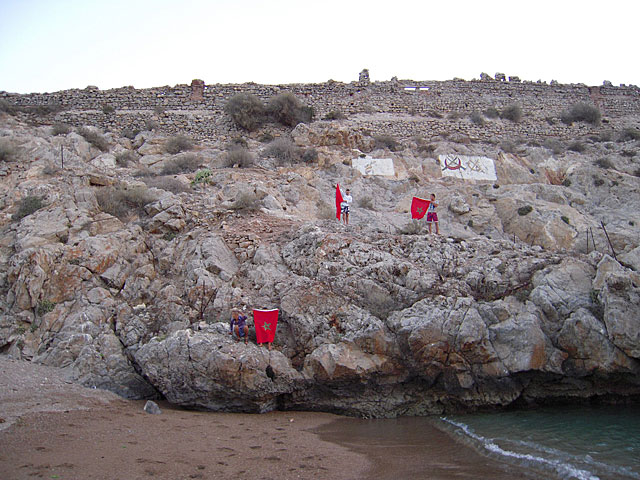
Four Moroccan activists from the Committee to Free Ceuta (Sebta) and Melilla were briefly detained at dawn on Wednesday this week after trying to occupy the Penon de Velez de la Gomera fortress off the Moroccan coast. Both Ceuta and Melilla are considered by Moroccans as their territory.

A total of seven activists reached the fortress, on a peninsula 130 kilometers west of Melilla. Arriving on foot at 6.30am, they tried to place flags from their movement. Stopped by Spanish military border police, three activists fled while the other four were questioned, identified and then released, said a Spanish enclave government delegate, El Berkani.

Committee activists have made several attempts to occupy Spanish-occupied rock fortresses recently, El Berkani said. In 2002, the landing of Moroccan troops on Spain's Perejl Island in the Strait of Gibraltar caused a diplomatic incident between the two countries.


The Casablanca tramway - nearing completion


The construction work on the first tramway in Casablanca is nearly completed with October the 15th set as the date for test driving trains in actual traffic conditions and checking all equipment. The October  date is nearly two months before the expected commissioning of the giant urban development.

Work on the railway platforms is on schedule with finishing touches underway with full completion expected on September 10.

The 22 km of overhead contact lines are in place and 15 km has already been electrified.

The control centre of the operation will initially run 37 trains, but capacity has been built into the system to accommodate 49 trains and in anticipation of new line extensions or an increase in the number of trains.

The first tramway line, which crosses the city from east to west covers a distance of 30 km, linking the main areas of the city include 48 stations and stops travelers. Each train, with a length of 65 m, can accommodate 600 passengers with 100 seats, an expected number of 250,000 travelers daily via a fleet of 37 trains.

To give a new visual identity, it is also planned the construction of two large squares - UN and Casa Voyageurs and the planting of 2,000 trees. In all, some 90 hectares of the city of Casablanca which will be fully refurbished.


"Human Rights" delegation criticised

Human rights observers held meetings with tribal leaders, peacekeepers and Moroccan officials on Monday as they wrapped up a visit to the Morocco's Western Sahara.

Their visit comes amid a row between the United Nations and Rabat, which has demanded the replacement of new UN peace envoy Christopher Ross, whom it accuses of "bias" in efforts to resolve the status of the territory.

The delegation, led by Kerry Kennedy, of the Robert F Kennedy Centre for Justice and Human Rights, and Mary Lawlor, director of rights group Front Line Defenders, held morning meetings with tribal leaders and the region's governor, an AFP reporter said.

In the afternoon, the group visited the headquarters of the UN peacekeeping mission.

On Sunday, the delegation held a closed meeting at their hotel with Sahrawi pro-independence groups, who repeated their demands to see the mandate of the peacekeeping mission extended to cover human rights. It also met pro-Moroccan groups.

However there has been widespread cynicism about the biased nature of the trip. Richard Miniter, writing for an on-line journal criticised "...chumming around with a group credibly linked to terrorists who are at war with the United States, and consorting with drug smugglers who are essentially at war with all civilized peoples."

Morocco is a frontline state in America’s war against “Al-Qaida in the Islamic Maghreb” (AQIM), a branch of the late Osama bin Laden’s terror network. This is the group that plotted to bomb the U.S. Embassy in Bamako, Mali. It schemed to kidnap drivers on the Paris-Dakar road race. It has held for ransom more than a score of Europeans.

AQIM also plots to kidnap or kill American diplomats all across North Africa. Morocco is a constitutional monarchy with an elected government, so undermining it hurts a vital U.S. ally in both the war on terror and the war on drugs.

Miniter claims that both the terrorists and the drug lords have been repeatedly linked to the Polisario Front — the same anti-Moroccan rebel group that hosted the Kennedy women.

Miniter is scathing about the visit saying "Two scions of the Kennedy clan went to Morocco and came away with a breathless tale of police brutality against separatists. The problem? The separatists represent the Polisario Front, a brutal rebel group linked to al-Qaida and drug smugglers. Their first-hand account, which was published by The Huffington Post, doesn’t mention that their radical chic tour continued to the Polisario Front’s remote Saharan camps in Southern Algeria, where the rebels used the naïve Kennedy women for all the propaganda value they could wring out of them." Read the full article here

A source within the Moroccan government, not authorized to speak on the record but with direct knowledge of the circumstances surrounding Kennedy's visit, expressed concern for the peace process. "Kennedy and her team, after asking for Moroccan assistance to organize the trip, refused to meet with anyone not supportive of the Polisario." Further, the official was adamant that the Moroccan government communicated to Kennedy and the RFK Center they were "welcome here (Morocco,) could stay as long as they want, and we are pleased to arrange meetings with Moroccans and Sahrawis with differing views than those within the Polisario."

Inquest into couple's deaths in Morocco

A joint inquest into the deaths of a couple from Worcestershire killed in separate falls while on holiday in Morocco is due to take place today. Roger and Mathilde Lamb, from Pensham near Pershore, were with their four sons in the tourist resort of Essaouira last August when they died in separate incidents.

Mrs Lamb, who was 43, is believed to have fallen from the apartment her family were staying in on August 17. She died the next day.  Mr Lamb, who was 47, died after falling from a separate building a few days later.

Mechanisation gives Argan oil a boost

A Moroccan university professor’s interest in the economic preservation of the declining Argan tree has resulted in women harvesting the tree’s valuable oil increasing their income by more than ten times.


Zoubida Charrouf (pictured above), a professor at Mohamed V. University in Morocco, initially developed an interest in the tree and its oil for conservation reasons, but has since improved the extraction of oil by establishing processing cooperatives – such as the Ajddigue and Taitmatine cooperatives – run entirely by local women. This commercialisation of Argan oil has boosted business in the cooperatives and emancipated the women by offering them a meaningful livelihood. Charrouf says that Argan Oil “should readily find a place of choice amid the most profitable oils for human health”. Celebrities as diverse as Sophie Dahl, model and writer, and Heston Blumenthal, one of Britain’s leading chefs, are fans.

The commercialisation was achieved by mechanising some of the tedious production tasks, such as grinding the nuts and pressing the oil. This sped up the operation and also improved the quality of the oil, doubled its shelf life, and reduced waste. Membership in the cooperatives now ranges from 35 to 40 women, who now earn about $8.60 a day, an increase of more than ten times from when the projects began in 1997. Argan oil is now a high value niche product on the international market, and what began as a cottage industry could now provide more employment to Moroccan women.

”At the time [the project started], we were losing more than 600 hectares of Argan forest each year,” says Charrouf. “But we also wanted to convert this ecological problem into an economic opportunity. I knocked at several doors, but no one believed in my project. Now Argan oil is known around the world.” The economic opportunity that Charrouf uncovered for Moroccan women is now being supported with grants from the Moroccan government and the European Union.

“Being part of the cooperative freed me from tedious domestic work in people’s homes,” said one member of the Taitmatine cooperative. “Now I’m learning to read and write and I’ve learned how to ensure the quality of the Argan kernels. The cooperative has made me more independent. I’ve been able to visit other cooperatives in other provinces. I’ve seen how girls and women like me have been able to shape their own destiny and move ahead to develop their cooperatives.”


The hunt for oil in Morocco heats up

Morocco is becoming an increasingly attractive prospect for International Oil Companies (IOCs) looking for new exploration opportunities to add to their portfolios .With one of the most attractive tax regimes in the world and political stability unlike many of its neighbours, companies like Cairn are moving into Morocco.

Cairn will buy 50 percent of the Foum Draa blocks in Morocco, a third purchase this year after acquiring North Sea explorers Agora Oil & Gas AS and Nautical Petroleum Plc. After investing nearly US$ 1 billion in Greenland and still looking for results Cairn needs to diversify its exploration efforts in new areas and Morocco and the Mediterranean fits the bill. Cairn has sold most of its Indian holdings and thus has money to invest.

Much of Morocco remains unexplored and although there have not been significant finds yet the 3 D seismic surveys and geographical data are promising , particularly for offshore. The Edinburgh-based Cairn will pay US$ 60 million for fifty percent stake in a license shared with a number of small companies at Foum Draa block located in the western offshore of Agadir.

The current license holders San Leon, Serica and Longreach will hold interests of 14.2 percent, 8.3 per cent and 2.5 percent respectively, while the Office National des Hydrocarbures et des Mines (ONHYM) will hold 25 per cent.

Recent news flow from Morocco is a “very positive indicator” for Tangiers Petroleum which has significant acreage in the sought-after stretch of coastal north-west Africa, according to City broker Old Park Lane.Genel Energy has farmed into the Sidi Moussa block, and its investment together with Cairns amounts to deals worth in excess of $100 million and committments to drill two wells in the area.

Morocco has become a honey-pot for the ambitious mid and large-cap exploration groups as the geological understanding of coastal West Africa has increased.

Alongside Genel and Cairn, are Total , Repsol , Anadarko and Kosmos which are all active in the waters of the country’s coast.

Compared with its near neighbours Morocco is still largely under-explored, although this is changing with the latest influx of oil companies.

Moroccan Sufi expert dies

The specialist on Moroccan Sufism, Zakia Zouanat, died this week.


Zakia Zouanat Anthropologist, specialist of Moroccan Sufism and author of an important work on the extensions of this heritage in the world, died Thursday night at the age of 55, following a long illness.

Zouanat, who was a researcher at the Institute of African Studies of the Mohammed V University in Rabat, is particularly known for her work on the Sufi heritage aspects of Morocco and its influence around the world. Her seminal work on this subject is "The Kingdom of the Saints" (le Royaume des Saints).


"In the era of globalization the soul is desperate. How does one give to the other if one does not know oneself; if one has not preserved what we value most, our identity? Sufism is the central part of the Moroccan identity!"  Zakia Zouanat


The Germans are coming

Lufthansa launches new flights to Marrakech. September 1, 2012 will see the start of flights to Marrakech from Berlin and Dusseldorf, with two weekly frequencies. These air links will meet the ambitions of Morocco in relation to the German market, which in 2011 accounted for 4% of the tourist activity in Marrakech, with arrivals and overnight stays exceeding 70,000 and 165,000 nights respectively. Morocco has set a goal of doubling the number of German tourists in 2020, from 200,000 to 400,000 tourists per year.

Forest fires threaten rosemary plantings

Between January and this week, 326 forest fires have occurred in Morocco, according to figures from the Office for Water and Forests and the Fight against Desertification (HCEFLD). 3406 hectares of vegetation were destroyed, the equivalent of 3,400 football fields went up in smoke. The East is the region most affected by the fires. Near Nador, Berkane and Taourirt, 1866 hectares of vegetation burned in the latest fire. Commercial rosemary is almost certain to sustain damage.


OPINION

Morocco Is on the Path to Change

Hicham Ben Abdallah el Alaoui is a consulting professor at Stanford University's Center for Democracy Development and the Rule of Law, and is the president of the Moulay Hicham Foundation. He is a cousin of King Mohammed VI of Morocco and third in line for the throne. He wrote this piece for the New York Times

The Arab monarchies have survived the turmoil in the Middle East for several reasons. First, the monarchic institution remains deeply linked to national identity in many of these countries because of anticolonial struggle and the historical importance of the institution itself. Second, monarchies have traditionally arbitrated conflicts between different groups and classes, acting as benevolent caretakers of society. They have also allowed other institutions, like parliaments, to represent the people, thus staying above the political fray.

Like Jordan, Morocco is trying to satisfy its citizens by liberalizing instead of democraticizing.

These factors have earned Arab monarchs a respite from the wave that swept away regimes in Tunisia, Egypt, Libya and possibly Yemen, but the respite will not last forever.

In the Gulf, enormous oil revenue has permitted monarchies to initiate new welfare and development programs to deflect public pressure. Geopolitics matter too: it has become clear that Saudi Arabia will not permit the crisis in Bahrain to truly threaten the existence of its monarchy. Likewise, at the international level, the United States and the European Union have little desire to encourage any more instability in this economically vital area.

The issue of monarchical survival has become inextricably entangled with the dynamics of Sunni-Shiite sectarian tension, which pits Iran against the Arab Gulf kingdoms. This discourse has grown hegemonic: not just the monarchies but also oppositionists have internalized these fears, blunting the demand for political reform.

Morocco and Jordan — the two oil-poor monarchies — are trying to satisfy their citizens by liberalizing instead of democratizing. They have turned to controlled political openings cloaked in the language of freedom but intended to perpetuate the status quo. Limited constitutional reforms, tolerance of more opposition and new parliamentary elections are welcome steps, but such measures do not devolve power away from the palace.

And such policies cannot indefinitely quiet the restive middle classes, who are no longer satisfied with constrained pluralism and demand genuine participation. What they desire is not revolution but reformation toward constitutional monarchy, a new system of governance that embodies the spirit of democracy while retaining the historical role of monarchism in these societies. The path to change may be uneven, and sometimes even chaotic, but it has begun.

SHARE THIS!
Sunday, February 12, 2012

Argan Oil - Greed and Ethics

Lucy Siegle, writing in The Observer, weighs into the debate over Argan oil and takes an interesting ethical perspective. Argan oil is probably one of the most over-hyped products in the last decade. The unethical nature of some of the pharmaceutical companies created an uproar when they tried to copyright names such as "Moroccan Oil". Now things are turning around and some of the companies are realising an ethical approach is much better for their image. Of course this will not stop the nonsense talked about argan, or the greed and extreme over-pricing (See our story here).


As Siegle points out, the surge in popularity of argan oil coincides with the decline of the argan forests. Until recently the only place these trees grew was in southwest Morocco. As we reported recently, the Israelis are now trying to muscle in on the boom and appear to have managed to grow a small plantation but while it may have a high yield, the quality is yet to be proven.  Since time immemorial the pips from the fruit were pressed by hand by Berber women – no mean feat as the kernels are 16 times harder than a hazelnut. Argan oil supports 2.2 million people living a subsistence existence in rural regions. It is vital both economically and culturally.

In The Observer, Siegle quotes Moroccan academic Zoubida Charrouf (pictured left) as one of the first to realise that "There has to be a return to the disenfranchised of these regions who taught us about the argan's benefits" by establishing women's cooperatives that allowed Berber women to get a fair price for the kernels and ensured that they were part of the supply chain. Now there are about 50 co-operatives.

Zoubida Charrouf, Professor in the Science Faculty at Mohamed V University in Rabat, is hugely admired for her approach to saving both the argan trees and the women who earn a living from it.

"I didn’t know that I bothered people ... well, I knew that I did, but I didn’t know quite how much. People reproach me three things. They reproach me for having helped women get out of the house. They reproach me for having improved the extraction of argan oil. And they reproach me for being interested in a tree that belongs to ordinary people, not to academics." - Zoubida Charrouf

A responsible brand will be able to tell you where its argan is from and might have formed an oil production centre with cooperatives. Some cosmetic firms, chastised for patenting various properties of argan oil, have tried to make good – L'Oréal has a responsible sourcing policy and works with co-operatives. This is the way forward if the real producers are to capitalise sustainably on argan oil's popularity.

Siegle also notes that the Moroccan government is intent on trippling the oil production from the forest region that is now protected as a Unesco Biosphere Reserve. Since 2009 only oil produced here and using some artisanal production can be sold as argan oil. But beware; you will see some argan oil euphemistically called Moroccan oil: this is likely to be the cheap version from private industrialised plants favoured by much of the personal-care industry. Argan pips are bought in bulk by middlemen, oil extracted using solvents, and labels attached depicting Berber women hard at work. In reality there's no benefit sharing going on.
SHARE THIS!

Wednesday, February 08, 2012

The Argan Oil Hype Continues


Over the past few years The View from Fez has highlighted the nonsense talked about argan oil. The one thing however, that is not nonsense, is the amount of money being made by those who can convince others that the oil has the almost mystical properties some advertisements claim. The fact is you can buy 250 mls of argan oil in Morocco for under $10 escapes most people's attention. And, yes it is quite good for the skin, probably fine to put in your hair and the culinary version of the oil is really nice to dip bread in for breakfast. But now there is a new marketing push into the argan oil fad - "Argan 100".

An Israeli company Sivan is promoting “Argan 100” – a "super strain" of Argan that is tolerant of the Mediterranean climate and can produce ten times more nuts than the average tree in Morocco, they say. “We are the only company that knows how to raise Argan trees and to bring them to market professionally, so that every year we will know how much oil to expect,” says company’s chief agronomist Chaim Oren.

ripe argan nuts

An Israeli "innovation" website carries a story riddled with inaccuracies. The website, "No Camels" headlines:  Rare Moroccan Argan Oil – Now Made In Israel then proceeds to claim "Until recently, it was a rare product grown only in the Atlas Mountains." Not true. It actually grows on the coast and with argan forests now covering some 8,280 km² they could hardly be called rare. The website also falls for and perpetuates the old goat harvesting myth in which it is necessary for goats to eat and then expel the nuts before they can be processed. Of course this is rubbish.

Maybe the most insidious claim by the company is "This commercial endeavor may also be beneficial for the Argan trees in Morocco, as the competition with the local market could reduce the tree’s chances of extinction. The United Nations’ conservation body UNESCO has set up reserves to protect the dwindling Argan trees in Morocco." The sad truth is that if this Israeli argan makes major market penetration then a lot of Moroccan women will be out of work and the trees will lose their value and may well be cut down to make charcoal.

Yes, a "super strain" of argan does sound too silly to be true, but think again, if there is money to be made and enough fashion victims believe the hype, then the manufacturers will probably make a fortune before the cosmetic industry turns to the next "big thing" - Barbary fig oil.

THE VIEW FROM FEZ REPORT ON THE ARGAN HYPE IS HERE: LIQUID GOLD?


You will find more information about Argan oil here:

Making Argan Oil in Fez


 SHARE THIS!

Monday, September 05, 2011

Argan Oil ~"Liquid Gold" ~ at what cost?


Moroccan Argan Oil is touted as "liquid gold" and the "ultimate cosmetic product". Yet, behind the hype and profits, the Argan forests and the people who depend on them are facing threats to their continued growth. Our correspondent, Ibn Warraq reports. 

"Berber women began cultivating Argan oil pre-modern times, for its healing properties, employing it for a variety of uses from cooking, to topical treatment of skin diseases, to cosmetic uses in the protection of the hair and skin against the harsh, dry, climate of the Moroccan desert. In the 1500’s, the legend of the miraculous Argan Tree and it’s precious oil began to reach Europe, with demand for the exotic oil reaching its historical height in 1867 when it debuted at the International Fair in Paris." - cosmetic company

  "Stars will be flashing "liquid gold" on the red carpet like never before. While it has recently seen its popularity increase, Argan oil from Morocco has been a secret among the Hollywood "A-list" for many years. "Essence of Argan" will be exclusively providing selected stars with their product before they arrive on red carpets at movie premiers for this years Toronto International Film Festival." - PR release

 I really like Argan oil. It tastes just great on bread for breakfast. It's not bad on vegetables, and wonderful on fish. I don't usually rub it on my face or in my hair. However, my mother swears by it. In fact we buy some each month down in the souq. In the past I would buy half a litre but recently the price went up again so now I buy a smaller bottle for about 180 dirhams ($22.00).  I blame the "Hollywood A-list" of course. If they continue "flashing" this liquid gold, then my mother and I will be unable to afford it.

We certainly couldn't afford the prices some of these products sell for. It seems incredible, but 15 mil of pure Argan Oil on sale for $35 works out at $2300 a litre. Of course there are all those expenses, freight, packaging, advertising and so on, but it is a long way from the $300 per litre that the  export quality  local product sells for. It may be "liquid gold", but it's not the local women at the end of the rainbow.

The Argan oil industry is now big business and the cosmetic companies are playing hardball, even going so far as to attempt to discredit rivals -"Aside from the mix of Argan oil that can be found within the product, Moroccanoil products also include silicone and other fillers ".  Then there are all those ways to make the product more powerful. Truthfully, who is going to buy simple Argan oil, when you can get...


Oh, and for the record, I believe that the "Superfruit Indian Amla Oil" is Indian gooseberry. Whatever. It might taste nice on bread.  To be honest, I really don't care how much the cosmetic companies can screw out of the pampered rich, as long as the hard working Moroccan women get paid a decent amount and the Argan forests are protected.


Over recent years, the women's co-operatives have been at the forefront of the Argan oil boom that began in the 1990s. However, recently, the men are moving in and there is a growing problem with diluted oil, bogus co-operatives and a lack of accreditation. To make the situation even worse, there are negastive impacts on the actual Argan forests themselves. Local people are calling for action

Khadija Benaiss, chairperson of Amanar co-operative 

"The argan oil sector employs a substantial number of women, who provide for many families that benefit economically and socially from this activity. I would like to take this opportunity to launch an appeal to the Ministry of Agriculture, the argan agency and the High Commission for Water, Forests and Decertification Control to give more attention to this sector, because it needs it." - Khadija Benaiss, chairperson of Amanar co-operative "

And the price? Moroccan Hair Oil, $50 for 100ml. In the USA we came across 50 ml for 369.90 MAD which works out at 7398 MAD a litre... someone is making a lot of money.

The argan tree (Argania spinosa) is endemic to Morocco, where it is second in coverage only to the cork oak tree and is ecologically indispensable. Its deep roots are the most important stabilizing element in the arid ecosystem, providing the final barrier against the encroaching deserts. Despite its uniqueness and indispensability, the argan tree faces a variety of serious threats.

Nearly half of the argan forest disappeared during the 20th century – and average density in the remaining half dropped from 100 to less than 30 trees per hectare. This historical pressure on the forest was driven by demand for high quality charcoal (especially important during the world wars) and, more recently, to conversion to agricultural production of export crops such as tomatoes.

While neither of these pressures emanated from locals in the argan forest, the important contemporary forest threats do. Particularly important among these threats are local intensification of livestock browsing and grazing and encroaching suburban and rural settlements – driven in part by recent European demand for rural real estate near popular tourist destinations such as Essaouira.

Back in 2006, The View from Fez reported about the large scale replanting (see story here Argan Replanting) but it is a long and slow process. The tree resists domestication and remains extremely difficult to transplant or establish on any meaningful scale outside Morocco. In recognition of its ecological value and local economic importance, the argan forest region was declared a UNESCO Biosphere Reserve in 1998.

The man who appears to be most up to date on situation is Travis Lybbert, an associate professor in the UC Davis Department of Agricultural and Resource Economics. According to Travis, the booming demand for Morocco’s argan oil, now the most expensive edible oil in the world, is providing economic and social benefits for rural communities but appears to be threatening the health and future of the native argan forests in southwestern Morocco

"Our research indicates that while the argan oil boom seems to have benefited locals and improved educational opportunities, especially for girls, it has not improved the forests and may actually have led to their degradation,” says Travis Lybbert.

Argan oil, derived from the seeds of the deciduous argan tree fruit, has been an important resource for Morocco’s Berber people for centuries. The oil came to the attention of the outside world in the 1990s and is now highly sought for culinary, cosmetic and medicinal purposes, pushing the price today to roughly $300 per litre

As demand for argan oil has grown since the beginning of the boom around 1999, many people have looked to the argan oil market as a “win-win” way to reduce rural poverty and lessen the environmental threat to the argan forests. Lybbert and his colleagues have been investigating those claims during the past decade, concluding in part that among the households in the argan-growing region, those with access to argan fruit benefited economically and were more likely to send their girls to secondary school.

The researchers saw similar benefits of the argan trade across villages and communes or collections of villages. We conclude that the argan boom has benefited some rural households. Encouragingly, households that stood to benefit from the boom in 1999 increased their weekly consumption spending at souk (market) and goat herd size more than households that did not stand to benefit. These households were also significantly more likely to send their girls to secondary school in subsequent years.

However, the researchers also found evidence of negative effects. For example, as households benefited economically, they often purchased more goats – the primary threat at this time to the argan forests, because the goats climb the trees to graze their leaves. Households also appear to be resorting to more aggressive fruit harvesting techniques, which can damage branches and dislodge buds for the next year’s production. To complement this household-level analysis, the researchers used satellite imagery from 1981 to 2009 to see the impact of the argan oil boom, finding evidence that rapid appreciation of argan oil prices had not helped the argan forests and may even have sped their degradation

The researchers argue that policies and programs that aim for “win-win” benefits to both local households and local biodiversity must be based on empirical evidence and informed by the complex interactions between people and nature, which are often shaped by social norms, institutions and markets.

Along with Lybbert, the research team included Abdellah Aboudrare, a researcher at the École Nationale d’Agriculture in Morocco; researcher Deborah Chaloud and statistician Maliha Nash, both with the U.S. Environmental Protection Agency in Las Vegas; and Nicholas Magnan, a postdoctoral fellow with the International Food Policy Research Institute in Washington, D.C.

You can see a pdf version of their research paper here. Argan Research

You will find more information about Argan oil here:

POST SCRIPT!

Just when you thought that the cosmetic virtues of Argan were the only way of saving the world from wrinkles and fuzzy hair... a new saviour has come along! Yes, make way for a deluge of hype about common old prickly pear. Ooops... the glam name is "Barbary fig oil"... and here is what we can expect to hear a lot more of....

Barbary Fig Oil, celebrated as an effective anti-ageing skin potion, is following argan oil as a great new cosmetic export from Morocco. But the tiny amount of oil extracted from each cactus fruit makes Barbary fig oil the most expensive on the market, about a 1,000 euros ($1,440) a litre.

Beyond its cosmetic virtues, the United Nations is urging Morocco to develop the cactus plant in a country where 80 percent of farming is carried out in arid or semi-arid regions. The push to develop Barbary fig, a cactus fruit well-adapted to extreme weather conditions, comes with a belief that several revenue streams could stem from it.

If successful, the cactus could stand as a business model to other countries looking for cash crops suitable to inhospitably hot climates. Eight tonnes of the Barbary fig fruit -- sometimes known as prickly pear -- are needed to produce a litre (quart) of oil used for cosmetics, said Karim Anegay, head of the cactus programme at the economic promotion office for southern Morocco. "This oil is commercialised by Moroccan companies as its anti-ageing virtues are of excellent quality but it's still early days," he said.

In Casablanca, cosmetics company Azabane uses Barbary fig oil in shampoo and creams. Redouane Stouti, a 27-year-old entrepreneur, owns a farm in the Errhamana region, where he produces 10 litres a month from his vast plantation.


Tuesday, October 13, 2009

Moroccan Argan Oil - fashion and fair trade


Though the Berber people of southwestern Morocco have used Argan oil for centuries in their cuisine and for medicinal and cosmetic purposes, it has only been within the last decade that argan oil has become known to the outside world. In that time the prices of Argan oil have sky-rocketed. So, how much is Argan oil actually worth? In fact, that is not really the correct question. The question should be, "who is making money out of this Moroccan export?".

The Argan oil used for cooking is made from toasted Argan nuts, whereas that used for cosmetics is made from fresh nuts, so doesn't have such a strong smell. The retail price of both oils is around the same. In the medina, 50ml of the cosmetic oil costs Dh50 in a herb shop and in the fancier Arganza near Boujloud. But it is a sure thing that the women who work so hard to produce this fabulous oil see very little of the average 346.50 Moroccan dirhams that a woman in the West will pay in order to rub a little in her hair.

And the fashion magazines have picked up on Argan oil in a big way - here is an extract from Vogue:

Moroccan Oil is the latest buzz hair product sweeping the beauty biz by storm. “It’s all the rage in the US,” Leonard Newton from Desmond & Molly Jones salon

The key ingredient in this magic blue bottle is Argan oil, a naturally derived oil from Morocco that’s rich in vitamin E and essential fatty acids and used heavily in skincare for its age-defying effects. Used in hair products however, it helps to restore shine and bounce to dull, lifeless strands.

“It gives lustre and control to the hair promoting softness, while still allowing the hair to be styled in various ways be it wavy, curly or natural.” Newton says. Keeping in mind a little goes a long way, Newton recommends rubbing a few drops of Moroccan Oil in between palms before applying to mid-lengths and ends. Allow one minute for the product to be absorbed by then style as required.

Argan cosmetic oil in Fez (photo Helen Ranger)

And the price? Moroccan Hair Oil, $50 for 100ml. In the USA we came across 50 ml for 369.90 MAD which works out at 7398 MAD a litre... someone is making a lot of money.
So, what does it take to make Argan oil? It has been calculated that the people of the region spend a collective 20 million working days per year extracting the oil. It takes 15-20 hours to produce the 2 1/2 kilos of kernels needed to produce one litre of oil.


You will find more information about Argan oil here:


Monday, August 17, 2009

Moroccan Argan Oil - a growth industry


Earlier this year, The View from Fez reported on the making of argan oil in Fez, where some local businesses were giving demonstrations of the ancient techniques employed. (See story here: Argan Oil in Fez.

You will also find an Argan oil recipe here: Chicken Salad with Almonds, Mango and Argan Oil


The popularity of Argan oil is on the increase, with many travel and cooking writers featuring it. One of the latest is the Christian Science Monitor. Here is an excerpt...

For centuries, the Berber people of south-west Morocco have used oil from a tree endemic to the region as a staple food and in traditional medicines.

In recent years, there’s been increasing demand for oil from the argan tree in Western countries, where it’s used by gourmet chefs, and by cosmetic companies which claim it has antiaging and restorative properties. Now the Moroccan government is hoping to triple production of argan oil by 2020, from the current level of around 100 tons a year.

It’s hoped that poor rural women in particular would benefit from expansion of the argan oil industry in an arid region with few industries and employment prospects. The trouble is, the slow-growing argan tree is already listed as an endangered species, presenting scientists with a huge challenge to avert over-exploitation.

Argan oil comes from the two to three kernels found inside the pit of the oval-shaped green fruit of the tree. Traditionally, it is women who crack the pit, lightly roast the kernels, then pound and knead the resulting paste to extract the oil.

Using traditional methods, 2 pints of oil requires about 220 lbs. of fruit, and up to about 20 hours of work in one of about 25 women’s cooperatives set up in the region since 1996. Some of the co-ops have introduced a degree of mechanization that reduces the amount of manual labor required.

Others, however, such as the Marjana Cooperative near the Atlantic coastal city of Essaouira, prefer to maintain traditional methods to maximize employment. As the Marjana Co-op’s production rose from 1.5 tons in 2006 to 3.4 tons last year, the number of women employed full time almost doubled to nearly 50 workers.

For many women, it is their first paid job, and they can earn up to about $280 a month – a good sum in a region where many people live below the poverty line.

See full story here; Morocco: Demands rise on argan tree

More information on argan oil in Morocco.

1400 hectares of argan to be planted
Argan oil from Morocco
Argan oil extravaganza in Fez
Moroccan argan oil faces cloudy future
Argan oil recipe
Moroccan Truffles.


Thursday, May 21, 2009

Making Argan Oil in Fez


Cracking open the argan nuts

Until recently you would have needed to go to the area around Essaouira to see argan oil being produced. Now, an enterprising Fassi has incorporated a demonstration of the oil production into his cosmetic shop in Fez.

Removing the kernels

The kernels are then ground in the stone mill to produce the oil.

Sandra Killen from Australia taste-tests the oil

At the moment the shop is so new that it does not even have a name yet. However, to find it, walk from Place Seffarine, pass the tanneries and continue straight ahead. You will find it next to a restaurant on the right hand side.

More information on argan oil in Morocco.

1400 hectares of argan to be planted
Argan oil from Morocco
Argan oil extravaganza in Fez
Moroccan argan oil faces cloudy future
Argan oil recipe
Moroccan Truffles.

Tags:

Thursday, March 12, 2009

Moroccan Argan Oil Recipe


Chicken Salad with Almonds, Mango and Argan Oil

4 chicken breast halves, with bones and skin
Coarse sea salt, finely ground
1 tablespoon plus 1/8 cup argan oil
1/8 cup grape seed oil, or light olive oil such as an extra virgin made from Moroccan or French Picholine olives
1/2 cup blanched, sliced almonds
3 tablespoons red wine vinegar
1 tablespoon lemon juice
1 shallot, minced
Freshly ground black pepper
1 English cucumber, cut into 1/2-inch cubes
1 large ripe mango, peeled and cut into 1/2-inch cubes
3 tablespoons chopped tarragon
10 cups of rocket salad
2 Belgian endive ( Witloof) trimmed, leaves separated

Put the chicken into a large, deep pot. Add cold water to cover and 1 tablespoon of salt and add cold water to cover bring to a boil over high heat. Reduce the heat and simmer for 15 minutes. Remove the pan from the heat and set aside for 20 minutes. Drain and when cool enough to handle, shred the meat, discarding skin and bones. Put the meat in a large mixing bowl.

Meanwhile, heat 1 tablespoon of the argan oil in a small pan over medium-high heat. Add the almonds and cook, stirring constantly, until lightly toasted, about 1-2 minutes. With a slotted spoon, transfer to towel and sprinkle with 1/4 teaspoon of salt. Set aside.

In a jar with a tightly fitting top, combine the remaining 1/8 cup argan oil, 1/8 cup grape seed or olive oil, vinegar, lemon juice, shallot, and salt and pepper to taste and shake until well combined - you may also use all argan oil in the vinaigrette for an even nuttier flavor. Pour over the chicken, add the cucumber, mango, tarragon, and rocket and toss to mix. Arrange the endive leaves on 6 serving plates. Top with the chicken and greens mixture and sprinkle with the almonds and serve immediately.

Serves 6

See all our Moroccan recipes here: MOROCCAN MENU!

Tags:

Argan Oil - a Moroccan first for green labelling


PDO - Protected Designation of Origin - is a accredited green label for foods which are produced, processed and prepared in a given geographical area using recognised know-how. And the first product in Morocco to be awarded that label is argan oil.

Cosmetic argan oil (photo: Helen Ranger)

An action to label it as the first Moroccan PDO product is being carried out in order to protect argan oil from speculation. The cosmetic use of argan is spreading rapidly and there is a growing understanding of its use in cooking and salads by chefs around the world. Many consider it a more versatile product that truffle oil.

The agricultural sector in Morocco covers between 15 and 20% of national GDP; on the other hand, rural population represents 47% of the Country's population. Between 3 and 4 million people are directly involved in the sector, and some 100,000 people work in the food processing field.

Culinary argan oil - better than truffle oil.

An ambitious plan has been recently approved by the Moroccan government for the relaunch of agriculture that provides for an investment of 20 billion dirham (about 2 billion euros) from 2009 to 2013. The plan, called "Green Morocco", is supported by the public bank Crédit Agricole and is to finance about 1000 projects.

The Moroccan minister for Agriculture and Fishery Aziz Akhannouch recently explained that this investment plan lays on two pillars: on the one hand there are big producers, on the other hand small businesses. As for small businesses, investments are set in the direction of fair trade economy, that includes Slow Food's projects for Biodiversity as well.

Argan - a goat paradise

The argan

The argan is one nut that is literally hard to crack. It is ingested by goats, expelled, collected, cleaned and then the hard work begins. The nut requires steady pounding, usually done by hand, and it is employed to produce an oil prized for cosmetic, culinary and medicinal uses.

The work of harvesting the fruit and processing and selling the oil is largely carried out by women's cooperatives. During the 80s the argan tree was menaced by a constant and progressive deforestation, and the harvest almost stopped of its berries, from which the oil is derived.

In 1995 Zoubida Charrouf, professor of Chemistry at Science Faculty at Rabat's Mohammed V University, started working so as to develop argan oil's production, safeguard argan trees and improve Moroccan peasant women's condition.

The surface of argan forests in Morocco amount to some 830,000 ha. This area is under UNESCO's protection due to its role as a "bulwark" against desertification.

More information on argan oil in Morocco.

1400 hectares of argan to be planted
Argan oil from Morocco
Argan oil extravaganza in Fez
Moroccan argan oil faces cloudy future
Argan oil recipe
Moroccan Truffles.

Monday, June 02, 2008

Argan oil extravaganza


Another interesting shop has recently opened in the medina. Arganza, at 9 Rue de la Poste in Batha, specialises in argan oil which is indigenous to southern Morocco and is used in cooking and in cosmetics. Lumen investigates ...

Lamiae Lahlou runs this pretty shop. She is very knowledgeable about the products and speaks excellent English. There are two ranges - edible argan products as well as cosmetic products. The edible range includes argan oil in beautiful bottles and there are two types: one with the traditionally robust, nutty flavour made from toasted argan nuts, and another with a lighter flavour made from nuts that are only lightly toasted. After toasting, the nuts are cold-pressed to extract the oil. All the products are organic and contain no preservatives. And argan is good for you: it is said to prevent cardiovascular disease, lower cholesterol and stimulate the circulation and the immune system.
Also in the range are nut butters - for those who miss peanut butter or who love the traditional amlou. These jars of nut butter contain argan nuts or peanuts along with honey, almonds and cinnamon.


On the cosmetic shelves are delicious-smelling bottles of argan oil with essential oils added. You can choose from verbena, lavender or orange, or try a mixture - these three essential oils along with petitgrain for relaxation, or a lymphatic drainage mix of lemon, cypress and eucalyptus. All the essential oils are from Morocco. There are also small jars of white ghassoul mixed with essential oils. Soaps, including savon beldi will be on the shelves soon, and facial and body creams will follow.

Argan oil is particularly good for the skin as it hydrates and revitalises. Its anti-inflammatory properties mean it's helpful for arthritic conditions.


Tags: