Showing posts with label Gnawa. Show all posts
Showing posts with label Gnawa. Show all posts
Saturday, October 06, 2018


Thursday, October 04, 2018
The Gnawa Lions by Christopher Witulski - Review
Christopher Witulski's book, The Gnawa Lions is the result of extensive research and immersion in the the world of Morocco's gnawa culture. It should be essential reading for ethnomusicologists. At the same time the style and content is such that it is easily accessible to a wider audience - especially those with a desire to delve deeper into Moroccan culture

In the book the balance between the academic discourse and vignettes of Witulski's experiences sit happily together. Witulski was fortunate to be invited into the inner circles of both gnawa and Sufi brotherhoods, not just as a researcher, but also as a performer. The resulting book is a fine contribution that explores a world not readily available to a casual visitor to Morocco.
Traditionally gnawa musicians in Morocco played for all-night ceremonies where communities gathered to invite spirits to heal mental, physical, and social ills untreatable by other means. Now gnawa music can be heard on the streets of Marrakech, at festivals in Essaouira, in Fez’s cafes, in Casablanca’s nightclubs, and in the bars of Rabat. As it moves further and further from its origins as ritual music and listeners seek new opportunities to hear performances, musicians are challenged to adapt to new tastes while competing for potential clients and performance engagements.
Christopher Witulski explores how gnawa musicians straddle popular and ritual boundaries to assert, negotiate, and perform their authenticity in this rich ethnography of Moroccan music. Witulski introduces readers to gnawa performers, their friends, the places where they play, and the people they play for. He emphasises the specific strategies performers use to define themselves and their multiple identities as Muslims, Moroccans, and traditional musicians. The Gnawa Lions reveals a shifting terrain of music, ritual, and belief that follows the negotiation of musical authenticity, popular demand, and economic opportunity.
“Christopher Witulski’s focus on musicians’ lives, including their multiple musical, interpersonal, and ideological interactions and encounters, provides a welcome and important perspective that captures the reality of lived experience, complete with its complexities and contradictions. It is a highly perceptive account that never strays far from the ethnographic experience.” — Richard Jankowsky, author of Stambeli: Music, Trance, and Alterity in Tunisia.The Gnawa Lions can be purchased online HERE
Christopher Witulski is an instructor of ethnomusicology at Bowling Green State University in Bowling Green, Ohio. In the past he has been a correspondent for The View From Fez.
SHARE THIS!
Friday, June 22, 2018
Hamid El Kasri and Snarky Puppy set the bar high in Essaouira
Hamid El Kasri and Snarky Puppy set the bar high in Essaouira. Chris Witulski reports for The View From Fez
Almost as soon as the Essaouira festival's opening parade concluded, the crowds moved toward the main stage at Moulay Hassan square where Hamid El Kasri's gnawa troupe was to play with the American jazz group Snarky Puppy.

Compared to previous festival fusions that I have seen, which ranged in quality—I remember some that felt as if jazz playing guests were improvising over a bed of gnawa sound for an hour and others, like Wayne Shorter's visit, which were memorably powerful—this performance was a clear result of the week that the musicians had spent working together.
The two groups were tight, professional, and funky. This may speak to the mallem's ʿprofessional experience and Snarky Puppy's eclectic musical productions, but whatever the reasons, it worked.

Throughout the concert, Kasri's gnawa stayed clearly in the foreground. But Snarky Puppy's role was hardly in the background. They brought colorful sounds and brilliant solos, not to mention groovy beats that fit flawlessly into gnawa music's difficult rhythms.
I was struck by fleeting moments of familiarity: I could swear that I heard a moment from Stan Kenton's big band arrangement of "The Peanut Vendor" in the middle of a song for the Muslim saint and gnawa spirit Sidi Abd alQadr while an electric violin solo fit beautifully the dense but light textures elsewhere.

Kasri's stage presence itself showed the fruits of the ensembles' interactions, as he moved around like a lead guitarist, to encourage and play off of soloists around the large stage.

SHARE THIS!
Wednesday, March 15, 2017
Gnaoua Festival Spreads its Wings
As part of the festivities marking the 20th edition of the Essaouira Gnaoua and World Music Festival, to be held in Essaouira from June 29 - July 1, the major Gnaoua maalems (leaders) are setting out to conquer American and French audiences

The Gnaoua Festival Tour will take place from March 16 - March 27, 2017 as the initiative of the Yerma Gnaoua Association and the organisers of the Festival.
The Gnaoua Festival Tour will bring together some of the greatest Moroccan Gnaoua maalems with jazz and world music musicians to perform in New York, Washington and Paris.
 |
| Gnaoua Musicians: photo Jesse Poe |
At each venue well known musicians will join the Gnaoua on stage to merge their musical universes in harmony with the spirit of the festival. “In 20 years, we have come a long way, and we wish to recall to what point, and beyond the cultural dimension, the Essaouira Gnaoua and World Music Festival has shown the face of a new Morocco; authentic and modern at the same time, specific and universal, and resolutely African," says Neila Tazi, Producer of the Gnaoua and World Music Festival, and Founding Member and Deputy President of the Yerma Gnaoua Association.
During the tour, the Gnaoua maalems will first perform their traditional repertory, before sharing the stage with internationally renowned artists for collaborative sets. The Gnaoua Festival Tour will start in New York on March 16, 2017 at Lincoln Centre, then will fly to Washington to perform on March 18 at the Kennedy Centre, before travelling back to New York for the last concert at Brooklyn Pioneer Works on March 19. In these concert halls, the Gnaoua maalem Hamid El Kasri and Abdeslam Alikkane will perform alongside Karim Ziad, Will Calhoun, Jamaaledeen Tacuma, Shahin Shahida and Humayun Khan.
 |
| Hamid El Kasri : photo Sandy McCutcheon |
After the United States, the tour heads to Paris where, on March 27 at the Bataclan, maalems Mustapha Baqbou and Hassan Boussou will perform along with Tony Allen, Hindi Zahra, Titi Robin, Mehdi Nassouli and Karim Ziad.

The Gnaoua Festival World Tour 2017 is presented by the Yerma Gnaoua Association and The Essaouira Gnaoua and World Music Festival. The tour is made possible thanks to the official sponsorship of OCP, the partnership of TV5MONDE Group, and with the support of the Moroccan Embassies in France and the USA, and the support of Momex.

The Gnaoua fraternity has sprung from populations originating from Black Africa, mainly comprised of slaves and their descendants. Gnaoua are a fraternity practicing ritual possession of a mystical and therapeutic nature which might have been inherited from sub-Saharian animist cults.
Some maalems believe Gnaoua music and rituals share common origins with Voodoo, Cuban Santeria and Brazilian Candomblé. These practices then evolved adapting to their local settings to ensure continuity.
A Gnaoua troup usually consists of master musicians, instrument players (three-string guembri lute, qarqabu metal castanets, tbal drum), fortune-telling therapists (chouwafate), mediums and simple followers. Together they practice a syncretic possession rite (called lila de derdeba), which combines the cultural contributions of Black Africa, the Arab-Muslim civilisation which came from the East as well as the indigenous Amazigh (Berber) cultures. During the lila, the adepts take part in rites of possession.
SHARE THIS!
Thursday, February 09, 2017
Gnawa and Blues Concert in Tangier
An evening of Gnawa and Blues music is taking place in Tangier on February 10th at the Ahmed Boukmakh Cultural Centre. Performing will be Maalema Joyce Tape and Maalem Boulkheir El Gourd. According to the organisers Gnawa’n Blues is a chance for the public to “To sing Africa, to dance Africa, to tell stories of Africa … to vibrate to African rhythms with Africa.”

Abdellah Boulkhair El Gourd, one of the main ambassadors of Gnawi culture, was born in 1947 in the Kasbah of Tangier. Along with studies, he was introduced to the Gnaoua philosophy. In 1967, Abdellah Boulkhair worked at radio station Voice of America when he met American pianist Randy Weston. In 1992, the two friends realised an old dream by bringing together on the same disc the majority of the old maâlems (master musicians) active in Morocco.

Gnawa (Gnaoua) music is a rich North African repertoire of ancient African Islamic spiritual religious songs and rhythms. Its well-preserved heritage combines ritual poetry with traditional music and dancing. The music is traditionally performed at lila, entire communal nights of celebration dedicated to prayer and healing guided by the Gnawa maalem, and their group of musicians and dancers.
Though many of the influences that formed this music can be traced to sub-Saharan West-Africa, its traditional practice is concentrated in Morocco and the Béchar Province in southwestern Algeria.
SHARE THIS!
Wednesday, May 04, 2016

Friday, July 25, 2014
Volubilis Music Festival 15th Edition
The 15th Edition of the International Festival of Volubilis Traditional World Music in Meknes ~ July 31 to August 3

The program includes an interesting mix of artists from around the world including the Palestinian group Dalal and the extremely popular Moroccan Gnawa musician Maalem Hamid Kasri.
.jpeg) |
| Hamid El Kasri |
Under the High Patronage of His Majesty King Mohammed VI, the Ministry of Culture has organised the 15th edition of the International Festival of Volubilis Traditional World Music.
The 15th edition intends to build bridges between the past, present and future with the celebration of archaeological sites through their integration into the economic, cultural and environmental dynamism of the country.
The programme this year includes performers from Palestine, Spain, Ukraine, Ivory Coast, Italy, Gabon and Morocco.
This edition will pay tribute to two great pioneers of Moroccan music, Mahmoud Al-Idrisi and Amal Abdelkader.
Programme
Parade of troops 19 + Show: 00 Thursday, 31/07/2014
Opening Ceremony Site Volubilis 8:30 p.m. Friday, 01/08/2014
Troupe Anwar DAKAKI-Morocco
Tribute: Mahmoud Al Idrisi and Amal Aberlkader
Troupe Dalal-Palestine
Ukrania Theatre Troupe Arkou-Lahboul 8:30 p.m. Saturday, 08/02/2014
Flamenco troupe, led by artist Maria Molyneux Spain
Troupe Maalem Hamid Kasri-Morocco
Troupe "Onoanzi" Côte d'Ivoire Theatre Lahboul 8:30 p.m. Sunday, 08/03/2014
Troupe Neapolis Oonsompel-Italy
Troupe Oulad Bouazaoui-Morocco
Contacts
M.Bouselham Daif
Mail: bouselham.daif @ gmail.com
SHARE THIS!

Tuesday, December 10, 2013
Gnawa Music Concert ~ Free at ALIF Riad Tonight
A Gnawa Music Concert at ALIF Riad is free and open to the general public tonight (Tuesday, December 10th) at 6:30 PM

This is a great opportunity to experience this famous Moroccan folk music with a talented group of local musicians: Ouled Houssa.
Gnawa music is a rich repertoire of ancient African Islamic spiritual religious songs and rhythms. Its well preserved heritage combines ritual poetry with traditional music and dancing. The music is performed at 'Lila's', entire communal nights of celebration, dedicated to prayer and healing, guided by the Gnawa Maalem and his group of musicians and dancers. Though many of the influences that formed this music can be traced to sub-Saharan West-Africa, its traditional practice is concentrated in Morocco and the Béchar Province in South-western Algeria.

Tonight's concert is free and open to all ALC & ALIF students and the general public. If you are a visitor to Fez as your Riad manager to give you directions.
Refreshments will be served!
SHARE THIS!
Wednesday, July 03, 2013
AiR Sidi Ali - Artists Respond ~ Exhibition Opening in Fez
Every year, in the week following the Prophet's birthday up to 50 thousand Moroccans descend on a small mountain village of Sidi Ali near Meknes. An exhibition at the French Institute in Fez presents the responses of photographers and artists to experiencing the mousem
 |
| Sidi Ali |
The pilgrimage or mousem is traditionally an Hamadcha Sufi event but now includes ritual events from a number of groups, most notably the Gnawa and Jilala. These groups work with spirits, helping those who are possessed by saints or spirits to develop and reinforce their lasting relationship, leading to blessings, health, money, or the removal of specific symptoms.
People rent houses and hire groups to host ritual events, and the town is loud, full of these musical activities day in and out. Simultaneously, each group can be hired to take sacrifices down the hill, progressing to either the tomb of Sidi Ali Bin Hamdush (for the Hamadsha) or Lalla Aisha's cave. Pop music blares, competing with these (popular) ritual sounds, and the entire place is inundated with energy.
For the first time this year a number of artists and photographers visited the mousem and this exhibition shows their response to activities in the town. The exhibition, AiR Sidi Ali - Artists Respond, opened this week at the French Institute in Fez.
 |
| Rene Kladzyk, Jess Stephens and Vanessa Bonnin |
Artists involved in the project included Vanessa Bonnin who had four fine photographs on display. Jess Stephens from Culture Vultures responded to the event with a series of adornments inspired by the rituals and music-based ceremonies at the Moussem.
The other artists include Hollis Bennett, a photographer from Texas, whose work focuses on small groups of people. "He shows their individual intricacies and how they fit into society by standing apart," says Jess.
Rene Kladzyk, a multidisciplinary artist based in Brooklyn, New York, gave a solo performance, CROWNWORC, using sound and movement. It was inspired by the practices of possession and trance at the mousem.
A video installation by Fez based contemporary dancer, Camelia Hakim, calls on her research into Gnaoua ceremonies.
 |
| Musicians from Sidi Ali share a joke with Jess Stephens |


The exhibition runs until August 31 at the French Institute Gallery in the Ville Nouvelle. For more information: Click here
 |
| The Fez Hamadcha |
See a two-part description of the Hamadcha Mousem at Sidi Ali :
:
SHARE THIS!
Saturday, March 02, 2013
Old-Style Fez Gnawa - Photo Essay
Thanks to a break in the wet weather and a warmer than usual evening the Gnawa layla at Riad Zany was able to take place in perfect conditions. The rare chance to see the old-style Gnawa ritual performed in full was appreciated by both locals and visitors to Fez
As musicologist Christ Witulski explained to the guests, the musician, Malem Aziz wuld Ba Blan, is the sole remaining Gnawi here in Fez who exclusively performs the old local style of Gnawa music. The Gnawa use their music to repair relationships between people and saints or spirits. They move through a series of musical segments, each praising and welcoming a group of these spirits into the ritual space, inciting trance in adepts. The nature of these spirits is the subject of much heated debate, as practitioners and detractors locate them in local Islamic history or sub-Saharan devil worship, respectively. The possessing spirits, grouped and labeled by color, have preferences for specific incenses, songs, and even foods, making the event a sensory and spiritual journey during an evening.
For those who were unable to attend, here is a short photo essay to give you a taste of what was another wonderful musical event at Riad Zany.
 |
| The group leader: Malem Aziz wuld Ba Blan (left) |
 |
| Musicologist Chris Witulski explains the ritual to the audience |

As is the normal practice, the musicians gather in the street where they chant prayers and bless the milk and dates (stuffed with walnuts and sprinkled with rose water) as well as blessing the incense for the ritual.


 |
| Sue Bail from Riad Rcif sprinkles rose water on the musicians as they enter the riad |

Once inside the riad, the music begins with a circumambulation of the fountain. At the same time the audience and guests are offered dates and milk as a form of welcome.


 |
| During the ritual there are various "solo" dances such as the one balancing a full bowl on his head while dancing |
 |
| An older member of the group dances while burning himself with candles |
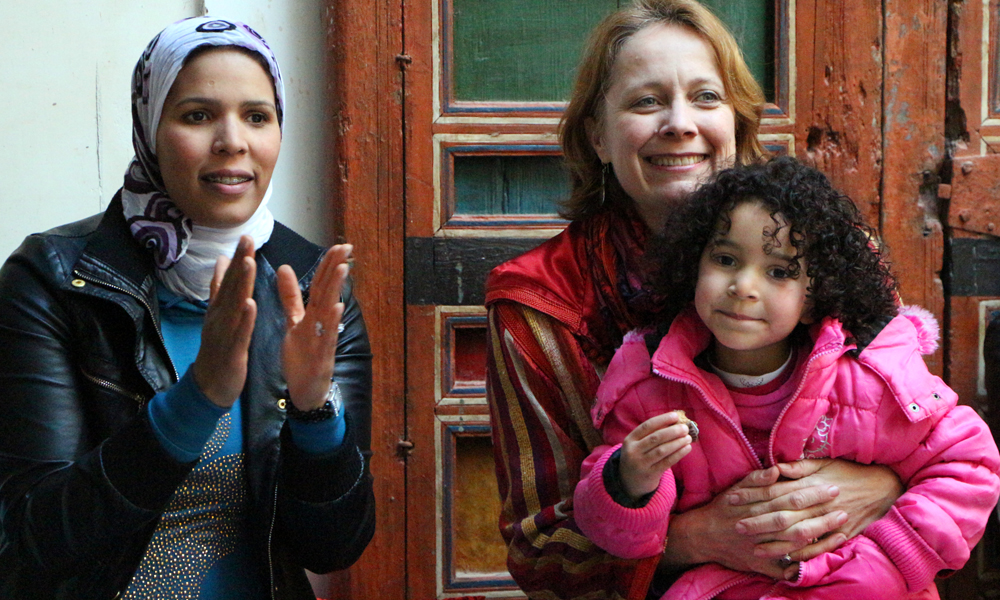
Because the ritual takes several hours to perform, there are breaks for min tea and cakes. The audience comprised a wide rang of age groups and nationalities. Present for this ritual were Argentinians, French, German, Dutch, American and Australian visitors as well as local residents and Moroccan families.


 |
| And as usual, the evening ended with dancing |
The View from Fez would like to thank:
Malem Aziz wuld Ba Blan
Chris Witulski - Musiciologist
Phil Murphy - Musicologist
Rachida - Hostess and Couscous preparation
Sue Bail - Rose water and outdoor heating specialist
Photos: Suzanna Clarke, Sandy McCutcheon
SHARE THIS!
Tuesday, February 26, 2013
Old-Style Fessi Gnawa Ritual at Riad Zany
This Friday The View from Fez is extending a public invitation to a rare Gnawa event in the Fez Medina. Old-style of Gnawa music is seldom heard these days and there are few people who understand and perform the rituals. Members of the public are welcome at Riad Zany (a donation will be requested) and the ceremony begins at 2pm and will probably run until 10pm. Mint tea will be served. As this is a courtyard performance it is recommended you dress warmly and bring a blanket!
 |
| Gnawa musicians in Tangier - a different style than the music in Fez |
Malem Aziz wuld Ba Blan is the sole remaining Gnawi here in Fez who exclusively performs the old local style of Gnawa music. The Gnawa use their music to repair relationships between people and saints or spirits. They move through a series of musical segments, each praising and welcoming a group of these spirits into the ritual space, inciting trance in adepts. The nature of these spirits is the subject of much headed debate, as practitioners and detractors locate them in local Islamic history or sub-Saharan devil worship, respectively. The possessing spirits, grouped and labeled by color, have preferences for specific incenses, songs, and even foods, making the event a sensory, and spiritual, journey through an evening.
While most Gnawa Laylas (nights) extend from the late night into early morning, Friday's event will be an Ashiya, an evening. This shorter ritual, from 2:00pm to somewhere around 10:00pm, is a condensed form of a ritual that used to last three days, even up to a week. We begin with the dakhla, an entrance that uses large drums (tbal) slung over the shoulders of the musicians. With candles and blessed foods, the group processes into the home, dancing and singing praise to the prophet Mohamed and other saints. Dance and entertainment prepares the ritual space and invites the spirits while recounting the Gnawa's history in slavery. We then enter the Shourfa', the segment dedicated to the descendants of the prophet, holy men of God who wear white when they re-animate their trancing adepts. At this point, the ritual has begun and we watch the group work with the various other spirits. Sidi Musa dances with a bowl of water balanced on his head, the forest spirits bless the foods of the woods and play with fire, Abraham may dance with prayer beads while reciting the Quran. The women, including Lalla Aisha, conclude the ceremony under the dark of night.

Two generations ago, this music began to change. Malems, Gnawa musicians who lead the ritual, from the medina, Fez Jdid, and near the palace in the Moulay Abd Allah neighborhood played this heavier style of Gnawa music until some youth began to notice new sounds coming from the Casablanca region. Aita, Moroccan popular music from that area, was taking hold across the country. High singing and faster rhythms were changing people's tastes, and the Gnawa were loathe to be left behind. Before long, and thanks to a few specific malems of that era, this pop music influence percolated through the allegedly unchanging Gnawa ritual. Malems began to tune their instruments a little bit higher, tightening the strings and stressing the upper ranges of their voices. Rhythms creeped into quicker tempi and dances became more acrobatic. Requests for popular songs gave malems reason to learn a wider variety of Moroccan music, finding unique ways in which to import diverse melodic ideas into the aural sensibility of their ritual.
The heavy, older Fessi style all but disappeared. While this happened only within the past few decades, the transformation has been nearly complete. A few individuals still remember a handful of the old versions of these songs, but the market for them has diminished. Malem Aziz finds work now as a specialist, catering to those who still desire the Gnawa ritual of the past. He rarely steps onto stages and, like malems of past generations, has other full time work. His family line is one of the respected chains in local Fessi Gnawa history.
 |
| Trancing to Gnawa |
Friday's performance will be a complete ritual. My purpose is to create a recording for my own research on aesthetic changes in Gnawa music and interactions between this ritual, those of other brotherhoods, and popular culture. The event is open, and will be hosted by The View from Fez. Donations to defray the costs to the hosts will be accepted. Come, and strongly consider preparing to stay for the entire event. The length (7 or 8 hours) is part of the sensory experience, just as important as the colors, sights, smells, and tastes. The courtyard will cool down, especially in the evening hours, so bring a good coat or blanket to wrap up in. Even if you have seen Gnawa music previously, this open ritual will emphasize the spiritual and musical heaviness of the experience, as lived here, in Fez.
Text: Chris Witulski
See our photo essay of the event here
Venue: Riad Zany, Laayoun (enter via Rcif)
Starting: 2pm
Ending 10pm
info: 067 27 65 657
Respond: Facebook Events
SHARE THIS!
Subscribe to:
Comments (Atom)