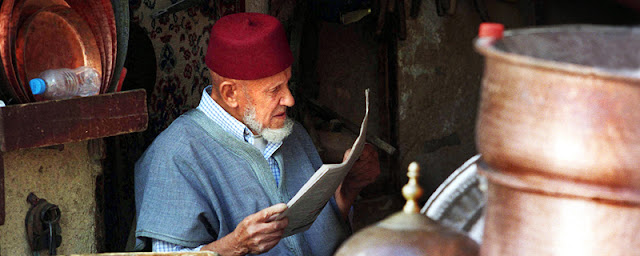
For Arabic and French speakers wanting to delve deeper into the Moroccan psyche, there are plenty of books available. However, if you are an English speaker, the range is extremely limited. This is not just a problem for prospective readers but lack of access to translators is also an issue for authors. Recently, The View From Fez, sat down with two Moroccan writers to discuss the problem
 |
| Fouad Guessous |
Fouad Guessous is a man with a deep love and knowledge of Melhoun poetry. Melhoun is said to have first emerged as a pure literary creation in the Tafilalet oases of southern Morocco in the fifteenth century. And it is from this region that Fouad Guessous opens his remarkable compilation of sixty-three poems in the original Arabic alongside superb French translations. The first two of the thirty-two poets, to whom he introduces the reader, hail from Tafilalet - Mohammed Masmoudi (17th C) and the man who laid down the rules that allowed enrichment of the art form, Abdeleziz Maghraoui.
Today the Melhoun form has spread through the Maghreb, where it is referred to as laqsida in Moroccan Arabic. In standard Arabic it is known as 'qasida" (Arabic: القصيدة) or "zajal" (Arabic: الزجل).
The laqsida is usually in three parts. There is an overture followed by verses sung solo, which in turn are interrupted by the harba refrain between the verses. Another refrain, called dridka (Arabic: الدريدكة) is a simplified form of the harba, taking off from an accelerated rhythm to announce the end of a laqsida.

Fouad Guessous points out that the "true Melhoun" is the section that is sung solo, while the instrumental music of the harba is purely to allow the singer a short break. Morocco produced a great number of poets from Fez, Meknes and Marrakech who adopted the Melhoun form to spread popular poetry.
Guessous's compilation of sixty-three laqsida, is above all a work of love. The translations to the French are superbly crafted and deserve to be read far wider than by those for whom Melhoun is simply the object of academic study. Therein lies the problem. Although the first edition was published back in 2008, Guessous has yet to find a translator to bring the poems to English speakers.
Guessous is adamant, "Translation is a difficult task at the best of times, but much more so when the text is poetic. It needs a poet. It must be the work of a poet." He has yet to find one.

In the same predicament is Hamadcha Sufi Tariqa (Brotherhood) mqaddem (leader) Abderrahim Amrani, who has compiled an impressive list of contributors to a book on the poetry of the Hamadcha Tariqa in Sidi Ali. The book is available only in Arabic, but a French edition is expected in the near future. However, like Fouad Guessous, Abderrahim knows that an English language edition is the key to wider exposure.
Amrani's collection of articles, poetry and historical photographs of the Hamadcha Brotherhood and the Mausoleum of the Tariqa's founder, Sidi Ali Ben Hamdoush, is a gem. The title of the book is itself poetic in Arabic, translating (perhaps) as "The Book of Watering the Flowers of Sidi ibn Hamdoush". In Moroccan Arabic the word used for "book" in the title is an old and very poetic form kunnäsh, rendering the title as:
Kunnäsh Azzahr al Marshoush
Fi Qasäid Sidi Ali Ibn Hamdoush
For those interested in the Hamadcha, this book is essential reading and the photographs from the turn of last century are historically important. The more modern history of the Hamadcha, such as their highly successful tour in Australia, sadly don't get a mention.
 |
| Amrani and Guessous - two characters in search of a translating poet |
Once again this is a book that, as Guessous said, needs a poet as translator. To let it rest among the huge list of works untranslated would be a shame for those who love the Sufi tradition in Morocco.
Text and photographs: Sandy McCutcheon
Anthologie de la poésie du Melhoun marocain by Fouad Guessous ISBN 978-9954-8323-6-X
Kunnâsh Azzahr Al-Maroush Fi Qasâid Sidi Ali Ibn Hamdoush by Abderrahim Amrani published by Gnôsis - Éditions de France - (Yahya Cheikh) ISBN 978-2-35750-015-0
Text and photographs: Sandy McCutcheon
Anthologie de la poésie du Melhoun marocain by Fouad Guessous ISBN 978-9954-8323-6-X
Kunnâsh Azzahr Al-Maroush Fi Qasâid Sidi Ali Ibn Hamdoush by Abderrahim Amrani published by Gnôsis - Éditions de France - (Yahya Cheikh) ISBN 978-2-35750-015-0
SHARE THIS!


