Showing posts with label Orientalism. Show all posts

Monday, September 03, 2012

Orientalist Art and Moroccan Jewellery Auction in Paris


Sotheby’s have announced two auctions in Paris on 9 October 2012 of a superb ensemble of Orientalist pictures, including Islamic works of art, ceramics, arms, and Moroccan jewellery from the famous Villa Aïn Kassimou in Marrakesh, property of Patrick Guerrand-Hermès.

Two Auctions

October the 9th is the date for two auctions at Sotheby's in Paris. The first, at 2:30 PM CEST is entitled Regards sur l'Orient. Orientalist Paintings and Sculptures & Islamic Art.

Jeunes Marocaines Debout, 1941 by Edy Legrand 

This sale is headlined by an impressive selection of 50 Orientalist paintings by Western-born artists inspired by North Africa, including the spectacular Gorges of El Kantara near Biskra by René-Charles-Edmond His and Young Women in Festive Costume by Edy Legrand. The latter is joined by the important and moving Portrait of Sliman Ben Ibrahim by Etienne Dinet, in addition to the charming Young Woman from Constantinople by Frederick Arthur Bridgman, which is reminiscent of Jean-Léon Gérôme.

The sale also contains a beautiful selection of sculptures, with a small group of Viennese cold-painted polychrome bronze groups cast by the Franz Bergman foundry, busts of oriental women by Friedrich Goldscheider and a beautiful bronze Snake Charmer by Josef Wind. The final section of this sale is dedicated to Islamic works of art, including a Quran folio in Kufic script from the 10th century.

The second auction,  at 4:00 PM CEST is the Collection Patrick Guerrand-Hermès, Tableaux Orientalistes et Art Islamique provenant de la Villa Aïn Kassimou, Marrakech

Horseman with a Sloughi, by Henri-Emilien Rousseau

A descendant of the prestigious Hermès family and former director of that famous fashion company, Patrick Guerrand-Hermès fell in love with Morocco over 50 years ago. He carefully recreated the atmosphere of the beautiful Moroccan homes of the 19th century in his Marrakech villa, Aïn Kassimou.

Built for Olga Tolstoy, Leo Tolstoy’s daughter, and purchased by Barbara Hutton, this luxurious estate was the setting of his collection which stands as a testament to the great diversity of Orientalist art, from the first generation of romantic artists to travellers from the early 20th century.

Among the offerings at Sotheby's are a beautiful selection of sporting paintings shows Guerrand-Hermès’ passion for horses, a symbol of his family exemplified by Horseman with a Sloughi (pictured above), which is among several works by Henri-Emilien Rousseau.

La sortie du Pacha by Edme Alexis Alfred Dehodencq

Among the most anticipated works will be The Going Out of the Pacha by Emile-Alfred Dehodencq (pictured above) and an important group of paintings and drawings by the Russian-born artist Edy Legrand, depicting Morrocan kasbahs. The sale will also offer a selection of Morrocan jewels, weapons and ceramics.

The estimated price of La sortie du Pacha by Edme Alexis Alfred Dehodencq is between 120 and 180 thousand Euro.

The ensemble of around one hundred paintings, drawings, watercolours and engravings presents a sweeping overview of (mainly French) Orientalist Art from the late 18th century to the 1930s.

Find out more or buy a catalogue from Sotheby's website

SHARE THIS!

Sunday, July 02, 2006

Postcards from Fez - the ghosts of colonialism


Many people interested in the Medina of Fez were lucky to attend a recent lecture by Simon Kenrick in which he challenged the audience to not only question the imagery of Fez portrayed in the tourist brochures, but to suggest alternatives.

Simon Kenrick visits Riad Zany


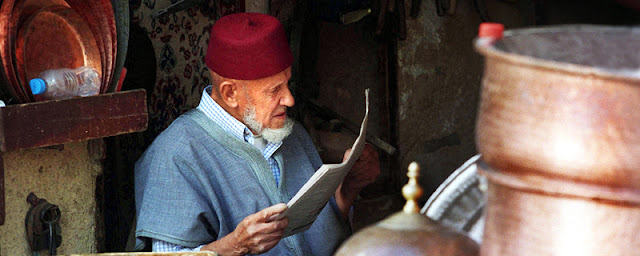
Is Fez "timeless, romantic, mysterious" as the tourist brochures and travel writers insist? Or are these notions part of an ongoing colonial mindset about the "Orient"? And if we are continuously presented with images of "the waterseller', "the snake charmer", " the veiled women entering an arched doorway" and the "timeless face of the Berber carpetweaver"...is that what we then look for when we visit Morocco?

On investigation it seems that the notion of timelessness is historically specific and arose around the time of the industrial revolution, to counter the alienation of instincts and reason produced by modernism and mass production.

The Orient as "other" is also part of this lingering colonial mindset. Rana Kabbani in her 1986 book, Europe's Myths of the Orient, has this to say: Europe was charmed by an Orient that shimmered with possibilities, that promised a sexual space, a voyage away from the self, an escape from the dictates of the bourgeois morality of the metropolis.

Simon Kenrick, in his lecture, raised many other intriguing issues, all of which are worthy of further exploration. His discussion about the famous Bab Boujloud (the Blue Gate) was fascinating. Not only is the gate not old and historic it is, in fact, a French colonial construction. The French first built the gate as a triumphal arch and then replaced it with the gate so photographed today.


As Kendrick surmised, the position of the gate is also interesting, because it was not originally an entrance to the Medina, but rather a hole punched in the walls to allow French troops access to the top of the Medina and to the two main thoroughfares.

Simon Kenrick also questioned the widely held belief that the French decision to preserve the Medina was an enlightened one. Rather, he argues, it was pure self-interest. It was, as other critics have pointed out, urban apartheid with the new city being classical European in style with broad avenues and modern gas, electricity. On the other hand the Medina was prevented from any progress "because we are respecting your timeless heritage." The result was to lay the framework for the tourist industry images of today - "timeless and mysterious".

In fact, the medina is neither timeless or mysterious. It is modernising and - on investigation- its layout and way of life, logical. Yet, as long as the tourist industry feels that they must market Morocco and the Fez Medina with the old images, they will perpetuate attitudes and perceptions that should be consigned to history.

See all The View from Fez POSTCARDS HERE.