Friday, September 16, 2011

Ben Jelloun and the "Arab Spring"


In an interview with SPIEGEL ONLINE, Moroccan-born author and poet Taher Ben Jelloun talks about the Arab Spring and the burgeoning creativity in post-dictatorship countries. He also describes the challenge of writing from the perspective of Libya's former leader Moammar Gadhafi.

Photo: Hartwig Klappert
'People now, finally, are free and we are seeing an upsurge in creativity,' Jelloun says.
Taher Ben Jelloun was, born in Fez. He has published more than a dozen books, including 'The Sand Child' and 'Racism Explained to my Daughter,' which have been translated into more than 30 languages. He was the first Magreb author to win France's leading literature prize, the Prix Goncourt with his 1987 novel 'The Sacred Night.'

As a young man, Jelloun joined the student rebellion against the repressive Moroccan police in 1966 and was sent to a military camp as punishment. He later emigrated to Paris, where he earned himself a reputation for speaking out about the plight of North African immigrants. Earlier this year his essay collection, 'The Arab Spring,' was published in French and German. In 2011 he was awarded the German Erich Maria Remarque peace prize. He is currently in Berlin taking part in the city's annual literature festival. It was herer that he gave this interview with the German newpaper Spiegal OnLine.

PIEGEL ONLINE: Your recently published essay collection deals with the Arab Spring. Are you worried what will happen once the euphoria dies down?

Jelloun: Yes. These countries have been abused and scarred by dictators. Now the pieces have to be picked up slowly. The changes and reforms needed will take a long time, many years. But citizens are impatient. Their impatience is understandable -- they have fought for reform and now they want to see swift changes.

SPIEGEL ONLINE: Is there a way to settle this sense of urgency?

Jelloun: Many young Tunisians, for example, want to emigrate to Europe because things are not changing fast enough for them. How can you tell young people that the transition needs at least another generation to become properly established? How can you tell them to sit back and wait for the change which they fought and risked their lives for? This is very hard. It is a painstaking process to construct a post-dictatorship system and the question is whether people's impatience can hold out.

SPIEGEL ONLINE: What other major challenges do you anticipate?

Jelloun: Until now the individual was not recognized in the region. Tribes or ethnic groups were recognized but not the individual. In Libya, Moammar Gadhafi exploited the conflict between ethnic groups and played one tribe off against another. But now Arab revolts have been driven by individuals' urgency for change. The concept of the 'individual' has been born during these revolts. At the same time, tribal structures and ethnic traditions will not simply disappear. Tribal culture will have to enter into a modern framework and that is very complicated but individualism is here to stay.

SPIEGEL ONLINE: What needs to change politically?

Jelloun: Changing people's mentalities is a major challenge. These countries need to face up to entrenched corruption. People are used to living with corruption, it is a habit for both the corrupted and those who corrupt others. It is very difficult to change this culture overnight.

SPIEGEL ONLINE: How has the revolt reflected in the literary scene?

Jelloun: I think there will be a creative boom. The fact that people are finally free means that we are seeing a surge in creativity of all sorts.

SPIEGEL ONLINE: What was the situation for writers during the dictatorships?

Jelloun: There was a lot of state censorship but there was also the powerful force of auto-censorship. Even those who lived in exile were very, very cautious. Exiled writers from Iraq and Syria, for example, could not talk or write freely out of fear for the safety of family members still in their home countries. For instance, Lebanese writers who criticized Syria and its role in Lebanon have received death threats. Samir Kassir, a Lebanese writer who published articles speaking out against the Syrian dictatorship, was assassinated in June 2005. It is widely thought that the Syrians killed him.

SPIEGEL ONLINE: Will there now be a wave of writers in exile returning to their countries?

Jelloun: Yes, that is happening already, for example, in Egypt. This trend is not restricted to intellectuals. We are also seeing a wave of entrepreneurs and high-level businesspeople returning to their native countries because they see new opportunities there. There is reason to be hopeful, but our hopes may be disappointed in the long run.

SPIEGEL ONLINE: How do you think European governments could best support Arab writers?

Jelloun: More support would be a good opportunity for European governments to make amends for the inexcusable things they did during the dictatorships. Arab writers' voices should be heard in Europe. They should be invited to address people and their work should be translated. They should not be invisible anymore. But their assistance should extend beyond the arts. They need to help the countries reconstruct themselves materially and politically too.

SPIEGEL ONLINE: You mention the 'inexcusable' role of Europe politicians in their relations with the dictatorships. Are you angry about the cozy ties?

Jelloun: No, I'm not astonished by how Europe behaved. Hasn't it always been like that in Europe? Haven't Europe's economic and material and energy interests always been put before their principles?

SPIEGEL ONLINE: You addressed hundreds of teenagers during the Berlin Literature Festival. What was your main message to young people?

Jelloun: To read! Reading is under threat by young people's attachment to computers. Those machines are everywhere, but reading is essential. It can help them understand other cultures. Reading can open their eyes. There is still too much confusion between Islam and terrorism. Young people shouldn't mix this up. They should learn that Islam is a monotheistic religion like Christianity and Judaism -- and, like Christianity and Judaism, it has fanatics, but that doesn't mean the fanatic element is at the core of the religion.

SPIEGEL ONLINE: Do you like the media catchphrase 'Arab Spring?'

Jelloun: I like the term Arab Spring as it is the first time in years that the international media is reporting something positive about the Arab world. On the other hand, the word 'revolution' is being misused by the media. It is an Arabic revolt, not a revolution. Revolutions have to be prepared. They are carried out by a movement, a party and an ideology, it's about constructing something new in the medium or long-term. A revolt is a spontaneous expression of anger. Tunisia, for instance, has long had a vibrant civil society. That helped the revolt, but what really effected change, in Tunisia and elsewhere, was the population's spontaneous expression of anger.

SPIEGEL ONLINE: In your book Arab Spring, you write from Moammar Gadhafi's perspective. Was this hard?

Jelloun: Quite the contrary, I like to climb into people's heads, even if dictators give me a headache. I like the process and you discover extraordinary things. It is like being an actor, you try and get inside the person, see how they tick. You can play at being someone else. Others who have read these essays have said they recognize the portrayal. I couldn't do the same about Angela Merkel as she seems to be an ordinary woman doing usual things. I am interested in writing from the point of view of people who are far from the norm, people who do extravagant things. Angela Merkel doesn't apply to that criteria.

Interview conducted by Jess Smee. Our thanks to Spiegal Online.

Thursday, September 15, 2011

Morocco must investigate Saudi "maid-trade"


Back in early September, the recruitment committee of the Council of Saudi Chambers of Commerce and Industry announced that recruitment companies would be established and will be licensed to bring in housemaids from Morocco, East Asia and South Africa. The move has caused outrage in unusual places. Ibn Warraq reports for The View from Fez.

The reason for this recruitment move, according to a Saudi chamber official, was that they were turning to Morocco and other countries to get its domestic workers following a dispute with the Philippines and Indonesia, the largest suppliers of housemaids to the Gulf countries. The dispute has centred on pay and conditions, but Indonesia had earlier this year also criticised the Saudi government for beheading an Indonesian maid. Of the 1.2 million Indonesians working in Saudi Arabia, over 70% are domestic helpers.

The ban on maids from Indonesia and the Philippines hit Saudi households hard, causing many to resort to hiring illegal maids over Ramadan. The Saudis are reliant on foreign workers to perform their household tasks for them and very few Saudi women will work in such menial positions despite high unemployment, as they would be looked down on by other Saudis.

The ban came into effect following the two countries attempts to introduce regulations for the work conditions of their nationals. Trade Arabia said both countries demanded better working conditions for their employees. Saudi walked away from the negotiations abruptly and decided to look for domestic employees from countries such as Morocco who they perceive as not as concerned about imposing regulations to protect their workers. It also became clear that lower rates of pay could be offered to other nationals.

Right from the beginning the scheme ran into problems in respect to recruiting maids from Morocco. The recruitment committee said that the immediate employment of Moroccan maids could prove an issue as there were no official recruitment offices in Morocco to process the papers of prospective domestic helps. It was suggested that there could be a way around the problem with Saudi citizens being given work visas to bring housemaids from Morocco on their own.

The whole issue of Saudi maids has been at the centre of international protests for years, especially in regard to exploitation, sexual harrassment and torturing of foreign housemaids. The notion that indvidual Saudi's could fly to Morocco and find a young woman and take her back to Saudi, is truly worrying and will, no doubt, offend our readers.

The chairman of the Council of Saudi Chambers of Commerce and Industry, warned Saudi citizens against contacting any offices claiming to be able to send housemaids from Morocco to the Kingdom. "They are all fake. You should not heed the false claims of these fake offices." he warned prospective employers.

The spokesman of the Labor Ministry, Hattab Al-Anzi, said the recruitment offices would grant citizens work visas for housemaids from Morocco. "It is now the responsibility of the citizen to look for authorized private recruitment offices to bring workers from Morocco," he said.

Then, suddenly, the plan to import maids from Morocco ran into even more problems. Those fighting to stop the "maid-trade" got support from an umlikely source - Saudi women. They objected to the importing of Moroccan girls, not because they didn't think they would work hard, or that they were against the exploitation of young foreign women. No - it was because they thought the Moroccan women were too beautiful. At first it sounded like a sick joke, but the Saudi women were serious.

"Many Saudi woman have objected to plans to import domestic workers from Morocco…they say the Moroccan women are beautiful and this will cause continuous anxiety and concern in Saudi families,” - 'Sharq' Daily

It is a relatively rare for the voices of Saudi women to be raised in protest. This year there have been notable exceptions as some women protested for the right to drive, whilst others demanded the right to vote. Now they have another common cause - to ban female domestic maids from Morocco. It started slowly, but over a few days the protests grew to the point where the Saudi women innundated the government with complaints that Moroccan women are just too beautiful and may lure their husbands away. According to the website Emirates 24 the Shura Council was “deluged by demands from Saudi women”

"Moroccan women are so attractive that their husbands could easily fall for them…others said Moroccans are good at magic and sorcery and that this could enable them to lure their husbands.” - 'Sharq' Daily
Saudi women protest against Moroccan maids

If the women of Saudi Arabia fail to stop this "maid-trade" then it is imperative that the Moroccan government scrutinise the contracts and conditions of every maid taken to Saudi. They should also take steps to educate Saudi women to understand that while Moroccan women may be beautiful, they are not dangerous.

Morocco and Salé feature in Pirate King


The View from Fez is always happy to receive guest posts. Today our guest is the author Laurie R. King.  Laurie is the bestselling author of 21 crime novels, including a historical series featuring young Mary Russell and her somewhat more famous husband, Sherlock Holmes. King’s new novel Pirate King is set in 1924 London, Lisbon, and Morocco. Laurie explains what attracted her to our part of the world.

The USA edition (left) and the UK edition


Pirate King - A synopsis


In England’s young silent-film industry, the megalomaniacal Randolph Fflytte is king. Nevertheless, at the request of Scotland Yard, Mary Russell is dispatched to investigate the criminal activities that surround Fflytte’s popular movie studio.

Russell is traveling undercover to Portugal, along with the film crew that is gearing up to shoot a cinematic extravaganza, Pirate King. Based on Gilbert and Sullivan’s The Pirates of Penzance, the project will either set the standard for movie-making for a generation or sink a boatload of careers.

Nothing seems amiss until the enormous company starts rehearsals in Lisbon, where the thirteen blonde-haired, blue-eyed actresses Mary is bemusedly chaperoning meet the swarm of real buccaneers Fflytte has recruited to provide authenticity.

But when the crew embarks for Morocco and the actual filming, Russell feels a building storm of trouble: a derelict boat, a film crew with secrets, ominous currents between the pirates, decks awash with budding romance—and now the pirates are ignoring Fflytte and answering only to their dangerous outlaw leader, La Rocha. Plus, there’s a spy on board. Where can Sherlock Holmes be? As movie make-believe becomes true terror, Russell and Holmes themselves may experience a final fadeout.

Why Morocco?

Sometimes a place chooses you. Sometimes you’re just wandering, simply headed somewhere, maybe even out for a holiday, and you walk past a place and it reaches out and grabs you. People travel for different reasons. We humans are curious creatures, and we wonder about others—how they live, act, eat, sound. Of course, curiosity about others is often an extension of curiosity about ourselves: What would I look like in a different setting? How would I act away from home? How would my thinking change if I ate different food, slept under different roofs, wore different clothing? And if you’re a writer, you may be looking for a place where your mind can spend a year or so while writing the next book.

Salé - where the dead have front row seats
I came to Morocco as much on a whim as anything else: I was staying with family members in Lisbon when we decided to take a short trip somewhere else, and chose Morocco. The book I was working on was about pirates, and although it’s a comic sort of a romp, there was an appeal in setting part of it in the old pirate kingdom of Bou Reg Reg, in Salé. So we flew into Casablanca and took the train to Rabat, and poked around the area for a day or so, finding enough local colour to make things fun and making a close enough survey of the area for a work of historical fiction.

Then we went to Fez. And my plans for the next year or so were instantly hijacked.

Our introduction to the city was appropriately confusing, yet firmly grounded in its own unique brand of logic. When we arrived, the man we were to stay with was elsewhere, and the arrangements he had made to have us met seemed to have wandered away. However, when we showed his card to a bunch of fellows washing cars near Bab Guissa, they instantly knew him. Or, claimed that they knew him. And with no further ado, one of them proceeded to bundle our possessions onto a cart and race away into the medina.

Now, in many other parts of the world, this would be cause for some degree of alarm. In some parts of the world, one would be insane to follow, lest one’s person disappear along with the luggage. And no doubt luggage theft is not a crime that is completely unknown in Fez. But in this case, it was indeed the logic of the medina, taking us to safe haven.

And so it went, for the days we were there. The tangle of streets seemed to make sense to our feet, if not our eyes, so that we were never definitively lost. We were greeted with good cheer even by those with whom we had nothing apparent in common. The city went about its business, and taught us more about the country and its people than any museum could.

At the end, it became a battle to keep Fez from taking over my pirate book. My characters longed to set off inland from Salé. I had to lock them behind city walls to keep them from wandering off, taking the plot with them. Finally, I made a bargain with them: if you stay in Salé and Rabat for Pirate King, you can head for Fez as soon as it’s finished. Reluctantly, they agreed.

I’d had no intention of writing a book set entirely in Morocco, but next year’s novel, Garment of Shadows, is all about Fez, and the Rif revolt, and the French Protectorate under Lyautey. However, even after that, it’s going to be tough to get the characters to move on.

Thanks to Laurie for this post.


And, now a little known fact -The character Robinson Crusoe in Daniel Defoe's novel escaped from the pirates and sailed off to liberty from the mouth of the Bou Regreg river in Salé!


Wednesday, September 14, 2011

Upcoming Culture in Fez


Diverse cultural activities are on offer in Fez over the next few months. These include exhibitions, film and a self-development workshop.

Exhibitions

Historic photographs of Fez

Trilogie Fassi 1916-1917 opens on September 23 at 6.30pm and will be on show until the end of October at the gallery of the Institute Francais de Fes.

This exhibition is taken from the second album of 120 photographs taken by Commandant Larribe, titled "Morocco Picturesque", and features captions by Alfred Bel, the founder of Batha.

Film stills

The Invisible is an exhibition focusing on the film stills of Spanish photographer José Haro. Since 1993, he has been working on portraits, advertising, photojournalism and film sets. He is the recipient of Kodak and Agfa European Portrait awards. His film stills includes the latest Almodovar film La Piel que Habito ("The Skin I Live In").

The Invisible opens at the Cervantes Institute in Fez and will run until October 20.

Movie

The critically acclaimed film Omar M'a Tuer ("Omar Killed Me" - see our earlier story here) will be screened at the French Institute's Mediatheque on next Wednesday, September 21 at 7pm.


This 2010 film is based on a true story which began with the murder of 65-year-old Ghislaine Marchal, who was found stabbed and beaten to death in the basement of her villa, in an affluent suburb north of Cannes. At the crime scene was the grammatically incorect inscription “Omar m’a tuer” written in Madame Marchal’s blood and pinpointing her gardener, Omar Raddad (Bouajila), as the murderer.

The engrossing historical dramatisation includes the questioning of Raddad's conviction by an intrepid novelist and his attempts to free the illiterate Moroccan, whom he thought was simply an easy police target.

Course

Bookings are now open for a workshop from November 25-27 called Harmony, Confidence and Serentity in the beautiful surrounds of Jardin des Biehn.

The course is being taught in French and includes yoga by Kleo Brunn and Sophrology by Catherine Biehn. It combines the apparently contradictory aspects of discipline and letting go.

"These two paths lead to physical, mental and spiritual unification; to harmony, confidence and serenity," says Catherine Biehn. "The slow and natural pace of Fez and its very special energy offer ideal conditions for this course."


Jardin des Biehn

Think of Morocco - "picture the ruins"!


"When you think of Morocco you immediately picture the ruins, the sandy beach, the camels and the traditional houses. It’s true that this is how most of that area looks like, but there are modern adaptations too. Take for example this spacious house. It’s located close to Sidi Kaouk’s long sandy beach and the surrounding landscape is full of history." - Homedit.com

Believe it or not, but that quote is from a reasonably professional looking design and architecture website. When a colleague brought it to our attention we decided to have a look and decided it was worth sharing. And, for the record, we don't "immediately picture the ruins" when we think of Morocco!

"rather traditional furniture"

The house, with furniture oddly described as "rather traditional but with a modern twist" is situated at Sidi Kaouki, just 27 kilometres south of Essaouira. It has established itself as one of the top windsurfing and surfing venues in Africa and now boasts some pretty decent accommodation. You can see more pics of the house here: HOUSE

See The View from Fez Postcard from Sidi Kaouki here.

The View from Fez "Postcards" - snapshots from around Morocco - are all here: POSTCARDS FROM MOROCCO

The Tuesday Souq in Azrou


For those with a reasonable amount of time in Fez, day trips are a great way to take a break from the Medina and get to see more of the surrounding countryside. The easiest destinations include, Meknes, Volubilis, Moulay Idriss, Sefrou, Ifrane and Azrou.

Every week in Morocco there are more than 800 country souqs held. Usually the name of the souq is the name of the day on which it is held. So, on a Tuesday, it is a good plan to head to the Tuesday souq at Azrou.

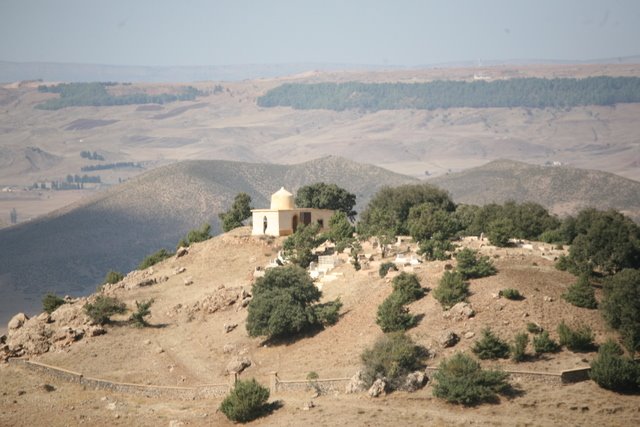
Spectacular Middle Atlas scenery -photo Sandy McCutcheon


If you have the money, then hiring a car and driver for the day is a good option and will cost between 600 and 800 dirhams for the day).  A grand-taxi will cost 28 dirham a seat. There are also six buses (18 dirham)  from Fez to Azrou every day. If you are traveliing by car, go via Imouzzer  and take a coffee break in to the resort and university town of Ifrane. Most of the tour parties stop at the first hotel (Les Chamoix), but we would suggest going a little further into the town and trying one of the more reasonably priced cafes. Ifrane is a little like a European alpine village and the architecture will remind you an Austrian mountain village.

After Ifrane you travel through cedar and oak forest to Azrou. If you stop in the forest, it might be a good thing to heed the warnings about the Macaques (Barbary apes)and read our story : Morocco - making the animals anxious?

The Amazigh (Berber) name, Azrou, means "great rock" owing to a strange volcanic outcrop just outside the western edge of the town. As the town is at 1250 metres, it can be chill so go prepared.

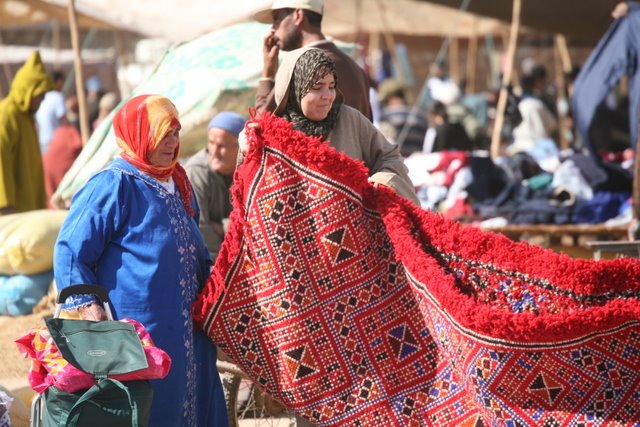
Azrou carpet souq - photo Suzanna Clarke
 

The Tuesday Souq is hard to miss, as from early morning the people stream into the open area 1.5 kilometres outside the town to the northeast. Just inside the souq gates are some of the cheapest carpets (compared to Fez) although the quality is variable. Bargain hard and you should be able to get something worthwhile. Look out for the red carpets with geometric motifs as these are the speciality of the Beni M'Gid Berbers who gave up the nomadic lifestyle and founded the town.

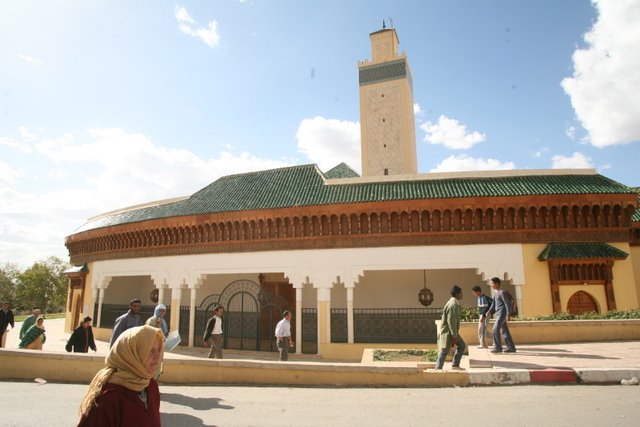
Azrou Mosque - photo Suzanna Clarke
 

In the centre of the town is a strip of restaurants serving basic Moroccan dishes, but be prepared to pay tourist prices. A street meal that would usually cost six of us around 100 dirhams cost double that as we were charged for the usually complimentary olives and salad. Still, the chicken was delicious. For something a  little different, try trout or the rabbit tajine at the Hotel des Cedres in Place Mohammed V. Also on Mohammed V you will find ATMs and Cyber Abridnet where you can check your email for 6 dirham for 30 minutes..

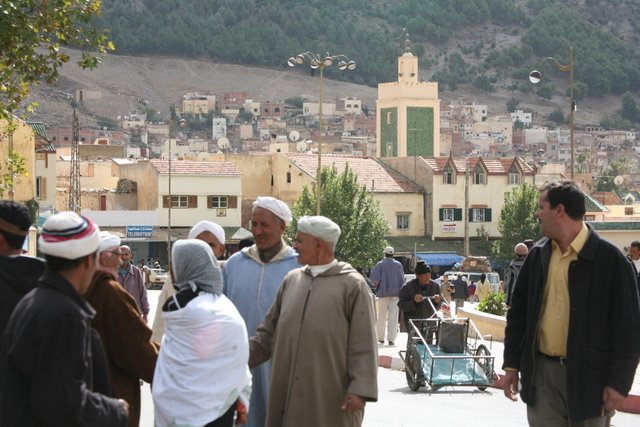
Azrou town centre - Photo Suzanna Clarke
 

This week, photographer, Gérard Chemit, visited Azrou and kindly sent us the following photographs of the Tuesday Souq.


Tuesday, September 13, 2011

Morocco declared Malaria Free.


Good news stories do not usually make the headlines and so our readers may not have been aware that it is now official - Morocco is malaria-free.
No longer a problem in Morocco!
Malaria had not been a major issue in Morocco for decades. The very limited risk was only in rural areas of Chefchaouen Province and the risk deemed so small that the taking of anti-malarial drugs was not recommended.

Now Roll Back Malaria and the UN World Health Organisation have certified that Morocco is malaria-free. Two other nations, Turkmenistan and the United Arab Emirates - were also certified.

Roll Back Malaria (RBM) is the world's lead organisation in the fight against the disease and was set up in 1998 by three UN agencies and the World Bank. It now has more than 500 "partner" organisations which coordinate work and pool expertise.

Global deaths from malaria have fallen by a fifth over the past decade, reflecting an influx of funds to fight the disease with better drugs and mosquito nets. Mortality from malaria in 2009 was 781,000, compared with 984,000 in 2000.

It attributed the improvement to a surge in funding, which rose from 100 million dollars in 2003 to 1.5 billion dollars in 2010, bringing total spending over the decade to some five billion.

"This dramatic rise in funding helped transform the malaria landscape, making universal coverage with proven interventions an achievable goal for many countries," said a RBM report, 'A Decade of Partnership and Results.'

Research continues into vacines for malaria
Big donors who appeared on the scene included the Global Fund to Fight AIDS, Tuberculosis and Malaria and the Bill and Melinda Gates Foundation.

In a press release, it claimed a 38-percent reduction in deaths over the decade, a figure based on world population growth and what would have happened if the mortality trend in 2000 had been maintained to 2009 without anti-malaria intervention.

Around 80 percent of all malaria cases and more than 90 percent of malaria deaths occur in sub-Saharan Africa, where the disease also costs around 12 billion dollars annually in lost output.

So far, enough insecticide-treated nets have been distributed to cover nearly 80 percent of Africa's population at risk.

Drugs like chloroquine are being replaced
In more good news, Artemisinin, the drug derived from a Chinese plant, which in 2006 became the recommended malarial treatment by the World Health Organisation, continues to be extremely effective. Artemisinin replaced medications such as Chloroquine, that had run into resistance by the parasite that causes the disease.

Artemisia Anua
The drug has a fascinating history and one that makes you ponder why the West has been so slow to embrace traditional medicines. Artemisia has been used by Chinese herbalists for more than a thousand years in the treatment of many illnesses, such as skin diseases and malaria. The earliest record dates back to 200 BC, in the "Fifty-two Prescriptions" unearthed from the Mawangdui Han Dynasty Tombs. Its antimalarial application was first described in Zhouhou Beiji Fang ("The Handbook of Prescriptions for Emergencies", Chinese: 肘后备急方), edited in the middle of the fourth century by Ge Hong.

Monday, September 12, 2011

"Kif-kif" and "Kif" are not kif-kif !


In a local coffee shop here in Fez, two tourists were having a loud argument. Judging by the number of Arabic words being bandied about, it seemed clear that they had spent a fair bit of time in North Africa or the Middle East. The subject of their heated discussion was the word "Kif" and its relationship to "kif-kif".

In the old days "Kayf" was classical Arabic for "relaxation or pleasure". Nowadays it's modern descendant "kif" has become one of the most widely used terms for dope, grass or weed. In Morocco a sebsi or sibsi (plural: s'basa ), is a traditional pipe (pictured below) used to smoke the finely clipped pieces of cannabis.


One of the amazing things about language is its ability to leap from culture to culture around the world. In the case of "kif", it sprang from Arabic and now appears in English, Dutch, German, French and probably a lot more. But, as as the arguing coffee drinkers were explaining, it can become confused with the expression "kif-kif" which (in Moroccan Arabic), means "the same as" "same same", or "so so". "Kif-kif" has also been adopted into Amazigh.

In French slang le kif is an interest, hobby or something one really likes to do, for example as in my case.... Manger des moelleux au chocolat, c’est mon kif!
 
We did a quick search on the web and discovered that "kiffer" has become a verb too. Je kiffe cette meuf! (I love this girl), Un vrai kiffeur is ‘a true stoner.’Ça, c’est très kif. ‘That’s cool, that is.’

In addition to "kif", "kif-kif" has entered modern French as a slang adjective, courtesy of the migrant population, so one might hear "Le beurre, la margarine, c’est kif-kif, n'est-ce pas? ‘Butter, margarine, it’s all the same, isn’t it?"

My American friends inform me that a "kiffer" is street slang for a nasty character and in German "Du bist ganz gekifft" translates as "You are stoned out of your gourd."

So, next time your pedantic friends start tossing the word "kif" around, you can use the rarely spoken sentence "Kif-kif and kif are not kif-kif."

SHARE THIS!
Print Friendly and PDF

New Edition of Lonely Planet Morocco


The release of a new guide book is aways good news for any tourist destination. It is doubly so when that destination is Morocco and the guide book is the Lonely Planet. Not only is Morocco one of Lonely Planet's top destinations, but over the years Lonely Planet has been the most popular guide book on the market (see our story here). The View from Fez team has been evaluating the new edition.


The tenth edition of Lonely Planet Morocco could not have come at a better time. As Ibn Warraq reported yesterday, (see story here) the tourism market is recovering. In addition the past couple of years have seen a great number of developments in Morocco and much has changed since previous editions.

Tony Wheeler, who founded Lonely Planet with his wife Maureen believed that "a great guide book should do three things: inform, educate and amuse". Happily, we can report that this latest edition does just that.

Those familiar with Lonely Planet will notice some changes in style and format. Gone is the rather plain "quick reference" section on the inside cover. In its place is a double page spread with essential sections of the book: "plan your trip", "on the road", "understand Morocco" and "survival guide". Each of the sections lists page numbers for its major contents. These sections are also colour coded so that flicking to each section is easier than in previous editions.

Plan your trip

This first section covers such things as the "18 top experiences". In the previous edition the reader was offered 25 highlights. One suspects that this reduction was brought about by budgetary constraints. In an odd twist the previous number one, the Fez Medina, has been relegated to number two behind Marrakesh's "Djemaa el-Fna street theatre".


There are other changes that appear to be a result of cost-cutting. The quality of the paper and the matt instead of glossy photographs are just two examples. However, the layout and basic information is all precise and quickly found. The "month by month" rundown is well thought out and the "suggested itineraries" are a good guide for first time visitors to Morocco and superior to those in the 9th edition.

Another change is the placement of general information for travellers. In the previous edition there were around sixty pages at the front of the book, covering a variety of topics from the environment through to advice for women travellers. In addition there was a "directory" at the end of the book. In the 10th edition most of this is now at the back of the book in the "survival section". In some cases the advice is in a more concise form.

On the road

This section contains all the essential information on various major destinations, starting with Marrakesh and Central Morocco rather than the previous entry point of Casablanca and the Central Coast.

The Marrakesh and Central Morocco entry was written by Alison Bing, who returns to the areas she has written about in the ninth edition. Bing knows her area extremely well and writes with authority and not a little wit. Her introduction to this chapter, however, is a rewrite of the previous edition. It is probably not such a bad thing, as her previous introduction was (and still is) well written!

An annoying thing about the new format are the lists of "five best" this or that. Our feeling is that it must have been restricting for the writers and there were may have been "words" exchanged with those back at Melbourne HQ.

The updated map of Central Morocco is a vast improvement and, like the map of Marrakesh, is much easier to read. There is also the welcome inclusion of a pull-out map of Marrakesh, but disappointingly, none for Tangier, Fez, Casablanca or Rabat.The writing about Marrakesh itself also contains much of the previous text, but thankfully refreshed in parts.

When it comes to riads and hotels the list appears more exhaustive and, as one would expect, there are some notable inclusions and omissions. Overall, it is a good snapshot of where to sleep and where to eat. One change is the dropping of the classification of hotels into budget, mid-range and top end. The new edition has a simple code beside each hotel with the number of Euro signs (€) denoting the price range.

The Atlantic Coast section of the book has had a major make-over. This is probably due to the fact that it has been researched and written by a new author - Helen Ranger - writer of the much in demand Fez Encounter. Ms Ranger is an experienced travel writer and it shows in the sections she has authored.

The information about the walking tour of Central Casablanca has been expanded and the maps have been improved.

One strange anomaly is the confusion over railway stations. Casablanca is served by two rail stations run by the national rail service, the ONCF. The main long haul station is Casa-Voyageurs, from which trains run south to Marrakech or El Jadida and north to Mohammedia and Rabat, and then on either to Tangier or Meknes, Fes, Taza and Oujda. A dedicated airport shuttle service to Mohammed V International Airport also has its primary in-city stop at this station, for connections on to further destinations. However none of the maps show Casa Voyageurs railway station. Casa Port train station - of less interest to travellers - while on the map, is not numbered with other transport services.

The Atlantic Coast coverage of this latest edition is more extensive and the attention to small details is impressive. For example,the bus to catch to get to Lixus is no longer numbers 4 or 5, but number 9. A small detail, but one that could make your trip to Lixus a little easier!

This section of the book includes Essaouira and again the updating of information is thorough. It is also pleasing to see that Ms Ranger has exploded the myths about Jimi Hendrix and his brief stay in Essaouira.

The Mediterranean and the Rif section was also authored by Helen Ranger and out of date information is gone and the coverage of the region much improved. The layout and information on trekking is well done, as is the attention to detail. The section on Tangier has captured the spirit of a city shrugging off its past and becoming an appealing destination for tourists.

Well known travel writer Paul Clammer, who was coordinating author of the 9th edition, returns to update the Imperial Cities, Middle Atlas and the East. Given the tourist boom in Fez and the range of new accommodation and restaurants, this update was much needed.  Clammer has done a good job on this, but because of the time lapse between research and publication, some details have already changed.

The Coordinating Author of this 10th edition  is James Bainbridge, who also contributed the Southern Morocco and Western Sahara update.  Again, all well done.

Understand Morocco &The Survival Guide

These two shorter sections not only have some valuable information, but have been set out in a way that makes them easy to read. One small lapse is in the language section where, unlike previous editions, the Moroccan numbers are missing the numerals between 10 and 20! Maybe the publishers are encouraging people to purchase the Lonely Planet Moroccan Phrase Book?

Our Verdict

There will always be those who like the older style of Lonely Planet guide book and for them, the changes in format and style will not be welcome. There is also the perennial problem alluded to earlier - that by the time any guide book reaches publication, it is already out of date.

Those quibbles aside, we think that Lonely Planet Morocco does its job well. It is easy to read; the maps are vastly better and the research in almost every region is impressive. The style of language retains that earthy flavour Lonely Planet is renowned for, ( which other guide book describes something as grotty?) but the general approach is a more mature one. If this is a recognition that not every traveller is a backpacker, then it is a step in the right direction.

Let's hope that those in Lonely Plant HQ will follow this with updated Encounter books for Fez and Marrakesh.


You can purchase by clicking image