Showing posts with label the-mediterranean-coast-and-the-rif. Show all posts

Tuesday, March 12, 2013

Drug and Smuggling Crackdown in Morocco

The first two months of 2013 have been a busy and successful time for police in Morocco. During that time a large number of arrests have been made particularly for incidents of smuggling and drug trafficking

In the latest incident in Casablanca police at Mohamed V airport arrested a Brazilian man attempting to fly to Europe with 90 capsules of cocaine in his stomach, a total more than one kilo. Security guards became suspicious when the 35 year old man became increasingly nervous going through security. An ultrasound was performed to confirm the presence of the ingested packages. According to initial statements by the arrested man, the capsules were ingested in São Paulo and he intended to take them to Europe. In October, a Nigerian died at the Casablanca airport after the collapse of 76 capsules which he concealed in his stomach.

The police prefecture of Oujda this week seized more than three tons of gasoline during a smuggling control operation. They also impounded three light vehicles, trucks and buses. During the operation 290 people were also arrested. An international network of drug trafficking, which operated using zodiac inflatable boats, was also dismantled during the same period and several people wanted by the judicial police were arrested in Nador. The police reported the seizure of large sums of money.

It has been a productive time for the police prefecture of Oujda who announced they had arrested 4,560 people during the first two months of 2013. Those detained are suspected of being involved in various crimes and misdemeanors. Among those arrested in 1210 were sought at the national level.

These operations have resulted in the seizure of more than 235 kg of marijuana, 24 kg of hashish, 77 grams of cocaine, 56 grams of heroin, 4,160 packets of contraband cigarettes and 1150 and psychotropic pills.


The 2012 report of the International Narcotics Control Board (INCB) confirmed the major role of Morocco in the export of cannabis, especially to Europe, its biggest market.

SHARE THIS!
Print Friendly and PDF

Wednesday, March 06, 2013

Free Sufi Concert in Fez this weekend


The Hamadcha on a recent tour to Meknes

You are invited to a free performance of wonderful Sufi music this Saturday afternoon at 4 PM

The Hamadcha Brotherhood are one of the most popular of the Sufi Brotherhoods in Morocco, and while they are very strong in the areas around Fez, their popularity has spread internationally, with performances in Europe and the US.

Sufi music is vitally important in Moroccan culture – particularly in Fez. Anyone new to it will find this performance an ideal introduction, while those familiar with the Hamadcha will have the opportunity to enjoy their exuberant, uplifting style once again.


Prior to the concert there will be a brief explanation by musician and scholar Fredrick Calmes (pictured above), who also plays and sings with the group.

This concert is hosted by the American Language Center Fes as part of their ALIF program.

Who: ALIF & ALC students and members of the public
When: Saturday March 9 at 4 PM
Where: ALIF Riad, Batha or meet by Batha Fountain at 3.45 PM
Cost: Free

SHARE THIS!
Print Friendly and PDF

Monday, March 04, 2013

The Moroccan Zorro - Unmasked


The Moroccan Zorro has removed his mask. Mounir Agueznay, the young man who has been nicknamed "the sniper of Targuist" has spent time over the last six years recording the actions of corrupt police. Hidden on a hillside above a road junction, "the sniper" used his small camera to great effect and along the way become something of a national hero

"It is time to have a face, but I will
continue to expose corruption openly," 


Targuist is a town in Al Hoceïma Province, in the north of Morocco and at last count had a little over 12,000 inhabitants none of whom were prepared to unmask their local hero.

Because Morocco is waging a war against corruption, Mounir Agueznay has become something of a national folk hero. His first video showing motorists, bus drivers and motorcyclists handing money to police was picked up and shown around the world on both Arabic and Western media. Yet his identity was not discovered. At the time the local police tried hard to discover his identity but the community protected him.


"With friends from the neighborhood, we were invited by the local authorities and the police. They questioned us at length and I had to deny everything," said Mounir Agueznay.  The authorities in Targuist strongly suspected Agueznay of shooting the videos, but after failing to catch him he says they turned on his family instead. "To get their revenge, they arrested my brother Radouane last October and accused him of drug dealing. He was sentenced to one year in prison," Agueznay said.


Targuist - the locals kept "the sniper's" identity secret

He has spent the last six years "underground" and during that time produced dozens of other videos showing police and officials in the act of corruption. He first agreed to give interviews openly to the Moroccan press last week, because "the character of the sniper became very well known, but had no face.  It is time to have a face, but I will continue to expose corruption openly," says Agueznay.

In December, Transparency International dropped Morocco eight places, in its annual Corruption Perceptions Index for 2012, to 88 out of 176 countries rated, below Burkina Faso and Liberia. According to the Berlin-based NGO, 55 percent of Moroccan business leaders polled said corruption was "standard," while 53 percent said the government's policy was "ineffective."

The Islamist Party of Justice and Development (PJD), came to power after winning historic November 2011 elections on the back of pledges to tackle endemic corruption in Morocco. PJD officials say strides have been taken, with lists published last year of those benefiting from privilege, through the awarding of government contracts, and most recently with a new law that protects corruption whistleblowers.

"Disappointed" 

The "sniper of Targuist" says he is disappointed by the government of Islamist Prime Minister Abdelilah Benkirane, who heads the PJD.  He ran as a PJD candidate in his village during the November 2011 elections, which followed constitutional reforms introduced by the king in response to Arab Spring protests, but despite the Islamists' sweeping victory, he was not elected.

"I really didn't believe it. I thought that after the electoral slogans of the PJD against corruption and in favour of real transparency, things would change... Unfortunately the government has still not taken any concrete measures on that," he said.

Benkirane, in an interview with French news channel France 24 last October, stressed that the battle against corruption needed time.

"Corruption exists in Morocco. It exists in lots of countries... but to different degrees," the prime minister said.  He said it was "a major issue, because there is a feeling of injustice among our people, who see people getting rich quickly without apparently having worked for it."

SHARE THIS!
Print Friendly and PDF

Monday, February 25, 2013

The art of living in the Fez Medina - A Public Talk


Join Suzanna Clarke, author of A House in Fez, as she shares her experiences of living in and exploring the Fez Medina – where art, design, architecture, music and ceremony are an integral part of everyday life.
Suzanna has amusing stories to share about her experience of renovating a 300 year old house, as well as offering insights into the history and culture of this rich and vibrant city through words and photographs.

When: Tuesday February 26 at 6.15 PM
Where: ALIF Residence, 28 rue Mohamed Diouri, Ville Nouvelle, Fez.
(Opposite the American Language Center. Ask the security guards.) 


SHARE THIS!
Print Friendly and PDF

Tuesday, January 22, 2013

Morocco ~ Then and Now - El Hoceima

The View from Fez is in debt to Enzo Pantosti for bringing the old photograph of El Hoceima to our attention. The photographer of the 1950's shot is unknown, but Enzo took the modern one.


Al Hoceima, Hotel Etoile du Rif, 1950. In those years, it was called Hotel Florido.


Al Hoceima is a city in the north of Morocco on a northern edge of the Rif Mountains, on the Mediterranean coast. It is situated in the territory of the Ayt Weryaghel and Ibeqquyen tribes of the Rif, who speak Tarifit Berber, locally called Tamazight.

Between 1994 and 2004 the town and surrounding villages were hit by two earthquakes. The first, at 6.0 on the Richter scale, occurred on May 26, 1994. The second, at 6.4, occurred on February 24, 2004, killing more than 560 people.


SHARE THIS!

Print Friendly and PDF

Wednesday, December 12, 2012

The Fes Festival of World Sacred Music - Ben Harper Flashback


A little nostalgia from the 2011 Sacred Music Festival. The performance by Ben Harper turned out to be one of the highlights. Here is a reminder of just how sweet that highlight was.


For information on the 2013 festival CLICK HERE
SHARE THIS!


Wednesday, December 05, 2012

L’Amante du Rif -- A Film by Narjiss Nejjar


This 2011 film is based on a novel L’Amante du Rif by Noufissa Sbaï. This novel was published in 2004 in Paris in French with the support of the Moroccan Ministry of Culture. Barrie Wilson has written an interesting paper on the film. Barrie is Professor, Humanities and Religious Studies, York University, Toronto. As an academic historian and philosopher of religion, he specializes in three centuries: the 1st century BCE and the first two centuries CE. Here is a short extract from his paper presented Nov. 30, 2012 at the Toronto Psychoanalysis & Film Study Group and a link to the full text.

The title of this film, L’Amante du Rif, is intentionally ambiguous. When you see it in print, its meaning is clear. It can be translated as “The Rif Lover” or “Lover of the Rif.” That’s one meaning. “Rif,” by the way, is not a person but a poor, largely rural region. It’s an area dominated by the Rif mountain range in Morocco as that country sweeps northwards towards Gibraltar and Spain across the narrow entrance to the Mediterranean. So “Lover of the Rif” means someone enchanted by this region of Morocco.

Secondly, “Rif” is also a Moroccan nickname for the drug trade. That’s the main industry of this poor area where the main choice for employment for men is processing cannabis. So “Rif Lover” can also mean lover of weed.

Thirdly, If we only heard the words, “La Menthe du Rif” -- La Menthe, m-e-n-th-e, in English ‘mint,’ we could construe L’Amante du Rif as mint tea -- the mint tea of the Rif region. Mint tea is the beverage over which the women of this area congregate to discuss their poverty-stricken fate and to lament the ravages of the drug trade. Indeed, chapter 2 of the book on which this film is based has this title, the Mint Tea of the Rif Region. In this film we see the elderly women of the village recount their personal experiences and this reflects that tradition.

All these elements – love, drugs, fate -- are built into the film. The ambiguity is intentional.

It is a series of vignettes in the life of a young Moroccan woman. the film moves back and forth between Aya in the present as well as Aya in the past, 7 years ago, growing up and eventually landing in prison.

The film begins with Aya. The scene is haunting: Aya is half in darkness, half bathed in light. The black and white contrast is suggestive: good versus evil, freedom versus imprisonment, independence versus confinement. Aya sings a line from Bizet’s opera Carmen: “Love is a rebellious bird ... love me not, then I love you; if I love you, you'd best beware!”

`We hear this refrain four more times:
 seven years earlier when Aya and her friend, Radia, play on the roof tops;
 on their carefree way to the bakery;
 when Aya plays a DVD of Bizet’s Carmen;
 and when she dresses herself elegantly to take a parcel to the Drug Lord, “The Boss” as he is
called.

The oft-repeated words set forth one of the recurrent themes of the film -- that love cannot be tamed, that it knows no law, that it is rebellious and that it does what it wants. Aya is the untamed bird.


Everyone is trapped in this film and each seeks his or her own method of escape. The father faced a bleak future: poverty or to go to Spain. He chooses the latter and sends money erratically for the family to live on. There is irony here: in a traditional, patriarchal society, the patriarch of this family is absent....except for his red pickup truck which appears when the girls discover their sexuality and when Aya commits suicide.

The mother, too, is trapped, perhaps one generation out from traditional ways, dependent upon her husband, but also earning extra money sewing. She has little power but she is more modern and tolerant than the black burka-clad woman who appears periodically and disapprovingly. Islamic traditionalism, too, is never far from the scene. The mother has dreams, though, wanting her two sons to become “real men.” She tries to do the best for her daughter, repairing the hymen and so helping to restore her honor. Hers is a shame-honour culture.

The brothers themselves have little choice in what they do. As Ayed asks, “How do you think we get by? By selling seashells on the beach?” Ayed wants a piece of land on which to grow weed and was prepared to barter Aya for real estate. He has little choice as does Hafid who eventually leaves Morocco for Spain to work on the fishing boats. They are both trapped.

Ethical theory that stems from the Greek Aristotelian tradition emphasizes decision, deliberations, some knowledge of the range of alternatives, an understanding of at least some of the consequences. It presupposes the rational person who engages in an internal debate, examining the pros and cons of various forms of action and then selecting one to enact.

But the model of the rational human being mulling over a smorgasbord of alternatives does not apply here. Aya does not mull over alternate courses of action. She is not depicted as going over in her mind one course of action over another, weighing the pros and cons of each.

Aya’s choices are restrictive. To marry a cousin or the man from Spain? To be like her mother? To be like the black clad woman? None of these appeal. They are all too horrible to contemplate.

Disconnected somewhat from reality in her playful, non-serious adolescent world, her way out is fantasy. That is, she entertains the illusion that she can live life like Carmen, fiercely independent, in control, seeking romance and love. That she is Carmen imaginatively empowers her. This is not a conscious decision but something she opts for on an unconscious basis, something that expresses her deepest wishes, the alternatives being too terrible to confront.

She hooks up with the Drug Lord – partly out of her own Carmen-inspired desire to experience love and romance and partly because her brother has pimped her to him. In spite of his rape, lack of comforting words, she holds on to him throughout the prison ordeal. Even in prison she and the other female inmates participate in a Carmen make-believe, costumes and music, all disassociated from the terrible primitive and oppressive environment in which they have been thrust. The scene is surreal. Carmen is the way out. Or so they think.

Only at the end, when Aya reunites with the Drug Lord, does fantasy bump up against reality. Hoping for romance and love, Aya quickly realizes as he silently zips up his pants that she really doesn’t matter to him. Traumatized and stunned into awareness that he really doesn’t care, sensing that the Carmen fantasy is not going to work out, a script she had played for much of 7 years, she opts to set the car in motion to ride over the precipice. Death, the final way out of an intolerable situation. The fantasy that had sustained her, given her power, hope and determination, is shattered. And she opts – it’s hardly a conscious act of deliberation – she opts for death.

A few final words.

A fourth meaning of “L’Amante du Rif” is as a lament, L’Amante sounding like the French word for lament, a cry of desperation, a sad account, a wish that things could be different. A lament occurs when there is no solution from within a situation ... it represents a cry of desperation, a cry for help. It’s an attempt to raise consciousness, that the plight of women in at least this part of Morocco needs urgent attention.

L’Amante du Rif – Presented Nov. 30, 2012 at the Toronto Psychoanalysis & Film Study Group. Barrie Wilson, PhD. 

Note this is a short extract only. You will find the full  (PDF) text here.  L'Amante du Rif

SHARE THIS!

Tuesday, December 04, 2012

F7ALI F7ALEK - The Musical - Comes to Fez


Morocco’s own tragic love story, inspired by the classic American musical West Side Story, is coming to the Fez Medina. Under the same sky as Romeo and Juliet, Tony and Maria, and Morocco’s own Isli and Tislit, two unlikely lovers find themselves caught between rival gangs in modern-day Morocco.


After a successful four night run at the Kasbah Museum in Tangier in November, the F7ALI F7ALEK team is excited to bring the Moroccan Arabic language production south to Fez. Director George Bajalia, a Fulbright grantee and a Chicago-based theatre artist, and New York theatre producer, Tom Casserly (2012 Tony Nomination, Peter and the Starcatcher), teamed up with Tangier’s Zakaria Alilech to breath new life into an old story.

Featuring some of Leonard Bernstein’s iconic songs, as well as contributions from local Andalusian musicians, this performance on Saturday December 8th at the Cultural Complex Sidi Mohammed ben Youssef is sure to be unlike any other. Entry is free and the performance will begin at 8:15 pm.

In association with the American Language Centers in Morocco, F7ALI F7ALEK is sponsored by a U.S. Embassy Cultural Affairs grant to the American Cultural Association. This performance in Fes is made possible by the American Language Center Fes and the Arabic Language Institute.

Check out Joe Lukawski’s review of the show for The View From Fez, as well as the video he put together about the performance with the help of Hugo Massa.   Click here to watch the video in French.


SHARE THIS!

Sunday, December 02, 2012

The Power of an Image


Photographer Tamara Abdul Hadi recently visited Fes to continue her project Picture an Arab Man. Vanessa Bonnin reports for The View From Fez.

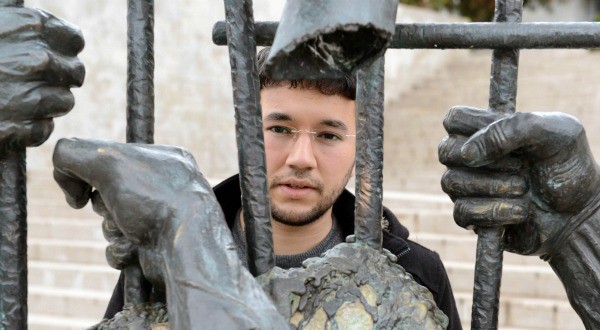
Tamara Abdul Hadi in Fes - photo by Vanessa Bonnin

While writing this article I am sitting on a train and opposite me are two Moroccan men, travelling separately. One is sleeping, his dark eyes closed and shadowed under the hood of his jacket, his full lips peaceful under a long elegant nose. His dress is modern – jeans, striped jumper, black coat, except for the pair of traditional yellow babouche on his feet. The other is reading a text in Arabic (back to front in my Western eyes) and is slightly paunchy in the face, with thinning black hair despite his relative youth.

I am alone in a first class carriage with them and stereotype demands that I – a Western female travelling alone on a train, late at night – should be cautious and perhaps fearful.

In reality this concept is very far from the truth.

The sleeping man had helped me with my heavy suitcase onto the train, offering the moment I had paused uncertainly looking at the steps up to the carriage. He had also helped me find my seat and lifted the suitcase onto the rack, taking pains to ensure it was secure and would not fall. The reading man, on noticing I had finished my book and was resting, offered to switch off the overhead light in case I wanted to sleep. Despite the fact this would have meant he could not continue to read himself.
Neither of them have stared, leered or done anything to make me uncomfortable – they have been respectful and courteous.

The point I am making is that Moroccan men are as a different as they are numerous. There is no stereotypical Moroccan man, just as there is no stereotypical Arab man.

This is the premise of Tamara Abdul Hadi’s photographic project called Picture an Arab Man. I first wrote about it in April [See story here] and since she received the funding to continue she has visited Kuwait, the United Arab Emirates, Tunisia and now Morocco. I caught up with her in Fes.

“Yes Morocco! I finally made it!” Abdul Hadi says. “My first impression is that the country is loaded with character and history, and I love that.The people are amazing, I’ve met people who are so very supportive of the project, who gave me their time and I am so thankful for that. In Rabat I saw the city, the art scene, the Kasbah, which was so inspiring.

“Fes on the other hand, I felt the history walking around. The medina was enchanting. Actually, I would use the word enchanting for Morocco in general.It definitely enchanted me!”

Abdul Hadi has been overwhelmed by the positive reaction to her project during her recent travels in the region.

“In each of the countries I found Arab men who were supportive of the project and agreed to be a part of it,” she says. “My general experience from the past four months of shooting for the project has been that no matter the man’s age/background/religion/social class/nationality - they had one thing in common. They wanted to support a project that aims to change the way they are represented in the media and challenge that stereotype.”

Her consciousness of the power of an image has been central to Abdul Hadi’s experience as a photojournalist and informs the direction her work has taken. In 2007 she was working on an assignment for the New York Times in Jordan, covering the visit of then US President George Bush.

“There were demonstrations against his visit and his policies,” she says. "I was photographing the demonstrations and at one point towards the end of the demo, they started burning American and Israeli flags. When that happened, of course all of the photographers ran to photograph that but I chose to put my camera down. Those kinds of images feed the negative stereotypes about Arabs.

“That image was going to get out, about ten photographers working for all kinds of newspapers and photo agencies were taking it, but I felt like it was up to me to put one less damaging image out there.”
Since then she has chosen to focus more on social documentary photography, which she believes has more of an impact in spreading awareness and challenging stereotypes.

However the recent media hype of the demonstrations about the US-made anti-Islamic film shows what she is up against.

“Honestly I don’t even think that ‘film’ is worth talking about,” Abdul Hadi says. “I’m disappointed with the reactions that have spread around the region, and feel like they do harm to the Arab and Muslim image. There are much more important causes to get together about and use our voices for - like Iraq or the situation in Syria.

“Look, there’s no doubt Arabs and Muslims are stereotyped because of the images the media feeds through. And there’s also no doubt that those images are from real situations. But that’s not all there is.
“That’s why I’m doing this project. To show another side. There’s always another side.

“I’m challenging the image we are used to.”

Abdul Hadi is clearly passionate about Arab issues – she wears t-shirts with slogans like ‘Free Palestine’ and ‘I Love Iraq’ and earrings painted with the Arabic saying ‘Al Sabur Miftah il Faraj’, which roughly translates to ‘Patience is a Virtue’.

And her family obviously share her cause of depicting the Middle East in a way that contradicts the Western status quo, through art.

Her sister, multimedia artist Sundus Abdul Hadi (www.sundusabdulhadi.com) has produced the series of work Warchestra commenting on the war in Iraq and more recently Flight Series – a collaboration with Tamara about the uprisings in the Middle East. Her brother-in-law Yassin Alsaman (www.narcy.net) is a musician and writer and has produced work such as the album Fear of An Arab Planet.

Abdul Hadi currently lives in Beirut but has spent time in both Palestine and Iraq recently, and was distraught by the suffering of the people of both countries.

“I went back to my country in October 2011, after a really long time, not having that many memories of it and the experience was a sense of complete shock at how the country looks and how the people are struggling to survive, and seeing my family and how they were living. But the youth really struck me when it came to a sense of hope and creating a feeling of renewal and positivity for the future.”

One way she feels that the younger generations can deal with their experiences is by expressing themselves through art.

“I helped with a workshop with an organization called Sada-Echo for contemporary Iraqi Art, which is an non-profit project supporting new and emerging arts practices through education initiatives in Iraq and public programs internationally. Seventeen young students from Baghdad’s Art institute went through a one-week intensive art course in Sulimaniyah, Northern Iraq.

“Also, I was in Palestine through 2010 and most of 2011 where I taught photography at a United Nations women’s college in the west bank city of Ramallah.

“It was one of the most inspiring and important experiences of my life.

“The kind of work they did really varied between trying to use art as therapy, and the work would be very dark, but others would do work that had nothing to do with the darkness. So it depended on their personal expression.

“I believe that art therapy, be it music, theatre, photography, painting, writing and more, is an extremely important tool in encouraging expression, especially in marginalized communities.”

Abdul Hadi’s experience of the youth in Morocco was equally inspiring and she found the response to her project overwhelmingly positive, while also learning more about Arab identity throughout the journey.


Whilst in Fes, Abdul Hadi photographed a variety of young men, including Yassine [pictured above], a local Gnawa musician.

“I was lucky to have met and photographed amazing young men who believed in the concept and wanted to support the project. Through these shoots I learned a lot about Morocco and Moroccan society, just by having conversations with these young men.

“I went to Tunis and Morocco without really knowing anyone – I went in with an open mind, and really had no idea what to expect. I ended up learning more about myself as an Arab from this North African country, which is a 7-hour plane ride from my home.

“One thing I definitely came away with was that I felt Moroccans were extremely proud of their Arab and Berber identity, and I think that is really beautiful.”

Tamara Abdul Hadi’s website can be found here: http://www.tamarabdulhadi.com/
Her stay in Fes was sponsored by Dar Roumana: http://www.darroumana.com


SHARE THIS!
Wednesday, November 28, 2012

Opera Comes To The Fez Medina


Riad Fès have just announced that they will have a mini opera season in Fez. Two of Italy's young opera stars will be Fez with a programme of some of the best loved arias. And the best thing? They will be performing right beside your table as your eat dinner.

mezzosoprano Nadia Pirazzini 

From January 2nd  to 5th, opera is coming to Fez with a feast of fine music. The programme will include the great arias by Gluck, Mozart, Rossini, Verdi, Bellini, Donizzetti, Tchaikovsky, Bizet, Strauss, Puccini, Massenet, Saint-Saens, Gershwin and Tosti. The performances will be by mezzosoprano Nadia Pirazzini and sopranoValentina Corradetti accompanied by pianist Cristina Giardini.

sopranoValentina Corradetti

Dinner is 550 MAD per person (excluding drinks) 
Please note that the concerts start each evening at 8.30 pm. Punctuality is essential! 

Riad Fès - Relais & Châteaux


To find out more, or to make a reservation
Telephone: +212 535 74 12 06
Email: reservations@riadfes.com
Website:  Riad Fès - Relais & Châteaux
Address:  5 Derb Ben Slimane Zerbtana 


SHARE THIS!

Friday, November 23, 2012

Moroccan News Briefs #80

This week's wrap-up of news from around Morocco 

Free Press in Morocco

Communications Minister Mustapha Khalfi said this week that there could be no "democratic evolution" in Morocco without a free press.

"There cannot be democratic development without a free and responsible press," Khalfi, who is also government spokesman, told a seminar in Rabat on "Evaluating the freedom of the press."

"Morocco is classed as the worst in north Africa... The observer organisations use indicators that are justified, but other factors are involved that are not very precise, which is why dialogue is needed," he said.

"A number of categories do not reflect the reality on the ground," added Khalfi at the opening of a two-day seminar attended by Human Rights Watch (HRW) and Reporters Without Borders (RSF).

As The View from Fez reported earlier, Al Jazeera TV will be allowed to return to Morocco. In addition, Sky News, BBC and Al-Türkiye will soon have permission to broadcast in Morocco.  The minister said that the accreditation of Al Manar TV and Al Mayadine was still under consideration because of the large number of contacts in this folder. El Khalfi, who presented the budget allocated to communication for the year 2013, said the Moroccan media field would expand to include the linguistic and cultural aspects as required by the new constitution.


 The Moroccan Istiqlal party wants to legalize cannabis cultivation 

In parliament on Tuesday Nouredine Mediane, member of the Istiqlal party, has fiercely defended the legalization of cannabis cultivation in Morocco. He did so in the presence of Interior Minister Laenser.

The President of the Istiqlal group in the House of Representatives, explained that cultivation could be beneficial for citizens, if it is done in limited areas.

Nouredine Mediane, speaking at a session on the budget of the Ministry of Interior, said that "the transformation of barley into beer and figs into mahia, does not prevent the legalization of barley cultivation or the cultivation of figs."

Mahia is a popular traditional alcoholic spirit made from figs. Morocco already has a very successful wine and brewing industry.


Fez airport - bad news

Passenger traffic at the airport Fez Saïss has decreased by 21.36% during the month of October, compared to the same period previous year, according to statistics from the National Office of Airports (ONDA). This is mainly due to the cancelation of Ryanair flights due to the dispute between the airline and ONDA.


Ryanair returns to Morocco

Ryanair, Europe's only ultra-low cost airline, confirmed the return of 2 London-Marrakech routes to its winter schedule, with 8 weekly flights to/from London Stansted (4 per week) and London Luton (4 per week) from February 2013, as late additions to its winter 2012-13 schedule.

According to Ryanair's Stephen McNamara, "Ryanair is pleased to confirm the return of its London Stansted-Marrakech and London Luton-Marrakech routeswhich will start in February 2013, as late additions to our winter 2012-13 schedules, meaning UK passengers can escape the cold on our low cost routes and enjoy some African sun this winter. To celebrate these routes, Ryanair is launching a 100,000 seat sale with prices starting from £18 for travel across Europe in December, which are available for booking until midnight Thur (22 Nov). Since seats at these crazy low prices will be snapped up quickly, we urge passengers to book them immediately on www.ryanair.com."


Air Arabia announces new route

Air Arabia Maroc, a subsidiary of the Sharjah-based low cost airline, has announced the expansion of its network to Montpellier in southern France on November 14. The carrier is now operating a weekly service with a A320s from Marrakech, complementing existing Montpellier services from Casablanca, Fez and Nador.


Moroccan Unemployed Protest

Moroccan police with batons broke up a protest by more than a thousand unemployed graduates in central Rabat on Wednesday, the second protest this week ahead of the parliamentary vote on the first part of the 2013 budget.

Leftist and Islamist graduates protested in different groups of several hundred each in the area around the Moroccan parliament, in an apparent effort to outwit police who prevented protesters gathering outside the parliament building on Sunday. The graduates said the government had broken promises made in the past year.

"We want jobs," said protester Hicham el-Hachemi. "We got a written promise and the attention of the government, so we are here to push them to take us into consideration."

"If the government doesn't respond, we will unify all the jobless and organise a massive protest," said Mohamed Amine Sekkal, one of the organisers of the protest.


Karan Johar films at Marrakech Festival

Hindi Cinema completes 100 years next year and the Marrakech Film Festival will be the first to pay a tribute to the centenary. As a special gesture they will be screening some of the Hindi movies that have made a mark this year and in the past.

Karan Johar
Karan Johar's Khabhi Khushi Kabhie Gham will be screened on the opening night. Amitabh Bachchan and Karan Johar will be attending the screening at the main square. On 2nd Dec, two of Johar's films that released this year Agneepath and Student Of The Year will be screened at the main square. Johar will be at the screening for Agneepath alongwith Rishi Kapoor. Johar, Sidharth Malhotra, Alia Bhatt and Varun Dhawan will atttend the screening at the main sguare for Student of the Year.
For Karan, it is even more special, because perhaps for the first time a festival is having three screenings from his banner.

“It’s a great tribute for the Indian film fraternity to be honoured at an international platform such as this. The festival also has a special emotional connect with me because my films, such as Kabhi Khushi Kabhie Gham, have a vast audience in Morocco,” says Karan.


Moroccan Children Acting Debut in Advert - Stunning

A new advertisement for Nedbank Private Wealth features an amazing performance by two Moroccan children. We would not normally bring you an advert, but the performance of the children is exceptional and worth watching. The filming was directed by Egg Films' Kim Geldenhuys.

Working closely with M&C Saatchi Abel executive creative director Gordon Ray, art director Helen Botes and producer Bronwyn Henry, Kim shot on location in Morocco at Ait Benhaddou, a fortified city and UNESCO World Heritage Site that has hosted films like Gladiator and Prince of Persia.

The two lead children were street cast, had never acted before, and didn’t speak English, but both produced memorable performances.  with Kim directing them via a Moroccan actress who acted as the translator.


SHARE THIS!

Thursday, November 22, 2012

Thanksgiving Day in Morocco

Like halloween, Thanksgiving Day is not a Moroccan holiday and yet every year it is celebrated around the country among the expat community. The eating of turkey is traditional and turkey salesmen in Fez reported higher than normal sales over the last few days. Today The View from Fez went hunting for a Thanksgiving Day celebration and we did not have to go far before the smell of roast turkey and baked pumpkin pie wafted into our nostrils.


The turkey being carved
Delicious turkey stuffing

The celebration of Thanksgiving Day is a national holiday primarily in the United States and Canada. It is said to have originated with the early colonists giving thanks for a good harvest. Thanksgiving is celebrated each year on the fourth Thursday of November in the United States and on the second Monday of October in Canada. Because of the longstanding traditions of the holiday, the celebration often extends to the weekend that falls closest to the day it is celebrated. Several other places around the world observe similar celebrations. Thanksgiving has its historical roots in religious traditions, but today is celebrated in a more secular manner.


The tradition of having pumpkin pie at Thanksgiving is an interesting one. Early Americans would not have had pies because they had no ovens in which to bake them. However, some suggest they stewed pumpkins or filled a hollowed out shell with milk, honey and spices, and then baked it in hot ashes.


One of the earliest pumpkin pie recipes that includes a crust comes from Francois Pierre la Varenne, the famous French chef and author of Le Vrai Cuisinier Francois (The True French Cook 1661). It was translated and published in England as The French Cook in 1653. It has a recipe for a pumpkin pie that included the pastry:
Tourte of pumpkin - Boile it with good milk, pass it through a straining pan very thick, and mix it with sugar, butter, a little salt and if you will, a few stamped almonds; let all be very thin. Put it in your sheet of paste; bake it. After it is baked, besprinkle it with sugar and serve - The French Cook
.
In the USA many pumpkin pies are made with store bought pastry crust and tinned pumpkin. We can report that the pumpkin pie we sampled in Fez was much more the genuine article; real pumpkin and homemade pastry - delicious.

SHARE THIS!

French Institute Film Festival Fez


  FILM FESTIVAL FEZ

  EMOTIONS AND FEELINGS 

  IN PARTNERSHIP WITH

  ASSOCIATION OF FEZ SUN 


FROM 23 TO 25 NOVEMBER REX CINEMA 

   The essence of cinema is not he give us emotions, bring us into     the lives of others, with their joys and their sorrows? Family stories, love stories, often frustrated by unexpected setbacks, disasters, betrayals, injustices, friendships disappointed, unexpected difficulties. The film makes us share. These are the stories of others, but also ours. "We swim in full melodrama," it is sometimes said. What happiness.

FRIDAY, NOVEMBER 23

17H
OPENING FILM
THE FIFTH STRING
IN THE PRESENCE OF THE DIRECTOR
SELMA BARGACH 

(2011) Morocco
Original
French subtitles


In 1999, Malek, a young passionate musician lute, leaves his old Medina of Casablanca, from his uncle Amir. To teach him the intricacies of lute music of this master promises to reveal the secret of the 5th string and gives the example of Ziryab, an exceptional musician. But Amir quickly realize the boldness of his nephew, the place he took in his life and does not let him go. During his rigorous teaching, Malek meets Laura, a young musician, who gives him the energy to pursue his dream.

19H
MIRAGE OF LIFE 
DOUGLAS SIRK 

(1959) USA
U.S. version
French subtitles


Lora Meredith, a young widow wanting to become an actress, meets Annie Johnson, a black woman whose daughter, Sarah Jane, white skin. Sarah Jane and Susie, the daughter of Lora Meredith, befriend and pose on the beach at Coney Island for the amateur photographer Steve Archer. Uniting their misfortune, Lora and Annie decide to live and raise their daughters together until the whirlwind of fate involved ...

FOLLOWING THE PROGRAM OF SATURDAY 24 AND SUNDAY 25 AND DOWNLOADABLE ON THIS LINK


SHARE THIS!

Autumn Tourism in Morocco

While the flow of visitors arriving in Morocco had been relatively steady over the last month, the numbers appear to have increased in the last couple of weeks. Tour groups from Europe as well a considerable number of families from South America, Australia and New Zealand have been arriving recently. Guest house owners in the Layoun and Rcif areas of the Fez Medina report being at full capacity and with many forward bookings. Visitors are taking advantage of the fact that autumn is a cool but beautiful time of year and after the recent rains the countryside is green for the first time in months.

A frozen cedar forest - photo Jearld Moldenhauer  - Dar Balmira Gallery 

The snowfalls in the High Atlas have abated for the moment and the roads have been cleared of the snow.


Recent visitors (pictured above and below), Amy from Australia and Saara from Finland, exploring the Fez Medina for the first time found it "awesome". They spent a couple of days shopping in the Medina before heading off on a day trip to the Roman ruins at Volubilis, lunch in Moulay Idriss and a visit to the granaries in Meknes. 


Booking Early

Michele Reeves from Plan-it-Fez says that October was a very busy month, and though the numbers of arrivals have slowed slightly, it remains steady. Recent arrivals have been from America, the UK and countries in South America and most had the foresight to book well in advance. Michele says that last year people were booking accommodation and tours at the last minute which caused problems with supplying vehicles. Now, however, she says people are booking for late November and December, well in advance. Culinary tours and day trips, she says, remain incredibly popular.


Aisha Bail (pictured above), who manages Riad Rcif, says that the last couple of months have been incredibly busy with guests flowing in from European countries (due to the discount flights). The interesting demographic change she has noticed is there have also been many South American vistiors from countries such as Argentina, Mexico, Chile, Columbia and Brazil. They have also had a growing number of tourists from the Scandinavian, Baltic and Eastern bloc countries including Lithuania, Poland and Russia. Other riad owners in the Layoun, next to Rcif, have reported an increase in visitors from the Indian subcontinent.

Aisha Bail agrees with Michele Reeves that there is a trend towards many people booking well in advance. Some, she says, as far ahead as August 2013. Like Michele Reeves, she welcomes this as it makes management so much easier.

False Guides

The problem that concerns Aisha Bail most is the new breed of sophisticated false guides on the trains. The View from Fez has reported on this before, but it is worth repeating the warning. According to Aisha, the men, posing as businessmen, get on the trains to Fez at Meknes or Casablanca, and then try to convince visitors that the riad they are staying at is not a good place. Other visitors say that the men act in pairs with one laying the ground work and a follow-up person backing up the stories of poor accommodation. They also try and convince people that where they have booked is a "dangerous" area of Fez. They then offer to act as their guide in Fez and find them "better" accommodation. Unfortunately, even though many false guides have been stopped in recent weeks, the men on the trains continue to evade the police.

More info: 
Plan-it Fez: email: info@plan-it-fez.com. Website: www.plan-it-fez.com Tel: +212 (0) 678 549 482
Riad Rcif website
Rent a riad in Fez
Morocco Basics 

SHARE THIS!

Wednesday, November 21, 2012

Extreme Homes Film Shoot in Fez


The Fez Medina is about to get some major exposure on television with an audience numbering in the millions. The featuring of two Fez Medina houses on the show Extreme Homes and the footage of Fez taken in glorious weather will hopefully provide a big boost to tourism

The beautiful Riad n°9

The word "extreme" means different things to different people, and what may seem extreme to one person is simply "home" to another. The TV series "Extreme Homes" takes an up-close look at some of the world's most spectacular houses ever built — including a modern Italian castle, a seaside house made of refrigerator panels, a floating home that was a ferry boat and a spherical house that revolves with the sun. Now the film crew have been in Fez finding out what makes the Dars and Riads of the Medina so unique.

The crew spent a day with Stephen di Renza and Bruno Ussel at the stunning Riad n°9 and then a day with The View from Fez team at the more modest Riad Zany. Here is a quick look at the crew in action.


Cameraman Piers (left) with Joseph Hassel the Producer/Director
Sue (Aisha) Bail from Riad Rcif drops in to bring cakes and chat with the director
Musicologist and oud player Philip Murphy 
French camerawoman Claire taking detail shots 
Claire in the kitchen with Rachida making mint tea
Joe and Piers discussing continuity


SHARE THIS!

Monday, November 19, 2012

TINGHIR-JÉRUSALEM: ECHOES OF MELLAH - Documentary on Wednesday


As part of their Documentary Month, the French Institute in Fez is showing TINGHIR-JÉRUSALEM: ECHOES OF THE MELLAH - with the director Kamal Hachkar in discussion after the film. The film is in French.


The venue is Cinema Rex on Wednesday November 21 at 7pm

"In France, I grew up in the idea that all Berbers were Muslims. But in my hometown of Tinghir in the Moroccan Atlas, the stories of my grandparents allowed me to discover that other Berbers were Jews. Yet, in the early 60s, despite more than 2,000 years of common history, these Jews left the Atlas. My research showed the buried memory of the generation that experienced the Jewish presence, but quickly this research took me to Israel where I found some of the families from Tinghir. Along with them, between Israel and Morocco, "Tinghir Jerusalem: Echoes of the Mellah" resonates with songs, voices and stories of the dual identity shared between Jews and Muslims." - Kamal Hachkar


SHARE THIS!

Sunday, November 18, 2012

Moroccan Photo of the Day - Omar Chennafi


Today's Moroccan photograph is yet another wonderful shot from Omar Chennafi in Fez. (click image to enlarge)

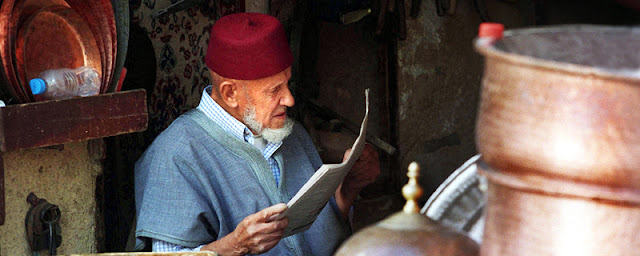
Moroccan men in Fez - Omar Chennafi

SHARE THIS!