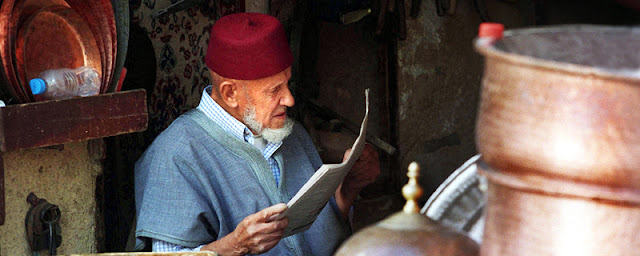

Here is everything you need to know about the Fez Sacred Music festival! Although the festival site is splendid, at this stage it does not contain a lot of background information, so The View From Fez has done some research for you.
While every effort has been made to give you accurate information, any errors are those of The View From Fez - and you should always refer to the official site. There are further links at the bottom of this post.
The 12th annual Fes Festival of World Sacred Music (2 – 10 June 2006) is titled Harmonies. And, if the provisional programme is anything to go by it should be a wonderful event. Please bookmark this page as we will develop this post as more information comes available. Some details may change, but at the moment the programme is as follows.
08:30 p.m. At the Bab Makina
William Christie and Les Arts Florissants (France) - Rameau, Mondonville, Rigel & Mozart.
 William Christie, harpsichordist, conductor, musicologist and teacher, is the inspiration behind one of the most exciting musical ventures of the last twenty years. His pioneering work has led to a renewed appreciation of Baroque music in France, notably of 17th and 18th century French repertoire, which he has introduced to an ever-growing audience.
The vocal and instrumental ensemble Les Arts Florissants is one of the most well known and respected early music groups in the world.
Performing in an historically informed manner, the ensemble was founded in 1979 by the Franco-American harpsichordist and conductor William Christie, and takes its name from a short opera by Marc-Antoine Charpentier.

Les Arts Florissants were largely responsible for the resurgence of interest in France in 17th and 18th century French repertoire, and in European music of this period more generally.
04:30 p.m. - At the Batha Museum
Hassan Haffar & Omar Sermini (Syria)
08:30 p.m. - Bab Makina
First part : Keyvan Chemirani - Rhythm of Speech (Iran, India, Mali)
Second part : Abida Parveen (Pakistan)

Hassan Haffar is a Syrian musician whose latest album is "Jardin d'Eden" (Hassan Haffar et les Munssheds d'Alep)He has a wide following in the Arab world as well as in France. Omar Sermini is a disciple of the famous muedhin of Aleppo, Sabri al Mudallal.
 Keyvan Chemirani is the son of the zarb player Djamchid CHEMIRANI. Keyvan was born in Paris in 1968 and grew up surrounded by his father's music. At the age of sixteen he started to play with his father. For his fascinating album The Rhythm of Speech, Keyvan Chemirani has gathered together a group of musicians from a wide variety of musical horizons. Through improvisation, Chemirani shows the innate rhythmic connections that exist between disparate languages and musical styles. Featured artists include Neba Solo and Nahawa Doumbia from Mali, Suda Ragunathan from India, Alireza Ghorbani from Iran, Delphine Aguilera from Provence, Erik Marchand from Brittany, Franoise Atlan from Andalucia,Halil Neciboglu and Kudsi Erguner from Turkey and Faiz Ali Faiz from Pakistan.
 Abida Parveen is a popular singer of Ghazals, Sufiana kalaam and Punjabi folk. She was born in Larkana, Sindh, Pakistan in 1954. Her father Ghulam Haider, ran a music school. The family was also close to shrines of Sufi saints and she was brought up in the environment of deep mysticism, poetry and music of Sufi saints. She learnt music initially from her father and then from Sham Chorasia gharana master Ustad Salamat Ali khan. Her singing career took off after marriage to Ghulam Hussain Sheikh, senoir producer in Radio Pakistan.
Her style of singing is full throated, almost manly. The strong influence of Begum Akhtar is evident. Her classical background gives her command over ornamentation and control over notes. The intensity she brings to singing makes her a compelling artist.
 Abida primarily sings Qawalees, Sindhi & and Punjabi Kafees of great Sufi poets of the past. After the death of Nusrat Fateh Ali Khan, many consider her the next great mystic singer on the world stage. She is also adept at singing ghazals. An album released by Times Music, Faiz by Abida, made a splash by featuring on the international world music charts. The album was notched at number 12 among the top 20. It features the master poet Faiz Ahmed Faiz's ghazals captured in an exquisite fashion.
04:30 p.m. - At the Batha Museum
Agrupación Música - Missa Criolla (Argentina) - 17th & 18th century music from Latin America.
08:30 p.m. - At the Bab Makina
Fuji Yama Ondekoza: Taiko Drumming from Tokyo (Japan) - Running Drumming and Dancing on the earth.
 The original and still the finest of the folk Masses, Missa Criolla by Ariel Ramírez, comes straight from church liturgy. It is a setting of the Ordinary of the Roman Catholic Mass, sung in Spanish. This setting differs from the settings of Palestrina, Bach, Mozart, et al. The principal differences are that this Mass features Argentine, Creole and Bolivian folk dance rhythms, accompanied by authentic instruments. The similarities are that this Mass has the same deeply moving religious prayers and jubilant praises. Agrupación Música was formed by the Argentinean composer Juan Carlos Paz, in Buenos Aires in 1937.
 Taiko is the heartbeat of Japan. As percussion instruments are generally the most primitive instrument in any society. The taiko existed and was used in the ancient Japan over 2000 years ago. According to some archeological and anthropological researches, ancient people in the Jyomon era already used drums as a communication tool or an instrument for religious rituals. However, the percussion they used is guessed to be quite different from the one used today.
In 1969 Tagayasu Den founded the group Za Ondekoza on Sado Island located in the northern part of the Japan Sea. The group was totally different from the other groups ever formed. The members were not natives of the island, actually they came from all over Japan, and some of them were youths disaffected with bustling big city life. They lived together in a commune, cultivated fields, and ran a marathon daily. The rigorous physical training seemed to be the group's dogma to create a good sound. In 1975, the sensational event that they performed taiko on stage just after they run the whole Boston Marathon astonished the entire world. Za Ondekoza was credited with the first Japanese group with spreading the taiko music all over the world.
04:30 p.m. - At the Batha Museum
Yungchen Lhamo (Tibet)
08:30 p.m. - At the Bab Makina
Curro Piñana - Missa Flamenca (Spain)

Yungchen Lhamo literately means "Chant Divinity". Yungchen has also performed in support of many Tibet organizations, including Tibet House New York, The Milarepa Fund, Students For a Free Tibet, Tibet Relief Fund, Australian Tibet Council, The Dalai Lama Trust New Zealand, AIPLP, the Pema Tsal School in India and for such aid groups as Amnesty International, Walk Against Want, Reebok Human Rights Awards, IUCN and Survival International. At such events, she has performed alongside a variety of luminaries, including Philip Glass, Annie Lennox, Michael Stipe and Sheryl Crow.
Yungchen is currently at work on her much-awaited fourth album, in what promises to be the next chapter in an already exquisite musical career.
Although she spent years in Australia, Yungchen Lhamo now lives and makes music in New York City.
 Curro Piñana is the grandson of the flamenco maestro Antonio Piñana has a huge reputation for meticulous and careful performance, as well as working with emotion and commitment. According to one reviewer... "Curro Piñana has found a field that is promising in terms of developing different styles with an abundance of tonalities, using a continuous and generous array of qualities that allow his voice, which is laden with nuances, to stand out with brilliance. Curro Piñana took care of breaking the ice, accompanied on the guitar by his brother Carlos. He began with cartageneras, followed by taranta and soleá which he said "is very close to my heart because the verse is from a great poem by a great poet, Jorge Luis Borges. Among his work there is a very small book titled 'Entre las seis cuerdas', where he tells the story of Alejo Albornoz, a rich man who is stabbed to death"." MISSA FLAMENCA was composed by the flamenco guitar master Paco Peña.
04:30 p.m. - At the Batha Museum
Jordi Savall: Roots & Memories - Christian, Sephardic and Arabo-Andalous music of the Mediterranean Music. (Spain)
08:30 p.m. - At the Bab Makina
Antonella Ruggiero : Sacramonia with the Arké Quartet (Italy)

JORDI SAVALL, is the most celebrated viola da gambist in the world. His sound track for "Tous le matins du Monde", a film on French composer Marin Marais, starring Gérard Depardieu, brought SAVALL international recognition and sold over half a million copies worldwide.
Jordi Savall was born in Igualada in 1941. At the age of six, he started his musical formation in the school choir of his native city (1947-55). He later completed his formation at the Barcelona Conservatory of Music (cello 1959-65).
Immediately afterwards he began his training in ancient music, collaborating with Ars Musicae and studying at the Schola Cantorum Basiliensis in Switzerland (1968-70). In 1974, with his wife, the soprano Montserrat Figueras, and other musicians from different countries, he created Hesperion XX. With this ensemble, he rapidly came to the forefront of the interpretation of medieval, Renaissance and baroque music, and created a new style of interpretation, characterized by great musical vitality and the same time maximum historical fidelity. After living in Switzerland for twenty years, he returned to Barcelona to found La Capela Reial de Catalunya, an ensemble dedicated to the interpretation of vocal music prior to the year 1800. Finally, in 1989 he created the baroque and classic orchestra. Le Concert des Nations. Unanimously recognized as one of the main present day interpreters of the bass viol, during these last twenty years Jordi Savall has carried out an intense activity as a concert performer and director. He has made more than 100 recordings and won numerous distinctions such as the "Grand Prix de I'AcadEmie du Disque Lyrique" 1990. In 1988, he was designated Officer of the "Ordre des Arts et des Lettres" by the French Minister of Culture. In 1990, the Generalitat of Catalunya awarded him the Creu de Sant Jordi.
Since 1973, he has been a teacher at the Schola Cantorum Basiliensis. His work in teaching, research and as a concert performer makes him one of the main figures in the process of revaluation of historical music which is happening in Europe during these years.
Jordi Savall (b.1941) is a viol player & conductor from Catalunya. He has been one of the major figures in Early Music since the 1970s, and has been a major exponent of solo viola da gamba performance as well as various innovative approaches to ensemble. His repertory ranges from the medieval era to the French baroque and beyond. In the early music newsgroup, Savall is so popular, he is often referred to as God. In fact, this is something of an "in" joke there. Savall's popularity really took off with the movie Tous les matins du monde, although he was well-known to viola da gamba enthusiasts prior to that.
 Italian pop singer Antonella Ruggiero used to sing at parties as a child, his first step to becoming a local star years later. After attending the Fine Arts Academy, the young woman started working as a designer for an advertising company. In 1975, Antonella Ruggiero joined Matia Bazar, a popular vocal group founded by Aldo Stilita, which achieved international recognition in the late '70s. In October of 1989, the singer decided to leave the band. After an inspiring length of time in India, Antonella Ruggiero began her solo career with the release of an album called Libera in 1996. That was followed by 1997's Registrazioni Moderne, produced by Roberto Colombo. It included the song "Per Un'Ora D'Amore," which climbed the most important Italian charts. In 1998, the artist came in second place at San Remo's Festival for singing "Amore Lontanissimo."
In Sacramonia Antonella explores new territories with great power, with music from the sacred repertoir such as... Hail Mary, Kyrie, Missa Luba, Gloria and Missa Criolla.
At the ancient ruins of Volubilis
First part : Songs of the Brotherhoods of Morocco, Al Bouçairi (Morocco)
Second part : Aygun Baylar- Mystical songs - Mugam from Azerbaijan. (Aïzerbadjan)
04:30 p.m. - At the Batha Museum
Black Voices – Sacred songs A capella (England)
08:30 p.m. - Bab Makina
Enrico Macias et Lotfi Bouchnak (France and Tunisia)
 Quietly and gently, informally and gradually, Black Voices was nurtured under the directorship of Carol Pemberton and Bob Ramdhanie. Since 1987, these two friends have steered Black Voices into one of the most solid performance and teaching companies, sharing a cappella, primarily from Africa but also throughout the Diaspora.
The company has been inspired by Sweet Honey in the Rock, Mahalia Jackson, Take Six to name a few, but since inception, has forged its own dynamic way of distilling and re-presenting black music from a Caribbean, black British perspective. Grounded in the black church, the group began presenting a cappella, both sacred and secular, which was always challenging and entertaining. From Gospel to spirituals, Caribbean to African, jazz and blues, Black Voices is firmly rooted in music that energises and uplifts, challenges and educates.
The company hosted and presented its own a cappella series with BBC Radio 2, has performed for radio and television in numerous countries around the world, has produced six CDs, researched, produced, directed and performed in several international collaborations.
 Enrico Macias, whose real name is Gaston Ghrenassia, was born on December 11 1938 in Constantine, Algeria, into a Jewish family. He had a normal schooling, but also enjoyed music, particularly the guitar. His father was a violinist in the orchestra of Cheick Raymond Leyris, the great master of Maalouf, the Arab-Andalucian music unique to Constantine. At 15, young Gaston was already a member of this prestigious orchestra, and soon became the heir-apparent to Cheick Raymond.
In the beginning of 2003, Enrico Macias released "Oranges Amères", his latest album produced by his son Jean-Claude Ghrenassia. Featuring the singer’s come-back to the eastern sounds of his early career, the album also proposed lyrics conveying a pacific message. Also entitled "Oranges Amères" and penned by Marc Estève and Art Mengo, the first track set the subtle mix between tradition and modernity that ran throughout the rest of the album.
For the first time in six years, Enrico Macias embarked upon an enthusiastic tour around France to present his new songs to his faithful public. Starting with the Olympia from March 1st to March 9th, he also took part in many summer festivals including the Vieilles Charrues in Carhaix in July.
Along with many other public personalities, he participated in the Women’s March "Ni putes, ni soumises" (Neither a whore, nor a submissive housewife) in order to demonstrate against the rise of sexism and poverty within the French inner cities.
 As sales of the album "Oranges amères" topped the 100,000 mark, Enrico kicked off a major autumn tour which included a date at the Zénith in Paris on 15 November. Around this same period Enrico also released a double live album entitled "Live à l'Olympia 2003," which featured a selection of recent hits and old favourites.
04:30 p.m. - At the Batha Museum
"Sufiyana" Music - Sacred music from Kashmir (India)
08:30 p.m. - At the Bab Makina
Saber Roubai sings Abou al Hassan al Shusturi (Tunisia)
Sufiyana - the core of Sufi thought is for each being to be "in the world, but not of it". To be free from all material aspirations and to to achieve a spiritual experience of intensity and immediacy that transcends conscious striving. Over the centuries, this practice has engendered a vast corpus of poetry articulating the mystical experience and the experience of the mystics.
In Kashmir, the Afghan rulers introduced Sufiyana music has its origin from Iran and was dominant in the early twentieth century.The instruments generally being used are Kashmiri Sontoor, Saze-Kashmir, Kashmiri sitar and Tabla. The leader sings and the accompanist follow and play the instruments also.
The instruments which are generally being used in the Chakri are: Rabab, Sarang (Kashmiri), Natu (the earthenware pot), lately Harmonium and Banjo have been added to it. Chakri is followed by Roff, sung in continuation with Chakri but the tempo is slightly faster.

Saber Roubai has a huge following in the Arab world and is known to give marathon concerts that go on to the very early hours of the morning. He has many cds but information about him in English is unfortunately scant.
04:30 p.m. - At the Batha Museum
Mystical songs of the Women of the Maghreb (Morocco, Algeria and Tunisia)
08:30 p.m. - At the Bab Makina
First part: Cantates (France)
Second part: Salif Keita (Mali)
 One of the world music mega-stars, Salif Keita is known as The Golden Voice of Mali.
 Salif Keita's unique sound blends the traditional styles of his West African homeland with influences from Cuba, Spain, Portugal, and the Middle East. The instrumentation that accompanies his singing represents a fusion of European and African popular music, ranging from guitar, organ, and sax to traditional African instruments such as the kora, balafon, and djembe, often synthesized and sampled. He has enjoyed a prosperous career not only in his native Mali, where he was awarded the National Order of Guinea by President Ahmed Sekou Toure, but also in Europe and America, where he became well-known after moving to Paris and collaborating with other African pop stars there.
"Happiness isn't for tomorrow. It's not hypothetical, it starts here and now. Down with violence, egoism and despair, stop pessimism. Let's pick ourselves up. Nature has gven us extraordinary things. It's not over yet, nothing's decided. Let's take advantage of the wonders of this continent at last. Intelligently, in our own way, at our own rhythm, like responsible men proud of their inheritance. Let's build the country of our children. And stop taking pity on ourselves. Africa is also the joy of living, optimism, beauty, elegance, grace, poetry, softness, the sun, and nature. Let's be happy to be its sons, and fight to build our happiness."
- Salif Keita, December 2001
*****************************************************************
As well as the main program, there is a secondary festival -The Festival in the City.
It runs from the 3 to 11 June at different venues :
- Bab Boujloud Square : Free concerts of sacred music.
Some of the concerts given at Bab Al Makina are repeated at Bab Boujloud.
- Dar Tazi : Sufi Nights featuring various Sufi Brotherhoods, in a convivial and spiritual atmosphere.
- Youth Hostel of Fès : Art Workshops
- Batha Museum, Bab Boujloud Square and Dar Tazi : Art Exhibition
At this stage the provisional program for the Festival in the City will include:
Saturday 3 June
- Fanfare March, Salé Airforce Base
- Naima Samih
Sunday 4 June
- Hamid El Kasri
Monday 5 June
- Ibn Al Arabi Ensemble
- Rachid Gholam Ensemble
Tuesday 6 June
- Youth Talent Show
- Najat Atabou
Wednesday 7 June
- An evening with Azzedine Montasser, accompanied by
- Amal Abdelkader
- Fadwa Imalki
- Ahmed Ibrahim
Thursday 8 June
- Bnet Aichatah: Hassani songs
Friday 9 June
- Fatima Tabaamrant: Amazigh songs
Saturday 10 June
- Evening of Tribute
Sunday 11 June
- Hadda wa aki
Official Festival Site
THE SPIRIT OF FES
THE VIEW FROM FEZ: The Fes Sacred Music Festival
THE VIEW FROM FEZ: More on the Fes Sacred Music Festival
THE VIEW FROM FEZ: Festival Accommodation Shortage!
Tags: Morocco, Fès, Sacred Music, Festival


