Friday, October 07, 2016

Election Day in Morocco


Friday, October 7 is legislative election day in Morocco These are the second elections to be held since the reforms of the 2011 Constitution and the tenth since independance. Expert commentators suggest it will be a struggle between two of the major parties - the PJD and PAM. Others in the mix for opposition will be the old Istiqlal and RNI or the FGD, which wants to establish itself as a third-way and revive the left. There are thirty parties taking part in the election


Less than half of the population or some 15.7 million Moroccans are registered on electoral lists. The voting takes place in 92 constituencies to elect 395 deputies, including 305 under local constituencies.

Of critical importance will be the participation rate; in 2011 it was barely 45.3% of the 13.6 million voters registered on the electoral roll at that time.

On social networks, many Moroccans living abroad (MRE) complained of not being able to participate directly in elections, having to settle for proxy voting. The question of the vote of MREs and their representation in parliament was the subject of a long debate between political parties and the Ministry of Interior, which cited several obstacles to a direct vote of the MRE.

For Istiqlal's Hamid Chabat it may well be a close shave

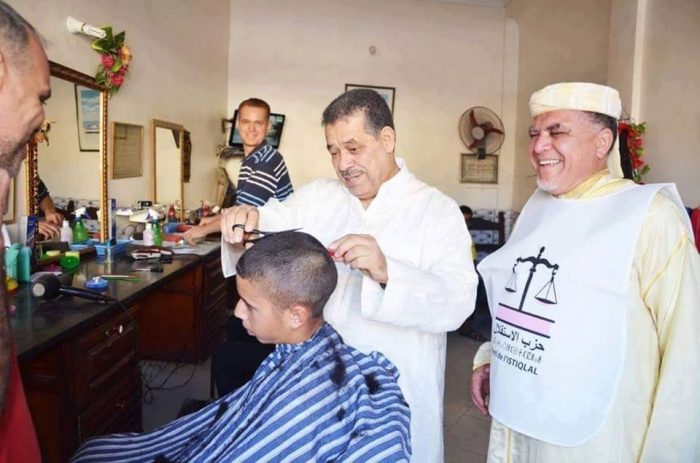
Meanwhile the candidates are going to great lengths to endear themselves to the public by staging photo-opportunities. If there was a prize for generating the widest range of photo-ops it would probably go to Hamid Chabat, secretary general of the Istiqlal party who tops the list of the candidates in the Fez North constituency. In various shots, he has appeared with a mechanic, before going to a hairdresser where he was photographed wielding the the barber's scissors. Then he was shown preparing donuts and drinking yogurt.


PAM (Party of Authenticity and Modernity) brought out "the PAM Girls" with plate after plate of food.

There are 37 national and international bodies, including 31 national associations, accredited to observe the elections, in addition to the Observers of the National Council for Human Rights.

Polling stations opened this morning at 8am and, according to a statement from the Interior Ministry, there have been no problems.  The identity of voters is be based on the national ID card and after voting people's thumbs are marked with indelible ink.

The Interior Minister Mohamed Assad will make a live television report either at 10:30 or 11 p.m.


At the end of the day only one thing is certain - there will be a lot of cleaning up to do. The littering of the streets by party supporters has drawn anger from a large number of people on social media. It was certainly not the right image for a country where the "Zero Mika" (no plastic) campaign was hailed as progressive and socially responsible. It is highly unlikely that the politicians will pitch in and help clean up the mess they created - all of which is, as one young Moroccan said on Twitter, is "situation normal".

SHARE THIS!

Thursday, October 06, 2016

Large Numbers of Chinese Tourists Arrive in Fez


The cooler weather is not the only thing to arrive in Fez in the last few weeks. Along with superb weather has come an influx of thousands of Chinese tourists. Not only are there many large tour groups, there are also couples and individual travellers

And, it is not only Fez, but the entire Kingdom that is benefiting, with the number of Chinese Tourists to Morocco tripling since May. While South Korea, Thailand and Japan continue to be the most popular travel destinations for Chinese tourists, there was a 3500% year-on-year increase in visa applications to Morocco processed by Ctrip, a Nasdaq-listed travel agency based in Shanghai, China.

The major factor behind this boom is the Memorandum of Understanding signed last May which aimed to strengthen bilateral cooperation between Morocco and China, particularly in tourism.

Lahcen Haddad, Minister of Tourism, and Li Jing, the Chinese Director General of the National Tourism Administration, signed the Memorandum of Understanding to strengthen bilateral cooperation in tourism, investment and promotion and to promote the development of tourist flows, including knowledge exchange in the fields of management and training.

Among many things, the MoU has canceled the visa for Chinese tourists to visit Morocco. This resulted in the increased the interest of the Chinese tourist market in the kingdom by 300 percent, as reported by China Tourism Academy.

This rise in interest is the highest in the world in comparison with other touristic destinations that stand at 60 percent increase at best. This is mainly due to the competitiveness of Morocco in regards to travel cost.

According to Moroccan newspaper Hespress, Morocco has become one of the ‘warm’ destinations for Chinese tourists, as the temperature drops in other destinations.

A map posted by the same Academy shows that Chinese tourists are more drawn to Morocco than any other African country, while South Africa is the second most attractive African country.


Earlier this year, during a seminar was co-organised by the Ministry of Tourism, the Moroccan National Tourism Office (ONMT), the National Tourism Confederation, and the Tourism Observatory, where Morocco’s Minister of Tourism reported on Morocco’s plan to attract 100,000 Chinese tourists by 2020.

“The Ministry of Tourism offers an important position to the Chinese market in its vision for the future, which expects to attract 100,000 Chinese tourists by 2020,” said Haddad.

One obstacle that needs to be addressed is that there are no direct flights between China and Morocco, so popular routes with third countries in between are chosen. The packages this year for Chinese tourists include a stop-over in Dubai.

Trips to Morocco are fully booked for this month and September, According to Zheng Lijuan, assistant president, China International Travel Service Co, rips to Morocco in August and September were are fully booked.

China has significant potential as an emerging market for tourists. The country had 98.2 million tourists in 2013 and generated $102 billion in tourism spending in 2012, making it the top country for tourism spending.

Along with the Chinese arrivals Tourism activity rebounded in Agadir during the month of August with a  9.44% increase in arrivals with many coming from the growing  Russian market.

According to statistics of the Regional Council of Tourism (CRT), a total of 140,901 tourists visited Agadir, against 128,744 in the same period of 2015. Moroccans account for more than half of the arrivals - 76,724 against 68,889 a year earlier -  representing an increase of 11.37%. The French came second with 14,549 tourists, a figure down 10.31% compared to the same period of 2015, followed by the English who totalled 7,285 visitors (+ 0.97%).

The Russian market recorded a net increase from 1,188 in August last year o 4089, an increase of 344.19%. This growth confirms the recovery of the Russian market which has already recorded in July an increase of 468%, or 5,180 arrivals against 1,105 in the same period of 2015.

In terms of classification of tourist accommodation unit, classified 4 star hotels come in first with 44,578 tourists, followed by 5-star hotels with 32,386 and tourist villages with 21,248 visitors. The occupancy rate in the various tourist establishments recorded an increase of 4%, or 77.89% against 75.08% in August 2015.

SHARE THIS!

Tuesday, October 04, 2016

Moroccan Dialects Face Extinction


The United Nations Educational, Scientific and Cultural Organisation (UNESCO) has compiled a list of endangered languages in the world. The data collected shows that in Morocco there are eight threatened languages, including two considered "extinct"

The common denominator of these languages is thatthey only exist in remote territories and that the linguistic decline is most severe in regions where Amazigh (Berber) languages are dominant. The languages ​​inherited from the Jewish community or Spanish are increasingly rare.

United Nations Education, Scientific and Cultural Organisation (UNESCO) regularly publish a list of endangered languages and provides a classification system to show just how 'in trouble' the language is:

Vulnerable - most children speak the language, but often restricted to certain domains (e.g., home)
Definitely endangered - children no longer learn the language as a 'mother tongue' in the home
Severely endangered - language is spoken by grandparents and older generations; while the parent generation may understand it, they do not speak it to children or among themselves
Critically endangered - the youngest speakers are grandparents and older, and they speak the language partially and infrequently
Extinct - there are no speakers left.


There remains a gap between law and practice in the use of the Amazigh Language

Berber Figuig and Southern Oran, in the far-eastern area of  Morocco, remains the preserve of the Zénètes, language. The Zénètes are Amazigh people nestled in the coast from Tangier to Tripoli. At present between 20 and 30,000 people still speak this dialect, says Unesco. These populations are confined in seven oasis: Did Wadday, At-Amar, At-Lamiz, At-Sliman, At-Anaj, At-Addi and Iznayen. According to the terminology used by the UN is "vulnerable"; most children can speak the language, but often restricted to certain areas such as home.

The father of the famous traveller, Ibn Battuta, was a speaker of the Zénètes language. According to the Algerian researcher Rachid Bellil, the word Zenetes was Arabised and its meaning is Iggen or ijjen which means 'one' in Amazigh.

Worse off than their Amazigh peers around Figuig are the populations of Beni Snassen in the mountainous chain in the far north-eastern Morocco, who also face the loss of their language. This is where the tribe Aït Iznassen has long built its stronghold in territories of strategic importance.

Unfortunately, no census has ever included this variable of the mother tongue, says Unesco, but estimate some 25,000 people continue to speak the Tamazight dialect of this region. It is especially in the small towns that dot the Oriental as the tongue is still spoken - Aklim, Madagh, Aghbal, Tafoughalt, Chouihiyya Sidi Bouhouriyya and Fezouane. However, this Tamazight dialect of Beni Snassen is "endangered" as children no longer learn the language as their mother tongue at home.

Moroccan Judeo-Arabic, classified as "severely endangered" is "spoken by grandparents; while the parent generation may understand it, they do not talk to each other or with children "  Estimates say only 5000 speakers remain,  mainly concentrated in the region of Fez.

Ferdinand II of Aragon and Isabella I of Castile caused the spread of Judeo-Spanish

Judeo-Spanish is derived from old Castilian and Hebrew and is now spoken by "a number" (in fact, no data on the speakers of the dialect is available according to UNESCO).  Speakers are mainly Sephardic Jews of Western Europe and North Africa. Besides Algeria, it can be found in Melilla and Sebta. Judeo-Spanish originally spread around the Mediterranean after the expulsion of Jews from Spain by a decree signed in 1492 by the Catholic Isabella of Castile and Ferdinand II of Aragon.

Sanhaja of srayr is a language related to several dialects - Zenaga, chleuh and Kabyle - and is still spoken in northern Morocco, west of the Rif. Recent research showed some vitality, although it is classified as "critically endangered"; the youngest speakers are grandparents and their ancestors, and they speak the language partially and infrequently.

The data on Ghomara, named after the eponymous ethnic northern Moroccans of Berber origin, between the rivers Oued Laou and Ouringa, north of Chefchaouen, Tetouan south and east of the Rif, is more critical.  The people of Kasba Tadla, about thirty kilometres from Beni Mellal, know little of their local Tamazight dialect. UNESCO says the number of speakers is so small (1,637 people) that is is listed as having "no more speakers ".

Judeo-Berber has vanished. This language, once deployed in rural areas of the upper Atlas and Middle Atlas, did not survive the exodus of Moroccan Jews in the 1950s.

According to writer Ahmed Assid, an Amazigh specialist, the disappearance of some Amazigh dialects is mainly due to the rural exodus, the restricted nature of certain communities and their abandonment by the state.

"The rural exodus has contributed to language decline" - Ahmed Assid

"The Arabisation policy which began with  independence, has had a negative effect on the Moroccan linguistic landscape. These languages have been neglected by the state because they were not taught. Neither have they been the subject of any academic work," says Ahmed Assid.

"Migration to urban centres has emptied the countryside of its inhabitants,and caused the gradual disappearance of the language from one generation to the next. Coming to a larger urban centre an Amazigh speaker is obliged to borrow from other languages, especially Darija. He goes on to adopted the dominant language, the language of the administration - French and Arabic - favouring those that will guarantee his children a place in society and social privileges " .

Yet the state now seems to want to catch up. In 1994, King Hassan II came out in favour of teaching Tamazight in schools, partly due to a larger political opening and partly in response to the pressure of Amazigh-rights activists. In 2003, his son, now King Mohamed VI, put the initiative into practice. In the new constitution he helped create in 2011, Tamazight was recognised as one of Morocco’s official languages. Tamazight writing now adorns the facades of most public buildings.

But “there isn’t a real language policy yet,” says Abdeslem Khalafi, a researcher at the Royal Institute for Amazigh Culture (Institut Royale de la Culture Amazigh du Maroc, IRCAM). “There’s hesitation. Mentalities aren’t ready to integrate Tamazight and give it a chance. There’s a change in discourse, but not yet in practice.”

The recognition of Tamazight as an official language alongside Arabic in the 2011 Constitution is already a foundation stone. "The government talks about the rational management of culture and heritage, including diversity of language and culture that has marked our country. This is a fundamental thing," says Ahmed Assid.  However, he denounces the procrastination of the government, "which has dragged its feet for five years" over the draft law establishing the Amazigh language and its of integration in education and various priority sectors of public life.

Despite the recognition of Tamazight as an official language in Morocco in 2011, only 12% of Moroccan children learn the language in school. While an estimated 35-40% of Moroccans speak various varieties of Tamazight, teachers, students and professionals face difficulties in using the language in workplaces, universities and schools. The wide gap between law and the practical, daily use of Tamazight, has a huge impact on Amazigh cultural heritage

Hopefully, Morocco can save some of its previous linguistic diversity.

SHARE THIS!
Monday, October 03, 2016

Spain and Morocco May Allow Visa-Free Access to Sebta and Melilla


Spain hopes to boost the economy of of its two occupied areas in Morocco - Sebta (Ceuta) and Melilla - by allowing Moroccans visa-free access. The proposal will be studied and (hopefully) applied in principle in a few months


Talks between the Spanish and Moroccan governments on the abolition of visas for entry to Sebta began several months ago. Morocco has been studying a Spanish proposal on access to the territory for all Moroccans without needing of a Schengen visa.

This proposal came as no surprise to the Moroccan authorities, since several Spanish officials, including the governor of Ceuta, have been pushing for the central government in Madrid to take an initiative in this direction. The call from officials became more insistent in view of the sluggish economy in Sebta and Melilla, following the financial crisis which has hit Spain.

The building by Morocco of the Mediterranean port of Tangiers has also contributed to lower economic activity in the two cities, despite their status as tax-free markets.

Morocco, after careful consideration, accepted the Spanish proposal and it only remains for Morocco to study all its aspects, particularly on the security front, which is considered essential due to the radicalisation of a number of inhabitants from these two occupied areas. There is also the issue of hundreds of African migrants who await the opportunity to reach the two cities that are part of the European Union. Free movement of people across the border post of Tarajal will be confirmed when the new government emerges after the elections of 7 October.

"mule women" of Melilla Photo: Fernando Del Berro

Another pressing issue is the thousands of small smugglers and "mule women" who continue to operate in both cities. This commerce takes place daily at Barrio Chino - a border crossing from Melilla to Morocco for pedestrians only. As long as a porteadora can physically carry her load, it is classed as personal luggage, so Morocco lets it in duty-free. The women have the right to visit Melilla because they live in the Moroccan province of Nador. But they are not allowed to reside in the Spanish territory.

Access in future will be granted only to holders of identity cards indicating residence in the Tetouan region. At the same time there is talk of opening another crossing point at Tarajal 2 to reduce the pressure on the first.

SHARE THIS!

Sunday, October 02, 2016

Sanaa Saïda - Happy Islamic New Year!

Sanaa saïda - Happy Islamic New Year - à tout ceux qui ont pour religion l'islam, happy New Year!


Muslims worldwide are commemorating the Islamic New Year observance this weekend. Also known as Hijri New Year, it falls in the second holiest month in the religion's calendar after Ramadan.

As well as marking the beginning of Islamic year 1438, the celebration allows Muslims to think about what they want from their own lives

The View From Fez wishes our readers and their families a peaceful and happy day - Sanaa saïda 

SHARE THIS!

Saturday, October 01, 2016

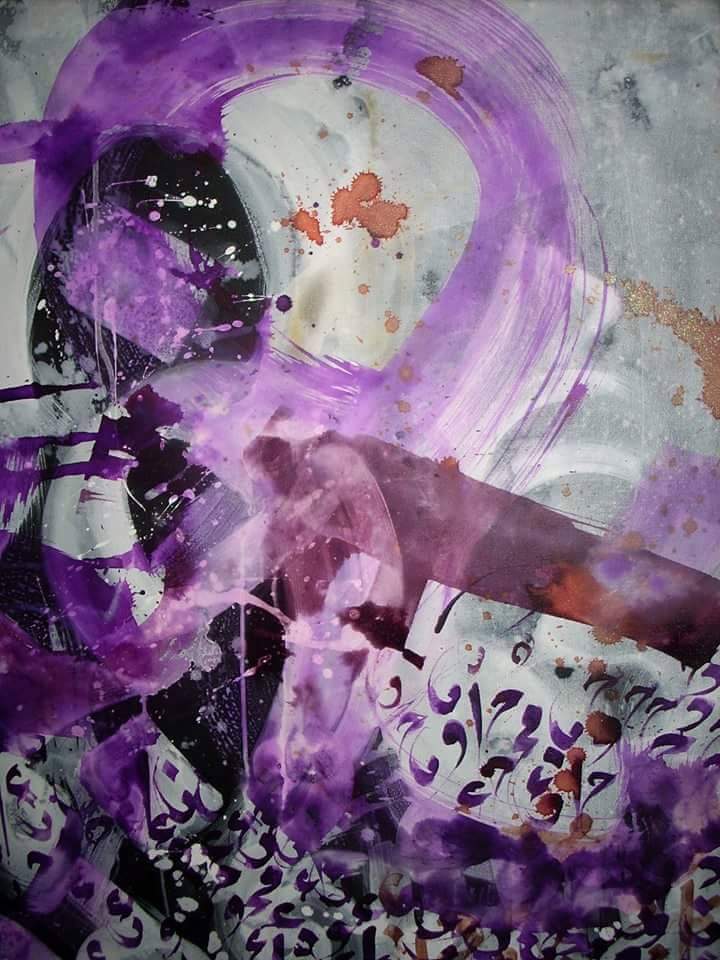
Aziz Kibari - A Popular Moroccan Artist


There are many young Moroccan visual artists striving to make a living in a very competitive sector. One  of them who has shown that hard work, talent and dedication can turn a dream into reality is Aziz Kibari. Born in Beni Mellal in 1973, he has lived and worked in Marrakech since 2003


Aziz is part of an extraordinary family of artists. Habib is a painter, Abdelhadi, a sculptor and a sister who makes paintings carpets and a brother who is a sculptor using the beautiful Thuya wood from Essaouira.

Aziz has worked over the years to improve and expand his techniques and media using gouache and acrylic on paper with warm colours, natural.

Aziz Kibari instantly detects the artistic potential of beldi characters straight out of the imagination of the artist, inspired by his youth on his parent's farm.

"Through my paintings, I try to recover a lost world in all its simplicity with an attachment to the land and nature's inspiration." - Aziz Kibari


Aziz Kibari, who has a BA in English literature, started painting at a young age (at the secondary school). At the university,started exhibiting and selling his first paintings to his teachers and making portraits for his classmates and friends.


In 2007 Aziz spent time at the Cite des Arts in Paris meeting artist s from different countries. He then returned to Marrakesh,and started working, painting,exhibiting. He has been exhibiting at Design and Co Art Gallery since 2009.

A donkey walk
A trip in nature

Aziz kibari
Art Studio Charaf Marrakesh
Mob +212 660 636 484
azizkibari@gmail.com

SHARE THIS!

Friday, September 30, 2016

"Hymn for the Sahara" - Festival in the Desert


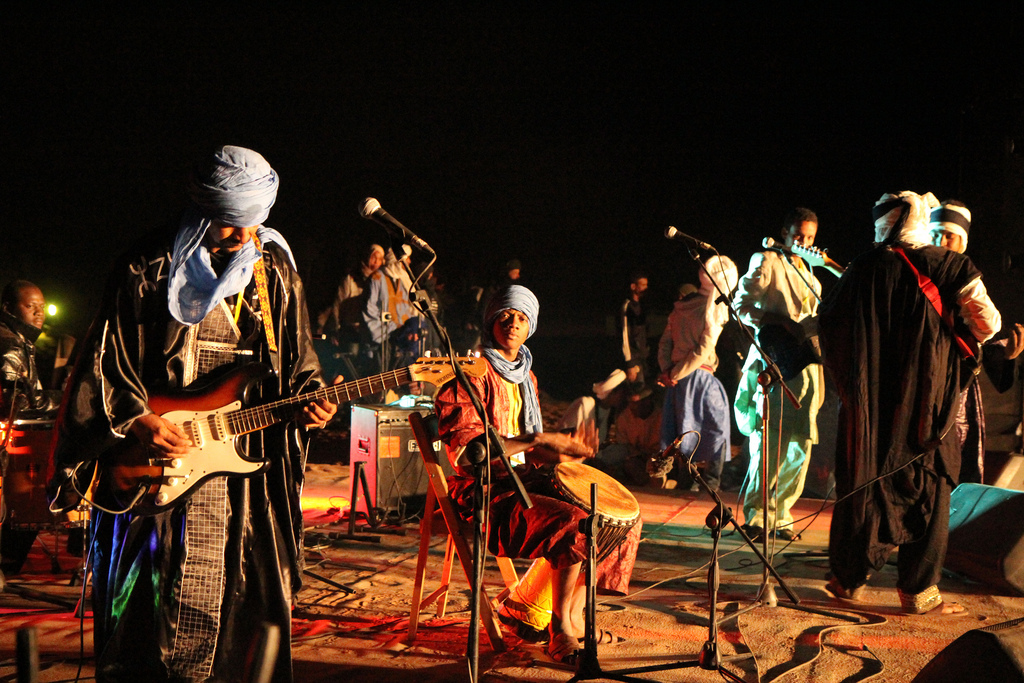
"Hymn for the Sahara" is an exciting 3 day festival under the stars in the desert of south Morocco. It will take place on the 28th, 29th and 30th of October 2016 in M'Hamid El Ghizlane, in the province of Zagora

The organisers aim to celebrate nomadic heritage and world music. In addition the festival will feature the 3rd edition of the Peace Caravan promoting peace and stability in the Sahara and Sahel. This is a festival where visitors can relax in the dunes, listen of music & poetry, dance under the moon and enjoy art or participate in workshops about the fragile environment of the desert.


Festival Taragalte – 7ème édition «Hymne au Sahara» - 28 au 30 octobre, 2016  - M’Hamid El Ghizlane, Maroc
«L’Oasis, source de vie au cœur du Sahara»

Célébration de la Culture nomade et des musiques du monde -Conférences, ateliers, expositions, artisanat et projections de film.

A month to go - and the work has begun

The festival sprung from a team of young local Moroccans who, in their words, "had a dream to make a contribution, no matter how modest, to the development of the Sahara region of Morocco". The team is already hard at work transforming the site in preparation for the festival.

This team, coming from a traditional Saharan Nomad background, wished to contribute especially to the preservation of the ancestral heritage of this region.

Expect tents and a lot of carpets

Taragalte concept was born out of a partnership between the local team with local foundations as well as national and international institutions, all wishing to make a contribution to genuine development of this region.


Taragalte concept not only wants to make an economic contribution to the region, but also to strengthen the cultural exchange between people. To stimulate the cultural exchange, the initiative aims to strengthen the connection between the different communities, already present in the Sahara when the great trade caravans were still running, to increase awareness and preservation of their cultures. The organisers say that exchanges are not only important between local people, but also for people passing through, among each other and with the locals.


Performers include:
Oum, Morocco
Tinariwen, Kel Tamasheq / North of Mali
Sahmaoui Aziz, France / Morocco
Kaira Arby, Mali (representing Festival Timbuktu)
Awek, France
Imerhan N'Tinezraf, Algérie
Hamid Ekawel, Niger
Hassani Group, Mauritania
Mohamed Dorentie (representing Festival Segou, Mali)
DJ U.R.S.N Suisse
Groupe Amazigh Amediaz Band Morocco
DrâaTribes, Morocco
Generation Taragalte, Morocco
Chabab (young) M'hamid, Morocco

Groupe en résidence «Caravane Culturelle pour la Paix» Maroc / Mali: Mariam Koné /
Samba Touré / Benzabo / Cheik Sikasso Ahmed Ag Kaedi / Said Jardouj / Ibrahim Laghferi

Groupe en résidence «Ecole de musique Joudour Sahara/Playing for change»
Pjeunes talents de M’hamid encadrés par:
- Nabyla Maan Morocco
- Fadimata Walt Oumar du Disco / Tartit Mali
- Samira Dainan Netherlands
- Susie Ibarra Philippines / USA


For more info check website: Taragalte.org
The full programme as a PDF can be downloaded here: Taragalte Festival

SHARE THIS!

Monday, September 26, 2016

Moga Festival in Essaouira - Oct 14,15, 16


After the Electronic Dunes festival success amidst the Star Wars sets at the heart of the Tunisian Sahara, the natural scenery of the Game of Thrones series in Essaouira will provide the backdrop for the first edition of MOGA,  a festival of music and electronic cultures. The venture is a new initiative from Panda Events and the Runtomorrow Moroccan collective

For three days, festival-goers will be treated to what the organisers say is "an experience out of time, an unprecedented escape in Essaouira, the old "Mogador", punctuated by intense moments of music, discussions and parties".

 Between the Medina, the beach and guest houses and in the heart of the argan forests will be musical brunches, workshops, exhibitions and digital video installations.

The nearby town of Ida Ougourd, festival-goers can take a walk in this typical riad architecture of the region of Essaouira and enjoy the music. This is the main stage  and is open from 4:00 am to 19h.


MOGA FESTIVAL
Contemporary Music and Digital Arts


Programming: October 14
Bella Sarris [Techno House / Desolat / Australia]
Chaim [Deep House / BPitch Control / Israel]
dOP live [Live Band Techno / Circus Company / France]
ETSU [Techno / Morocco]
SIS [Groovy house & Wild Techno / Cocolino / Germany]
Kali.G [Deep Techno & Ethnic / Wind Horse - Are Serious? / Morocco]

Programming: October 15
Live Soul [House / Innervisions / Germany]
MANDY [Techno House / Get Physical / Germany]
Culoe De Song [House / Innervisions / South Africa]
Shaun Reeves [Techno House / Visionquest / USA]
Driss Skali [Deep House / Casbour, Death by Analog / Morocco]>
Madjy & Massimo [Morocco]

Programming: October 16
Dj Tennis [Deep Techno / Life & Death / Italy]
Magda [Minimal Techno / Items & Things / USA]
Mind Against [Techno / Life & Death / Italy]
Koddi [Deep Techno / Runtomorrow, PWFM / Morocco]
Renaat [Techno & more / R & S / Belgium]
Secret 47 [Deep Techno / Y Serious? / Morocco] Pool party at Sofitel Essaouira Mogador 15 and October 16 Festival-goers will delight in the lush vegetation overlooking the ocean. A superb and huge pool areas, ideal for a "day party" memorable, from 12:00 to 20:00. Programming: October 15 Lee Burridge [Techno House / All Day I Dream / United Kingdom] Gorje Hewek & Izhevski [Techno / All Day I Dream / Russia] Yokoo [Deep House / All Day I Dream / France] Sweet Salty [Deep House / Coco Beach, French Kitchen / France]

MOGA Website and ticketing

SHARE THIS!

El Jadidia to Host 9th Salon du Cheval

Under the patronage of His Majesty King Mohammed VI, the 9th Salon du Cheval (Horse Show) will be held at Exhibition Park Mohammed VI in El Jadida, from the 11th to the 16th of October 2016

Since its creation in 2008, the Horse Show Association aims to promote the horse industry, and highlight the heritage and ancient equestrian traditions of the Kingdom. It contributes to economic and social development of rural areas and brings together the efforts of various operators and professionals in the equine industry in Morocco

A range of different activities highlighting all aspects of the horse: sports, culture, crafts, fun, economical ... and the equine industry: saddlery, farriery, armoury, riding and driving. For the edition 2016, the Organising Committee held a press conference yesterday to present this year's programme.

Under the theme "Traditional equestrian arts", the 9th edition showcases Morocco's equestrian arts such as the famous Tbourida (Fantasia). Troops of the various regions of the Kingdom will compete for the Grand Prix of Tbourida from His Majesty King Mohammed VI.


The 9th edition will feature a number of important breeds including Purebred Arabian and the Moroccan Breeders' Cup for Arabian Horses, the National Competition for Arab-Barb horses, the International Championship of Bearded Horses, as well as an international jumping competition counting towards qualification for the World Cup.

In order to sustain Morocco's equestrian culture, the show dedicates a range of activities for younger children with a competition for ponies and an art event for young talent in a special village for children.

Horse displays will be held daily and will highlight equestrian excellence through the participation of leading international figures.

Lectures on scientific and cultural topics will also take place in order to exchange information about important current topics such as "stem cells in veterinary medicine" and "Tbourida art among Moroccan traditional equestrian arts."

SHARE THIS!