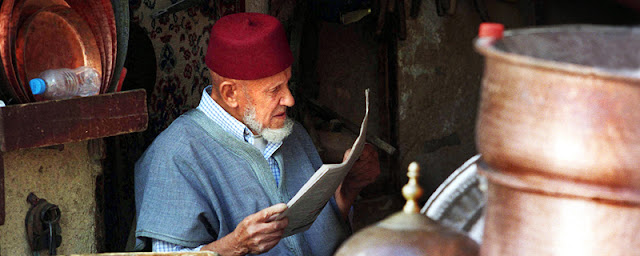
With temperatures in Morocco set to continue in the high 30s (Celsius) people are going to great lengths to stay cool - including taking a weekend break out of the country. In the last in our series on chilling out during the heatwave, our regular correspondent, Vanessa Bonnin, is joined by Kura Perkins in the Italian city of Siena for a horse race like no other in the world. Vanessa Bonnin and Kura Perkins report
While it may be too late this year, one way to beat the August heat in Fes is to jump on a cheap flight to Pisa, Italy – the gateway to Tuscany. It’s summer there too, but with temperatures in the low to mid thirties and soothing landscapes like the Chianti region’s rolling hills, it feels a lot cooler. Another reason to go - twice every year in Tuscany one of the oldest horse races in the world, the Siena Palio, takes place.
Far from a tourist event, Il Palio is a Tuscan tradition. This is no ordinary horse race; it is bareback, there is no betting and the track is a grand medieval piazza – the Piazza del Campo – that dates back to 1292. To the outsider it might seem that horses just run three times around an awkwardly shaped racetrack, but this race is steeped in history, politics, rivalry and the everyday existence of the Sienese people.
To be able to really understand Il Palio, it is necessary to understand the contrade, Siena’s 17 rival city districts. For over five centuries, they have played a vital role in the city’s life and in the organisation of Il Palio.
 |
| Aquila (eagle) contrada flag bearers practice their routines in car parks around the town |
Each contrada owns a geographical area within the city walls and has its own government, coat of arms, official festivities, and patron saints. Contrade are identified by their name, often taken from an animal (turtle or snail, for example) and distinctive emblem and colours.
Two weeks before the race the streets that lead to the Piazza del Campo are adorned with the crested flags and decorative streetlights of the district. You can see the Alfieri (flag wavers) of each contrada practising their complex routines for the pre-race procession – their giant flags sweeping through the air and spinning beneath their legs as they try to perfect the highlight move: spearing the flags many metres into the air to be caught by their partner deftly with their arm hooked under their leg.
 |
| Aquila banners above and Onda (the wave) below |
The annual Il Palio events are the result of a year of preparation by the contrade. It is a chance to prove their might against one another, and to sure up long-standing vengeances with archrivals.
Only ten contrade can take part in each race, held on two days; July 2 and August 16. Seven contrade are automatically entered and the last three names are taken from a hat. Professional bareback riders are commissioned by each contrada in advance of the race but their horses are drawn randomly.
Many hours before the race takes place at 7pm, crowds start to fill the piazza. To secure a position next to the barriers with a good view, it is necessary to camp out from the early afternoon. The wealthier Sienese have the luxury of either booking a seat in the stands (around 400 euros each) or have friends with access to an apartment with balcony overlooking the crowds below. Mixing with the throng in the centre is part of the experience – sociable and convivial until an hour before the race when gritty determination becomes necessary to hold on to your spot!

To keep the crowds entertained, three hours before the race a major historical pageant in medieval dress begins, called the Corteo Storico. Each contrada parades around the dirt track in a colourful array of costumes, ranging from full suits of armour to harlequin-style outfits. The participants seem to be exclusively male, however with the addition of the very feminine medieval wigs worn by many, it is sometimes hard to tell. No one in the parade smiles – perhaps it is considered more dignified when wearing the ultimate fancy dress costume in public.
This pageant is where the flag wavers get to show off their carefully choreographed routines, leaping and twirling with the pride of their contrada resting on their shoulders. The flag wavers also take part in a competition just before the race where according to superstition, the contrada who throws their flag the highest is said to win the race.
The culmination of the parade is the arrival of a large wagon drawn by four white oxen. The wagon carries trumpeters in costume and various dignitaries, but most importantly the trophy – a large silk banner, the ‘Il Palio’ of the race name depicting the Madonna of the Assumption – they are all competing for. As the banner is slowly paraded around the race track, everyone waves their teams flag at it for luck, creating a ripple effect throughout the huge crowd like thousands of colourful butterflies. The banner is then hoisted onto the balcony that holds the city officials, the circuit is cleared of people and the dirt track is swept to perfection.
 |
| Heading to the start line |
Finally, the moment we’ve all been waiting for arrives – the horses and riders emerge and make their way to the starting area.
Silence descends as the police carry a secure draw of the starting order to the race-starter. Il Palio cannot begin until all riders are within the two starting ropes, so the contrada drawn last controls the start of the race. Although unlikely to win, this contrada will walk away the richest as a result of bribes. There is an element of luck in Il Palio however, as long in advance of the race strategies are plotted and inter-contrada allegiances are formed. Wheeling and dealing continues right up to when the starting gun fires.
 |
| Awaiting the last horse to enter the ropes L-R Torre (Tower), Tartuca (Tortoise), Lupa (She-wolf), Onda (Wave), Bruco (Caterpillar) and Oca (Goose) |
Contrada captains can be seen having furious, hushed conversations at the start line. While it may appear the tenth horse is disobediently avoiding the start-line, this is a deliberate stalling tactic while jostling takes place between allied contrade, eager to secure a favourable starting position as a result of the timing of the last horse’s entry.
The horses line up again and again, going in and out of the start ropes. The jockey in tenth position keeps one eye on the start line and the other on his contrada captain. This un-nerving part of the race has been known to take 45 minutes in some years.
Tension rises, contrade scream at one another waving fists, school children chant and the crowd shouts vai, vai, vai!’ (go, go, go!).
 |
| The race is underway |
Just when the wait becomes unbearable, the ropes suddenly drop and they’re off! The race involves only three laps around the track, but with sharp turns and no saddles, it can be dangerous for both horse and rider and jockeys often fall. The race is over within 75 seconds.
 |
| Almost losing it on the most dangerous corner |
This August, Onda (the Wave) won the banner (Il Palio) and the glory. Crowds immediately jump the barriers and stream onto the track, the winning contrada members climb the balcony to claim the trophy and another parade – this time with smiling and emotional people delightedly waving flags – begins. The parties in the streets will last all night.
 |
| The winning horse - Onda contrada |
Preparations for the following year’s Il Palio begin the next day. But for those yearning to enjoy the event again, Siena has a TV station that shows re-runs all day, every day throughout the year – alternatively, it is possible to watch the James Bond film Quantum of Solace featuring a major action sequence set in the middle of Il Palio.
SHARE THIS!