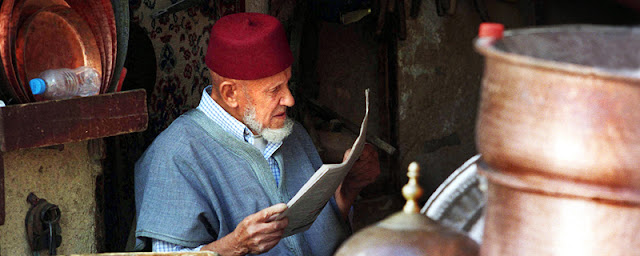
For most travellers, the name “Medina” conjures up images of Fez, Marrakech or maybe Rabat. Of course there are other medinas in other countries, but it did come as a surprise to the team from The View from Fez to discover another Rabat – and one that also had a medina.

Medina (or M’dina as the locals spell it) is the old capital of the island of Malta and compared to the Fez, Medina it is tiny. The population is a mere 300, although it is contiguous with the village of Rabat with a population of around 11,000.
 |
| M'dina seen from the air, with Rabat in the background |
 |
| The Old Gate - the entrance to the medina |
The other outstanding difference, and perhaps a surprising one given the Islamic influences that have affected Malta’s history, is the absence of a mosque. The names M’dina and Rabat (from the Arabic for “suburb”), as well as the layout of the city, reflect the Fatimid Period which began in 870 AD and lasted until the Norman conquest of Malta in 1091 AD. Sadly no buildings remain from pre-Norman times.
 |
| The medina streets can be toured in just twenty minutes |
The Arab chronicler and geographer Al-Himyari recounts that in 870 AD, following a violent struggle against the occupying Byzantines, the Arab invaders, first led by Halaf Al-Hadim, and later by Sawada Ibn Muhammed, looted and pillaged the island, destroying the most important buildings, and leaving it practically uninhabited until it was recolonised by the Arabs from Sicily in 1048-49 AD.
 |
| A courtyard house with fountain |
It is uncertain whether this new settlement took place as a consequence of demographic expansion in Sicily, as a result of a higher standard of living in Sicily (in which case the recolonisation may have taken place a few decades earlier), or as a result of civil war which broke out among Arab rulers of Sicily in 1038 The Arabs introduced irrigation to Malta and some fruits and cotton, The most lasting gift was language. Malti is originally a Semitic language descended from Arabic in a blend of Tunisian Arabic and the Siculo-Arabic adopted on the island from Sicily: Over the years it has evolved into Malti – the Maltese language.

While the medina in Malta is both interesting and beautiful, in any day in the tourist numbers are so great they swamp the local culture. It is a reminder of just how precious the Fez Medina is and how important it remains that its heritage and living culture is preserved.
Story: Sandy McCutcheon
Photographs: Suzanna Clarke
SHARE THIS!
