Showing posts with label Poverty. Show all posts

Monday, December 04, 2017

Volunteering in Morocco - A Case of Black and White


It is well known that there are many organisations providing opportunities for foreigners to volunteer in Morocco. What is less well known is that there is a large volunteer sector in Morocco, run by and for Moroccans. Some are well established large organisations, while others are smaller

Recently,The View From Fez came across a remarkable group of young people who have formed their own volunteer group called The Black White Family. The name comes from the group's optimistic view that "wherever there is black in this world there is also white".

The organisers of the group, Amine Haoumi, Hamza Chlayh and Ayoub Elkoulali, have watched their idea of helping others catch on and now the Black White Family numbers around 70 young university students between the age of 17 and 25. The group, which started in November 2016 raised over 20,000 MAD in its first year.

"We have become one big family"

Oumaima Hanafi (19) says that they are like a group of friends who have "become like a family". Asked why she does it, she doesn't hesitate. "It makes us happy to make other people happy."

One of the first endeavours was to volunteer at the local El Amal orphanage, where they provided the children with food and clothes as well as spending time playing with them and making music. Also in their first year they raised money for surgery for a person who could not afford the medical expenses.

More than twenty members of Black White have donated blood at local clinics.

During the last Ramadan, Black White provided food for 8 families for the month as well as distributing food packages to impoverished or homeless individuals.

Boutaina Beroigui giving blood

In between raising money and volunteering at the orphanage, the members search out families in need. A recent excursion took them to the area around Ifrane where they discovered families living in structures covered in plastic. "There were no lights, or water, and the floor was bare earth."  Black White then provided solar panels to provide light and heating.  Next on the agenda is to donate a large tent capable of providing shelter from the snow.

Feeding women at a home for the elderly

One of the biggest problems Black White has is the issue of trust. Being only a year old and comprising only young people, many people are hesitant to donate. Hopefully this is something that will change in the future.

Donations of clothing, blankets and money can be made by contacting The View From Fez.


Delivering food and clothing in the hills!


SHARE THIS!

Thursday, June 15, 2017

"Cities Without Slums" Making Progress

"Cities without slums" is an ambitious programme to eradicate slums from Moroccan cities. Since it was launched back in 2004 it has assisted more than 380,000 families

According to the Minister of National Planning, Town Planning, Habitat and Housing City policy, Nabil Benabdellah, 82% of the total number of families, or 320,829 families, are involved in the programme either at the stage of being fully completed or in progress.

He reported that 18,920 families have been allocated completed units and are waiting to move in, and 43,916 families are waiting units that are under construction.


The Minister indicated that there are several constraints and barriers to programs, including refusal of membership from certain families, expansion of urban areas, natural increase in the families residing in slum neighbourhoods, the difficulty of responding to subfamily demands and changing criteria, the rarity of real estate and the difficulty of accessing bank loans.

Overall, the programme is making progress with 56 out of a total of 85 cities having been declared "without slums".

SHARE THIS!

Saturday, September 10, 2016

The Real Cost of Eid

On average the sacrifice of Eid al-Adha eats up nearly 29% on average of the monthly total expenditure of Moroccan households. According to the High Planning Commission (HCP) the financial burden on the household budget varies according to a family's standard of living


In 10% of the poorest households this cost represents more than half (57%) of the monthly total expenditure, against 15% for the wealthiest 10% of the population.

In order to perform the ritual of sacrifice, a majority  (96.2%) of Moroccan households opt for sheep while the rest prefer goats (3.3%). This is the case particularly in rural areas. Only a few (0.5%) choose cattle.

Another remarkable revelation by the  HCP claims that during Eid al-Adha families consume nearly 41% of the annual amount of red meat consumed by households. This is even higher (65.4%) for 20% of the poorest households.  In contrast to the richest households who consume 31.3% of their annual red meat consumption.


On the positive side, the rural economy benefits, with spending by all households reaching 13 billion dirhams last year.

The feast of Eid al-Adha was not observed by 4.7% of Moroccan households in 2013. This proportion has decreased compared to the period 2000/2001 when it reached 5.2%. The HCP says that urban households are more likely not to sacrifice sheep than rural ones (5.9% against 2.5%).


According to the HCP, the richer and more educated an individual is, the more he tends to avoid this religious obligation. Nearly 12% of households in the 10% of the wealthiest population do not sacrifice sheep on the occasion of Eid.  11.6% of households with higher levels of education are part of that trend, against 4% for household heads with no education.

Complicating the financial burden this Eid is the approaching school year which begins just one week after the festival. Moroccan households will pay more than usual with 20% affluent households spending more than 78% of their total monthly expenditure just on these two events. School fees have risen sharply in recent years (+ 40% in 10 years).

SHARE THIS!

Saturday, November 28, 2015

El Baraka Angels - Making a Difference


Moroccans are renowned for their generosity of spirit and nothing exemplifies it more than an organisation called El Baraka Angels

Since its creation in 2003 El Baraka Angels has provided assistance to more than 8000 families with seven food distribution caravans, two medical caravans , school renovations, circumcision campaigns, summer camps and programmes of cultural and artistic activities.

This year is the third consecutive year, El Baraka Angels have organise special winter caravans to support rural populations living in isolated mountain areas. This year they have broadened its reach to include the Province of Azilal following an early and unseasonal plunge in temperatures.


This week twenty-five members El Baraka Angels began their eighth food distribution caravan in the mountainous villages of the Province of Azilal, with a load of almost 40 tons of gifts and winter necessities.

The inhabitants of the rural town of Zaouiat Ahensal,  one of the poorest areas and most isolated of the province, will welcome this caravan which will allow 750 families to receive packages to tide them over the extreme cold period until the milder weather returns.

The packages include 42 kg of basic food and non-perishables, blankets and warm clothing for adults and children.
"In towns in the rural areas, the mobilisation of civil society in times of extreme cold is essential. For us, besides being an important support for these families, these caravans allow us to study the field and identify new enclaves for our projects supporting education, school renovation, medical caravans and very soon also income generation, projects" - Selwa Zine, President of the El Baraka Angels Association.


In 2016 the association is preparing for a renovation project that will improve fifteen schools in mountainous rural areas. It has already completed six school renovations and another is underway in the rural commune of Dayet Aoua.

After completing the first trip this week, members and volunteers of El Baraka Angels will take a second caravan in less than a fortnight, this time towards the Ifrane Province for the benefit of another 750 other families located there that they have been assisting for the past three years. The association intends to conduct sustainable and lasting support actions for the populations in the hundreds of mountain villages that make up the province.

The High Atlas and Middle Atlas regions have been the scene of tragedies in the past caused by the extreme cold.  In 2006 reports described the death of over thirty people including eight children.  At the time the deaths angered local inhabitants who began a march to raise awareness of  the living conditions in these villages.  The following year there were reports of the deaths of thirty people including four women and twenty-six babies.

A child in Anfgou

In December 2012, social networks, national and international media focused on the death of an infant in Anfgou, a landlocked village in the Middle Atlas, where temperatures dropped to -16 Celsius.

Following the death in Anfgou there was a national reaction with in-kind donations valued at more than more 600 000 Dirhams (60,000 USD) collected and then sent to the region.


To support the actions of the El Baraka Association you can make a donation by cheque or bank transfer:
Account name: El Baraka Angels
Account Number: 007 810 24 0001055000000210
Swift Code International BCMAMAMC
Agency Attijari Wafabank, Avenu de France, Rabat

"Death will always have to keep you company, ease your suffering by collecting the souls exhausted by time and winds of winter..." -  Hassan Oumada


SHARE THIS!
Print Friendly and PDF

Thursday, November 19, 2015

Morocco's Cities Without Slums Project - Update


Morocco's ambitious "Cities Without Slums" project is moving forward. The Minister of Housing and City Policy, Nabil Benabdallah, speaking this week at a meeting entitled "The Quality Test for Real Estate" announced that the social housing project had signed more than 800 agreements for the construction of 1.3 million homes. He also reported that more than 500 projects have been started for more than 410,000 homes and over 180,000 homes had already received certificates of conformity.

The Minister of Housing, Nabil Benabdallah

So far 54 cities have been cleared of slums and 248,659 households have seen their housing conditions improve, as part of the "Cities Without Slums" project.

According to the Minister, by the end of August 2015, the project to create low cost temporary accommodation had completed more than 57 000 units and for middle class housing, 39 agreements were signed for the construction of nearly 15,000 housing units.

A Casablanca slum - set for clearance

The slum clearance programs have been running for a number of years. 2006 saw the relocation of 60,750 families at a cost of 6.7 billion dirhams. In 2011 a regional program relocated 45 920 families at a cost of 4.8 billion dirhams.

The minister also made note of the progress being made in quality control and technical standards for all new buildings. There are now 13 technical committees drawing up standards for for building materials, improving the competitiveness of industrial building materials, promoting health and safety regulations as well as strengthening of the Moroccan regulatory system relating to construction products and certification of international standards.

These 13 committees cover  all facets of building construction, including hardware, wall tiles, terracotta earthen products, plumbing, windows and mirrors, carpentry standards for doors and windows, fittings and sanitary products, thermal insulation, sound insulation, building performance as well as sustainable construction methods.

SHARE THIS!
Print Friendly and PDF

Tuesday, July 01, 2014

Sixty Million Dirhams for "Operation Ramadan 1435"


On Monday the Oulad Moussa Kariat district of Salé welcomed King Mohammed VI as he launched Operation Ramadan 1435. The initiative, funded by the Mohammed V Foundation for Solidarity, will dispense more than 60 million dirhams worth of foodstuffs to the most vulnerable people in Moroccan society


Thousands of people are involved in the operation including social workers, students and volunteers who will work together on the tasks of identifying recipients and distributing the aid. Widows, the poor and disabled will be among the 2.27 million beneficiaries from 473,900 households. Some 403,000 of those households will be in rural and remote areas.

The King also laid the first stone at the site of what will be a new training centre for young people from disadvantaged backgrounds.

At the same time an attempt by a forty year old radical Islamist to disrupt the King's visit was quickly dealt with. The man had gone to several schools on the route of the royal tour and changed the words under the Moroccan flag from "God, King and Country" to "There is only one God."


The man was arrested. Salé and in particular the Medina are known areas of Salafist and extremist elements but it is thought this man was acting alone. Police are investigating. Neither of the King's engagements were disrupted.


SHARE THIS!
Print Friendly and PDF

Saturday, November 16, 2013

Morocco's Bread Price - "Consequence of price hike would be dire"


The price of a loaf of bread in Morocco  is a particularly sensitive issue. But for a while the country's bakers have been pushing for a a price increase. Traditionally a single round loaf, known as khobz, has been one dirham. This may not sound like much but for poor people it has been a constant for years.

Also at issue is the weight of the bread. Legally a round khobz should weigh 200 grams, yet bakers often reduce that to  as little as 150 grams.

A price hike was to have been brought in at the beginning of next week, but the Moroccan commercial bakers have come to a last minute agreement to hold off  a price increase pending the outcome of talks with the government.

The plan by some 15,000 bakeries to raise prices 10 - 30 centimes per loaf is on hold, the head of the Moroccan Federation of Bakers and Patissiers (FBPM) announced on Wednesday (November 13th).

The increase was envisaged because the Benkirane government had yet to honour an agreement reached in 2011, federation chief Lahoucine Azaz said.

Bab Marrakech bread vendor Hassan Herdoul says his customers seek the lowest prices. photo: Mohamed Saadouni

"The problem of the increase in the price of bread, in terms of tension between the government and professionals, is not new. This has been on the table for many years," the head of the Moroccan Federation of Consumer Rights (FMDC) told the English web site Magharebia.  According to Bouazza Kherati, "The loaf should meet the legal weight requirement," the consumer advocate said. "Manipulation of weights is the problem that citizens do not see."

Another issue complicates efforts to regulate the sector, Kherati said. "There are people selling bread in the street weighing no more than 150 grams at 1 dirham," he noted. "They are popular with ordinary citizens who do not care much about weight, because the important thing for them is to get the bread at the lowest possible price."

One such unregulated vendor is Hassan Herdoul, who sells bread in front of the Bab Marrakech market at 1 dirham per loaf. "Citizens accept my goods because I sell hot bread for less than bakers offer. This is what the citizen is looking for - a lower price"  he says. "I do not care if bakeries increase the price of their bread. I'm fine so far and making good money," he added.

Noureddine Adib, who leads a popular movement called "Don't Touch My Loaf", warned of the consequences of touching the bread of the poor. "The events that took place in Casablanca in 1981, when the authorities entered into a bloody confrontation with the citizens and many lives were lost, was triggered by an increase in the price of bread," he told Magharebia.

He continued, "Bread means a lot to the regular citizen. Most ordinary citizens live on bread, olives, and tea. Touching their daily loaf means a real revolution, so I warn against increasing the price of bread even by one cent."

"The citizen may cope with an increase in the price of sweets or milk, or any other consumable, but if you touch bread and the basis of his life, the consequence could be dire," Adib warned.


About Khobz

Khobz is the Moroccan and standard Arabic word for bread.  Tamazight (Berber) kesra

Although khboz and kesra may mean different things to different Moroccans, both terms are used in a general sense to refer to oven-baked bread which is shaped into round, flattish loaves with lots of crust. During a traditional Moroccan meal, khobz often replaces utensils such as forks or spoons as it is used to scoop up meat, vegetables, sauce, salads, dips and more.

Different types of flour can be used to make khboz. Exactly what goes into each loaf, and how large or small it is shaped, is a matter of personal preference. White, semolina, wheat, rye, bran and barley are some of the flours that might be used, while anise and cumin seeds are just two additions that could be added for extra flavor.

SHARE THIS!
Print Friendly and PDF

Tuesday, October 29, 2013

Spotlight On Casablanca ~ A City Divided


Casablanca, Morocco’s largest city, struggles with a growing divide between the “authentic” upper class and hundreds of thousands of migrant Bedouins who populate the city’s slums. Mohammad Benaziz, writing for As-Safir, reports
One side of Casablanca - children play in Sidi Moumen slum

Here they sell sheep … here is the "sheep hotel" … straw, coal, onions, knives and other tools meant for grilling. Between each market and "hotel" is a dumpster, and near each dumpster are warnings posted on the walls: "Cleanliness is a part of faith," "Place trash here" and "Please do not urinate here."

In almost all of the city's districts, especially in the suburbs, sheep owners set up shops in tents where they sell their goods. Because the apartments are small, the vendors raise the sheep until the morning of the feast. Thus, they had posted a sign on the dirty tent: "Five star sheep hotel." This is conclusive evidence of the importance of meat in society. During Eid al-Fitr, relatives merely exchange phone calls. However, during Eid al-Adha, it is necessary to visit other people's homes and share meals.

Fatty sheep are particularly prized. To entertain the sheep and calves, the "hotel guard" takes them out of the tent in the early morning for a short stroll. You can only imagine the scene after the slaughter. At this time, the "civilized face" of the city disappears, and it is dominated by the "Bedouin lifestyle."

King Mohammed VI was angry when he spoke in parliament in Casablanca at the opening of the new legislative session on Oct. 11, 2013. The king said he had been carrying out tours of the city's various neighborhoods since 1999, to access the conditions. This is what he concluded:

"Casablanca is a city of glaring social inequalities, where the rich live alongside the poor. It is a city of both high-rise towers and slums. It is a financial and business center as well as a center of misery, unemployment and so on. Furthermore, there is waste and dirt that pollutes the city and distorts its reputation." The king concluded with a rhetorical question: "Yet, why has this city, which is one of the wealthiest in Morocco, not realized the tangible progress that its male and female residents aspire for, like that realized by a number of other cities?"

Casablanca's residents rejoiced, because the best solutions are those that arise from the king's anger. The city's mayor immediately announced a war on garbage. While waiting for the results, we must ask: How did Casablanca reach this miserable situation?

In terms of local management, the mayor's office has never been characterized by partisan agreement. Rather, the city's path has been marked by coalitions whose members fight with one another and accuse the other of what they are all guilty of. Partisan quotas have led to an excess of public employees in the city. The city employs 17,400 public servants, while in fact only one-third of this number is needed. This has depleted the city's budget, as Casablanca rapidly expands. Newcomers have settled in the plains surrounding the city, which received intensive waves of migration. The population has increased from 20,000 in 1900 to more than 5 million in 2012.

Another side of Casablanca - the Corniche 

Politically, the city witnessed violent uprisings in the era of King Hassan II, in 1965, 1981 and 1984. Thus, the security forces have been cautious when dealing with Casablancans. The late king had experienced difficulties when it came to controlling uprisings in major cities, and he realized that Casablanca was a bellwether for all of Morocco. Thus, it was divided into five, and later six, prefectures. This deprived its leaders of a comprehensive vision for the future, and division overcame "administration." Residents were left to fend for themselves, after the state withdrew from the field of development and paved the way for the police administration in this field.

The city is located in a fertile agricultural region in the heart of "productive Morocco," the area that was first occupied by the French in 1907. The arid mountain regions of the country were not occupied until 1930. Hubert Lyautey, a French army general, had described these areas as "nonproductive Morocco." He meant that these regions were not useful for the French, of course. Thanks to Casablanca's prime location, it receives food from all directions — from the land and the sea. Thus, food prices are reasonable, despite the high cost of housing. Everywhere in the city there are donkey-drawn carts carrying fresh fruits and vegetables, harvested just hours prior.

In Casablanca, food does not sit in supermarket freezers for hundreds of hours. It is a city that monopolizes a third of Morocco's industry. This has made it a "metropolis," attracting a huge number of migrants, particularly from Morocco's southern and eastern regions. Thus, those who [complain] that Casablanca's budget is double that of Fez, neglect to mention that the former's population is many times that of the latter. This is despite the fact that when Fez was established, Casablanca did not even exist. Casablanca appeared for political reasons, when the colonizers established coastal cities to weaken the influence of the conservative cities in the interior. These new cities included the elite that would rule independent Morocco.

In the high-end neighborhoods — where the "original" Casablancans live — the residents are nostalgic for the city as it was at the beginning of independence. This was before it was assaulted by "Arabism" — or Bedouin Arabs who occupy the public domain and engage in unstructured economic activity. The "city folk" scoff at the Bedouins and say that these slums have become the norm.

Where do outsiders stand? This is the opinion of those who benefit from a structured economic system; they live in modern neighborhoods and ignore the fact that modernity is costly. It is hard for one with full pockets to understand the brutality of need.

The slums — in the other's point of view — are a blessing for those who do not have a degree, a job or the resources to live. These slums are opening and welcoming, and appropriate for those uprooted from other regions, particularly women. This is because the big city liberates the women from social constraints and gives them the chance to redefine themselves, away from tribal customs and their "nonforgiving" approach.

Hundreds of thousands of people come [to the city], where free trade is widely available. They start small projects, sometimes without capital, or borrow whatever goods they may need. Some merely set up a small tent and call it a restaurant or "a factory for repairing pressure cookers." … These "Arab" migrants depend on their muscles to earn a living. They work long hours and have no time or energy to think. This repetitive work strengthens their muscles, yet weakens their minds. This physical exhaustion prevents them from engaging in any cultural efforts. Given their situation, they demand nothing, thus granting the state total peace. Even when their carts are confiscated, they do not light themselves on fire [in protest].

However, these migrants still do not achieve peace. Theatrical performances, television shows and films have dedicated a lot of time to making fun of the figure of the "Bedouin in Casablanca." Moreover, many Moroccan comedians ridicule the Bedouins, contributing to discrimination and targeting. In these comedic sketches, the Bedouins speak in a funny accent, using a lexicon that is becoming extinct. They are naive, lost in the big city and easy to take advantage of, since they are not as intelligent as the "city folk." This is vulgar and foul comedy, which garners few laughs. It insults the dignity of the spectator and goes beyond reality. It is a type of superficial humor that fails to capture the spirit of Casablanca.

The article was translated from As-Safir Al-Arabi, a special supplement of As-Safir newspaper whose content is provided through a joint venture of As-Safir and Al-Monitor. Translation by: Tyler Huffman


SHARE THIS!
Print Friendly and PDF

Friday, October 04, 2013

Fez Students Given A Helping Hand


A group of students from the American Language Center recently made a difference to the lives of a number of Fez children starting school
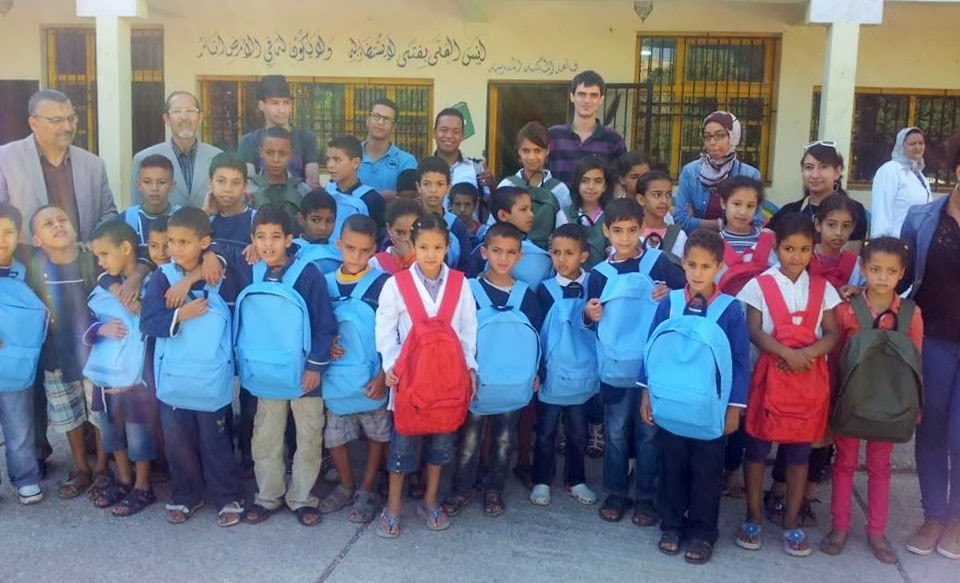
At the beginning of the school year on September 17, members of the ALC Community Service Club met at the American Language Center and spent time assembling 30 backpacks filled with school supplies. Three days later, the bags were delivered to Khalid Ibn El Walid public school at a poor neighbourhood in Fez.

This is just one of the ALC Community Service Club's activities, which also include tutoring English and other subjects to girls at the Center for the Protection of Girls in Ziat; to boys at a similar institution, and at the local Women's shelter.


ALC Community Service Club member, Samir El Mouti, was at the school when the delivery was made.  "The students were very pleased to receive their bags," he said."Most of them were between the age of 8 and 10 with a big smile that lighted up their little faces when we handed out a lovely bag to each of them."

The school's headmaster told the Club members, “It is a good initiative, especially as it helps students from a marginalised area of the city who can’t afford to buy school supplies for a proper education...Those little students will always remember this day.”


Club member Ibrahim Talal said, "It was a great opportunity to help those students who are in need and I had a wonderful time taking part in such heartwarming activity."

Samir adds, "Doing a simple gesture to bring out the best in people is something rewarding that shows that there are people who really care about what matters in our society, such as education. We believe in a better world...Thanks to all the CSC members who gave such a wonderful moment to those children."


To see more about ALC Community Service Club activities, take a look at their Facebook page - Community Service Club Operation Reach Out.

SHARE THIS!
Print Friendly and PDF

Thursday, September 12, 2013

Giving Charity in Morocco - No Pens Please!


Giving is important for many travellers, especially in a country where there is very little in the way of a social safety net for the poor.  However, it is important not to encourage begging. This is especially important with children. A child who makes money from tourists is likely to beg rather than attend school


Every city will have several charities to help orphans and other disadvantaged children, women, disabled people and for working animals, the American Fonduk in Fez or Spana in Marrakech. Some you can visit and volunteer to help for a day, some will appreciate any spare clothes, games, unwanted mobile phones (if you are coming with a half empty suitcase for shopping bring some stuff to leave here) and some will just appreciate a cash donation.

Your Riad or hotel should be able to point you in the right direction. Check the authenticity of any charity you choose to support carefully.

Recently a traveller intending to visit Morocco posted on a travel advice forum.

We are coming to The Atlas Mountains and the Sahara Desert regions I have heard before that people took ballpoint pens to give to the children. My question is; Do the children still like to receive ballpoint pens?

Our friend, the ever helpful Tim Cullis responded:
Pens are actually extremely cheap in Morocco and are plentiful. Kids don't need yet more pens, what you give out as gifts are sold on or swapped. So please please please do not hand out pens, sweeties and anything else to children, and don't hand out medicines to anyone. It causes utter mayhem for other travellers. I almost took the eye out of one begging girl who got too close to my motorbike on a corner and the handguard hit her on the temple.
 sign erected by the authorities asking you NOT to do this

Translation: Don't make too much noise, keep a distance from wild animals, respect places of worship, avoid behaviour likely to shock locals, don't give to people--especially children--sweets, pens, drugs, so as not to encourage begging.

SHARE THIS!
Print Friendly and PDF

Monday, January 14, 2013

High Atlas Rescue Mission


Moroccans have rallied to support villagers in the High Atlas Mountains. Several tons of food and hundreds of mattresses and blankets were distributed this weekend to villagers in remote mountain villages

Calls were launched in recent weeks via social networks from people moved by the situation of these people and information referring to the death of a number of infants.

The response has been positive and "six truckloads of mattresses, blankets and food" have been distributed since Friday "to 2,000 families living in 10 villages, including that of Anfgou" said Elmahdi Benabdeljalil spokesman for a group composed of sixty concerned Moroccan citizens.

Children in impoverished conditions in the Atlas Mountains

At 1600 meters, Anfgou (400 km south of Rabat) is located in one of the coldest regions of Morocco. In December, a month and a half old baby perished, a victim of the cold and lack of infrastructure. The death brought to five the number of young children who died in similar circumstances, according to local media.

"More than 20 tons of food and hundreds of blankets were distributed to the inhabitants of different villages," said Mr. Benabdeljalil. "With the help of simple people and some families, we were able to collect more than 350,000 dirhams (32,000 euros). One person gave 100,000 dirhams (9,000 euros). I can say that the operation was successful. "

He said he was pleasantly surprised by the cooperation of local authorities who provided all the logistical support for the success of this operation.

The High Atlas region suffers from isolation and a lack of infrastructure and many roads are impassable in winter. Residents complain about having to transport essential goods on donkeys and icy roads.

On Friday, Agriculture Minister Aziz Akhannouch, acknowledged that "there is still a gap between urban and mountainous areas. It is in this sense that the Directorate for Rural Development and mountainous areas was created to coordinate and develop projects for the development of rural and mountainous regions," he pointed out.

SHARE THIS!

Monday, May 21, 2012

Rural Literacy Education for Morocco's Women


Rural education offers Morocco's women the promise of a quiet revolution. Women in remote parts of Morocco are benefiting from a scheme that also teaches civil rights, numeracy and even beekeeping. Santorri Chamley, writing for The Guardian's Poverty Matters blog, reports from Beni Zuli.

Fatima Kadmire (left), one of the beneficiaries of the literacy programme for women in Beni Zuli Photograph: Santorri Chamley


In a tiny classroom at the Maison de Citoyenneté support centre for the education of rural girls and women in Beni Zuli, an isolated village in Zagora, deep in south-eastern Morocco's Draa Valley, Fatima Kadmire is describing how learning to read and write is transforming her life.

"The best thing is that I can now dial numbers and send text messages on my mobile phone without having to rely on others to do it for me," says Kadmire, 21, who is sitting at a small desk at the front of the class.

She is one of the beneficiaries of an accelerated literacy programme targeting rural women and girls in Zagora and other remote regions in Morocco as part of the national literacy strategy. The class she is enrolled in is run by the Association des Femmes pour le Développement et la Solidarité (Afdes).

Afdes is part of Réseau Associatif pour le Développement et la Démocratie (Razded), an umbrella group of associations and NGOs established in 2007. The organisation's aim is to strengthen the role of women in Zagora's economic development and democratic process, in partnership with the department for literacy.

As well as the 300 hours they have to acquire basic reading, writing and numeracy skills, beneficiaries are given lessons in social and civil rights, development, environment and income-generating activities such as weaving, baking and beekeeping.

The Maison de Citoyenneté, or Citizenship House – a peach-coloured building opposite the mosque on Beni Zuli's main thoroughfare – is one of the first adult education community support centres in Morocco. It was built to help address one of the biggest barriers to education facing rural women and girls: lack of access to learning centres and middle schools (attended by 12- to 16-year-olds), which are usually located very far from home.

Beni Zuli, which has 18,000 inhabitants, is a beautiful village with traditional mud-brick houses. Like the rest of the province, it is flanked by the imposing Atlas mountains; its arid landscape is punctuated by a string of lush palm groves and oases. The village is one of the most remote in Zamora, which itself is a two-and-a-half hour drive along a narrow mountain road from the nearest airport, in Ouarzazate. With more than 70% of its 280,000 population aged under 30, the province is among the programme's main target regions.

One of the main objectives of the programme, which is enabling Kadmire and other rural women and girls to overcome deep-rooted cultural and traditional constraints, is integrated social and economic development. Post-literacy training will enable them to consolidate the literacy skills they acquire, preparing them to run micro-projects.

Such help, which promises to lift rural women out of the cycle of illiteracy and poverty, is welcome. In 2004, King Mohammed VI pushed through landmark reforms to the Mudawana family code against tough opposition from religious conservatives in 2004. The measures attempted to address a range of issues including underage marriage, women's rights, domestic violence, forced child labour and sexual trafficking. Despite the reforms, however, many rural women remain second-class citizens.

Almost 20,000 women and girls have benefited from the accelerated, state-funded literacy programme since it was introduced in Zagora in 2007. Its grants cover course fees, teacher-training and learning tools such as textbooks and pens.

Story and photograph: Santorri Chamley

Read the full story here


SHARE THIS!

Thursday, March 15, 2012

Morocco's Cities Without Slums Project - An Update


Morocco’s housing deficit stood at roughly 608,000 units in 2011, with a significant shortfall in terms of the availability of government-sponsored accommodation, exacerbated in part by the Kingdom’s move to eliminate shantytowns and shift residents into proper housing.


Cities Without Slums

The project, known as Cities Without Slums (Villes Sans Bidonvilles, VSB), was launched in 2004 with the aim of relocating families from poorer neighbourhoods and placing them into new houses in urban areas. The programme, which now impacts some 1.75m people, has seen remarkable progress towards achieving its objectives. Since the programme’s launch, an additional 400,000 people have been added to the government’s targets, and according to the Ministry of Housing, 70% of the scheme has been realised so far. Some 1.2m households have either been relocated or are currently awaiting the completion of their new home.

As a result, 43 out of the 85 towns affected by the VSB scheme have been declared slum-free. In the 42 remaining towns, more than 60% of the work has been achieved. Casablanca, Marrakech, Kénitra, Rabat, Larache and Guercif are among the next 17 towns who will move all targeted households into new homes.

Moving families out of the slums is a priority

The VSB programme has been most successful so far in the Oriental Region, located in north-eastern Morocco, where 83% of the targeted households have been demolished and families relocated. The Al Omrane-Oujda group, a real estate company placed under the supervision of the Ministry of Housing, has been one of the main players in the region in helping eradicate slums.

Also among the company’s main projects is that of the urban zone planned for the town of Al Aroui where 210 ha will be dedicated to housing. Some 36,000 housing units will be built in the area for about 180,000 inhabitants. Relocating families into the refurbished apartments planned by the government has been made possible thanks to a number of financing mechanisms. Fogarim, which has provided government-backed mortgages to people with low incomes since 2003, has enabled 81,000 people to obtain their own home. Among these, 15,200 households that have been relocated under the VSB scheme have benefitted from the Fogarim scheme. At the end of 2011, the credit distributed to these families accounted for around 11%, or Dh1.22bn (€109.3m), of total issued Fogarim credit.


New housing in Taza


Payment Defaults Cause Problems

However, the Fogarim programme currently faces a major challenge as a number of payment defaults have been reported in towns such as Oujda, Azrou and Rabat, where some households have failed to pay off their monthly instalments of around Dh1500 (€134). Authorities have asked banks for more time before taking judicial action again the loanholders, and the Ministry of Economy and Finance has put in place a new loan, the Fogarim-VSB, that specifically targets this segment of the population and lowers their monthly payments to Dh1000 (€90).

Morocco’s residential sector will continue to expand as the government pursues its objective of relocating people to newer, urban housing. Already some 4000 ha of land per year have been reclaimed for urban projects, with some 45% of this used for real estate, according to the Ministry of Agriculture. With the government planning to develop a further 70,000 ha, the sheer volume and scale of the government’s housing schemes should leave plenty of room for growth in real estate.


Steady Growth in Property Sector

As evidenced by an increased demand for construction materials, including a dramatic 25% rise in cement sales, Morocco’s property sector is continuing to see steady growth thanks in large part to a strong emphasis on social housing – a segment that has consistently run a deficit of supply, thereby promising continued expansion in the years to come, Global Arab Network reports.

Residential property remains the real estate sector’s main driving force, accounting for around 67% of total sales. In 2011, prices increased by 3.4% compared to 2010 and the number of units sold on the market was up by 13.6%. According to the latest statistics released by Bank Al Maghrib for the last quarter of 2011, the volume of transactions in the residential property sector rose by 22.8%, mainly due to the increase in middle-income and high-end apartment and villa sales. In the last quarter of 2011, villa prices saw a year-on-year (y-o-y) increase of 4.2% and sales rose by 11.3%.

However, it was apartment sales that lead the sector, accounting for around 61% of total sales. Prices saw a y-o-y increase of 5.2%, while the volume of transactions rose by 25.7%. The majority of real estate activity comes from further along the socioeconomic spectrum, at the affordable housing end, which accounts for more than two-thirds of total residential demand.


SHARE THIS!

Friday, July 20, 2007

Morocco Facts: Population distribution


"In 2008, the world reaches an invisible but momentous milestone: For the first time in history, more than half its human population, 3.3 billion people, will be living in urban areas. By 2030, this is expected to swell to almost 5 billion. Many of the new urbanites will be poor. Their future, the future of cities in developing countries, the future of humanity itself, all depend very much on decisions made now in preparation for this growth."

Ever wondered where most Moroccans live? Well according to Moncef Fadili, a UN housing expert, six out of every ten Moroccans live in urban areas. The problem with this is that they live in areas where poverty and exclusion are rife and unemployment rate reaches 16%. Speaking to the United Nations Population Fund (UNFPA) State of World Population Report (2007), Mr. Fadili listed the main development programs adopted by Morocco: e "Millennium Goals development," "Free-Slum cities program", and the large-scale anti-poverty program "the National Initiative for Human Development."

"All these programs are meant to guarantee decent housing for Moroccans and ensure sustainable development," he explained.

Speaking on the same occasion, UNFPA Representative to Morocco, Georges Georgi affirmed that urbanization is "a natural process which comes as a result of natural growth and not only rural migration."

Quoting the report, he said that it was "erroneous" to believe that the rural population is better off in the countryside and that rural migration should be monitored.

The UN Coordinator in Morocco, Mourad Wahba, warned that this data-rich report "raises questions that must not be ignored." He called upon world leaders to provide social services and infrastructure to urban populations and invest for the good of women and young people.

According to this report,dubbed "Unleashing the Potential of Urban Growth," 3.3 billion people, will be living in urban areas. By 2030, this is expected to swell to almost 5 billion. The report also notes that cities embody the environmental damage done by modern civilization, however, it concedes that experts and policymakers increasingly recognize the potential value of cities to long-term sustainability.

Commentary

According to Alexander G. Rubio editor of "Bits of News" in "One problem is that a bit too much thinking coming out of the environmental movement is informed by the sensibilities of a Western urban middle class, nostalgic for a rural idyll that was partly never there, or would not be sustainable today, and least of all in the parts of the world where the problems are the most pressing.

Most of the world's poor, now and in the past, relocate to the cities of their own free will, and for perfectly rational reasons. While urban poverty might be more concentrated and obvious, it nevertheless represents hope of a better life for them and their children, in parts of the world where the countryside is subject to periodic famines. Hard as life may be in big city slums, you seldom see masses of starved people with distended bellies littering the streets.

One reason is that, like the street proletariat of ancient Rome, even the slum population in the cities wield more political clout than their relations in the countryside. Living practically cheek by jowl with the urban poor, the political and economic elite can not afford to disregard the danger of riots and organised action by people so close to home and the centre of power."


Read the State of the World Population Report here: English, French, Arabic, Spanish.

Tags:

Tuesday, March 13, 2007

Beggars in Morocco - a new approach


Approximately 15% of beggars under the age of seven are hired workers and are paid between 50 and 100 dirhams per week to beg for their employers.


A new programme by the Ministry of Social Development, Family and Solidarity has been created to try and reduce the number of beggars on the streets of Morocco. In a recent report on the situation, a government spokesperson claimed that up to 15% of the beggars under the age of seven are in fact hired to work the streets.y 15% of beggars under the age of seven are hired workers. The total number of beggars in the country is estimated to be close to 500,000.

The new programme will encourage the assimilation of beggars into society through family integration, institutional sponsorship and economic integration.

According to an article in Magharebia, the programme calls for a "social approach" - that includes the integration of beggars into their family sphere by helping them find work, helping them locate an institutional sponsor, and by creating legal consequences such as the arrest of beggars that return to the streets.

A parallel approach involves raising public awareness of the need to discourage begging and to inform beggars of the options available to them. However, as alms giving is one of the pillars of Islam and giving to the poor, blind and infirm, part of everyday life, it is hard to see how people could be convinced to give less.

However, the Minister of Social Development Abderrahim El Harouchi says "The phenomenon of begging is an epidemic that weakens Moroccans’ honour and human rights and tarnishes the country’s reputation. Begging has become a circulating culture that eats away at the root of the social and economic reform efforts Morocco has made."

According to Magharebia, the programme groups beggars into three different categories: deviant beggars, beggars of need and beggars out of work. A 2004 Moroccan Childhood Protection League study showed that 56% of beggars are men and 44% are women. El Harouchi noted that approximately 15% of beggars under the age of seven are hired workers and are paid between 50 and 100 dirhams per week to beg for their employers.

Tags:

Thursday, February 15, 2007

Morocco moves to ban child maids.


"We aim to create a Morocco that is worthy of its children." - Yasmnia Baddou

As we reported last year, Morocco has been active in the fight against all forms of child labour. For some time concerns have been raised about the number of very young girls being taken from their rural homes and put to work as domestic servants.


Yasmnia Baddou (pictured above), Morocco's secretary of state for family, childhood and the disabled, last year said that the new law she was introducing aimed to "create a Morocco that is worthy of its children" and would focus on "regulating domestic labour and punish all use of little girls as maids."

According to the US rights group Human Rights Watch, Morocco has one of the highest child labour rates in the Middle East and North Africa. This is despite the fact that Moroccan law bans children under 15 from working.

However, a survey carried out by Morocco's employment ministry, the rights group International Programme on the Elimination of Child Labour (IPEC) and the World Bank, found that some 600,000 children between the ages of seven and 14 work in Morocco - 11 percent of the country's children in that age group.

The Human Rights Watch's report issued in December 2005 said that "girls as young as five work 100 or more hours per week, without rest breaks or days off for as little as six and a half Moroccan dirhams (about 70 US cents) a day. These girls are often exposed to physical and even sexual abuse and denied schooling."

New Initiatives

Morocco has now launched a national program to fight employment of little girls as maids and help them enjoy a better life.

Dubbed Inqad (rescue in Arabic), the programme provides for an array of measures and calls for pooling efforts to reach the goals of the ten-year National Action Plan for the Childhood aiming to eradicate the employment of little girls, through opening new vistas for a better future where they can enjoy all their rights.

Yasmina Baddou said employment of children under the age of 15 decreased from the 2004 level of 600,000 to 177,000, and pointed out that at the heart of the problem was illiteracy, school drop-out, illegal immigration and large network of intermediaries involved in the illegal activities.

Baddou highlighted the efforts made by her department to encourage girls' schooling in rural areas, increase the minimum ages of children's access to employment from 12 to 15 years, prohibit the use of children under the age of 18 to carry out dangerous work and consolidate coercive laws.

Inqad, which was devised by the State secretariat in charge of Family, Childhood and the Disabled, also aims at re-integrating these domestic servants into society.

Tags: