Showing posts with label Taza. Show all posts

Sunday, September 20, 2015

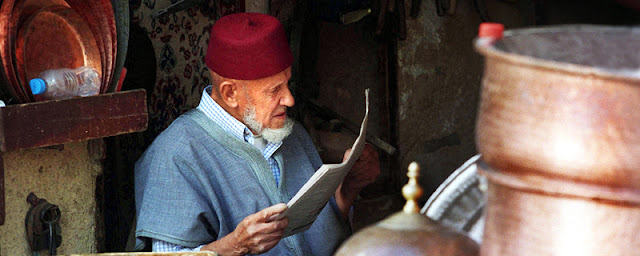
Moroccan Photo of the Day ~ Eid Sheep Souk in Taza


Photographer Suzanna Clarke visited the sheep souk in Taza where the business of find the right sheep for Eid was everyone's top priority


Click images to enlarge

See more of our Photo of the Day series here: Moroccan Photo of the Day

SHARE THIS!
Print Friendly and PDF

Sunday, August 17, 2014

Escaping the Heat ~ and the Crowds


With thousands of Moroccans crowding the beaches and the seaside towns such as Essaouira or up in the hills in Ifrane or Chefchaouen (see story here), The View from Fez went searching for the perfect combination of cooler weather and tranquility. We found the answer just over 80 Kilometres from Fez, at Auberge Ain Sahla


With twenty rooms and both indoor and outdoor dining areas, Ain Sahla is the perfect base for exploring the Jebel Tazzeka National Park. The architecture appears to be the offspring of a wonderfully whimsical marriage between Hobbits and Gaudi. There are numerous terraces with spectacular views as well as a perfectly maintained pool and (surprisingly) a small walled soccer field complete with goal nets!


Set beside the National Park, the area abounds with interesting flora and fauna, including the largest black bumblebees we have come across. For those with good eyesight there are also chameleons and a variety of lizards.

A large black bumblebee feasting on lantana flowers
A well disguised chameleon

The generous breakfasts and evening meals are all prepared onsite from local ingredients. The cooking is done on charcoal and wood fired grills and Berber ovens. In addition, the gardens are full of fruit trees with pomegranates, figs, citrus and grapes. With the wonderful Berber hospitality, guests are free to sample fruit straight from the trees.

All the cooking uses traditional methods and utensils


THE TAZEKKA NATIONAL PARK


The Tazekka National Park is only a few minutes drive from the auberge and offers spectacular scenery and a variety of walks and cave experiences.


Amongst the main attractions of the National Park are the Friouato caves (Arabic: مغارة فريواطو‎), better known by their French name Gouffre de Friouato.


The farthest explored point in the cave system is about 272 meters, but its real limits are still mysterious. However, some locals believe that it is about 3.5 kilometres in length. Be aware that climbing down and then up again does require a certain stamina. (See our story here.)


At the end of a day of exploration, returning to the auberge for a cool drink, a swim and some fine food, is the perfect conclusion.


Photographs: Suzanna Clarke & Sandy McCutcheon

SHARE THIS!
Print Friendly and PDF

Wednesday, January 30, 2013

Exploring the Friouato Caves - a day trip from Fez


Fez is the perfect place to base yourself for exploring the surrounding region. One fascinating getaway is to Jebel Tazzeka National Park, near the medieval city of Taza. There you can find an impressive underground cave network, the Friouato Caves.  Suzanna Clarke reports on a day trip with a difference.


Setting out to visit the Friouato Caves in Jebel Tazzeka National Park, I had in mind a leisurely Sunday stroll. Perhaps a short walk down a few steps, then the chance to admire a long, well lit rock gallery. Naturally, the caves were nothing like this at all.

The Friouato caves (Arabic: مغارة فريواطو‎), better known by their French name Gouffre de Friouato,  are located about 30 km south of the city of Taza. The farthest explored known point is about 272 meters, but its real limits are still mysterious. However, some locals believe that it is about 3.5 kilometres in length.


I and my two companions – Dr Gigi Kay, the director of the American Fondouk and her husband Dr Dick Hooper - found ourselves descending more than 100 meters into an enormous cave. This first chamber was lit through a hole at the top, through which trees and sky could be glimpsed. As we began our descent, we could only just make out people at the base of the climb. They looked to be the size of rabbits in a field. Initially there were hand rails, and then these petered out until it was a seemingly never-ending series of concrete steps - in reality there are more than 500.

The size of the cave seemed immense, and images from the Lord of the Rings movies sprang to mind. I could imagine the orcs scrabbling over rocks towards us. If not orcs, perhaps there is danger to be discovered in the depths of the cave system. People from the nearby village say many explorers have visited the cave, some of whom never returned.

When we reached the bottom of the first chamber, we followed the guide through a tiny crevasse in the rock, down another series of steps, to the interior of the cave. The sound of running water could be heard, and the chamber opened out to a limestone pool, constantly replenished by, a small waterfall. Clinging to the side wall were a couple of small bats, who ignored our torch beams.


We were grateful for our miners helmets and their lights, for the darkness was intense. We continued into another large chamber, which had a series of stalactites and stalagmites, formed by the deposition of calcium carbonate and other minerals. “It takes 100 years for a centimeter of stalactite to form, and even more for a stalagmite,” said our guide. According to my research, an average growth rate is actually 0.13 mm (0.0051 inches) a year. The quickest growing stalactites are those formed by fast-flowing water rich in calcium carbonate and carbon dioxide, these can grow at 3 mm (0.12 inches) per year.


We came to a limestone “table” on which there was a constant stream of water. Alongside it, the guide tapped a limestone stalagmite, which sounded hollow. When he shone his torch at the top of it, the length of it took on an eerie glow.

The multitude of sculptural shapes gave a magical feel to the cave. “You can imagine how they first thought of cathedrals,” said Dr Dick Hooper. I stood on the edge of a deep hole and could just see water at its base. More adventurous types than me have abseiled into its depths.

The Friouato Caves were first explored in 1930 by French adventurer Norbet Casteret. In 1969, a cave diving expedition by Exeter University Speleological Society passed two static sumps to discover more large chambers and shafts. The system ends in a massive choke of boulders. These may well be the same boulders that can be seen at the end of the upstream passages of the nearby Grotte du Chiker; this choke was also discovered in 1969 by the same group of cavers. There are also signs of an underground river that is believed to flow near the Grottes of Chiker.


We were offered the opportunity to continue into the depths for another three hours, to see yet more marvels, but declined and began our long ascent.

I have always thought myself claustrophobic, yet I was glad I had overcome whatever qualms I had had about being in a dark, enclosed spaces, to see an extraordinary natural phenomena.

Jebel Tazzeka National Park is located about 100 kms east of Fez, and can easily be reached via the new motorway which passes by Taza. Day trips can also be arranged with Plan-It Fez. 


Size Matters

Tourism leads to wild claims about "the world's largest" "the world's deepest", "Africa's largest" and so on. Unfortunately these claims are picked up, republished on websites and get taken as fact.  So to set the records straight...

While Africa has some impressive cave systems, it is well down any list of the world's largest or deepest caves. Africa's largest cave is (probably) Rhar Bou Ma'za (Tafna River Cave) in Algeria. It is 244th largest in the world at 18.4 kilometres.

Africa's 2nd largest cave (the 306th largest in the world) is said to be Sof Umar Cave in Ethiopia. It is formed by Web River, which rises from Bale Mountain. The 42 internal entrances and its total passages distance of 16 km. There is a short 1.7 kms tourist walk, which crosses the river seven times and takes about an hour.

None of the top ten largest caves in the world are in Africa.

The entrance to Mammoth Cave

The cave system with the greatest total length of surveyed passage is Mammoth Cave (Kentucky, USA) at 628 km in length. This record is unlikely to be beaten in the near future, as the next most extensive known cave is Jewel Cave near Custer, South Dakota, at only 242 km.

The longest surveyed underwater cave is Sistema Sac Actun in Yucatán, Mexico at 215 km. The record has been exchanged several times with Sistema Ox Bel Ha, currently at 182 km.

The deepest known cave (measured from its highest entrance to its lowest point) is Voronya Cave in Georgia, with a depth of 2,191 m (7,188 ft). This was the first cave to be explored to a depth of more than 2 km (1.2 miles).   The first cave to be descended below 1 km (0.62 mi) was the famous Gouffre Berger in France.  The Illyuzia-Mezhonnogo-Snezhnaya cave in Georgia, (1,753 m or 5,751 ft) and the Lamprechtsofen Vogelschacht Weg Schacht in Austria (1,632 m or 5,354 ft) are the current second- and third-deepest caves, respectively. The deepest cave record has changed several times in recent years.

The deepest vertical shaft in a cave is 603 m (1,978 ft) in Vrtoglavica Cave in Slovenia. The second deepest is Patkov Gušt at 553 m (1,814 ft) in the Velebit mountain, Croatia.

The largest room ever discovered is the Sarawak Chamber, in the Gunung Mulu National Park (Miri, Sarawak, Borneo, Malaysia), a sloping, boulder strewn chamber with an area of approximately 700 by 400 m (2,297 by 1,312 ft) and a height of 80 m (260 ft). The nearby Clearwater Cave System is believed to be the world's largest cave by volume, with a calculated volume of 30,347,540 m3(1.071713×10⁹ cu ft).

The largest passage ever discovered is in the Son Doong Cave in Phong Nha-Ke Bang National Park in Quang Binh Province, Vietnam. Explored by joint Vietnamese-British cave scientists of the British Cave Research Association, it is 4.6 km (2.9 mi) in length, 80 m (260 ft) high and wide over most of its length, but over 140 m (460 ft) high and wide for part of its length.

NOTE: It is interesting that a majority of explored caves occur in countries where caving is a popular sport. Many other countries probably have cave systems still to be explored. For example, China has massive limestone areas and it is expected those area will contain massive caves. 

For more information on caves see the wonderful site run by "caverbob" - http://www.caverbob.com/


SHARE THIS!
Print Friendly and PDF

Thursday, March 15, 2012

Morocco's Cities Without Slums Project - An Update


Morocco’s housing deficit stood at roughly 608,000 units in 2011, with a significant shortfall in terms of the availability of government-sponsored accommodation, exacerbated in part by the Kingdom’s move to eliminate shantytowns and shift residents into proper housing.


Cities Without Slums

The project, known as Cities Without Slums (Villes Sans Bidonvilles, VSB), was launched in 2004 with the aim of relocating families from poorer neighbourhoods and placing them into new houses in urban areas. The programme, which now impacts some 1.75m people, has seen remarkable progress towards achieving its objectives. Since the programme’s launch, an additional 400,000 people have been added to the government’s targets, and according to the Ministry of Housing, 70% of the scheme has been realised so far. Some 1.2m households have either been relocated or are currently awaiting the completion of their new home.

As a result, 43 out of the 85 towns affected by the VSB scheme have been declared slum-free. In the 42 remaining towns, more than 60% of the work has been achieved. Casablanca, Marrakech, Kénitra, Rabat, Larache and Guercif are among the next 17 towns who will move all targeted households into new homes.

Moving families out of the slums is a priority

The VSB programme has been most successful so far in the Oriental Region, located in north-eastern Morocco, where 83% of the targeted households have been demolished and families relocated. The Al Omrane-Oujda group, a real estate company placed under the supervision of the Ministry of Housing, has been one of the main players in the region in helping eradicate slums.

Also among the company’s main projects is that of the urban zone planned for the town of Al Aroui where 210 ha will be dedicated to housing. Some 36,000 housing units will be built in the area for about 180,000 inhabitants. Relocating families into the refurbished apartments planned by the government has been made possible thanks to a number of financing mechanisms. Fogarim, which has provided government-backed mortgages to people with low incomes since 2003, has enabled 81,000 people to obtain their own home. Among these, 15,200 households that have been relocated under the VSB scheme have benefitted from the Fogarim scheme. At the end of 2011, the credit distributed to these families accounted for around 11%, or Dh1.22bn (€109.3m), of total issued Fogarim credit.


New housing in Taza


Payment Defaults Cause Problems

However, the Fogarim programme currently faces a major challenge as a number of payment defaults have been reported in towns such as Oujda, Azrou and Rabat, where some households have failed to pay off their monthly instalments of around Dh1500 (€134). Authorities have asked banks for more time before taking judicial action again the loanholders, and the Ministry of Economy and Finance has put in place a new loan, the Fogarim-VSB, that specifically targets this segment of the population and lowers their monthly payments to Dh1000 (€90).

Morocco’s residential sector will continue to expand as the government pursues its objective of relocating people to newer, urban housing. Already some 4000 ha of land per year have been reclaimed for urban projects, with some 45% of this used for real estate, according to the Ministry of Agriculture. With the government planning to develop a further 70,000 ha, the sheer volume and scale of the government’s housing schemes should leave plenty of room for growth in real estate.


Steady Growth in Property Sector

As evidenced by an increased demand for construction materials, including a dramatic 25% rise in cement sales, Morocco’s property sector is continuing to see steady growth thanks in large part to a strong emphasis on social housing – a segment that has consistently run a deficit of supply, thereby promising continued expansion in the years to come, Global Arab Network reports.

Residential property remains the real estate sector’s main driving force, accounting for around 67% of total sales. In 2011, prices increased by 3.4% compared to 2010 and the number of units sold on the market was up by 13.6%. According to the latest statistics released by Bank Al Maghrib for the last quarter of 2011, the volume of transactions in the residential property sector rose by 22.8%, mainly due to the increase in middle-income and high-end apartment and villa sales. In the last quarter of 2011, villa prices saw a year-on-year (y-o-y) increase of 4.2% and sales rose by 11.3%.

However, it was apartment sales that lead the sector, accounting for around 61% of total sales. Prices saw a y-o-y increase of 5.2%, while the volume of transactions rose by 25.7%. The majority of real estate activity comes from further along the socioeconomic spectrum, at the affordable housing end, which accounts for more than two-thirds of total residential demand.


SHARE THIS!