Showing posts with label Helen Ranger. Show all posts

Thursday, December 09, 2010

Lonely Planet's Best in Travel 2011: Tangier hits the mark


Lonely Planet's new publication, Best in Travel 2011, features Tangier as one of its top ten cities to visit next year.
'A stylish new Tangier is being created with a dynamic arts community, renovated buildings, great shopping and chic new restaurants', says The View from Fez writer Helen Ranger and author of the piece.

Other cities recommended are New York, ten years after 9/11, Tel Aviv, Wellington, Valencia, Iquitos, Ghent, Delhi, Chang Mai and Newcastle (the one in Australia, that is).

The book has some exciting suggestions including Lonely Planet's list of the top 10 countries to explore (from Albania to Vanuatu), top 10 regions (think anywhere between Patagonia, the Shetland Isles and the Sinai), and the top travel experiences. In this category, you'll find where to find the world's greatest bookshops, the best vampire-spotting locales, the most super-luxe travel, and plenty of other ideas. Of the top 10 places to learn the local cuisine, Lahcen Beqqi of Fez is right up there along with Vietnamese, Mexican, Turkish and more.

For some armchair travelling and inspiration for your next holiday, this is a great book to have. Iceland, anyone?

Saturday, April 03, 2010

Fez Sacred Music Festival: valid criticisms?


The View from Fez looks at some criticisms of the Fes Festival - some old chestnuts and some more recent points of view.


The Fes Festival of World Sacred Music was established 16 years ago by Sufi scholar Faouzi Skali as a direct response to the first Gulf War. Skali felt that world peace could be enhanced by the harmony engendered by music.

For the first festival in 1994, musicians from the three Abrahamic faiths - Judaism, Christianity and Islam - were invited to play in Fez. Since those early years, the festival has grown to include musicians from other religions and belief systems: Hinduism, Tibetan Buddhism, Shintoism and shamans from various countries have been represented.

Is it spiritual?
One of the criticisms levelled at the festival is that some of the music is simply not 'spiritual'. While you can easily see the spirituality embodied in, for example, Christian Gospel music, can Spanish Flamenco be considered 'spiritual music'? Just because Ismael Lo is a member of the Tijania Sufi brotherhood, does this make his music 'spiritual'? And likewise in this year's programme, what's 'spiritual' about Ben Harper's music? Does his philanthropic espousal of worthy causes make his music 'spiritual'?

Aissawa Brotherhood

On a practical level, there have to be world-renowned artists at the festival to put bums on seats. Diverse performances will attract a larger crowd, festival music programming head Zineb Lemrabet said.

"During the festival, we offer a mix of musical genres to attract the largest number of people," she explained.

Lemrabet went on to say that "The spiritual essence is present in all types of music that we offer. Even rock music has that essence, as does rap - for example, the song 'Aissawa Style' by Moroccan group H-Kayne, which saw much success at the festival."

"It is also present in popular Moroccan music, as evidenced by the name of God and prayer to the Prophet Mohammad (peace be upon him) in many of the lyrics," Lemrabet added. "For me, what shows the presence of a spiritual essence is the audience's interaction with the singer."

"The call for tolerance is found at all festival performances," she said, "and everyone must broaden their intellectual horizons to receive that call."

Is it Moroccan?

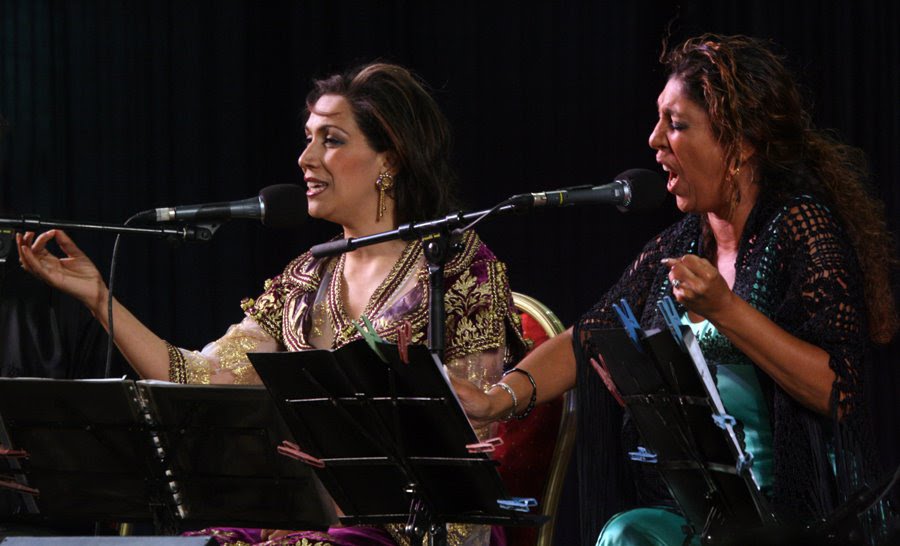
Samira Kadiri and Esperanza Fernandez

An oft-heard complaint is that few Moroccan artists are involved in the festival. The event has grown to include more international acts in recent years at the expense of Moroccan artists, according to critics.

"We have reservations as Maghreb artists with regard to the organisers' failure to take interest in Moroccan art, and we question the reason for the severe lack of Maghreb artists within the activities of a festival that is originally from Morocco," Moroccan composer Aziz Hosni said.

"We are proud there is a festival of this scale aiming to foster a culture of tolerance and religious co-existence and working to give Morocco a good image, and that many foreigners have paid to get to know the country," Hosni said.

The event may have lost its local focus with its growing success, however. The organisers have failed to involve local organisations, said Noureddine Mosaid, who serves as assistant president for the Fez-based Sabil Association.

"The festival targets the elite, and there is an absence of cultural involvement in events in the city, so we don't participate in developing its programme," he said.

Spirit of Fez President Mohamed Kabbaj defended the festival.

"If you look at the programme as a whole, we find it contains 90 percent Maghreb artists," he said. The events that lack Moroccan art, such as those at the Batha Museum and Bab el Makina venues, are private and charge an admissions fee, he said.

"The reason stems from wanting to make it more open to the cultures of different people and to not be dominated by a particular culture," Kabbaj said.

This year's festival features Moroccan Ahmed Essyad performing with the French ensemble Accroche Note on the afternoon of 7 June at the Batha Museum. There are some other artists from the Maghreb. It should be noted, too, that the majority of artists performing in the Festival in the City are Moroccan, including a number of Sufi brotherhoods.

Is it elitist?
Programming during the first few years of the festival was certainly elitist as most Moroccans couldn't - and still can't - afford a ticket to events at Bab el Makina (this year costing from Dh150-500).

However, in recent years there has been a Festival in the City running at the same time at the expensive events at the Batha Museum and Bab el Makina. Free concerts are held each day at 18h00 at Place Boujloud, at 20h00 at Ait Skato in the new city, and at 23h00 at Dar Pacha Tazi. There are also free exhibitions. This embraces the people of Fez who otherwise would not be able to enjoy the music on offer at this major event.

The Festival runs from 4-12 June.
See the programme here.
Wednesday, April 15, 2009

Women from Mayotte at Fes Festival of World Sacred Music


Helen Ranger admits to having to look up exactly where Mayotte is. She finds it's a small island of less than 200 000 people, near the Comoros in the Indian Ocean half way between northern Madagascar and northern Mozambique. Somewhat neglected by its French parent, the island is a favourite holiday destination for the French who love its beautiful beaches and dive sites, though prices (in Euros) are high.

At this year's Festival, the Deba women's group will perform songs, dances and Sufi rituals at 16h30 on Tuesday 2 June at the Batha Museum. Here's a sneak preview:


The most popular dance of Mayotte is called the wadaha (or danse de pilon) in which women and young girls dance in a circle around a mortar filled with rice, to the rhythm of drums, guitars and popular songs, simulating the pulverisation of the rice with pestles. It can also be a pre-nuptial dance.

Thursday, March 12, 2009

Faces in the medina: Annah Evington


Helen Ranger caught up with Annah over coffee at Cafe Clock to find out what this Australia-based New Zealander is doing in Fez.


Annah had a long-held dream of visiting Morocco to explore the colours, music and crafts. When an offer of a friend's house in Fez came up, she jumped at the chance and is in Fez for two months.

So has Fez lived up to the dream? The cold temperatures when Annah first arrived surprised her. She is finding the medina much more complex and multi-layered than she anticipated, but loves the authenticity of life here, the food and the crafts. She's enjoying her total immersion in such a different culture.

A principal organiser of the largest folk festival in the southern hemisphere, Woodford Folk Festival in Australia, Annah has a special interest in the music of the Maghreb. So far she's been enjoying the music at Cafe Clock and Fes et Gestes, but finds it difficult to discover where music is being performed as there's a general lack of publicity.

Not that Annah is spending all her time relaxing. She's busy putting together a tourism project in the South Pacific (see here) where she takes people swimming with hump-backed whales. She's also writing about her experiences there.

Annah has already been to Sefrou, Ifrane and Azrou where she fell in love with the cedar forests. Next on the agenda is a trip with friends down the eastern side of the High Atlas, ending up in Marrakech.

Will she be taking any souvenirs back to Australia other than her memories and photographs? Annah gets dreamy-eyed over the pierced brasswork lanterns and textiles, especially hendiras.


Tags:

Friday, March 06, 2009

Fez Medina's new antique shop


What do you do when you have TWO houses full of antiques and beautiful objets? This little conundrum has been solved by Mehdi Msefer, who has recently opened his new shop, Boutique Numero 1, in Batha.


The shop stocks ceramics, brassware, furniture, carpets, hendiras, jewellery and clothing such as caftans, djellabas, scarves and belts. Mehdi tells us that he has over 700 Berber carpets, and they are of particularly high quality.

carpet detail

The hendiras and cushion covers also display very fine work.

cushion cover

In the glass-fronted cabinets you'll find superb examples of jewel-coloured silk scarves and belts. Saleswoman Beatrice admits that it will be a wrench to sell anything at all, so attached is she to these beautiful pieces of artistry.

silk belts and scarves

When Helen Ranger visited, she was delighted to find that she knew Mehdi of old. He's also the owner of the excellent restaurant, Trois Sources.

Boutique Numero 1
1 Rue Ahmed Mekouar, Batha
(almost opposite the Treasury Office)
ph 0661 35 02 50
open 9am to 9pm daily

Tags:

Friday, January 30, 2009

Take the train


Are you concerned about your carbon footprint when you fly? Or maybe you'd like to get there slowly, taking advantage of sights along the way. Helen Ranger investigates travelling by train to Morocco ...


The excellent website Man in Seat 61 gives information on train travel in all sorts of countries, from the UK to Russia to South Africa ... and across Europe to Morocco. You can do London to Morocco in just 48 hours, in comfort and safety, without flying.

"And what a journey!", says the Man in Seat 61. " Take Eurostar to Paris, grab a beer in a Parisian café and board the excellent 'trainhotel' sleeper train to Madrid. Enjoy a meal with wine in the restaurant car and a nightcap in the bar before retiring to your sleeper for the night as the train speeds south across France, then wake up to breakfast as the sun rises over distant Spanish mountains. Spend a day in Madrid, visit the Prado Museum or soak up the atmosphere in the Plaza Santa Ana before taking an afternoon express across Andalusia to Algeciras on the Straits of Gibraltar. Next morning, take the ferry from Europe to Africa, the Rock of Gibraltar close on the port beam and the African coast getting slowly nearer."

And the trainhotel is pretty nifty:

the trainhotel's smart restaurant

couchettes are made up while you're at dinner

Ferries from Spain to Morocco
There are various options. The journey from Algeciras usually takes around three hours, or you can take a fast ferry from Algeciras or from Tarifa, this one around 40 minutes.

the fast ferry leaving Algeciras for Tangier

Moroccan trains
Travelling by train in Morocco is easy, safe and very cheap, and the trains are usually punctual. There are refreshments on board (coffee, tea, soft drinks, snacks, croissants in the morning and, it has to be said, somewhat stale rolls with chicken or cheese).

1st class carriage in Morocco

The trains have recently been upgraded and are very comfortable and air-conditioned. Seats are reserved in first class, but not in second class, where there are eight plastic-covered seats instead of the six plush seats in first. Fom Tangier, you can travel to Rabat, Meknes, Fez and Oujda, or to Casablanca and Marrakech. Onward journeys to Essaouira or Agadir are taken by bus.

So train travel is cheaper than flying, right? Well, actually, no. It does cost more, and of course takes more time, but the advantage is that you can stop off on the way. A day or two in Paris, or a visit to the Prado in Madrid, exploring Gibraltar, windsurfing in Tarifa or hanging out in a Tangier cafe are all options. Here are some costs:

London to Paris by Eurostar: Return fares start at £59 2nd class, £149 1st class.

Paris to Madrid on the trainhotel: 4-berth tourist class sleeper, return, £204

Madrid to Algeciras by Altaria train: normal return fare 98 Euros

Ferry from Algeciras to Tangier: 84 Euros return

Train from Tangier to Fez: 1st class one-way £9
from Tangier to Marrakech in a first-class couchette, one-way: £23

Flights:
Atlas Blue Gatwick to Fez: from £160 return
Royal Air Maroc Heathrow to Casablanca: from £1256 return

with thanks to the Man in Seat 61

Tags:

Saturday, January 24, 2009

Andalous Riad


Helen Ranger went exploring in the Andalous quarter and came across an interesting riad ...


The medina of Fez offers lots of places to stay north of the river, but when it comes to the Andalous quarter, this is the first one that Helen Ranger has come across. Owned by a trio of Brits, Riad Rmila is large and airy and has a spacious courtyard and garden with fountain. They'd like to rent out the house for holidays to finance the renovation of another house they've bought. This one has been well renovated, keeping the original tiles and plaster as far as possible, only augmenting them where necessary. There are two double bedrooms and two singles, and bathrooms are a treat; the one on the ground floor has a jacuzzi too.

Most visitors to Fez are familiar with the view of the Chaouwara tanneries. This house has a view of the pits from the other side, which puts a quite different perspective on things.

Best approached from R'cif, it's a ten minute walk from the taxi rank there. It's not for the faint-hearted, being in an area of the medina where you simply don't see any tourists ... yet. But there's a guardian to show you where the house is. It's interesting that just a couple of years ago, anywhere out of the Batha area was considered a bit risque, but houses in more and more areas of the medina are being bought up by westerners to convert into guesthouses or simply houses to rent for holidays.

You can find out more about Riad Rmila at Fez Riads or www.riadrmila.com.

Tags:

Wednesday, November 26, 2008

Dar Ba Mohamed Chergui


Recently our heritage editor, Helen Ranger, reported on the sale of Dar Ba Mohamed Chergui, situated on Derb el Horra in the Fez Medina.

One of the central courtyards

According to Helen Ranger, "the complex, along with the massive palace opposite, Dar Ouezzane, has been sold to a consortium of businessmen from Saudi Arabia, Germany and Switzerland for an undisclosed sum (thought to be in region of several million Euros). Dar Ouezzane alone had at least 20-25 inheritors, so it must have been some deal."

The idea is to restore the buildings and convert them into a 28-room hotel which will include a passerelle or bridge over Derb el Horra to connect between the two.

Just to give those who have never visited Dar ba Mohamed Chergui an idea of what is at stake, we sent our intrepid photographer Zany along to take some photographs:

The unique garden featuring star-shaped zellij planters

Interior and detail (below)


Photographs: Suzanna Clarke.

Tags:

Monday, November 10, 2008

Shnoo?


The View from Fez reported a few days ago (Confounding the Guidebooks) that our favourite medina restaurant owner, Thami, had confused everyone by painting a new sign above his restaurant that read 'Tohami'.

Once we'd pointed it out to him (and helped some Dutch tourists who were trying to follow directions in their Lonely Planet guide), Thami promised to change the spelling. He did - and had the whole street laughing:


Sandy is definitely Thami's favourite customer, but we're sure the sign will be changed soon so that everyone can find the restaurant.

Reporting: Helen Ranger.
Photograph: Helen Ranger.


Tags:

Friday, August 15, 2008

Fes et Gestes: new tea garden in Ziat


Fes et Gestes is just perfect for summer lunches. Helen Ranger investigates ...


Cecile Houizot-Nanot has done it again. First she organised those wonderful Sunday afternoon concerts at the Palais Mokri (that sadly are no longer); now she's opened a delightful tea garden in Ziat. And with the plethora of guesthouses in the Ziat area, some long-established and some new, this is very welcome.

The house is somewhat surprising - a French colonial design, with large windows opening onto the garden, but with Moroccan touches such as zellij and Iraqi glass. It was occupied for some 27 years by Sister Cathy, an English nun and midwife, who sadly died a few months ago. The garden is very pretty, with a central fountain much enjoyed by little Louis-Xavier, Cecile's son. Cultural events are planned such as painting and sculpture exhibitions, afternoon tales and evening concerts.

The name intrigued us ... it's a play on words, in French. If you know someone's faits et gestes, it means that you really know what makes them tick. So here is Fez ... et Gestes.

There's a wide range of fruit juices, teas and coffees at Dh15 or Dh18 - we sampled the house special coffee, delightfully spiced, and rooibos tea (most dear to Helen Ranger's heart) flavoured with lime blossoms and mint. Lunch is also available at Dh90, including water and tea or coffee. It's a hearty meal of a wide range of Moroccan salads, a tagine and dessert. It's possible just to have one or two courses.

Fes et Gestes can be found at 39 Arsat El Hamoumi in Ziat (see the map on the website), phone 035 63 85 32. It's open every day except Wednesdays from 09h00 to, well, it says 19h00, but Cecile says that sometimes people stay til 20h30.


Tags:

Saturday, August 09, 2008

Jnan Sbil update


The gates are open ... but you can't go in. Not yet, anyway.

The Jnan Sbil gardens on the north-western edge of the medina were always a favourite place for Fassis, where lovers and retired people could while away the hours among the palms, eucalyptus, weeping willows, citrus trees and bamboo. The park was opened to the public by Moulay Hassan in the 19th century. Two rivers - the Oued Fes with its water wheel - and the Oued Jawahir (river of pearls) flowed through the garden and there were three cafes. On the western edge near Bab Makina, the Nouria Cafe is still open and is a very pleasant place for tea or lunch. A broken-down waterwheel is still visible from the cafe.

But over the years, the gardens fell into disrepair and became not such a good place to go. A few years ago, ADER (the Agency for the Dedensification and Rehabilitation of the Fes Medina) was tasked with renovating the Borj and the walls surrounding the gardens. The Borj is now a museum of the natural environment and attracts lots of school groups, and the walls have been completed.


Renovated garden walls

The Mohamed VI Foundation for the Environment is now tackling the renovation of the gardens themselves. Directed by architect Rachid Haloui, this demanding project consists of three or four separate parts. The first two parts are expected to be completed by the end of October this year. These comprise the Andalous garden and the bamboo sections which are the oldest plantings of the garden and the most interesting. M Haloui reports that it has been extremely difficult to cope with the lack of water these days, even for the existing plants.

It doesn't look like the gardens will be open any time soon, but The View from Fez is looking forward to having the city's green lung restored and open for the public's enjoyment.

the central layout so far ...


photo credits: Helen Ranger


Tags:

Thursday, June 19, 2008

Medina flowers


Some time ago, Fez Riads took on the task of transforming a drab medina square into a garden. The project is now complete.

Kissariat Sanhaji before ...

The traditional guesthouses that are represented on the Fez Riads website donate 2% of their guests' accommodation bill to finance projects in the medina. The guests are happy to know that some of their money is going towards such projects, and the guesthouses feel that they are making a contribution to the community in which they operate.

... and after

Ricky Martin has been responsible for composting and replenishing the concrete flower boxes with earth, and planting the bushes and trees. Ricky has a wonderful rooftop garden of his own at his house in Asilah and friends who saw it encouraged him to offer his talents for their own terraces. He now has several projects on the go and some very happy clients. Contact The View from Fez if you'd like to know more.

Ricky Martin

People who live around Kissariat Sanhaji are delighted with their new garden and sit out in the evenings to admire it. They are also fiercely protective of the plants and keen to water the garden. The next part of the project is to provide a lockable tap outside the barber's shop so that shopowners are not inconvenienced when the plants need watering.


Fez Riads thanks all the guesthouses for their generosity.

Tags:

Wednesday, May 07, 2008

New shop on Tala'a Kebira


The View from Fez reporter, Helen Ranger, was sauntering down Tala'a Kebira and dropped into Made in M, a recently-opened shop with a distinctively different feel.

The interesting thing about this shop is that it stocks what it calls new Moroccan craft. There are the usual tagines, the leather handbags, the tassels, the argane oil products, but all in a new and exciting range of colours and textures. And the shop-fitting is a new departure for the Fez Medina.

The most striking products are the exquisite leather bags, which don't come cheap at Dh1750 each. There's a wide range of scented candles in metal-worked glass jars as well as pretty little betassled tadelakt boxes in a range of colours that start at Dh85. Argane oil is scented with flower waters and essential oils such as neroli, patchouli and jasmine. There are beautiful, shiny dark red or charcoal tagines and teapots for Dh220, and various candleholders. Passementerie curtain tie-backs start at Dh110 each. Presented in an elegant box is Les Delices du Saiss Phenicia extra virgin olive oil made from hand-harvested olives from the Fez region, at Dh200 per 750ml.

Find the shop at 246 Tala'a Kebira, just up the hill from Ain Azleten.

No doubt Helen will go shopping again soon, to report on another new shop about to open in Rue de la Poste, Batha ... watch this space!


Tags:

Sunday, April 13, 2008

A Portrait of the Artist ...


Jess - a self-portrait

Helen Ranger recently caught up with artist Jess Stephens, Cultural Co-ordinator at Cafe Clock. Here's what Jess has to say about her role at the Clock and life in Fez:

Before settling in Fez, I was a practising artist and teacher in Barcelona, Northern Spain, for eight years, involved in exhibitions and creative projects. Catalonia's capital city is rich in culture platforms and programmes.

I'm here in Morocco to realise a desire to set up an artist's residency programme in a rich and interesting culture, where visual artists, musicians and the literary can be inspired and informed, exchange ideas and share knowledge.

I first came to Morocco with this dream in 2005, and spent my adventures investigating potential tranquil locations close to an imperial city. Fantastic Fez being one of the capital cities for artisans and large enough to house the necessary requirements for my residency project, it was not long into my research that I discovered the nearby old Jewish town of Sefrou: perfect for both stimulation and focus.

With the thirst to realise creative projects in my new-found life, I was generously offered a rich platform for culture by Mike Richardson. His newly restored 300-year-old dar that houses Cafe Clock provides just such a platform, perfect for crossing cultures and borders.

As Cultural Co-ordinator at Cafe Clock, I am thrilled to amalgamate my skills as an artist, event organiser and teacher into a programme of visual art, multi-media, live music, lectures and calligraphy workshops. To aim to inspire and end up being motivated is a thrill.

Clock Culture strives to mix nationalities and cultures whilst intertwining traditional and contemporary creativity. Clock Culture and the artist's residency plan are closely related and one will feed the other.

One of our strengths at the Clock is the informal and welcoming environment, which encourages all people to dip or dive into a usually intimidating culture pool. Four months into the action, artists, musicians, artisans and the literary are getting to know Cafe Clock as a meeting point where we endeavour to collaborate, demonstrate, experiment and inspire, in addition to challenging ourselves. It's an approachable, unpretentious and refreshing environment to visit and spend some time. Tick, tock, tick, tick.

Clock Culture's future, we hope, will continue to develop openly and creatively as it has so far. The culture team and cafe staff are all stimulated and fired up for the next phase. We are programming language conversation groups, more music evenings, exhibitions and themed evening events. All in all, it's about collaborating with other organisations and creative individuals and contributing to the rich tapestry that is the Fez medina.

At present Clock Culture and Cafe Clock donate a percentage of concert ticket sales to Makadamat Ata3 who assist children in the medina to acquire reading glasses.

For the programme of events at Cafe Clock, see www.cafeclock.com.


Tags:

Tuesday, April 01, 2008

Fez Sacred Music Festival - Highlight No. 3


Goosebumps for Mary ...


Mary Finnigan

Well-respected journalist, freelance writer and media trainer Mary Finnigan is the UK Co-ordinator for the Fes Festival of World Sacred Music. Helen Ranger caught up with her to ask which performance she's particularly looking forward to at this year's Fez Festival.
'The one that gives me goose pimples is the Al-Kindi Ensemble with its internationally recognised maestro Julian Weiss', says Mary. 'Julian is of French/Swiss nationality, but for many years has been resident in Aleppo, Syria and more recently in Istanbul. He plays the kanoun - a zither-like instrument - with an awesome level of technical proficiency and musical depth. When Julian goes solo perceptive listeners are reminded of profound spiritual experience. Julian is a practising Sufi - and I have to confess to being a dewy-eyed Julian fan. No shame in this because he is also a learned musicologist who has researched Middle Eastern/Arabic musical traditions and writes about them to accompany the Al Kindi CDs - so that listeners have an intellectual as well as an aesthetic awareness of the music and its origins.
I'm unsure about Julian's collaboration with a Greek Orthodox choir this year. I'm not mad about European Christian liturgy - but perhaps my musical hero will open my ears to a fresh experience.'

The Al Kindi Ensemble performs with the Greek Choir on Sunday evening 8 June, at Bab al Makina.

See more about Mary at www.2write.co.uk.

See the full program here: The 14th Fes Festival of World Sacred Music

Ticket collection service here: Ticket Collection


Tags:

Wednesday, March 12, 2008

Morocco for dummies?


You can imagine the excitement in The View from Fez office when Tigga discovered this little gem:

People who purchase property for sale in Morocco will be able to enjoy low living costs, new research has revealed. According to a study by Teletext Holidays, food and drink in the north African country costs much less than in most of Europe.

Figures showed that on average, a pint of beer can be purchased for just 51p, while a three-course meal is priced at just over £10.
By contrast, a beverage in Spain would cost £1.56 on average and a meal would set people back about £17.50. This may be one reason for the growing popularity of Morocco among holidaymakers and second home buyers.

Commenting on the findings, Ash Makkar of Teletext Holidays said: "Interest in countries such as Morocco has grown significantly." He added that this showed that people were becoming more adventurous when choosing where to go on holiday.

Official figures recently revealed that during 2007, Morocco attracted more than seven million foreign leisure travellers.


Breaking news provided by Real Estate TV

You can imagine our excitement! So we took bets as to how such a story could come into existence and why any self-respecting sub-editor or even lowly journalist would bother.

Helen Ranger said it was a slow news day and the sub-editor made it up. Amal argued that it was from the pen of a work experience student and accidentally got into the "publish pile". Mouanis reckoned that the price of beer was not a good enough inducement to come to a Moslem country. Sandy sat in the corner and pondered the motivation for even doing such "research". And we all wanted to know how one took a "teletext holiday" - the general consensus was "by turning off the television".

In any case the good folk at the Real Estate TV Office need to get out more - there are real stories about why people visit Morocco and why they invest in property. The price of beer compared with Spain is not one of them.

Ps. We thought about providing a link so you could see the "story" for yourself, but decided that you will just have to trust that we didn't make it up!


Tags:

Tuesday, March 11, 2008

Taxis in Fez


After several years of living in Fez, Helen Ranger has a well-used mantra that she mutters to herself when travelling in a petit taxi. In addition to the usual bismillah that begins every journey, this has proved remarkably useful.

Last week she found herself deposited at school after a hair-raising journey, knuckles white, breath fast and heart pounding. This particular driver had honked madly as lights went green, swerved and lane-hopped, and screeched all the way up the hill to the new city.

But there are some very good stories about taxis, too.

John and Louise Lubbe of Pretoria had a wonderful Moroccan holiday last year, and after a week in Fez during which their son Rean also joined them from London, sadly left (this time in a
much more sedate grand taxi).

John says - 'When we left Fes last September (on the first day of Ramadan) Louise's cell phone fell out of her bag in the taxi that took us to Rabat. Afterwards we left a voice message with a friend's number as reference. We were very impressed (and a bit surprised) that the taxi driver actually phoned from Fes the next day (he found the cell phone when he cleaned out the interior of the taxi) and we arranged with him to return the phone to Rean (they met at Bab Boujloud). The man's name is Mohamed and his cell number is 0613236373 if you would ever like to refer visitors to a very nice, gentle, honest man (he speaks English fluently)! (He also took us to Meknes and Volubilis and is a very quiet and kind fellow).'

Erich Groat, medina resident, has another heart-warming story that this time relates to a petit taxi:

'Last October I took a petit taxi from the old medina to the Ville Nouvelle, getting off at a corner by the grand taxi stop (next to the unmentionable McDonald's). I was wearing a pair of trousers with badly designed pockets that tend quietly to eject their contents whenever one's knees end up higher than one's hips; such was my position in the front seat of the cab, as I'm a slightly tall person. I paid the driver -- a middle-aged fellow playing a ratty cassette of intriguing old Arabic pop songs as we drove -- with a ten dirham coin that was in the process of being ejected from my pocket. I said my goodbyes and closed the door, and found myself quite instinctively patting my pockets. Lo and behold, my wallet was missing... I knew that I'd had it when entering the cab, as I was checking it for small bills in case I didn't have any coins (paying with large bills can be quite an affair here).

Of course, that wallet, containing a not insignificant sum of large bills, was being motored away before my very eyes. Standard scenario: lots of cash (about 150 Euros and 500 dirhams), credit card, bank card, personal cards, phone numbers, a photo of my cat, etc. Rats!

There were other taxis nearby, so I rushed to one of them and asked if the driver if he knew that taxi. He didn't. Was there a central number I could call? Not that he knew of. He recommended, to my surprise (assuming my awkward French and broken Arabic were getting this right at all), that I stay at the corner where I'd been dropped off: if the taxi driver were honest, he said, he'd look for me there the next time he drove by, should he happen to. I was sceptical, but it was nearing the hour of the mid-day meal, when many drivers head home; perhaps I'd be lucky? For nearly an hour I stood on the corner, eagerly eying every taxi that came by, many of which stopped in disappointed hope of more business...

And, lo and behold again, my driver returned, pulled over, grinning madly, and waved my wallet at me through the passenger side window. After my innumerable thanks in several languages, he asked if I needed to go anywhere, and I said yes, back to the Medina, eager to continue thanking him over the warbly pop music. Though I had nothing but big bills to offer him for fare, I of course gave him one and insisted that he keep the change, but Moroccans will always be far better bargainers than I, and my offer was resolutely rejected. I went home a happy man, and changed my pants.


Tags:

Monday, October 15, 2007

Cool Vibes in Fez


Riad Fes is the latest place to hang out in Fez, as Helen Ranger discovers ...

The beautiful Riad Fes has a great bar in its new section around the lovely decorative pool. The marble floor and the columns are decorated in dark brown zellij, there are olives trees, subdued lighting, carved plaster modeled after the Alhambra in Granada and the atmosphere has a zen-like calm. The manager, Roumanian Cezarina Jaussoin, says that recently there's been a younger crowd coming in for a drink before dinner, and a large spattering of local expats. She decided it would be good to have music with a DJ, so in stepped Louis da Fez.
Louis is a professional DJ and brought along his twin desks and all his equipment. Tucked away in a corner behind the bar, he gets the turntables spinning between 7pm and 8.30pm on Thursdays and Saturdays, conjuring up a great atmosphere with some laid-back music. Cezarina hopes the guests will start dancing ...


photo of Louis da Fez: Tom Fakler


Tags:

Tuesday, October 09, 2007

Cafe Clock - coming soon!


Cafe Clock's Chicken Caesar Salad

Recently, a plaintive note was sounded by an English tourist who said he'd wandered the medina streets looking for Cafe Clock, to no avail.

The View from Fez
can report that the Cafe is due to open within weeks, and promises to be a most welcome addition to the Fez eating scene. It is a bit late (the opening party was in May), but as everyone knows who has tried to restore a house in the medina, things don't always go according to plan. But then, when you want perfection, things always take a little longer.

Last night Helen Ranger, Tamsin and Rose were guinea pigs as Cafe Mike was trying out a new chef. The Chicken Caesar Salad was fresh and delicious, with the right amount of dressing, crispy garlicky croutons and lashings of grated parmesan. It was a treat to the eye and the palate. Next came lasagne which promises to be a great dish. The finale (made by Tariq whose cakes are already famous) was banana, walnut and chocolate dessert cake, with a white chocolate sauce.

There's very little left to do on the restoration front. Lights have been installed in the street outside (Derb Magana, leading off Tala'a Kebira at the Bouanania Medersa), the kitchen is almost complete and the rooms are stacked with interesting-looking furniture and objets. The bookshelves for the library are finished, there's a great calligraphy mural on the wall, staff t-shirts are being made - it's all oh so close. We'll keep you posted.


Tags:

Friday, April 13, 2007

Summary of meeting with Wali of Fez and Medina investors


The Wali of Fez

Owners of guesthouses in the Fez medina (particularly foreigners) have long had problems getting the necessary authorisation to operate. Some have followed all the rules, only to have their applications refused for no apparent reason. Others fall short of the requirements in that they have three or four bedrooms rather than the required five. Some have even been told that they should build an extra room on the roof in case the law changes and they will need six. The Ministry of Tourism commission visits the house and insists on particular décor and advises the owners on colour schemes, withholding permission to trade until they’re happy with bright new carpets.

On the other hand, owners of established guesthouses (with authorisation) were unhappy at the proliferation of new guesthouses without authorisation, as the latter were trading without a licence and therefore were not paying taxes. The ‘illegals’ desperately wanted to be part of the mainstream and pay their taxes, but were unable to do so.

In stepped an upbeat, positive Wali (governor of Fez), at a special meeting of guesthouse owners held at the Prefecture Hall in the medina last week. He dealt first with matters of concern raised by established guesthouse owners, and then turned his attention to the problems of the ‘illegal’ guesthouse owners.

Maria Riesterer raised the question of the two new categories of guesthouses that have been proposed to Parliament. This was the question on everybody’s lips. The Wali asked the Ministry of Tourism delegate what the situation was. The delegate explained that there are two new categories which will allow smaller guesthouses with three or four bedrooms to operate, and that the act changing the law has now to be passed by Parliament.

Another question was raised about the commission’s insistence on particular décor. The Tourism delegate explained that Fez has a particular style and that all guesthouses should follow that style, allowing no interpretation and no personal taste. The floor was aghast.

The Wali would brook no such nonsense, and dismissed the official’s comments. In fact, he went so far as to say that he was shocked to hear that guesthouse owners had been so shabbily treated by local petty officials when there was such need to encourage tourism in Fez. He then pledged the establishment of a team at the Baladiya comprised of four people to guide investors in the medina, clarify the application procedure for various licenses, and to follow up.

The Wali also proposed the following:
• that the decoration of guesthouses is at the discretion of the owner rather than the tourism commission.
• that the process of acquiring various licenses related to restoring or establishing a guesthouse should be clarified and made accessible to everyone
• that help should be provided immediately to guesthouses wishing to operate now, before the new law is promulgated
• that there should be a list of restoration contractors and craftsmen operating in the medina to help investors
• that there should be better communication between the various government agencies for the sake of transparency and clarity.

Riad Lune et Soleil

The great follow-up to this story is that Riad Lune et Soleil owners, Pauline and Jurgen Moeller, next day received the authorisation they’ve been waiting for for 3½ years.

Pauline has something to celebrate.

Having been told by the authorities just last week that they should get rid of all that ‘old stuff’ (Jurgen is an avid collector of objets, carpets and textiles) and get some nice new stuff before they could be considered for a licence, they are now celebrating their new authorisation.

Jurgen is very happy with the decision


Story: Lumen
Photograph of Wali: Samir
Other photographs: Suzanna Clarke
.


Tags: