Thursday, July 07, 2011
Meanwhile, deep in the Fez Medina...
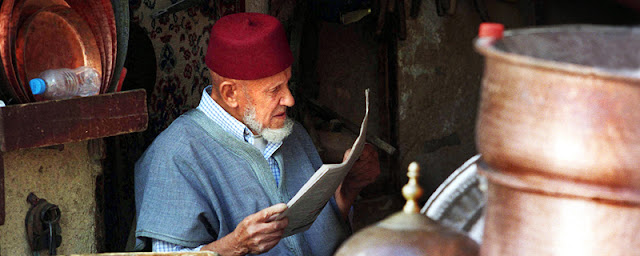
A newspaper boy was standing on the corner of an alley near R'cif with a large pile of newspapers, shouting, "Read all about it. Twenty five people cheated. Twenty five people cheated."
Intrigued, Sidi Idriss walked over, bought a paper, and checked the front page.
What he saw was yesterday's paper.
Sidi Idriss said, "Hey, this is an old paper, where's the story about the big swindle?"
The newspaper boy ignored him and went on yelling out, "Read all about it. Twenty six people cheated."
The Fez Declaration on Media and Information Literacy
Back on June 15, The View from Fez reported that Fez was to host an international conference ~ 'women and new media in the Mediterranean'. Well, the conference has been held and after a period of time for reflection has posted its initiatives. Happily, we can report on some very positive outcomes.
The First International Forum on Media and Information Literacy (MIL) was organized through partnership among UNESCO, the Sidi Mohamed Ben Abdellah University (Morocco), the Islamic Education, Scientific and Cultural Organisation (ISESCO), the Arab Bureau of Education for the Golf States (ABEGS) and the United Nations Alliance of Civilizations (UNAOC) and other partners. It was held from 15 to 17 June 2011 in Fez, Morocco, under the auspices of His Majesty King Mohammed the Sixth.
This Forum was the first of its kind at the international level to examine media and information literacy as a combined set of competencies (knowledge, skills and attitudes). Issues relating to importance of media, Internet and other information providers and their impact on learning, cultures and public opinion, as well as the empowering effect of MIL practices and global Internet governance were among the main topics discussed at the Forum.
Over 200 participants representing all regions of the world, including educators, information and media experts, civil society actors and social scientists, gathered to discuss MIL and share experience and knowledge.
The Fez Declaration, fully endorses the far-reaching vision that today’s digital age and convergence of communication technologies necessitate the combination of media literacy and information literacy in order to achieve sustainable human development, build participatory civic societies, and contribute to the consolidation of sustainable world peace, freedom, democracy, good governance and the fostering of constructive intercultural knowledge, dialogue and mutual understanding.
They call on all stakeholders to reaffirm their commitment to initiatives relating to MIL.
In connection with this event, the MIL Curriculum for Teachers launched at the Forum was translated into Arabic and French, and the Arab Region’s Consultation on Adaptation of the Curriculum was organized. Participating countries from the region included Egypt, Iraq, Jordan, Kuwait, Lebanon, Oman, Palestine, Saudi Arabia, Yemen and Morocco. A plan of action is being consolidated for piloting of the MIL Curriculum in teacher training institutions in Morocco, Lebanon and Oman. Discussion is on-going with other countries in the region.
In addition, the first International University Network on MIL and Intercultural Dialogue was launched through a partnership with the United Nations Alliance of Civilization. This will facilitate follow-up on the recommendations of the Forum and particularly the Fez Declaration on Media and Information Literacy. The Network on MIL and Intercultural Dialogue includes universities from Australia, Brazil, China, Egypt, Italy, Jamaica, Morocco and Spain.
The English Language Bookshop - new summer treats
The American Language Center bookshop in the Ville Nouvelle is situated at 2 Ave Ahmed Hiba, (just ask the taxi driver for the "American Centre). In the early weeks the stock was very limited. Thankfully that has all changed. While the shop has text books for the students at the Arabic Language Institute, and carries a range of dictionaries and some books for the Moroccan students learning English, there is now much more.
There are some handsome photographic books on Moroccan architecture and design,as well as wonderful cookbooks. The shop focuses on books about Morocco such as Edith Wharton's In Morocco, Fatima Mernissi's Dreams of Trespass, Peter Mayne's A Year in Marrakech, Paul Bowles' The Sheltering Sky and some of his short stories, and has some non-fiction by writers such as Fatima Sadiqi. Books written in English by Arab writers are also represented. Thankfully, with the expansion of titles, there is now a Paul (and Jane) Bowles section.
There was no modern fiction when the bookshop first opened. That too has changed and we discovered a good selection that will make perfect reading during the hot summer ahead.
Our approach is to have a wide selection of interesting titles, and to have new books coming in on a regular basis ~ David Amster, ALC Director
The bookshop's original policy of having only one copy of each book was simply bad retailing and has now been changed so that there are several copies of the most popular titles such as Tahir Shah's The Caliph's House", and Suzanna Clarke's A House in Fez.
So, next time you are after a good book, this bookshop will certainly have plenty to offer.
Wednesday, July 06, 2011
The Garbage Strike in Fez
The garbage collection strike that brought the Fez Medina to a virtual standstill for the last three days appears to be over.
![]() |
| A local boy holds his nose to avoid the smell |
![]() |
| Tourists step around garbage in Place Seffarine |
During Tuesday night and early Wednesday morning vast amounts of rubbish were cleared away. Local shopkeepers and residents were also hard at work washing and sweeping neighbourhood streets. R'cif, which had been one of the worst hit areas, was completely clean by 10 this morning.
![]() |
| Shops closed as the rubbish piled up |
Hopefully the clean-up will continue and visitors to Fez will once again enjoy the clean streets and friendly people of the Fez Medina.
Tuesday, July 05, 2011
Marrakesh bombing suspects on trial
Seven suspects have gone on trial for the bombing of the Argana Cafe in Marrakesh that killed 17 people.
At the opening of the trial last Thursday in Rabat, lawyers were granted an adjournment until August 18 to allow victims and defense teams sufficient preparation time.
The bombing, on April 28, killed Moroccan, British, French, Swiss and Portuguese victims.
The alleged ringleader, Adel Othmani, did not seem concerned by his appearance in the courtroom and smiled and waved at family members. He was arrested three days after the explosion and is accused of disguising himself as a guitar-carrying hippie to plant the two bombs that tore through the cafe overlooking the famed Jamaa el Fna square. Moroccan police say he has loyalties to al-Qaeda and tried to travel to Iraq and Chechnya.
The charges facing the seven suspects include premeditated murder, explosives possession, and membership in a banned religious group, according to the state news agency MAP.
The court refused a defense request to release the suspects ahead of the next court hearing, with the prosecutor angrily refuting the claim that the conditions of detention resembled those at the US prison camp at Guantanamo.
Security experts have stated that it is likely the bombing was intended to cripple the Moroccan tourist industry, which is a mainstay of the economy.
At the opening of the trial last Thursday in Rabat, lawyers were granted an adjournment until August 18 to allow victims and defense teams sufficient preparation time.
The bombing, on April 28, killed Moroccan, British, French, Swiss and Portuguese victims.
The alleged ringleader, Adel Othmani, did not seem concerned by his appearance in the courtroom and smiled and waved at family members. He was arrested three days after the explosion and is accused of disguising himself as a guitar-carrying hippie to plant the two bombs that tore through the cafe overlooking the famed Jamaa el Fna square. Moroccan police say he has loyalties to al-Qaeda and tried to travel to Iraq and Chechnya.
The charges facing the seven suspects include premeditated murder, explosives possession, and membership in a banned religious group, according to the state news agency MAP.
The court refused a defense request to release the suspects ahead of the next court hearing, with the prosecutor angrily refuting the claim that the conditions of detention resembled those at the US prison camp at Guantanamo.
Security experts have stated that it is likely the bombing was intended to cripple the Moroccan tourist industry, which is a mainstay of the economy.
Festival of Amazigh Culture in Fez
Morocco's new constitution, approved by voters last week, recognises Amazigh as an official language of the country. It's fitting, therefore, that the 7th Festival of Amazigh Culture will be held from 15-17 July in Fez.
The Festival's theme this year is The Amazigh Language in Education and Media in the Maghreb and the Diaspora. It comprises a series of talks, concerts, a play, workshops, a film screening, poetry readings, exhibitions of Amazigh carpets, books, art and a caftan fashion show. It's organised by the Spirit of Fes Foundation in conjunction with the Fes Saiss Association, the BMCE Foundation, the South North Centre and the University of Sidi Mohamed ben Abdellalh in Fez. Attendance is free of charge. Here's the programme:
Talks and exhibitions: Palais de Congres
Concerts: Bab Boujloud at 19h00 and Bab al Makina at 20h30
Play: Al Houria Complex
FRIDAY 15 JULY
16h00 Congress opens
18h00-19h30 Amazigh heritage and the role of identity in social change and human development
19h00 Bab Boujloud: Ahwash; Tifyur Group; In Con Trada (Italy)
20h30 Bab al Makina: Rumba Tarumba (Spain); In Con Trada (Italy); Hadda Ouakki; Daoudia
SATURDAY 16 JULY
Workshop: The Tifinagh Alphabet (presented by the Royal Institute of Amazigh Culture)
09h00: The civilisational and integrational dimensions of Amazigh culture
11h00: Socio-cultural representation of Amazigh in the education system
15h00: Teaching the Amazigh language in the Maghreb and the diaspora
15h00: Writing workshop
17h00: Amazigh in the education system and the media
19h00: Bab Boujloud: Daq Sif; Mayara Band
20h30: Bab al Makina: Ahidous Maestro; Ferroudja Saidia Group; Tachinwit
SATURDAY 17 JULY
09h00: Amazigh in the Maghrebi media
11h15: Poetry readings with poets Omar Taous, Moulay Ahmed Damou, Hddou Khoursa, Ait Larbi Moulay Elghali and Oubella Med Souiri
16h00: Complex al Houria: Amazigh film screening; dance and song by Femmes de la Source
19h00: Bab Boujloud: Ribab Fusion; Ithran al Houceima
20h30: Bab al Makina: Mohammed Mellal; Mohamed Rouicha; Caftan fashion show
For more information, contact Moha Ennaji.
The Festival's theme this year is The Amazigh Language in Education and Media in the Maghreb and the Diaspora. It comprises a series of talks, concerts, a play, workshops, a film screening, poetry readings, exhibitions of Amazigh carpets, books, art and a caftan fashion show. It's organised by the Spirit of Fes Foundation in conjunction with the Fes Saiss Association, the BMCE Foundation, the South North Centre and the University of Sidi Mohamed ben Abdellalh in Fez. Attendance is free of charge. Here's the programme:
Talks and exhibitions: Palais de Congres
Concerts: Bab Boujloud at 19h00 and Bab al Makina at 20h30
Play: Al Houria Complex
FRIDAY 15 JULY
16h00 Congress opens
18h00-19h30 Amazigh heritage and the role of identity in social change and human development
19h00 Bab Boujloud: Ahwash; Tifyur Group; In Con Trada (Italy)
20h30 Bab al Makina: Rumba Tarumba (Spain); In Con Trada (Italy); Hadda Ouakki; Daoudia
SATURDAY 16 JULY
Workshop: The Tifinagh Alphabet (presented by the Royal Institute of Amazigh Culture)
09h00: The civilisational and integrational dimensions of Amazigh culture
11h00: Socio-cultural representation of Amazigh in the education system
15h00: Teaching the Amazigh language in the Maghreb and the diaspora
15h00: Writing workshop
17h00: Amazigh in the education system and the media
19h00: Bab Boujloud: Daq Sif; Mayara Band
20h30: Bab al Makina: Ahidous Maestro; Ferroudja Saidia Group; Tachinwit
SATURDAY 17 JULY
09h00: Amazigh in the Maghrebi media
11h15: Poetry readings with poets Omar Taous, Moulay Ahmed Damou, Hddou Khoursa, Ait Larbi Moulay Elghali and Oubella Med Souiri
16h00: Complex al Houria: Amazigh film screening; dance and song by Femmes de la Source
19h00: Bab Boujloud: Ribab Fusion; Ithran al Houceima
20h30: Bab al Makina: Mohammed Mellal; Mohamed Rouicha; Caftan fashion show
For more information, contact Moha Ennaji.
Monday, July 04, 2011
National Geographic on Fez
The latest edition of National Geographic on line (http://natgeomusic.net) carries an extensive feature on Fez and its Sacred Music Festival, written by Evangeline Kim.
"Where but in Fes," asks Kim, "Morocco's renowned spiritual, cultural, and intellectual center so imbued with powerful Sufi saints' histories over 1200 years, could such an event take place?"
"Giant keyhole-arch palace gates, museum interiors, riad courtyards, and restaurants in the Medina burst with arabesque patterns in intricate mosaic zellij tile work, finessed plaster carvings, and interlacing polygonal geometric or flowering patterned cedar woodwork. Andalusian gardens bloom with fragrance in cooling foliage. By moments, an almost palpable crystalline light seems to illuminate the air while it materializes in the gentle yellow ochre shade covering palace walls and older buildings. Five times a day, polyphonies of the muezzin call to prayer roll across the city."
In two finely-crafted, in-depth articles, Kim gives an excellent overview of the Festival, from the afternoon concerts at the Batha Museum, to the evening events at Bab al Makina, as well as the Festival in the City concerts at Dar Tazi and Bab Boujloud (read the full article here).
It often seems that journalists covering the Festival attend a concert or two and then disappear to submit one short piece. But Ms Kim, it seems, not only explored the Festival and the city itself, but also took the time to meet local people and investigate local institutions.
TIJANI SUFI BROTHERHOOD
"Part of Morocco's great charm, interest and attraction lies with her people", explains Ms Kim. "We met the young scion of the great Tijani Brotherhood, Cherif Brahim Tijani. It was his great grand-father the venerable Cheikh Ahmed Tijani, who inspired the spread of Sufism in sub-Saharan Africa and all over the world.
Youssou N'Dour's concert was a tribute to this brotherhood. In his press conference, when urged by the Moroccan radio Chaine-Inter's incisive journalist/producer Aziz Hachimi, "Tell us in one word what Fes signifies for you, Mr. N'Dour? His answer: "Fes Tijani." And, in the medina neighborhood souks surrounding Cheikh Ahmed Tijani's mausoleum, business cards of the redolently aromatic Univers des Herbes (the local Berber pharmacy) and of a great traditional tailor of djellabas and robes, Abdelaziz Cohen, proudly proclaim their addresses as "next to Sidi Ahmed Tijani."
Cherif Brahim is an intriguing Sufi leader for the future. Although still young, he is well-versed in the cultural and spiritual history of the Tijani order, and quietly ponders his forthcoming responsibilities and hopes for Fes and Morocco. With a keen intellect and wisdom far beyond his age, he was in constant demand for interviews about his pride in the festival. He is well worth seeking out for greater knowledge about Sufism and its profound significance in Islam."
THE FES CRAFTS TRAINING & QUALIFICATION CENTRE
The National Geographic team also visited this Centre in Batha that was opened in 2009. Ms Kim reports:
"We met with the center's director, Ahmed Aboujaafar, whose enthusiastic and very careful management planning within the region's first apprenticeship program for artisans promises a greater, ensured socio-economic and cultural future for Fes and Morocco. The center has recently entered into a cultural exchange program with the UK under the auspices of Prince Charles. And will soon open another center in Casablanca. Mr.Aboujaafar has great hopes for and seeks to encourage increased international exchange programs.
The center was established to halt the decline in artisanal training since the beginning of the last century. Craftwork provides work and income to more than 53,000 artisans and a living directly or indirectly to more than 260,000 people in Fes, or 27 percent of the city's total population and 70 percent of the medina's population. It is a critical institution. To have visited the training ateliers and watched the crafts men and women at work was essential to a deeper appreciation of Fes' spiritual environment - especially during the festival.
According to Mr. Aboujaafar, a team of the center's master craftsmen of arabesque zellij, carved woodwork and plaster are already at work here in New York in the Metropolitan Museum of Art. In early November this year, the museum will unveil a whole Moroccan royal courtyard as centerpiece in the Islamic Arts halls. It will be breathtaking in visual splendor and the scope of its ingenuities, a true homage to the arts and culture of Fes." (See our story here.)
NEXT YEAR IN FEZ?
Ms Kim sums up her visit to Fez as follows:
"The mark of a superb festival must lie in its capacity to make one long to attend the next edition, to seek answers to lingering questions long after its conclusion - especially about Sufi symbolisms embedded in the ancient decorative arts of Fes. To wish to experience once again the extraordinary beauty of Fes' spiritual culture as it welcomes musicians and visitors from far and near, now remains part of a supreme memory."
"Where but in Fes," asks Kim, "Morocco's renowned spiritual, cultural, and intellectual center so imbued with powerful Sufi saints' histories over 1200 years, could such an event take place?"
"Giant keyhole-arch palace gates, museum interiors, riad courtyards, and restaurants in the Medina burst with arabesque patterns in intricate mosaic zellij tile work, finessed plaster carvings, and interlacing polygonal geometric or flowering patterned cedar woodwork. Andalusian gardens bloom with fragrance in cooling foliage. By moments, an almost palpable crystalline light seems to illuminate the air while it materializes in the gentle yellow ochre shade covering palace walls and older buildings. Five times a day, polyphonies of the muezzin call to prayer roll across the city."
In two finely-crafted, in-depth articles, Kim gives an excellent overview of the Festival, from the afternoon concerts at the Batha Museum, to the evening events at Bab al Makina, as well as the Festival in the City concerts at Dar Tazi and Bab Boujloud (read the full article here).
It often seems that journalists covering the Festival attend a concert or two and then disappear to submit one short piece. But Ms Kim, it seems, not only explored the Festival and the city itself, but also took the time to meet local people and investigate local institutions.
TIJANI SUFI BROTHERHOOD
Cherif Brahim Tijani (photo: Evangeline Kim)
"Part of Morocco's great charm, interest and attraction lies with her people", explains Ms Kim. "We met the young scion of the great Tijani Brotherhood, Cherif Brahim Tijani. It was his great grand-father the venerable Cheikh Ahmed Tijani, who inspired the spread of Sufism in sub-Saharan Africa and all over the world.
Youssou N'Dour's concert was a tribute to this brotherhood. In his press conference, when urged by the Moroccan radio Chaine-Inter's incisive journalist/producer Aziz Hachimi, "Tell us in one word what Fes signifies for you, Mr. N'Dour? His answer: "Fes Tijani." And, in the medina neighborhood souks surrounding Cheikh Ahmed Tijani's mausoleum, business cards of the redolently aromatic Univers des Herbes (the local Berber pharmacy) and of a great traditional tailor of djellabas and robes, Abdelaziz Cohen, proudly proclaim their addresses as "next to Sidi Ahmed Tijani."
Cherif Brahim is an intriguing Sufi leader for the future. Although still young, he is well-versed in the cultural and spiritual history of the Tijani order, and quietly ponders his forthcoming responsibilities and hopes for Fes and Morocco. With a keen intellect and wisdom far beyond his age, he was in constant demand for interviews about his pride in the festival. He is well worth seeking out for greater knowledge about Sufism and its profound significance in Islam."
THE FES CRAFTS TRAINING & QUALIFICATION CENTRE
The National Geographic team also visited this Centre in Batha that was opened in 2009. Ms Kim reports:
"We met with the center's director, Ahmed Aboujaafar, whose enthusiastic and very careful management planning within the region's first apprenticeship program for artisans promises a greater, ensured socio-economic and cultural future for Fes and Morocco. The center has recently entered into a cultural exchange program with the UK under the auspices of Prince Charles. And will soon open another center in Casablanca. Mr.Aboujaafar has great hopes for and seeks to encourage increased international exchange programs.
The center was established to halt the decline in artisanal training since the beginning of the last century. Craftwork provides work and income to more than 53,000 artisans and a living directly or indirectly to more than 260,000 people in Fes, or 27 percent of the city's total population and 70 percent of the medina's population. It is a critical institution. To have visited the training ateliers and watched the crafts men and women at work was essential to a deeper appreciation of Fes' spiritual environment - especially during the festival.
According to Mr. Aboujaafar, a team of the center's master craftsmen of arabesque zellij, carved woodwork and plaster are already at work here in New York in the Metropolitan Museum of Art. In early November this year, the museum will unveil a whole Moroccan royal courtyard as centerpiece in the Islamic Arts halls. It will be breathtaking in visual splendor and the scope of its ingenuities, a true homage to the arts and culture of Fes." (See our story here.)
NEXT YEAR IN FEZ?
Ms Kim sums up her visit to Fez as follows:
"The mark of a superb festival must lie in its capacity to make one long to attend the next edition, to seek answers to lingering questions long after its conclusion - especially about Sufi symbolisms embedded in the ancient decorative arts of Fes. To wish to experience once again the extraordinary beauty of Fes' spiritual culture as it welcomes musicians and visitors from far and near, now remains part of a supreme memory."
Saturday, July 02, 2011
Morocco's Referendum ~ early results
In Morocco, 72,6% of the voters decided on the constitutional referendum proposed by king Mohammed VI. The proposal passed with a 98% majority. The Interior minister, Taib Cherkuai, announced the results. The referendum voting was peaceful throughout the country and according to reports, the voter turn-out was not as high as had been expected.
By midday on Friday, Morocco's Interior Ministry told the state news agency Maghreb Arabe Presse that voter turnout was at 26 percent, and that the king had cast his vote in front of supporters in Rabat.
The BBC reported that low voter turnout at the referendum could spur demand for even greater freedoms – while adding that main political parties, unions and religious leaders have been urging support for the new constitution.
The reforms have received interational approval, with the European Union describing them as “a clear commitment to democracy”.
The vote will be the first constitutional referendum under the king's 12-year rule, and follows parliamentary polls in 2007, at which voter turnout stood at a record low of of 37 percent.
The speed of the results being announced was greeted with a certain scepticism by some commentators. As the popular Reading Morocco website put it... "in this referendum, there is something positive, after all: I found out that the Moroccan administration is so developed and advanced that it could count ballots nationwide, including from hundreds of villages scattered and isolated in the Atlas mountains, and do this in record time--four hours after the closing of the polling centers. What an extraordinary job you have done, my country."
The referendum sanctioned the policy of transformation from absolute into constitutional monarchy the king is sponsoring in response to the democratic requests of the Arab spring. While certainly a good step in the right direction, only time will tell if the protest movement will maintain their demonstrations. Questions are being asked about the actual number of citizens registered to vote (some 13 million)as a percentage of the total population (33 million) and there will no doubt be more attention to this point in coming days.
Reading Morocco also shared this "The voting activities on Friday, of course, quickly spawned jokes on the Internet. Here’s one popular joke: A man voted “No” for the new constitution by mistake. As he walked home, he realized his mistake and returned to the polling center to ask officials if he could change his vote. They told him: We already corrected that mistake for you, just don’t do it again."
Friday, July 01, 2011
Eating Italian in Fez
Opening a new restaurant a month before Ramadan, in a part of Fez’s Ville Nouvelle that is undergoing a major redevelopment, would appear a challenging prospect. But for Restaurant L'italien, it is one that looks set to pay off. Suzanna Clarke reports.
The View From Fez had heard the buzz around town about this new venture. Among several glowing reports, a local restaurant connoisseur told us that he had eaten the best Italian food at Restaurant L'italien since visiting Italy. So we set off this week to try it for ourselves.
Located across the road from the former Champs de Courses, which will eventually become the new Fez city centre, Restaurant L'italien has a terrace out front, flanked by olive trees.
Inside the decor is, “New York industrial warehouse meets Swedish meets Italian,” according to co-owner Alejandro Ferrando. With a fit-out by Italian architect Vanessa Di Mino, the restaurant has a modern designer feel, with a blonde brick feature wall, Eames chairs and lights from Habitat, yet still retains an air of casual comfort.
![]() |
| Alejandro and co-owner Alvaro |
![]() |
| Brahim - the pizza DJ |
Although entrees included tempting choices like Insalata Caprese and Carpaccio and hot items like Minestrone soup, we went straight to the pasta and pizza sections. I opted for one of the most popular choices, Pizza L’Italien, with rocket, semi-dried tomatoes, mushrooms and truffle oil, as well as the staples of mozzarella, parmesan and tomato paste. It was delicious, with a light and crunchy base and very fresh ingredients.
My husband selected the Ravioli di Spinaci, which the menu simply states has ricotta and spinach. But the reality was much more. While the plump parcels of home made ravoli were filled with fresh spinach and ricotta, the dish was set off to perfection by the creamy sauce with Cepe mushrooms. The overall effect was melt-in-your-mouth.
We couldn't manage the meat or fish main courses, such as Cote de Boeuf a la Florentine or Gambas Grises a l’italienne, so they will have to wait until next time.
However, we did squeeze in dessert - Panacotta ai fruitti di bosco and a Tiramisu. Presented in glasses, the panacotta was richer and creamier than I have eaten before and was delightfully complemented by the tartness of the berry coulis.
My partner’s Tiramisu, however, lacked the usual bite of liquor which is usually part of the mix – a concession to Moroccan tastes. It still had the distinctive coffee flavour through the sponge biscuits, beneath the mascarpone, but the result was lighter and blander than usual.
Overall, we would highly recommend Restaurant L'italien. There is an obvious attention to detail at every level, both in the decor and the kitchen. The service was friendly and attentive without being intrusive. The team have worked hard to get things right and it shows. There is free Wi-Fi for the business types and they do great coffee as well. In the cooler months the front terrace is likely to be crowded.
Entrees range from 50 to 90 dh; pastas and risottos from 60 to 120 dh; meat and fish dishes from 90 to 150 dh and pizzas from 60 to 100 dh. Desserts are around the 40 dh mark.
Ferrando says that the aim was for the prices to be “democratic – good food should be for everyone”.
Details:
Restaurant L'italien is open from midday to midnight. It’s at Residence Longchamp, Av. Omar Ibn Khattab; just down from the corner of Av. du Pakistan, opposite the former Champs de Courses. Bookings and delivery: 05 35 943384.
Review & photographs: Suzanna Clarke
Subscribe to:
Posts (Atom)


