Monday, November 30, 2015

Maâlem Hamid El Kasri Recovering in Hospital


Famed Gnaoua music icon, Hamid El Kasri, has been injured following a road accident

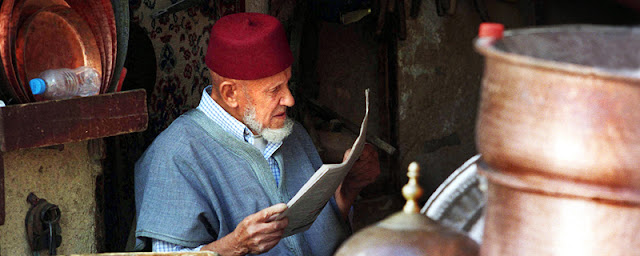
Hamid El Kasri : photo Sandy McCutcheon

The accident happened last week while he was driving on the highway between Casablanca and Rabat. According to media reports he went off the road before hitting a tree. Initial reports described him as being in a coma, however, this was later corrected by a spokesperson for the Sheikh Zaid Hospital in Rabat, who said El Kasri was "hospitalised but conscious."

The Gnaoui Maâlem has received support from around the country including a message from Neila Tazi, producer of the Festival Gnaoua and Essaouira World Music Festival who wished the artist via his Twitter account a "good recovery".

The View From Fez team also wish Hamid a speedy and full recovery.

SHARE THIS!
Print Friendly and PDF

New Chefs at Resto 7 - Food With Flare

Mix fresh Moroccan ingredients with Canadian experience and know-how, add a dash of Brazilian vibrancy, and what do you get? The new team of chefs at Resto 7

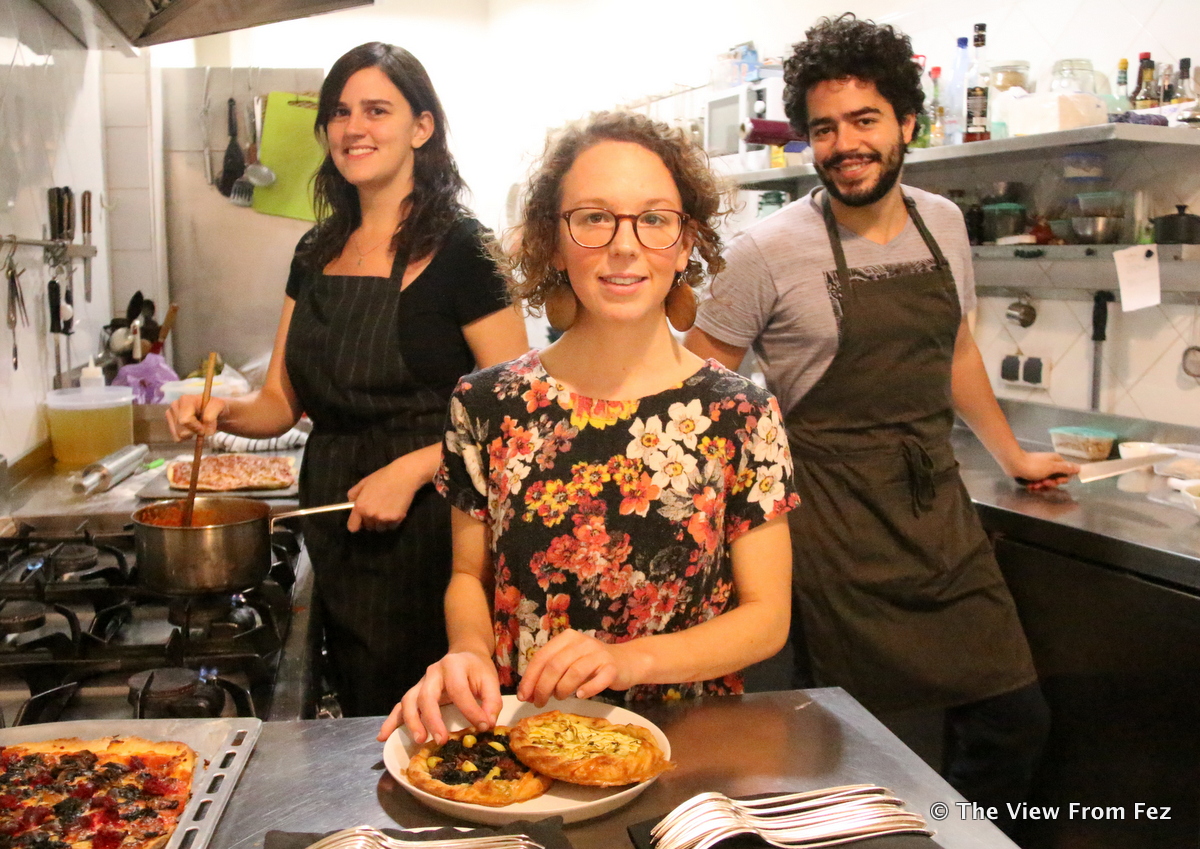
The team: Erica Bernhardt, Haley Polinsky and Gastao Rodrigues

Erica Bernhardt, Haley Polinsky and Gastao Rodrigues began their residency at the acclaimed pop-up restaurant last month, and will be cooking for Fez locals and visitors until January 17.

Dishes they have created so far include cucumber grape gazpacho, avocado roll with harissa shrimp; Fenugreek braised short-ribs, jerusalem artichoke puree, slow cooked onions and walnut salsa; fresh cheese gnocchi with roasted grapes and fennel, butter white wine sauce.

When The View From Fez team ate at Resto 7 last week, each dish was like an artwork, and the mix of flavours perfectly complemented one another.

delicious gnocchi 

It's not the first time that Haley Polinsky has worked in Fez. She spent time in the kitchen while  previous chefs Harry and Laura were in residence at Resto 7. "I came at the end of their residency and had a really positive experience here. The quality of food they were producing with the local produce was really great."

Knowing that running the Resto 7 kitchen on her own would be a formidable task, she asked two friends, Erica and Gastao, to join her. She knew that both were highly creative, and would respond to the challenge of working with seasonal ingredients and supplies that are not always reliable. "Erica and I ran another pop-up (in Canada), Galette Girls," she says.

From a small town in the Canadian province of Saskatchewan, Haley grew up on a honey farm. "so agriculture was a big part of my life," she says. She loved cooking with her mother, and decided to go to culinary school in Vancouver when she finished high school. On completion, she worked in catering, and then moved to Toronto, "...and got more into food scene". She met Erica while working at the restaurant C5 at Royal Ontario Museum.

Fenugreek braised short-ribs, jerusalem artichoke puree, slow cooked onions, walnut salsa

Stints at restaurants Grand Electric and Bar Isabel followed, before, "I quit my job last December and went travelling for five months. That's when I came to Morocco."

Haley's ethos is "to use as much local product as possible. I think it's important to know the farmer, and how the food is produced." She also works as a food stylist for professional photographers, "which is such a chilled atmosphere compared to working in the kitchen."

Erica Bernhardt was born in Rio de Janeiro, but her family left when she was young. "My mom worked for the Brazilian foreign service, so I grew up in the United States and the Czech Republic. Then I lived for a long time in Brazil as a teenager." After finishing a Masters in Political Sociology, Erica moved to Toronto. "I wanted to do something more practical, so I went to cooking school" After finishing, she began cooking fulltime, and worked at the Beverley Hotel and Opus restaurant. "I met Haley at C5, where I worked for a year and a half." Erica has been working as a pastry chef for the past three years, and during that time she and Haley started the pop-up "Galette Girls".

Galettes, or French pastry tarts, are something they have returned to with their lunchtime offerings at Resto 7, where delicious and beautifully presented savoury tarts are offered with a salad.

"This is my first time in Morocco. Initially, I felt completely overwhelmed when we walked into the Medina. I am super-excited about the markets. That's my favourite part of shopping."

Erica has created an unusual dessert with amlou, a Berber mix of ground almonds, honey and olive oil. "I made crème anglais, stirred the amlou into that, then set it with gelatine and breaded it with sweet feuilletine crumbs. It's then fried and served with caramelised bananas and wild strawberry jam.

Her partner, Gastao Rodrigues, was born in the tiny Brazilian city of Parnaiba. "I lived on a farm from when I was eight to thirteen, with pigs, cattle, sheep, orstrichs, coffee and sugar cane. I had a really fun time helping to take care of it."

Later during his teen years, they moved back to the city and Gastao's parents opened a restaurant. "I didn't know what I wanted to do, so I went to law school for a year and quit and decided to travel." His parents suggested he acquire a practical skill before he went, so Gastao took cooking lessons from the chef at his parents restaurant. "I couldn't fry an egg before I started."

While visiting Toronto, Gastao decided to take a cooking course his cousin had enrolled in. After graduating, he worked in a Portuguese restaurant for a couple of years, working his way up to being the chef. Then, from 2010 he was at a Brazilian restaurant, the Copacabana Steak House, followed by the Shibui Robata Bar from 2014. "I was working pretty much seven days a week, and learned a lot of Japanese techniques from Masaki, a Japanese chef from New York."

Five years ago, he met Erica at a party, and they have been together since.
"At first, when Haley asked us to come to Morocco, we said absolutely no way. But then we changed our minds."

"At first I thought it was a little overwhelming, but it has some similarity with places in Brazil, that are also crowded and disorganised."

Cucumber grape gazpacho, avocado roll with harissa shrimp

One of the aspects the trio have had to get to grips with is the "nose to tail" approach to meat in Morocco. "Shortly after we arrived, we went to the butcher and asked for eighty lamb shanks. He looked at us horrified and asked, do you know how many lambs I will need to kill to get that many? What will I do with the rest of the animal?"

Gastao says they are enjoying finding new ways to use the produce they find. "During the first week we cured trout with beets. And I really like the small 'beldi' lemons here. We sliced them really thin and burnt them slightly."

With the different cultural influences in their backgrounds, and their years of professional experience, Haley, Erica and Gastao are making the most of their time in Fez. Their dishes not only look exquisite, but the blend of flavours and textures in their dishes are carefully thought out, and work extremely well. If you have the opportunity to try their fare, I encourage you to take it.

To find out more about Restaurant Numero 7, also known as Resto 7, visit their website. CLICK HERE. 

Words and portrait photo by Suzanna Clarke. Food photographs by Haley Polinsky. 


SHARE THIS!

Print Friendly and PDF

Saturday, November 28, 2015

Sensationalism and Inaccuracy in Reporting Damages Morocco

Reporting of the recent atrocities in France has had an unfortunate side consequence for Morocco. Time and again the suspects were named as being French or Belgian - "of Moroccan origin". The result is the perception that somehow Moroccans were involved. 

To be clear, a Belgian or French national, is French or Belgian, no matter where their mother, father or grandfather was born.

According to Moroccan websites and social media, Moroccans reject any connection with the terrorists and like almost every other nationality has been showing strong solidarity with the people of Paris.


"Abdelhamid Abaaoud, the Moroccan who was behind the attacks in Paris"  - a review article entitled published in the online journal Le 360 

The most obvious case in point is that of Abdelhamid Abaaoud, the alleged sponsor of the attacks on November 13. Almost every news outlet, including some in Morocco, stressed that he had Moroccan parents. The information spread like wildfire in Morocco, relayed by the national media and social networks, provoking a wide variety of angry reactions.

"In my opinion, it is not authentic to label Abaaoud as Moroccan as he is a Belgian. I have nothing against dual nationality, quite the contrary,  but he grew up in Belgium. He speaks Arabic very badly, he knows nothing of Morocco," says Alioua Mehdi, a sociologist and lecturer at the International University in Rabat.

It raises the interesting question as to why Morocco is seen in such negative light.  Supposedly it enhances the news value of a story to label a terrorist as "Moroccan", when he patently has only an ancestral connection with the Kingdom. It is irresponsible and lazy journalism.

Following the Paris and Tunis attacks Moroccan tourism has taken a hit with local tourism professionals telling The View From Fez that tourist numbers have dropped dramatically.


Morocco has also caused anger in the ranks of daech (ISIL) by its assistance to French and Belgian security agencies. The group posted threats to Morocco on social media including  "to annihilate soldiers, blow up palaces and destroy the economy".  In response Morocco is on high alert.

Arabic daily Al Massae reports that Morocco's civilian security forces (police) and military (Royal Gendarmerie and the Auxiliary Forces) and its intelligence services are on high alert. The State Security Intelligence Unit, the DGSN has cancelled police leave and significantly increase the degree of vigilance at borders, airports and ports to to prevent terrorists entering the country.

SHARE THIS!
Print Friendly and PDF

El Baraka Angels - Making a Difference


Moroccans are renowned for their generosity of spirit and nothing exemplifies it more than an organisation called El Baraka Angels

Since its creation in 2003 El Baraka Angels has provided assistance to more than 8000 families with seven food distribution caravans, two medical caravans , school renovations, circumcision campaigns, summer camps and programmes of cultural and artistic activities.

This year is the third consecutive year, El Baraka Angels have organise special winter caravans to support rural populations living in isolated mountain areas. This year they have broadened its reach to include the Province of Azilal following an early and unseasonal plunge in temperatures.


This week twenty-five members El Baraka Angels began their eighth food distribution caravan in the mountainous villages of the Province of Azilal, with a load of almost 40 tons of gifts and winter necessities.

The inhabitants of the rural town of Zaouiat Ahensal,  one of the poorest areas and most isolated of the province, will welcome this caravan which will allow 750 families to receive packages to tide them over the extreme cold period until the milder weather returns.

The packages include 42 kg of basic food and non-perishables, blankets and warm clothing for adults and children.
"In towns in the rural areas, the mobilisation of civil society in times of extreme cold is essential. For us, besides being an important support for these families, these caravans allow us to study the field and identify new enclaves for our projects supporting education, school renovation, medical caravans and very soon also income generation, projects" - Selwa Zine, President of the El Baraka Angels Association.


In 2016 the association is preparing for a renovation project that will improve fifteen schools in mountainous rural areas. It has already completed six school renovations and another is underway in the rural commune of Dayet Aoua.

After completing the first trip this week, members and volunteers of El Baraka Angels will take a second caravan in less than a fortnight, this time towards the Ifrane Province for the benefit of another 750 other families located there that they have been assisting for the past three years. The association intends to conduct sustainable and lasting support actions for the populations in the hundreds of mountain villages that make up the province.

The High Atlas and Middle Atlas regions have been the scene of tragedies in the past caused by the extreme cold.  In 2006 reports described the death of over thirty people including eight children.  At the time the deaths angered local inhabitants who began a march to raise awareness of  the living conditions in these villages.  The following year there were reports of the deaths of thirty people including four women and twenty-six babies.

A child in Anfgou

In December 2012, social networks, national and international media focused on the death of an infant in Anfgou, a landlocked village in the Middle Atlas, where temperatures dropped to -16 Celsius.

Following the death in Anfgou there was a national reaction with in-kind donations valued at more than more 600 000 Dirhams (60,000 USD) collected and then sent to the region.


To support the actions of the El Baraka Association you can make a donation by cheque or bank transfer:
Account name: El Baraka Angels
Account Number: 007 810 24 0001055000000210
Swift Code International BCMAMAMC
Agency Attijari Wafabank, Avenu de France, Rabat

"Death will always have to keep you company, ease your suffering by collecting the souls exhausted by time and winds of winter..." -  Hassan Oumada


SHARE THIS!
Print Friendly and PDF

Friday, November 27, 2015

Winter Weather in Fez


The first really cold weather of the winter has arrived in Morocco with the Fez Medina recording morning temperatures as low as 2 degrees Celsius


If cold weather is no deterrent, then the region inland from Marrakech, such as the Ourika Valley, Asni Valley and Oukaimeden Valley, are the perfect places to get a feel for Morocco's alpine scenery. But be warned that the temperatures over the next few days are expected to be very cold. For the Toubkal area it will be mostly dry. Temperatures will be below freezing (max -3°C on Fri morning, min -6°C on Sun morning). Wind will be generally light.

None of the ski resorts are reporting significant snowfalls yet, but by mid-December, conditions should improve.

Marrakech is expecting mild temperatures

In the major tourist destinations the weather should be fine over the coming week. Casablanca and Rabat highs should be in the low 20s, while Marrakech will be slightly warmer averaging around 25 Celsius. Agadir will also average around 25 degrees.

Travellers to the sand dunes of Merzouga will have sunny days around 21 degrees but at night the temperature drops dramatically to between 3 and 5 Celsius.

Merzouga - expect cold nights

SHARE THIS!
Print Friendly and PDF

Recycling Workshop in Fez


This Sunday the ALC-ALIF Environmental Club is offering a fascinating recycling workshop in the Fez Medina

Click image to enlarge


SHARE THIS!
Print Friendly and PDF

Wednesday, November 25, 2015

A Majority of Moroccans Want English as Second Language


For months the debate about  linguistic identity has raged in Morocco. The tussle is between French, the English, with clear lines between those who favour retaining what they describe as the "language of history and the protectorate" and English, the language of "science and civilisation" 

The politicians have been vocal in the debate with Prime Minister Abdelilah Benkirane, expressing his desire to give English prime importance in the educational system and to become the second language after the Arabic.  The Minister of Higher Education, Lahcen Daoudi, has repeatedly stressed of English in the scientific disciplines, saying "We are obliged to gain proficiency in English" .

According to a recent poll by the Hespress newspaper, the overwhelming majority of voters want English over French in Morocco's educational system in Morocco.

The results of the poll of  41,526  people saw the support rate for English at 85.98 with only 14.02 percent of respondents wanting to keep French.

Dr Abdel Kader Fassi Fihri
International expert in the field of  linguistics, Dr Abdel Kader Fassi Fihri, says the result was"good news", because it reflects the awareness of Moroccan citizens in regard to the choice of foreign language, and the language of education in particular.

Fassi Fihri stressed that English, "being the universal language, is the language of trading and if you want to reach out to the world or want to move between one region and another, even in the Arab countries or  China, you need English. "

He also pointed out that English is the global language of science and scientific journals internationally are all indexed in English.

Dr Abdel Kader Fassi Fihri noted that "English has become the first language in Europe.  For example, in Spain, Germany, Portugal, and France the first other language is English," adding that he "You only find  French as the first foreign language in some African countries, which were a colony of France and Belgium."

According to Morocco World News, Moroccans have become more outspoken about the importance of switching the country’s education system from French to English. For the majority of them, as it is the case with the sample surveyed by Arabic-speaking news website Hespress, French is limiting their access to knowledge and economic opportunities. Even Moroccan officials have expressed on numerous occasions the importance of adopting English over French within the Moroccan educational system. For the head of government Abdelilah Benkirane, for instance, English is the language of today’s science, technology and commerce.

However, there are still people in Morocco who fiercely lobby for French to be kept the first foreign language of the country. Their efforts have yielded results as the Supreme Council for Education, Training and Scientific Research is said to be reconsidering earlier recommendations to replace French with English in the Moroccan curriculum. The new recommendations, if adopted, will be included in the Supreme Council’s Strategic Report to be submitted to King Mohammed VI.


The council headed by Omar Azziman, an advisor to King Mohammed VI, is said to have ordered the formation of a sub-committee to review the proposal of replacing French with English, a proposal already hailed by many members of the Council’s Permanent Committee on Curriculum, Programs, Training and Teaching tools in earlier sessions.

As one school teacher in Fez summed up, "The longer we take to make the switch to English, the longer we limit Morocco's possibilities."

SHARE THIS!
Print Friendly and PDF

Tuesday, November 24, 2015

Morocco - Renewable Energy Superpower?


The World Bank recently stated in an article on its website that: “Morocco is poised to make history soon when the first phase of one of the world’s largest concentrated solar power plants starts generating electricity. When fully operational, it will produce enough energy for more than one million Moroccans, with possibly extra power to export to Europe.”

In addition to providing electricity, the Noor-Ouarzazate power complex is expected to reduce carbon emissions by 760,000 tons per year which could mean a reduction of 17.5 million tons of carbon emissions over 25 years. The power complex is aimed at cost reduction whilst using new technologies to emit low-greenhouse-gas.


Morocco’s great advantage is the fact that it is the only African nation that is connected to the European electrical grid which will give Morocco access to a 400 billion Euro market for electricity.

Morocco’s environment minister, Hakima el-Haite, said that there could be a similar impact from solar energy to the region comparable to the impact of oil production in the past century. “We are very proud of this project. I think it is the most important solar plant in the world,” she said.

Environment minister, Hakima el-Haite

The Noor-Ouarzazate power complex is funded by around US$9 billion by international institutions, including the European Investment Bank and World Bank. The Saudi-built solar thermal plant will be one of the world's biggest when it is complete with mirrors that will cover the same area as the country's capital, Rabat.

Paddy Padmanathan of Saudi-owned ACWA Power, which is running the thermal project, said: "Whether you are an engineer or not, any passer-by is simply stunned by it. You have 35 soccer fields of huge parabolic mirrors pointed to the sky which are moveable so they will track the Sun throughout the day." He also predicts, "If Morocco is able to generate electricity at seven, eight cents per kilowatt - very possible - it will have thousands of megawatts excess.It's obvious this country should be able to export into Europe and it will. And it will not need to do anything at all… it needs to do is just sit there because Europe will start to need it."

The first phase (Noor 1 - 160 MW) is expected to go live by the end of the year.

The thermosolar cylindrical parabolic troughs at the 160-MW power plant will be coupled with three hours of energy storage capability. The power plant has contracted a sale price of MAD 1.6 (USD 0.159/EUR 0.150) per kWh and is expected to start feeding electricity to the grid by the end of the year.

Noor II, a 200-MW power plant with thermosolar cylindrical parabolic troughs and seven hours of energy storage capability, will sell its electricity output at MAD 1.36 per kWh.

Noor III, an installed capacity of 150 MW which will employ central tower technology with salt receivers and seven to eight hours of energy storage capability, will sell power at MAD 1.42 per kWh.

All three projects are being developed by two companies of the Saudi Arabian group Acwa Power.

Morocco's Noor 1 solar plant

Morocco has officially announced plans to continue its renewable energy development policy beyond the 2020 horizon with about 2,500 MW wind, solar and hydro capacity to come online between 2021 and 2025.

The new goals were revealed by Minister of Energy, Abdelkader Amara, at a ministerial meeting of the International Energy Agency (IEA) in Paris. Wind power is seen installing 1,000 MW new capacity between 2021 and 2015 while solar will contribute at least 1,100 MW and hydro will add some 450 MW.

In total, between 2015 and 2025, Morocco is planning to boost its renewable energy generation capacity by 6,760 MW, in which solar power will bring the majority with 3,120 MW, wind will add 2,740 MW more and hydro will grow by 900 MW, Amara, adding that the investment will total some USD 25 billion (EUR 23.5 bn).

With the new additions planned for after 2021, the total wind power capacity installed in the country should go over the 3,000 MW mark while solar will hit at least 3,140 MW in 2025.

Morocco's Dahr Saadane wind farm

Besides the 800 MW of wind farms which are already producing electricity, Morocco currently has 550 MW more under development and another 850 MW are soon to be awarded in a tender. The process will be finalised by the end of the year and contracts will be signed in the first quarter of 2016.

Wind power could be a major contributor in the electricity sector of Morocco. According to data presented by minister Amara in Madrid last June, the country’s onshore potential is estimated at 25 GW, of which 6 GW could be installed by 2030. The average wind speed is 5.3 metres per second (m/s) at more than 90% of the country’s territory, according to the wind atlas, developed by the Moroccan Renewable Energy Development Centre (CDER). The Tanger and Tetouan region (North of Morocco) measured particularly high at 8 to 11 m/s and 7 to 8.5 m/s were recorded for Dakhla, Tarfaya, Taza and Essaouira.

The offshore potential along the 3,500 km coast is estimated at 250 GW.

Since 2000, when the first wind farm in Morocco, the 50 MW Abdelkhalek Torres project, started turning, the sector has moved up on a steep learning curve. It had already achieved grid parity and in recent years, it has become an investment magnet with significant increase in projects.

In hydro, Morocco has 1,770 MW in operation. A further 450 MW, of which 100 MW by private investors, are expected to join the grid by 2020, and 450 MW more are now planned for construction between 2021 and 2025

SHARE THIS!
Print Friendly and PDF

New Flights - Rabat to Abu Dhabi


Starting from January 15, 2016, Etihad Airways will launch a new line linking the two capitals Rabat and Abu Dhabi with two flights per week


The new route to and from Rabat provides travellers with more choice in both directions between the UAE and the Kingdom of Morocco, and will allow the connection to other major destinations of Etihad Airways' network including the Gulf States (GCC), Asia, India and Australia. It will ,strengthen the existing daily service to Casablanca.

Flights are on Wednesdays and Fridays: EY616 Rabat - Abu Dhabi departs at 8pm and arrives at 7.25am. EY615 Abu Dhabi - Rabat departs at 10am and arrives at 3.15pm. Normal economy seats are priced at around 8,500 Moroccan Dirhams ($848 USD, $1,176 AUD)


SHARE THIS!
Print Friendly and PDF

Monday, November 23, 2015

French Films in Fez


The month of documentary - 16th edition - With the support of the French Institute

Thursday 26 and Friday, November 27th, 19h, Cinema Boujloud, Fez Medina.

Thursday 26: La Cour de Babel by Julie Bertuccelli - (2013)

They are college students, aged 11-15 years, together in the same reception class to learn French. A film that expresses innocence, energy and the contradictions of teenagers who, animated by the same desire to change life, challenge many ideas on youth and integration.

Friday 27: Golden Sleep by Davy Chou (2011)

The young Cambodian film world was abruptly halted in 1975 by the coming to power of the Khmer Rouge. Most movies have disappeared, the actors were killed and cinemas became karaoke restaurants. "Golden Sleep" is the story of a few survivors and tries to awaken the spirit of this forgotten film industry.


SHARE THIS!
Print Friendly and PDF

"Mutations, l’image et ses possible" - Photographic Exhibition in Fez


Organised by Morocco's French Institute as part of the 2015 France/Morocco cultural season, the 9th International Photos of Fez takes place from the 14th of November to the 15th of December

The exhibition, curated by Jeanne Mercier, is titled Mutations, l’image et ses possible (Changes: the image and its possibilities).

In the last decade, the practice of photography is changing our image of the world. In the last five years, these changes are particularly noticeable in Africa where the younger generation uses the potential of digital media to change the methods of developing and  dissemination - allowing the image to become more fluid.

With the advent of digital technologies - mobile phones, tablets, webcams, Flickr, selfies, Instagram - there has been an  explosion of images on the web and social networks. What has emerged is a globalised world, connected with ever more immediate visibility.

The Fez Photo International photographers have in common a desire to break down barriers and become part of a global culture that questions the new temporalities and realities.

The curator, Jeanne Mercier, is an art critic and independent curator based between Europe and Africa. She is co-founder and chief editor of Afrique in visu, around the platform in Africa. She has been a photographer since 2006.

 Visit the exhibition at the Cultural Complex Sidi Mohammed Ben Youssef.


SHARE THIS!
Print Friendly and PDF

Sunday, November 22, 2015

High Atlas Autumn - Photo Essay

Spectacular scenery is enhanced by the warm hues of autumn in Morocco's High Atlas mountain region. The View From Fez stayed at the Douar Samra guesthouse in the tiny Amazigh (Berber) village of Tamertert. As well as warm fires and hearty and delicious meals, the views from the terrace were extraordinary. It's an ideal base to explore Toubkal National Park by vehicle, by mule or on foot 

View from Douar Samra guesthouse in Tamertert
Autumn colours fill the valley near Imlil 
A shepherdess tends her small flock
Access to many villages is limited to 4 x 4 vehicle, mule or walkers
Morocco's highest peak, Mt Toubkal
Douar Samra guesthouse in Tamertert offers local hospitality
The main house at Douar Samra is lit only by candles
One of the garden rooms at Douar Samra
Rachida is the house manager and cook Douar Samra guesthouse
To see more information about Dour Samra guesthouse, please CLICK HERE

Photographs: Suzanna Clarke

SHARE THIS!
Print Friendly and PDF

Casablanca's Lincoln Hotel May Be Saved


The Lincoln Hotel, architectural jewel of Casablanca, may finally be restored after being abandoned for several years and threatening to collapse


Built in 1917 by the French architect Hubert Bride, the Lincoln hotel is a symbol of Casablanca's past. The Arabesque Art Deco building has had a colourful history, including housing American spies during World War II when it was the headquarters for the Office of Strategic Services (OSS), a United States intelligence agency formed during World War II.

Located on Boulevard Mohammed V, in the heart of downtown Casablanca, the hotel stood out for its neo-Moorish style and its carved wooden lintels.

Over time the hotel suffered from neglect; its facade blackened. One of its terraces collapsed in 1989, causing two deaths. After the accident the hotel closed down and the building was abandoned. The landowner, restricted from demolishing the building legally, allowed squatters to occupy the hotel in hopes that the infrastructure would not hold up to their occupation and the building might disintegrate naturally. A further death occurred in 2004 and in February this year (2015) another collapse caused the death of one man and injuries to two more.


Although having been abandoned for more than two decades, there has been constant calls for its preservation and restoration, especially from the conservation group, the Casamémoire Association. Architectural activists, city authorities and the Ministry of Culture prevented the destruction of the façade, and the site was named a National Historic Landmark which ensured that the landowner could not tear down the building.

Now the city authorities have launched a call for expressions of interest for the redevelopment and renovation of the hotel.

According to the announcement by the Urban Commune of Casablanca, the project includes the renovation of the hotel on an area of ​​2,500 m2 and which must safeguard its authentic architectural style. Investors and developers have been called to submit tenders for the project.

If the plan succeeds, a faded architectural gem will rise from the rubble.

To see more about the Casamémoire Association, CLICK HERE. 

SHARE THIS!
Print Friendly and PDF