Thursday, May 28, 2015

Fes Festival ~ Day Seven ~ Review


It was another fascinating day at the Fes Festival of World Sacred Music. It began with a sublime piano recital at the Batha Museum and ended with tales of lost luggage and a band that wasn't what most people expected...
La Conférence des oiseaux - Conference of the birds at Batha?

Medina Morning ~ Piano recital: Arabesque ~ Marouane Benabdallah


Marouane Benabdallah's exploration of Arab classical music at the Batha Museum was superb. After a few introductory words he sat at the piano, paused for a second or two and then began playing. It was immediately apparent that we were being treated to something special.

His first piece, composed by Dia Succari (1938-2010), was delivered with a gentle lyricism to the accompaniment of a chorus of birds from high in the tree above the stage.

His selection of music ranged from his own arrangement of Camille Saint-Saëns (1835-1921): Africa, Fantaisie op.89 to the tender, religiously inspired, La nuit du destin (Night of Destiny) by Dia Succari. The title of the piece alludes to the twenty-seventh night of the holy month of Ramadan.

Other pieces included Badrou Hosnen by Zad Moultaka composed for the Maqam Siba, one of the modes used in the psalms of the Qur’an; and Al Male Rachamim by Mohammed Fairouz, a prayer that is part of Jewish funerary rites. It was a repertoire almost unknown to the greater public in which the modes and rhythms of Arab music meld with the forms and structures of western classical music to create an original and unique synthesis.


The Saint-Saëns was an opportunity to display his undoubted virtuosity and irresistible dynamism and he dd so without theatrics or showmanship, but rather with the demeanour of a musician immersed in the music. Much of the time he played with his eyes shut, and a serene expression on his face. Of particular interest was piece by Moroccan composer Nabil Benabdeljalil (b 1972), who was due to give his own concert in the same venue later in the day. His sensual, crepuscular, Nocturne nº2 "Magdalena" was a delight.

Born in Rabat in 1982, Benabdallah took his first piano lessons at the age of four with his mother, a music teacher. Leaving Morocco at the age of 13 for further musical training at the Conservatoire Béla Bartók and then at the Académie Franz Liszt, both in Budapest.

 In 2008 he was awarded a prize from the Hungarian Parliament ‘in recognition of his exceptional talent and accomplishments in music’ – an honour that he shares with artists such as Placido Domingo, José Cura and other luminaries.


Marouane Benabdallah has always considered himself a musician rather than simply a pianist. Understanding how music works is his major concern, which is why he first studied theory, analysis, counterpoint and direction to integrate these alongside his piano classes. The result of all this hard work and study is what we witnessed today: a seemingly effortless display by a world class virtuoso. It will remain a festival highlight.

Batha Museum ~ Nabil Benabdeljalil and the Zakharif Ensemble

Thunder had been rumbling around the hills which surround Fez for an hour, and the wind was picking up, scattering leaves and the odd raindrop across the auditorium at the Batha Museum. As the committed audience members filed in, the management and technical team were still discussing contingency plans in the event of a storm.

Nabil Benabdeljalil

As the Zakharif Ensemble took to the stage in striped jackets reminiscent of a Speakeasy or Barber Shop quartet, the wind began to drop, as if in response to Nabil Benabdeljalil's homage to Schumann, and the birds of the Batha gardens began to sing again.

Before we could get used to the tranquil, tinkling piano, however, the saxophone joined in and the piece gained an altogether more jazzy, almost klezmer quality, before becoming Gerschwin-esque.


As the oud joined the arrangement, we travelled east once again and the piece gained an Arabian feel. Benabdeljalil had promised us a journey "from Egypt to Austria and the US", and we were fortunate all to have tickets!

After every couple of pieces, Benabdeljalil, a young Moroccan composer who received his training at the Académie Tchaikovski in Kiev, Ukraine, would introduce the next works and explain the genesis and inspiration behind them.


Despite his relative youth, he is already a well-known figure and he admitted that one of his compositions was part of the set of Marouane Benabdullah this morning in the same venue. Although he is very clearly the leader of the ensemble and composer of most of the pieces they played, he came across as humble and extremely grateful for the diverse input and skills of his fellow musicians. It was also clear that - despite his classical background, which shone through in a couple of his own compositions for piano - he enjoys flirting with different genres, breaking down boundaries and teasing the audience with unexpected combinations, insertions of extracts from well-known works, or momentary silences.


As he explained ahead of the last suite of pieces, Benabdeljalil's aim for the concert had been to start with the sensual - songs about romance, reproach and love - and move to the spiritual. This he achieved, via the short detour of an oud solo composed by band member Noureddine Ozzahr in homage to Berber oud master, Sidi Mohammed Rouicha, which evoked the dusty villages of the latter's native Middle Atlas. Benabdeljalil must have achieved some kind of spiritual connection - unlike other groups during this festival, he and the Zakharif Ensemble managed to tame the elements and play the rain away.

Bab Makina ~ The Not Temptations 


What started out as a potential Fes Festival highlight for many of the Western attendees, has been undone spectacularly by incompetence on the parts of both the Festival organisers and Royal Air Maroc. What was immediately apparent was that the bad reputation of RAM for losing luggage was well deserved when ‘The Temptations’ filed onstage wearing sweat pants, jeans and black t-shirts instead of their usual finery. What became apparent afterwards, when audience members checked their tickets, was that the Festival organisers has misled people to believe they were paying to see The Temptations, when in fact it was another group called The Temptations Review with Dennis Edwards.

Dennis Edwards

By doing so they have done a major disservice to the group, whose rousing performance has been undermined by this huge faux pas. The official festival website omits the crucial word ‘Review’ in the title of the band and says “The Temptations are, without doubt, the most well-known male singing group in the history of rock and soul music. A veritable institution created by Otis Williams, they were one of the pillars of the famous Tamla Motown label, that sent rhythm and blues across the world to become such a great influence on the British rock scene from the Rolling Stones to the Who to the Small Faces.

Otis Williams is indeed the founding member of the The Temptations - just not the group audiences saw tonight. Dennis Edwards joined The Temptations in 1968 to replace David Ruffin, and has been described as the official sixth member of the group, so certainly deserves the right to perform under a version of the group’s name. The line-up audiences saw tonight also consisted of David Sea, Mike Pattillo, Chris Arnold and Paul Williams Jr., the son of original Temptation Paul Williams.


So to the performance. Light rain delayed the beginning by half an hour and the stage crew scrambled to cover equipment with plastic, raising concerns that this was going to turn into another wash out like the cancelled concert this past Sunday. Consternation continued when the group finally arrived on stage looking like they were at a rehearsal, however they proved that they were consummate performers by engaging with the audience immediately. The crowd soon forgot what they were wearing as the music and dance moves dominated in a couple of barnstorming opening numbers.

Despite the problems, the audience was in party mode

These slowed down to a ballad that went out to “all the lovely Moroccan ladies” and this was the first taste of the individual group members coming out and doing solos. Mike Pattillo’s deep bass voice was impressively low, sending vibrations all the way to your toes. The song choice ‘Rainy Night in Georgia’ was very apt considering the weather conditions, however it had the blessed effect of stopping the rain! Umbrellas were lowered and everyone finally had a clear view of the stage.

A rendition of ‘My Baby’ led into ‘Get Ready’, which would have been a good moment apart from the fact the the sound dropped out and no-one could hear the lead singer at all, and the rest of the group barely. Fortunately the technicians recovered in time for the highlight of the night ‘Papa Was a Rolling Stone’. The high energy performance was set off by wonderful retro lighting and the crowd were on their feet and dancing. It was a goosebumps moment.


Another emotional moment was when they introduced the song ‘I Wish It Would Rain’. The song, as were many of their classic hits, was written by Motown writer Roger Penzabene and was about a woman he was in love with but couldn’t have. Tragically, he committed suicide not long afterwards. Later, the group also paid tribute to the four members of the original Temptations who have passed away.

"You may have noticed our outfits..."

Edwards then acknowledged the groups lack of costumes, saying “You may have noticed our outfits and this is because our bags went missing. Honestly we didn’t know what we were going to do, but the one thing I did know was that we were going to sing for you. We normally have these flashy clothes but we had to go out and buy five t-shirts - we hope you forgive us!”

And the crowd were ready to forgive and forget as The Temptations Review took them into full party mode with ‘Treat Her Like a Lady’, complete with flashing disco lights, and then of course, the finishing number had to be their most famous hit ‘My Girl’. Overall the performance of the group was slick, their harmonies spot on and vocals impressive. It was a shame that their best efforts have been undone by the scandal that emerged later. The Festival organisers have done them a huge disservice.


Dar Tazi ~ Sufi Nights


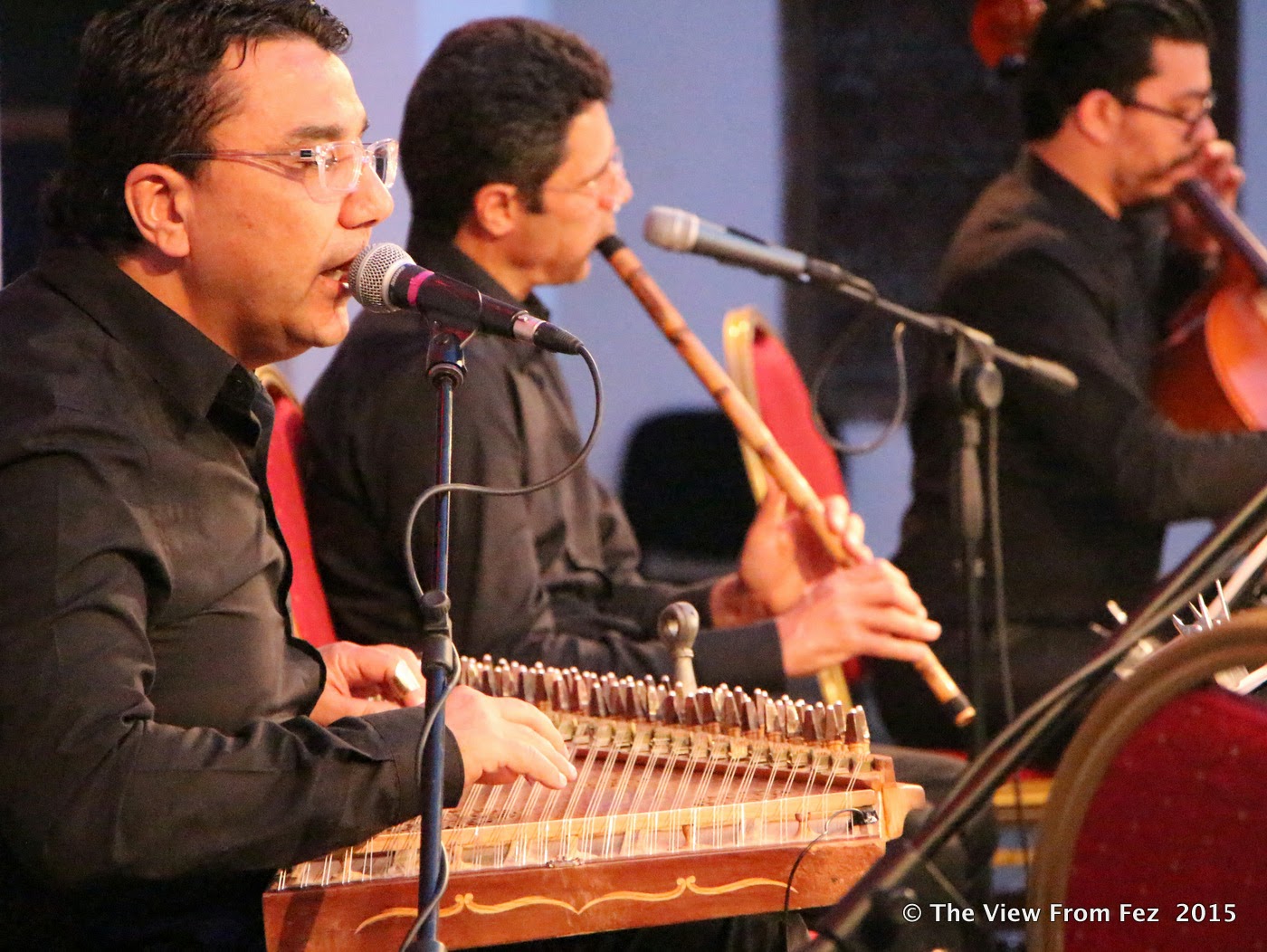
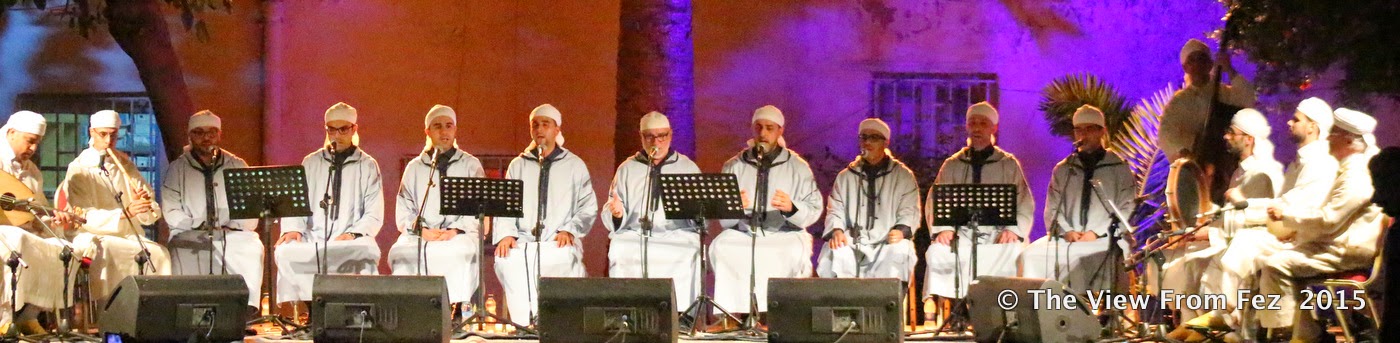
The group Zaouia Addarkaoui - Samaa Dar is a relatively new group. They were founded in 2000 in order to concentrate on the the art of Madih and Samaa.  Madih songs are eulogies to the Prophet Mohamed and in Samaa’ are spiritual poems.
Where celestial music becomes audible it combines the primordial sound and the absolute divine word. Through the practice of Samaà it becomes possible to experience the depths of being in universal harmony - musicologist Abdelfettah Benmoussa
As one member explained to The View from Fez, many in the group have academic training and participated in "research into the mystical realms". While it is hard to imagine the zaouia (Sufi lodge) members actually entering the mystical realms of jidba and hal (trance dancing), they could certainly sing. They contain within their ranks some very fine voices. One in particular, a younger man who sung the dikr (prayers) at the beginning, was exceptional. Also of note was the clarity and richness of the harmonies that emerged as they warmed up.

The young man (centre) had a superb voice and technique

Between performing and studying the group built the school "Dar Assamaa" which provides teachers in the Samaa, music and literature and everything that has a relationship with Sufism. Its mission is to disseminate and share tthe Sufi cultural heritage, and believe it plays a very important role in educating and guiding emerging performers against "moral deviation and intellectual extremism".

The group's leader - the malam 

The group enjoyed a largish audience and delivered what one French visitor described as "une merveilleuse soirée chorale de musique soufie" (a wonderful evening of Sufi Choir music).

The Buzz ~ Audience feedback with Fatima Matousse

Each day at the Fes Festival of World Sacred Music, we take time to talk with festival goers and find out what people attending the festival are talking about.

An inhabitant of Fes: “There is a change in the structure of the festival; I would say the people in charge are trying to make it an elitist event. They are targeting foreign audience and they are really trying to control and filter the audience; this was not the case during the previous editions. Also, this festival is not anymore a festival of sacred music; it is rather a festival of World Music. I was disappointed that the organizers did not have a plan B during the rainy day, it was sad that an artist well known as Oumou Sangre did not get to meet her audience.”

Nicole Amphoux, France: “For 15 years I attended the Fes Festival. I also attend the Festival of Sufi music since it started nine years ago. I would love to pay tribute to the original founder of the sacred music Fouazi Skali, thanks to him that the festival was born. All the music concerts that took place in Batha Museum were amazing. The place plays a major role in capturing the souls of the audience. You have a great musician in front of you in the nature and in a mysterious historical place. My favourite concerts so far are Fatoumata and Fonseca and the journey through Africa during the opening. I have also liked all the conferences especially the one about Hassan El Ouzzani. It was a bit early, but I loved them;”

An Inhabitant of Fes: “I will start with criticism; there is an absence of several media partners and sponsors that were strongly present in the past. Concerning the marketing of the festival, the same company and person is always doing it which is not fair for other marketing companies; it should be open to everyone to apply. Concerning the positive points, the festival boosts tourism especially the small guest houses and the organizers need to focus on improving the organization and the communication sides of the festival.”

Marion, France: “Everything is beautiful; there are always stronger and more beautiful moments than others during this festival. I love Diego character a lot, he was like a prince, I have his CD at home and I listen to him all the time. Though I think he did not do pure flamenco. I also loved Omar Sosa, his talented percussionist and charming dancer. I love the resistance to slavery through music and body moves. Of course I would conclude that I love Fez - as Muslims have in the Koran “God is beautiful and loves beauty”.

Klara, Belgium: "I am not sure I understand the relationship of sacred music with the music scheduled. As an anthropologist, I would have programmed Toumani Diabati and others. The most interesting one is Oumou Sangare, and she left without having the chance to sing due to not having a plan B for the rain. Fatoumata is good but she is an easy catch because she played in the recent film “Timbuktu”. I am not also interested to see The Temptations. Also the forums: as an anthropologist, I would have invited totally different people engaged in the political, research and African affairs. Honestly, I am not touched by the program because it lacks expertise and sharpness."

Mouna and Brahim, Fes: Mouna is 13 years old, she came to the festival with her 16 year old brother, Brahim. It is her second time attending the festival. She said “I liked the concert by Sabir Robai and I also came to The Temptations because I like them. I love the festival.”
Brahim told The View From Fez: “I like to come to the festival and its been four years now that I have been attending it. I love the choice of the music and the guests that attend.”

François and Gisele, France: Both François and Gisele were born in Fez. “We have been coming for two years. The opening of the festival was stunning and exceptionally beautiful and we love the Andalusian music as we are from Fez. But I think that there are less people than last year for sure."

Geneviève, France:“I don’t really see the link between what we see now and the sacred music. I think the organizers should define what sacred music is, so that people can decide whether they want to come or not.”

Sue, Fez: “I have been to several Fez Festivals and I always like the unexpectedness and the beautiful surprises such as music from Azerbaijan. What is frustrating for me is that there are so many things to see but they happen at the same time and it is hard to choose. It was devastating that Oumou Sangare did not get to play; it was really disappointing for me and for many of other people who only came to see her. The organizers could have scheduled her the next day as we know that Bab Makina was empty for the following day.”

Text: Vanessa Bonnin,  Lynn Sheppard, Fatima Matousse, Sandy McCutcheon
Photographs: Suzanna Clarke, Vanessa Bonnin, Sandy McCutcheon
Additional translation and research: Helen Ranger

Tomorrow at the Fes Festival

Weather: Cooler, A chance of a thunderstorm and morning showers. Top 23 Celsius and low of 13
4.30 pm - Batha Museum - Amen en la voz del Hombre
8.30 pm and 10.30 pm - Free Festival in the City - Bab Boujloud Homage: Hussain Al Jasmi followed by La symphonie de la Toctoca Jabaliya
9 pm - Bab Makina - Arabo-Andalous Orchestra of Fez directed by Mohammed Briouel

Sufi Nights
11 pm Dar Tazi - (Free) La Hadra de Chefchaouen: Khayra Afazaz

The View from Fez  is a Festival Media Partner and is covering all festival events and keeping visitors up to date with any change to the schedule via news stories and on Twitter :  @theviewfromfez

See all our Fes Festival 2015 reviews
Fes Festival Opening Night
Fes Festival Day Two 
Fes Festival Day Three
Fes Festival Day Four
Fes Festival Day Five
Fes Festival Day Six
Fes Festival Day Seven
Fes Festival Day Eight
Fes Festival Day Nine


The View From Fez is an official media partner of the Fes Festival of World Sacred Music

SHARE THIS!
Print Friendly and PDF

Wednesday, May 27, 2015

Fes Festival ~ Day Six ~ Review

Festival Forum
Topic: Contemporary challenges: education, health and geostrategy

Today's final Forum faced the challenging task of covering a wide range of global issues in a short morning. There was a danger that the topics would be covered too superficially or in too much depth for the three hour slot. However, a competent selection of panellists and a smaller, but engaged, audience ensured a decent discussion of a number of pertinent points regarding current affairs in Africa. The focus was intended to be on education and public health, but the majority of speakers specialised in the former. Several speakers had interesting anecdotes about the influence of actors such as international media, political elites, multinational companies and property speculators in Africa.

Phinith Chanthalangsy

Two speakers in particular proposed possible solutions for the issue of education and career mobility in Africa. Phinith Chanthalangsy, from the UNESCO office in Rabat, talked about his organisation's efforts to promote culture and human rights through South-South dialogue. Majida Bargach from Virginia University in the US had a very pragmatic proposal to equip young Africans to fulfil their potential. Citing the problem of borders closed to student exchanges in Europe and the US, she suggested that students travel between African countries to undertake work experience and become specialists in the African workplace. An audience member with connections to the Farage group encouraged her to discuss with him how the private sector might support such an initiative.

Majida Bargach

The range of issues was much more accessible to the audience members than on previous days, and as a result, many intervened from the floor with their own experience, as well as with questions. One summarised the challenge of education by citing Fatoumata Diawara, who played in the same venue yesterday: "Let our youth cross borders and gain the skills they need. They will come home and rebuild our countries."

Nights in the Medina III
Dar Adiyel ~ Sirat Al-Hilali

The epic Hilal story from the Poets of Upper Egypt
Ramadan Hassan, Mohammed Haza Nasra al Din and the Musicians of the Nile


The Hilal epic tells of the invasion of the Maghreb during the 11th century by the Beni Hilal and Beni Soleim tribes from the Arab Peninsula. There are still traces of this tale in Upper Egypt, where poets of gypsy origin sing this story accompanied by a rababah, a kind of fiddle with two horsehair strings and a coconut shell body, similar to the Arab rabab.

Tonight's five member all-male group resembled a troupe of itinerant troubadours. With their weather-worn faces and slightly tatty turbans, they looked as if they might have walked from Luxor to be with us, entertaining villages and gatherings along their way. Rather than invading the Maghreb, as did the 6000-strong Beni Hilal tribe about whom they sang, they enraptured their listeners.


The musical accompaniment to the story featured other traditional instruments of North Africa and Arabia in addition to the two rababah, including a large flat def (bindir) drum, a darbuka (goblet drum) and a range of flutes. Each section of the epic, which was sung, was punctuated by a musical solo. The most exciting of these was from the darbuka player, who encouraged audience participation through clapping, although our appreciation of his rhythm apparently left a lot to be desired! He laughed at our efforts as he returned to deftly tap out his own story on the skin of his drum. With these interludes, the performance was entirely accessible and enjoyable for those who did not understand the poetry element. This was confirmed by a call for "encore" at the end, which was graciously granted. There were few Moroccans in the audience, suggesting that those who had enjoyed it so much had not necessarily followed the complex story of the brave and rich men of Beni Hilal.


For those who are wondering what happens in the traditional 500-hour version, the El Hilali cross Egypt and settle in Tunisia, where they break a promise with the ruling Emir and go on to devastate the country. They continue their invasion into Libya and parts of Algeria, mounting raids, setting up independent principalities, and - fatally - continuing to fight among themselves. The infighting was their downfall. Add a little mystery, intrigue, double-crossing and seduction and you have all the makings of an 11th century soap opera!

Sidi Mohamed Ben Youssef Cultural Complex ~ Bhagavata Mela Ritual

Lord Krishna

The Festival programme presented a unique opportunity this evening - the chance to witness a sacred theatre group from India perform their ancient Sanskrit tribute to Lord Vishnu for the first time ever outside of their tiny village of Melattur in Tamil Nadu. Usually only performed once a year, on the birthday of Lord Narasimha (the fourth incarnation of Vishnu) in the Lord Sri Varadaraja Temple, the theatre group are embarking on a tour of six cities of which Fes was the first.


This form of theatre from South India is particularly moving. It is one of the last forms of ritual theatre in the sub-continent, originating in an India that is fast disappearing under the weight of globalisation. The village artists are deeply religious and for them, what counts more than any artistic idea is making the gods come to life, almost incarnating them. Exuberant, but also often gauche and naïve, this form of theatre evokes all the great theatres of the ancient world that keep alive the divine epics and mix theatre, music and dance.

The first indication that this was indeed a sacred ritual and not just entertainment was the musicians offerings of coconut, muttered prayers and the lighting of a candle at a miniature shrine with an image of Lord Narasimha, placed to the right of the stage, before the performance began.

A long low chant like an “oum” slowly built to a song accompanied by the venu (Carnatic flute) and mridangam (drum). The narrator, (thankfully) in English, announced that “the spirit of Ganesha will now enter and bless the audience and thus commences the play”.

The Demon King tries to turn Lord Shiva to ashes

The following hour and half showcased a spectacle of wonderfully costumed actors who played out a story of good triumphing over evil. A Demon King had convinced Lord Shiva to give him the power to reduce anyone to ashes by placing his hand on their head. Despite advising him not to misuse the power, the Demon King then tries to turn Lord Shiva to ashes. Shiva flees and goes into hiding. Then, both the soldiers of the Demon King and the gods search for Lord Shiva to no avail. The gods turn to Lord Vishnu for help, who disguises himself as a woman to entice the Demon King. In order to marry the ‘woman’ the Demon King is tricked into placing both his hands on his own head, thus turning himself to ashes
.
Lord Vishnu disguised as a women entices the Demon King

The narration was useful for a foreign audience to understand what would be a well-known tale to Hindus. However, much of the communication was done through dance, gesture, song and exaggerated facial expressions, “rather like an English pantomime” as one audience member commented. Another similarity to the medium was that all female characters were played by men. The style had echoes of the more well-known Kathkali theatre of Kerala, however as the theatre groups president pointed out, “Kathkali is much slower paced than ours”.

Sri S. Natarajan, President of the Bhagavata Mela group said after the performance: “First of all I want to thank the Festival and Morocco for having us here, we are very honoured. It was wonderful to perform for a foreign audience, I really enjoyed watching the reactions on the people’s faces as I danced. One unfortunate thing, we started twenty minutes late so I had to cut short some of the performance. We are going to Paris next, six places in total.”

Lord Vishnu

First time Festival goer Victoria Kindell said of the performance: “It was very colourful and visual, with the moving of the eyes and dramatic emotions, and intricate and disciplined dance. We were lucky to have an introduction to a different culture that we wouldn’t have been exposed to otherwise. I was very grateful for the English narrator, as the explanation of the story in the introduction was only in French, which would have been very limiting otherwise for most of the audience.”

Batha Museum ~ Dance Memory, Dance

On an idyllic evening in Fez the Batha Museum was the perfect setting for a mix of polyphony and jazz.  The venue had fewer chairs in place, most of them filled with festival visitors from Spain, Italy Germany and France. Tonight, the Moroccans are a minority and the overall audience numbers dramatically down from the level during the Sufi Festival a few weeks ago.


Six members of the the Corsican polyphonic group A Filetta filed on stage dressed in what has become traditional dress for polyphony - untucked black shirts and trousers. They began quietly, accompanied by Italian bandoneon (concertina) player Daniele Di Bonaventura.


Sitting to one side of the stage is Paolo Fresu,  a jazzman in the Sardinian tradition. For a while he seems lost in his own thoughts then he picks up his muted trumpet and softly joins in like a seventh voice; shy and hesitantly intruding...

After the first short number the lead singer explains (in French) that their programme is based on the island poets Aimé Césaire and Jean Nicoli. Césaire was a writer, poet and playwright from Martinique; Nicoli was a teacher and member of the resistance, executed in 1943 during the Italian fascist period.


After the second song the trumpet mute came off but at no time did it dominate the vocals. Between songs Paolo Fres, trumpet on his knees, his gaze on the carpet at his feet. At times his head would nod in time to the music as if he was waiting for the jazz muse to inspire him. Only when he bent to turn a page did it become apparent he was reading the music score.As the tempo increased the trumpet produced some subtle riffs which developed into a teasing interplay between the accordion and the trumpet. Meanwhile the choir leader climbed above the drone produced by his choristers to engage in some splendid vocal gymnastics.


There was (thankfully after the previous night) a distinct lack of ego displayed by all the performers. In its place was a charming humility that invited a connection between audience and performers.   However, polyphonic singing accompanied by an accordion lacks the spine-tingling chill produced by groups who sing pure a capella. Nevertheless, it was appreciated by many in the audience.

Corsicans and Italians, polyphonists and jazzmen, singing, playing trumpet and bandoneon, gave us a concert that was pleasant and relaxing but for all of that, never took off.

Sidi Mohamed Ben Youssef Cultural Complex ~ Badr Rami
The great Muwashshah tradition of Aleppo


Badr Rami was born into a musical family in Morocco to Syrian parents. He is a bit of a legend in Morocco, which, for those unfamiliar with the Syrian Muwashshah genre, - texts of a particular Arabic poetic form set to music - may be hard to fathom. This is his second consecutive year at the Fes Sacred Music Festival, so he clearly sells. Having said that, at around €25 a ticket, there were not many Moroccans in the audience tonight, although those present were very enthusiastic. A couple of women, sitting around the venue's large ornamental fountain, even got up to dance in it. Thankfully it was empty of water.

The concert was extremely slick. The 11-piece band appeared on stage in regulation black suits, including a 6-man string section (oud, 3 fiddles, a cello and a box zither), the darbuka (goblet drum), and a tambourine plus 3 backing singers.

Rami appeared to much applause, practically bursting out of his suit jacket, once they had played an introductory piece. In the vast courtyard of the Sidi Mohamed Ben Youssef Cultural Complex, it felt like an event arranged for TV for transmission on a festive occasion. It was so polished, the uninitiated could not even scratch the surface. Although the Moroccans in the audience happily clapped along, it felt like there was little warmth in the performance: Rami did not even interact with the fans until after the fourth song and the musicians didn't even look like they were particularly enjoying themselves.


This was the second gig tonight based on centuries old Arabic poetry. Despite the smooth and glossy production and the remarkable popularity of Badr Rami, his musical form and his storytelling felt less accessible than that of the Musicians of the Nile who had played earlier. The Egyptian El Hilali epic is supposed to be told over 500 hours. Forty-five minutes in, Rami's set felt like it might last that long. In the end, the audience were the judges and they loved it - the legend that is Badr Rami continues.

Sufi Nights at Dar Tazi ~ Tariqa Skalliyya

Hajj Muhammad Bennis

After a relatively quiet week at the Sufi nights, the largest crowd we have seen this evening and probably the largest at any venue, was at Dar Tazi. There was no doubt that the crowd puller was Hajj Muhammad Bennis. His voice and knowledge are much in demand here, and therefore he does not limit himself to one tariqa (Sufi order). In his poetic way of speaking he says, “like a bird that is not confined to one tree, I sing with many different orders here in Fez.”

The audience was full of Moroccan families, with lots of young children and toddlers, for possibly their first Sufi experience. Sitting in the front row of the crowd of several hundred was the regular contingent of Sufi practitioners who are always present at such events, as they were at the Fes Festival of Sufi Culture some weeks ago.

One of the many young Sufis in the tariqa

Hajj Muhammad is arguably the most important munshid (Sufi singer) in Fez and has been promoting Sufi samā` for years by performing, recording, and teaching young singers. It was noticeable that tonight the twenty-three member tariqa contained many young Sufis - a great sign for the future.

Tonight he led the Tariqa Skalliyya not from his usual position sitting centre stage, but in the shadows at the front, conducting "his orchestra" in the old style, using only voices and no instruments.

As they picked up the pace, solo singers took a turn you could hear cries of  “Allah!” from the audience when a soloist finished a particularly beautiful passage where poetry and melody were combined to create a transcendent space. It was an evening of truly spiritual music.


The Buzz ~ Audience feedback with Fatima Matousse

Each day at the Fes Festival of World Sacred Music, we take time to talk with festival goers and find out what people attending the festival are talking about.

Assia Fasia, Fez: "I come from France and I discovered Fez for the first time a year ago. I decided that it is my home and I have lived here since then. In addition the festival is magical and stirs all kind of beautiful emotions deep down your inner self."

Mohamed Azami, Fez:  "The souls inhabiting the houses in Fez must be happy to hear this music. I want to refer to Tahar Ben Jelloun when he said that Fez houses are special because they get to share the sky and the stars."

Jalil El Hayan and Nadia Fatri, Fez: "The festival is magical because of the chosen spaces such as Bab Makina and the Batha Museum. These places are rich in history; their walls tell stories which adds to the magic of the music itself. Also, we personally find the music’s quality exceeds the audience’s expectations. This year’s Festival is exceptional, with its invitation to delve into and celebrate our Africans roots. We consider Morocco as a bridge between African and European cultures. Though we were disappointed  because of the weather, especially that many events were cancelled." Nadia added that it was a chance for her to discover various African rhythms, melodies and dances which makes this program special.

Majda Alaoui and Nadia Haida, Paris, France: Majda and Nadia are originally from Morocco but live in Paris. They both came specifically to see the festival. They were enjoying the music and loved the melodies of Ramadan Hassan and his troupe. “At the very beginning of the festival, we were disappointed as the organisers did not have plan B (for the rain) during the Oumou Sangare concert. But other that, the musicians are amazing, the forum was also complementing the shows. I also liked that there are some free concerts for people who cannot afford it."

Jake, UK: It is Jake’s second time in Morocco, he said how much world music means to him. He sees Fez as a melting pot of cultures both historically and artistically and argues that when cultures meet, they enrich each other and that is what the festival is promoting.

Rabia Mestaoui, Fez: Rabia is a teacher from Fez. “I try to attend some of the events every year, but not all. For instance, I am really interested in the forum and music but my work load does not allow me to attend whenever I wish to; it is also the case of many colleagues of mine. I would love the organisers to involve more locals to ensure that there is a balance between national artists and international ones. The festival can also help emerging artists by giving them chances to play with professional ones.”

Iness Forissier, France: Ines was amazed by the forums and feels that she is in a journey in all over Africa not just Morocco. However, she thinks that last year was much more organised.

Aly Ndao, (Student in Morocco, Department of Gender, Society and Culture) Senegal: It is Aly’s first time at the Festival and he is attending all the forums as they enrich his academic studies.  However, he complains that the concerts are not affordable for students.  “I would love if there is a discount for students or free concerts to spread the benefits.”

Thelma Stone and Valerie Godson, UK: “This is my first time in Morocco. I came specifically for the festival, thanks to a friend of ours who has been a fan of the event. I have really enjoyed the concerts very much and our favourite concert so far is the Kurdish band that was on the opening night. We have been attending forums as well but we think that some of them are not interactive as much as others. But, overall, it is really a blessing to be here.”

Text: Sandy McCutcheon, Vanessa Bonnin, Lynn Sheppard, Fatima Matousse
Photographs: Suzanna Clarke, Vanessa Bonnin, Sandy McCutcheon
Additional translation and research: Helen Ranger

Tomorrow at the Fes Festival

Weather: Warm and sunny with a top temperature of 32 Celsius - a low at night of 16
11 am - Batha Museum - Piano recital by Marouane Benabdallah
4.30 pm - Batha Museum - Moroccan Zakharif Ensemble with Nabil Benabdejalil
8.30 pm and 10.30 pm - Free Festival in the City - Bab Boujloud - Saida Charaf - Orchestre Asri.
9 pm - Bab Makina - The Temptations with Dennis Edwards

Sufi Nights
11 pm Dar Tazi - (Free) Tariqa Darqawiya

The View from Fez  is a Festival Media Partner and is covering all festival events and keeping visitors up to date with any change to the schedule via news stories and on Twitter :  @theviewfromfez

See our previous Fes Festival 2015 reports
Fes Festival Opening Night Review
Fes Festival Day Two Review
Fes Festival Day Three
Fes Festival Day Four Review
Fes Festival Day Five
Fes Festival Day Six
Fes Festival Day Seven
Fes Festival Day Eight
Fes Festival Day Nine
Fes Festival - The Wrap


The View From Fez is an official media partner of the Fes Festival of World Sacred Music

SHARE THIS!
Print Friendly and PDF

International Forum: The Escalation of Violence Against Women in the Middle East and North Africa


This important forum takes place in Fez from the 29th of May to the 31st at the Palais des Congrès, Fez, Morocco 

PRESENTED BY ISIS CENTER FOR WOMEN AND DEVELOPMENT AND KONRAD-ADENAUER-STIFTUNG  RABAT OFFICE

The seventh edition of the Mediterranean Women Forum is open to everyone and with a special welcome to those who are visiting Fez for the Fes Festival.

While the post-Arab Spring turmoil is affecting men, women, and children, specific types of violence systematically target women and girls. The post-Arab Spring‘s initial backlash on women’s rights is not only gathering momentum everyday, but it is developing into unprecedented new types of violence against women with the mounting tide of Jihadism.

The new forms of violence range from the imposition of the niqab (total veiling), the ban of women from public unless they are accompanied by a male member of the family, a return of Female Genital Mutilation (FGM) for women between the ages of 11 and 46, stoning to death of (supposedly) adulterous women, assassination of female activists, Jihad al-Nikah (brainwashed women offering sex in support of the Jihadists), and enslavement (buying/selling of women and girls). These new forms of violence are indirectly sanctioning the already familiar types such as moralisation incriminating women for any social crisis, domestic battering, increased sexual harassment, forced marriage, and (gang) rape.

The seventh edition of the Mediterranean Women Forum aims at documenting and unveiling these new types of violence, linking them to the familiar types, understanding their social, economic and political ramifications, digging out their surface and deeper underpinnings especially in relation to Jihadism, and proposing strategies to alleviate and gradually stop them.

Languages of the Forum: Arabic, French, English (simultaneous translation provided)

Contacts: Prof. Dr. Fatima Sadiqi (ISIS), Academic Director
sadiqi_fatima@yahoo.fr
Ms Abir Ibourk (KAS), Logistics Director
ibourk.abir@gmail.com

A full programme is available in PDF form. If you would like a copy please email theviewfromfez@gmail.com with "Forum PDF" in the subject line

SHARE THIS!
Print Friendly and PDF

Tuesday, May 26, 2015

Fes Festival ~ Day Five ~ Review


Festival Forum - Hassan Al Wazzan (Leo Africanus): portraying Africa


Given the impossibility of interaction with the man himself, the format of today's Forum, which discussed 16th century chronicler of Africa, Hassan el Wazzan (Leo Africanus), was ideal and well-moderated by French historian Alexandre Pajon.

Oumelbanine Zhiri

A more diverse panel than yesterday featured three pre-eminent experts on Hassan el Wazzan: Spanish anthropologist José Antonio Gonzalez Alcantud; Moroccan Oumelbanine Zhiri, author several books and articles on Leo Africanus, and Madeleine Dobie, professor at the University of Colombia in New York. These three offered a comprehensive and multi-disciplinary overview of Leo's life in the context of his exile from Al Andalus, his conversion from Islam to Christianity following his capture by corsairs, and of a world undergoing great political geostrategic change.

Madeleine Dobie

As part, perhaps, of a broader African renaissance in our post-colonial times, Leo Africanus is a trending topic. As Ms Dobie noted, Malian director Abderrahmane Sissoko, (whose film, Timbuktu is showing on Wednesday at 3.30 pm at Cinema Boujloud as part of the Festival), is preparing a film about him and a play is slated for the Shakespeare Festival in the UK in 2017. (It has been suggested that Leo inspired Shakespeare's Othello). What was interesting from the panel's presentations is how Leo's book, A Description of Africa, published in Italy in 1550, shaped the European discourse on Africa, defined how Africa was seen and understood and even facilitated its ultimate exploitation by the colonial powers. As late as the end of the 19th century, maps of Africa were based on Leo's work.

Tomorrow's Forum will attempt in three hours to cover the huge topics of " Contemporary challenges: education, health and geo-strategy."

Nights in the Medina II

Batha Museum ~ Roberto Fonseca and Fatoumata Diawara

This afternoon the audience at the Batha Museum was treated to a trip from Africa to Cuba and back again. Fatoumata Diawara, as resplendent as a ray of sunshine in a traditional Malian costume in yellow, said, "We've been hypnotised with this story of borders. Musically we see connections that transcend borders - the percussion in Cuba is played in the same way as it has been in Africa for centuries."

Fatoumata Diawara
Roberto Fonseca

Roberto Fonseca and Fatoumata Diawara have to be one of the most gorgeous, charismatic - not to mention talented - pairings in world music. Their collaboration dates back to the latter's appearance on Fonseca's 2012 album, Yo. Their live partnership, however, which led to the EP, At Home, released this month, was born at last summer's Womad Festival in the UK. The Cuban-Malian connection, however, dates back way further. It was even due to be honoured in the collaboration which eventually became the Buena Vista Social Club, of which Fonseca was a part, but the Malian contingent never made it to the Caribbean island.


Fortunately for us, Fatou and Fonseca made it to Fez and were in fine form. Over the last couple of years, Fatoumata has been touring almost incessantly and has matured, gaining great confidence and becoming more politically engaged. The collaborative effort reflects this: from the funky Sowa, a track dedicated to those who have never known the love of their parents; to Clandestin, about the hot topic of immigration, with its rock guitars reminiscent of Ali Farka Touré; to a gentle love song inspired by the forced marriage that Fatoumata escaped aged 19. All the while, the five-beat rhythm which unites Mali and Cuba, was ever-present.

By the end of the set, the pair and their Cubano-Malian band had the place on its feet, dancing to a song dedicated to Nelson Mandela, punctuated with piano riffs worthy of Cuban greats twice Roberto's age. As the whole audience clapped along with the clave, Diawara loosened her turban and whipped her braided hair. Fatoumata Diawara clearly sees herself as the voice of the voiceless, the representative of under-represented African youth and women. She is a tour de force and we were so fortunate that her whirlwind stopped in Fez with her Cuban "brother" just for a few hours, so we could hear her voice from the heart of Africa.


Dar Adiyel ~ Li Daiguo


In the first completely solo performance of the festival so far, Li Daiguo proved that it only takes one supremely talented individual to command an audience, albeit one who is proficient on a dozen different instruments, and excels at throat-singing and beat boxing. Daiguo is one of the leading figures in China’s experimental and traditional music communities and tonight the audience at Dar Adiyel found out why.

Daiguo entered the stage humbly, with no words, picked up his pipa (Chinese lute), embraced it with eyes closed for a full ten heartbeats before his fingers began to pluck the four strings, producing a high pitched, repetitive sound like raindrops falling slowly, then accelerating into a more electronic industrial sound which in turn faded to a couple of notes that were distinctly oriental.


He continued to keep his eyes closed into the next piece, with his head thrown back and mouth agape as if breathing the music. He cradled the pipa, his movements expressing great tenderness and played with a manner of one caressing a lover. The crowd, mesmerised by his sound and motion, were suddenly jolted out of their reverie when he leant forward to the microphone and unleashed a volley of vocal beats that brought the piece to an end. Daiguo smiled as if he knew the shocking effect he had just had, and that the audience were now in the palm of his hand.

As well as powerful discord and changes of pace, Daiguo also knew how to utilise the power of silence, unafraid to leave long pauses between notes. He didn’t feel the need to fill every second with sound and moments of silence suffused the entire space, the crowd so immersed you could have heard a feather floating.


Daiguo switched to the cello, bowed one continuous note and commenced throat singing - a whistling sound like a bird of prey soaring over a mountain top creating a timeless and ancient soundscape. The range of his voice was startling, at times deep and guttural like monks chanting, sometimes loud with anguished cries. He also utilised the bow in a variety of different ways, sometimes almost sawing the strings, other times bashing the camien - always experimenting and pushing the limits of the instrument.

After the first shock the audience remained on edge throughout the performance, waiting for the next unexpected development. Diaguo commanded attention - he grabbed it early on and kept the crowd absorbed with his total focus, not speaking until one word at the very end. A simple "thank you".

Sidi Mohamed Ben Youssef Cultural Complex ~ Wajd 

A programme created for the Fes Festival by Sonia Mbarek

We are the protectors of the Sun.
There is only one reason we have followed God into this world:
To encourage laughter, freedom, dance and love
~ Hafiz
Sonia Mbarek would have loved to "encourage laughter, freedom, dance and love", but sadly had only forty-five people in the audience when she began, although the number rose to around sixty after her first song. The small crowd was a disappointment, especially in such a spacious and beautifully simple venue.

But, despite the small numbers, Mbarek and her five piece band filled the Cultural Complex with a air of grace as they delivered a programme that was both interesting and varied.


After a gentle introductory piece from cello and ney (wooden flute) Sonia Mbarek stepped up to the microphone. Her voice, sweet yet powerful, expressive and full of longing, was complimented by three members of her band providing backing vocals. There is much subtlety in the Tunisian touboûs with accents of Charki maqam and while there is depth and harmony in Sonia M’barek’s interpretations, it is always refined and nuanced. If there were to be any criticism it would be that her approach at times was technical and almost academic rather than produced from deep within.

With a background in Sufi contemplation, Mbarek sang around a dozen sumptuous works by great poets inspired by peace and personal joy - including works by Andaloussi (Anta fil Maoudhii) and Mohamed Iqbal (Mal ishq). Half way through her set she gave a wonderful rendition of one of the main works of the late Laâroussi Ben Khemiss Ettourki - Ennabi wi m’thala.


For the musicologically minded, it was interesting that the rhythms of this concert were chosen in accordance with those used in the various styles of Sufi inshad, such as daffa, Dkhoul, Btaïhi, Aissaoui and Wahda. These are allied to the mood of tarab (musical ecstasy) and the tempo of spiritual songs perpetually in search of trance and exaltation of the spirit. Tonight Sonia Mbarek may not have produced the ecstasy, but she did show us the direction in which it lies.

Batha Museum ~ Diego El Cigala


This was without a doubt, the busiest Batha concert so far, despite the many other events on offer. As we waited for the concert to begin, more people kept pouring in. And we waited. And waited. Someone instigated some slow clapping. Finally, the five-piece band, (Spanish guitar, electric guitar, double bass, percussion and piano), came on stage around 9:30pm to play a couple of lounge jazz numbers...Not quite what the audience had been expecting, but pleasant nonetheless. Once Diego el Cigala finally appeared, "very happy to be in Morocco and Fes for the first time," he received rapturous applause which hardly stopped until the concert ended two hours later.

Double grammy-winning El Cigala has a clear voice, the timbre of which reveals his gypsy heritage. He was billed in the programme as a "major voice of flamenco," however the initial numbers he sang - all in Spanish - were much closer to jazz than the drama of flamenco. He softly squeezed his heavily-jewelled hands together in the flamenco rhythm but there was little of the temperament usually associated with the genre.

Benjamin Bouzaglou - the crowd favourite, but only two songs

After a few numbers during which the tempo gradually increased, El Cigala invited Judeo-Andalusian singer Benjamin Bouzaglou on stage. Bouzaglou is a regular at Moroccan festivals of Andalusian music and his appearance was much anticipated, but disappointingly, he and the Spaniard only did two songs together, each singing in his native language. The effect was stunning and the audience loved it. The singers visibly enjoyed their collaboration, but we saw no more of Benjamin this evening, which was a great pity.


El Cigala's popularity was apparently in no way diminished, however, as he exited the stage and left his band to demonstrate their very considerable talents. Sadly, even when on stage, he hardly interacted with the audience. At times the performance felt like the jazz band in the corner of a hotel lobby rather than that of a flamenco maestro. Towards the end, they rattled through some piano-heavy Cuban-style numbers, influenced by El Cigala's 2003 collaboration with the late Cuban pianist, Bebo Valdés. These were exhilarating, but still not flamenco. By the end of the concert, however, the large audience gave him a standing ovation, shouting 'una otra,' wanting more. One more Cuban number and the El Cigala phenomenon was over.


Dar Adiyel ~ The Sacred World of Mugham

Arzu Alieva: voice
Elchan Mansurov: kamancheh (string instrument)
Malik Mansuro: tar (long-necked string instrument)
Shirzaa Fazaliev: balaban (double-reed wind instrument) and zurna (woodwind instrument)


The concert started as gently as a breeze over a grassy plain; with haunting notes from a balaban, a double-reed wooden flute. Next it was the turn of the kamancheh, a long-necked stringed instrument with a bulbous base, inlaid with mother of pearl, which sounded like a cross between a violin and a sitar, before the steel stringed tar took its turn. Occassionally Arzu Alieva kept rhythm on a daf, a frame drum covered in goatskin. Together, the instruments built up a soundscape - echoing the rich Ottoman and Persian traditions that are the origin of the mugham tradition of Azerbaijan. ​​


When Arzu Alieva began to sing, her voice was mournful, piercing and vibrant. She used a technique between a chest voice and a head voice, ululating in a way reminiscent of overtone singing.

Traditional Azerbaijani music has played a dominant role in the Caucasus and Central Asia. It has also benefited from exchange with other cultures in neighbouring countries: Georgians, Armenians, Turks, Dagestanis, Uzbeks and Turkmens. It finds its expression in the mugham, a vast vocal and instrumental oeuvre that depicts with great passion and refinement a whole range of expressions of love.

Many of the audience at Dar Adiyel relaxed on ​the carpets, and let the evocative music wash over them. Contained in the notes were the sound of the wind, the beats of horses hooves, and the call of a lone voice across a vast distance.


The haunting beauty of Azerbaijani songs was glorified by their national poet, Nizami Ganjavi:
Dear singer, take your saz in your arms,
Play sweet music for us,
Don't limit your range,
Our melodies are broad and rich.
Sidi Mohamed Ben Youssef Cultural Complex ~ Nawab Khan and Mantra


Nawab Khan

A performance of "therapeutic raga" may sound a little worthy, but Nawab Khan turns the event into one of delight. It should be remembered that the word "raga' derives from the Sanskrit ranj meaning ‘that which affects or influences the spirit and brings pleasure’. The purpose of a raga is to evoke aesthetic delight, to offer the listener a ‘flavour’ to taste, with an approach that has emerged over more than a thousand years.

Nawab Khan specialises in awakening the therapeutic aspects of the Indian modal system that is sensual, sensitive and poetic. His technique, like that of any good therapist, is to guide the audience with gentle phrases delivered in hushed tones. He explained that the music they would present came from the various religions from the Indian sub-continent.

However, the music, when it began, spoke for itself - it's initial effect being therapeutic in its own right. Some in the rather small audience succumbed and lowered themselves to the carpet, where, eyes shut, they drifted off in an ethereal cloud of bliss.


The four man group's first offering was immediately recognisable to the few local Moroccans in the audience, as coming from the Muslim tradition - Bismillah ir-Rahman ir-Rahim. "In the name of God, the Most Gracious, the Most Merciful". The music was quiet, gently mesmeric and ephemeral - drifting over the audience like a soft warm breeze.

As the balmy evening continued and the half moon became visible above the courtyard, the tempo increased, driven by some excellent tabla and sarangi accompaniment.

If it is indeed therapy, then Nawab Khan  is the therapist. This young classical musician from Jodhpur in Rajasthan and his companions perform on the Persian and Kashmiri santoor (stringed instrument), the sarangi (dulcimer) and tabla to guide the audience through the therapeutic, emotional labyrinth that is Indian music.

Sufi Night at Dar Tazi


Tariqa Machichiya is a Moroccan musical group founded in the beginning of the nineties by Sheikh Mohammed Hanini and is the custodian of the sacred traditions of classical Arab songs.

 The group is based in the mountains above Tetouan and, if tonight's performance is anything to go by, they deserve their reputation for fine renditions of Arab-Muslim musical traditional music with a touch of musical originality and creativity. While playing traditional music the Brotherhood employs non-traditional instruments (such as a double bass) and in many ways is closer to their alternative name - the Al Ghazali Ensemble .


While their repertoire is varied and interesting, it is not in the same league as the Isawa, Gnaoua or Hamadcha groups who forge their way towards the divine in a blaze of energy. The Machichiya are more sedate and probably better musically disciplined. Whatever the case, the large mostly Moroccan, crowd at Dar Tazi loved it.


The Buzz ~ Audience feedback with Fatima Matousse


Each day at the Fes Festival of World Sacred Music, we take time to talk with festival goers and find out what people attending the festival are talking about.

Youness Abeddour, Casablanca: "I am from Fez but I currently work in Casablanca, and I specifically came just to see Diego El Cigala perform with Benajmin Bouzaglou. I cannot resist coming; it is an amazing place for networking, reuniting with friends and learning about other cultures through music. I am really happy to see Diego El Cigala play with Benjamin. But, I was really disappointed that Benjamin did not sing for a longer time. He performed very quickly and disappeared.”

Elena Grodzievskagan, Russia: It is Elena’s first time in Fez and she came to see the festival which she enjoyed a lot. She says, “It is my first time ever to see Diego and Benjamin perform together, which is fascinating. My favorite artist during the show was the guitarist of the band of Diego, he was so absorbed and conveys many emotions through his guitar.”

Haim Casas, Spain: Haim lives across the border from Morocco and he comes often because he feels at home, he said. Haim’s favorite part during the show was the marriage of Judeo-Arabo music and Flamenco as they have already got so many melodies in common, both singers complemented each other despite the two different languages they sung in: Spanish and Arabic.

Hamoud Abeddour: “The last edition I attended of this festival was in 2012 and I came just to see Diego El Cigala and Benjamin Bouzaglou. But I think that their singing together was really short and I did not get to see Benjamin play for a longer time, which I did not understand. However, I won’t deny that I spent great time enjoying the show.”

Jean Pierre Deyls. France: He told The View From Fez that it was five years ago when he first came to Morocco and first attended the Fes Festival of World Sacred Music. "Since then I have never missed any edition. I am very interested in intercultural exchange which was portrayed today in the music performance where both India and Mali shared the stage. It was my first time to see a Malian perform with an Indian which I found quite interesting. However, I was disappointed that the concert yesterday was cancelled and I still have not been reimbursement which kind of frustrating as I paid 80 euros to see Oumou Sangare".

Eva Binder, Austria: This is actually my first time in Morocco, I heard from some friends back in Austria about the festival and I decided to attend this year. I am in love with spiritual music and I have got a friend who is studying Berber music at the university. I have fallen in love with the Medina of Fez already. I am enjoying it and I am definitely planning to come back.

Eva Monteilhet, France:  This is my first visit to Morocco, I like the festival - it is amazing especially that it is happening in such a beautiful, peaceful and historical place. The musicians are so happy and warm, I have a feeling that they are a family which I sometimes miss in Europeans concerts where music has become just a business and you don’t see the full enjoyment of artists on stage. What I did not appreciate much is that most of the audience is European and more specifically French; I did not see many Moroccans which was disappointing. I felt that the festival is made for Europeans more than locals. So far, I am glad to be here, I see everyone smiles.

Anass Lazrak, Fes, Morocco: I am from Fez and I always attend some of the events. I am much more interested in Andalusian music as I have grown up with it. What I really admire about the festival is that it is a contact zone for numerous cultures and people. However, some locals cannot afford to attend due to several reasons. For instance, the ordinary citizen is much taken by securing the daily needs for his or her family which is a challenge that prevents this category of people to even think to consume culture and attend concerts. Moroccans who attend the festival belong to a middle or a high class. I have also noticed that the festival is growing every year. At the very beginning, you would only see Moroccans and French people. However, now the audience is much more diverse. I have noticed that only people of certain age (retired) that afford to come as the timing is not suitable for families as the kids are attending school at this time of the year.

Lisa Grabenwager, Austria: I came across the festival on the internet and  decided to come to Morocco for the first time. The spiritual music does not leave any space for you to decide to love it or not; it just haunts your soul. Fez is a magical place and I hope to be lucky enough to come back next year too.

Anantha Krishnan, India: I think that thanks to the festival more attention is being paid to spiritual music and other festivals like it are starting to happen in various other parts of the world. I believe that Fez, as a place, remains special because of its architecture and histories. I have seen the Kora concerts before but the Dar Adiyel venue made it unique. I would like to comment on the fact that some of the music is irrelevant to spiritual music and the success of this festival depends on having a focus on the world sacred music. I was also disappointed that the organisers did not have a plan B for the concert that was cancelled because of the heavy rain.

Saran Kouyaté,  Mali:  (Saran is one of the singers with The Royal Art of the Kora) This is my first time in Fez. I love it and the audience seemed interested and happy. I started singing at the age of five and all my professors encouraged me to become a professional singer. I feel that the band and I are a family performing together.

Text: Sandy McCutcheon, Vanessa Bonnin, Lynn Sheppard, Suzanna Clarke, Fatima Matousse
Photographs: Suzanna Clarke, Vanessa Bonnin, Sandy McCutcheon
Additional translation and research: Helen Ranger

Tomorrow at the Fes Festival

Weather: Warm and sunny with a top temperature of 31 Celsius - a low at night of 12
9 am - Batha Museum - Forum - Contemporary Challenges - Education and Health
3.30 pm - Cinema Boujloud - Free film - Timbuktu
8.30 pm and 10.30 pm - Free Festival in the City - Bab Boujloud - Fettah Ngadi followed by Mouslim

Night in the Medina III

7 pm Sidi Mohamed Ben Youssef Cultural Complex - Bhagavata Mela Ritual - (India)
8 pm  & 10.30 pm Dar Adiyel - Sirat Al-Hilali with Ramadan Hassan and Musicians of the Nile
9 pm - Batha Museum - Dance Memory, Dance - (Sardinia and Corsica)
10.30 pm - Sidi Mohamed Ben Youssef Cultural Complex - Badr Rami  - Muwashshah of Aleppo

Sufi Nights
11 pm Dar Tazi - (Free) Tariqa Siqilliyya with Hajj Muhammad Bennis

The View from Fez  is a Festival Media Partner and is covering all festival events and keeping visitors up to date with any change to the schedule via news stories and on Twitter :  @theviewfromfez

See our previous Fes Festival 2015 reports
Fes Festival Opening Night Review
Fes Festival Day Two Review
Fes Festival Day Three
Fes Festival Day Four Review
Fes Festival Day Five
Fes Festival Day Six
Fes Festival Day Seven
Fes Festival Day Eight
Fes Festival Day Nine
Fes Festival - The Wrap

The View From Fez is an official media partner of the Fes Festival of World Sacred Music

SHARE THIS!

Print Friendly and PDF