Showing posts with label Nass el Ghiwane. Show all posts

Saturday, June 15, 2013

Nas al-Ghiwane shine at Fes Festival's Festival in the City


Shadows and light ~ Dominique A and Nass El Ghiwane at Boujloud

Approaching Place Boujloud for the free evening concerts had been a pleasant affair the six previous nights I had attended. I’d enjoyed the gentle ambience of strolling families and wheeling birds in the wide, high walled space, while anticipating matching fine music to mostly unfamiliar names.

This night however felt different; working through a mess of cars and skittering motorbikes, jostling people, and heavy bass blasting down the street, under what sounded like the amplified ghost of Ian Curtis. Apparently tonight’s concert had started on time, and loudly.

Somewhere up front, French indie songwriter Dominique A(né) was performing with two guitars and a drum kit, on a darkened stage.

Dominique A - somewhere in the dark

It was a little disheartening, after worming through the crowd, to find the usual entrance to the ‘press pen’ shut off by reinforced steel fencing. Eventually though, after more crowd worming, chats with various security chaps, and leaving to try again from a different direction, I found a small gate backstage willing to admit me.

Actually, I was relieved to have left for a few minutes. The grinding reverb of the guitars inside the walls had felt like they were my cardiac rhythms in some kind of grunge defibrillation.

Festival publicity had described Dominique A as ‘a poet of the intimate using subtle melodies... always in the shadows.’

As a non-Francophone, I could not appreciate the words, which were sparsely phrased within minimalist melodies. But certainly there were shadows. Indeed, it was not until a few songs in that I realized there was a keyboard in the dark recesses of the stage. Perhaps the black space the musicians were playing in- relieved by rapid thin white flashes- could explain what sounded like 1980’s Casio presets occasionally emerging from what eventually became a sub-Sonic Youth ‘wall of noise’.

Waiting for Nass El Ghiwane

There was no sign of the promised ‘sweet harmony of a wind quintet’. Perhaps they were entirely hidden in the gloom. But really, who cares. Move on. This was not who the surging crowd had come to see.The real drawcard was Morocco’s own- the celebrated, seminal, adored Nass El Ghiwane.

Originating in avant-garde political theater, Nass El Ghiwane are credited as ‘more or less inventing the modern Moroccan popular song’, mixing in contemporary, sometimes political and humanitarian themes to Melhoun melodic poetry; and ‘outside’ instruments to the great rhythmic traditions, such as Gnawa and Sufi, that they are interpreting and developing. The name means “new ghiwanes” referring to a Sufi sect who formerly sang news, religious lore and entertainment for the Berber people.

And then there was light! Nass El Ghiwane take the stage

Like many bands with a long career- their latest album, Baraka, is their 36th since 1973- members have changed over time, as musicians have moved on or passed away. Current lineup includes founders Omar Sayed and Allal Yaala , Chifa Abdelkrim and brothers Rachid and Hamid Batma. A stirring tribute was paid to former members during the evening.

Elias Muhanna, Professor of Middle Eastern Studies at Brown University, trying to describe their importance in Western terms said: "Nas al-Ghiwane are the Beatles of Morocco, the Rolling Stones of Morocco, the Bob Dylans of Morocco’- intensely famous, innovative and influential".

Writer Joseph Braude called them "perhaps the greatest singing group in the modern history of North Africa,"and it seemed every member of the crowd agreed, singing along from the first bar, and grooving along with them as much as the sardine-can conditions allowed.

Within minutes, photography became near impossible. The lights were on (in fact, the stage lighting was, as usual for these concerts, excellent.) But the front stage ‘press pen’, behind its reinforced steel fencing, was as packed and seething as the rest of the square. Surely not all these pogoing youth, elegant ladies and dancing children were journalists?

This was clearly a ‘must be at’ event for the people of Fes and, judging by the amount of attempted documentation going on, one to show your grandkids you’d been at. Phones, cameras, flashlights, iPads, babies... all were held aloft amidst waving hands.

Singing with a gruff intensity, driven by diverse and hypnotic traditional percussion syncopating across the constantly riffing guembri and banjo, Nas al-Ghiwane more than excited the audience. Human pyramids of boys formed amongst the throng, some bare chested, their t-shirts spinning like the tassels on Gnawa hats.

Human pyramids of boys formed amongst the throng

Not that this was a uni-generational or uni-style crowd. While girls posed and boys jostled to be included in front row shots, one elderly lady became very concerned I may inadvertently photograph her. A kindly policeman loaned her his orange vest to protect herself. There were still plenty of orange vests to go around. Security was serious, with what appeared to be khaki-clad soldiers filing in after midnight to double the front guard in case of pitch invasion.

I began to be glad of the little back gate. And that one of the black suited security chiefs was able to translate what singer Rachid Batma was saying towards the end, that was making the crowd near hysterical with cheers and chants.

"He is asking what is the difference between people, like you and me. And answering himself:
‘There is not a difference, we are all people. Feel good, whoever you are." Cheers, Mr Security Man. Thanks Nass El Ghiwane. And thanks again, Fes Festival and your excellent production teams for the great work you do to bring (mostly) wonderful music to the people.
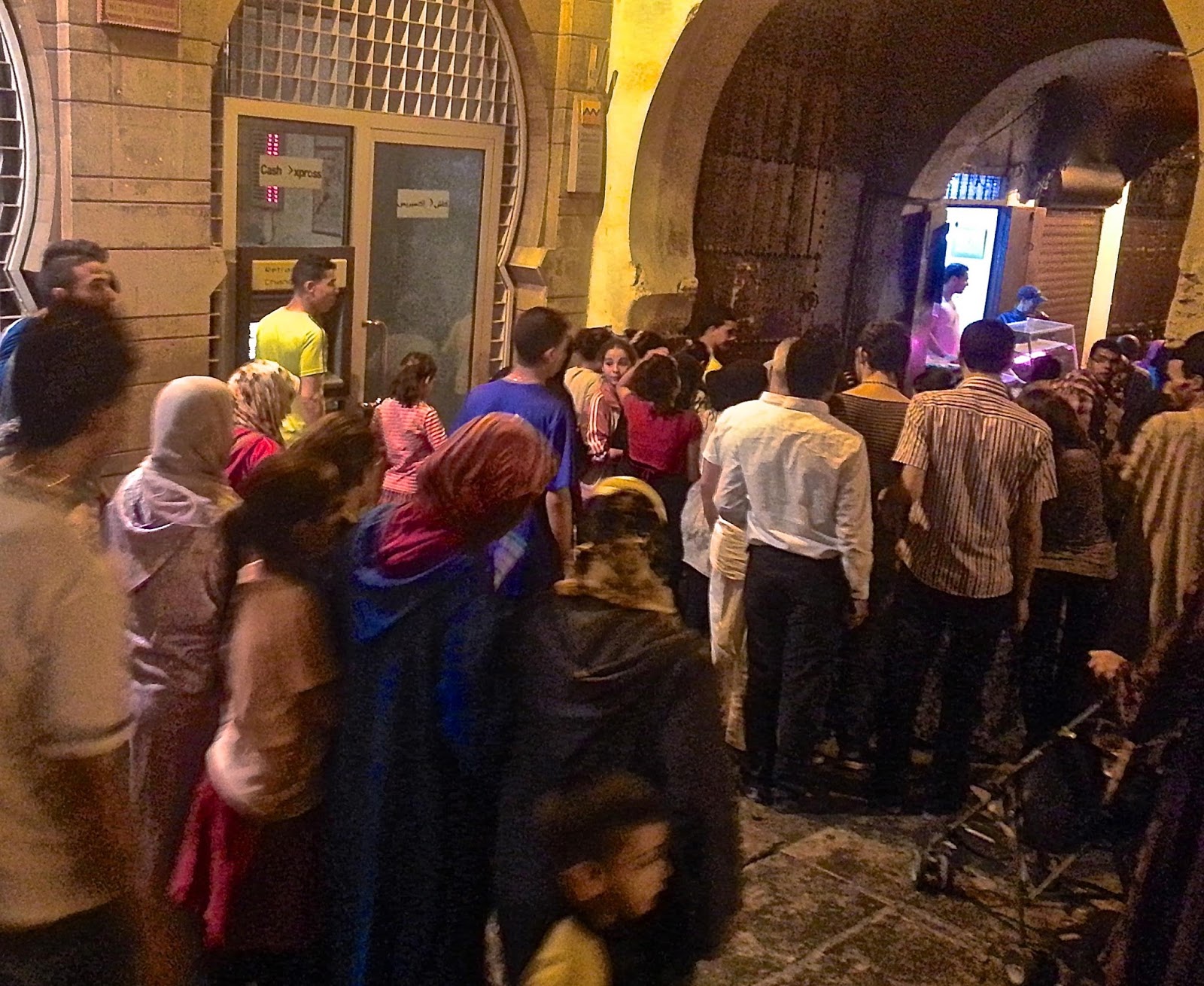
Wending their way home - at 1.30 am 

Any idea that the Festival is for just the ‘elite’ or ‘the ville nouveau’ was blasted by this night’s concert. Heading home through the Medina at 1.30 am after this free event meant joining a human river flowing down Talaa Sgira; the youth, the grandmas, the couples, the babies, the little Aussie traveller. We were all in it together, going in the same direction, and we felt good.

Text and photographs: Gabe Monson

Festival in the City Final night
Boujloud 10.30
Karim Ziad followed by the legendary Hamid Kasri


Fes Festival Fringe program
Fes Festival Medina Map
Fes Festival Food! 
Fes Festival Site

The View from Fez is an official media partner of the Fes Festival of World Sacred Music


SHARE THIS!

Print Friendly and PDF

Monday, September 10, 2012

Nass El Ghiwane ~ Enduring Moroccan Music


For decades now, Nass El Ghiwane have fascinated audiences with their individual stylistic blend of Gnawa trance music and social protest songs. Their popularity is such that they've been dubbed the "Moroccan Beatles". In the edited extract, Andreas Kirchgäßner profiles the group.


Troubadours of the Old and New Morocco

The stadium in Agadir is rocking. Long-haired youths tear off their T-shirts, waving them to the music like flags. People dance in a crush, pushing against the lines of soldiers and policemen trying to force them back. A girl slips bravely through the cordon, jumps between the musicians. She dances with them for a moment before the marshals pull her off the stage. But after the final chord, there's no holding them back. The youngsters storm the barriers, grab instruments, fly at the musicians. The plump Moroccan girl is back, and stands in front of Larbi Batma as he's leaving the stage, tying her scarf around his neck…

Those impressions are from the wild 1970s. And indeed, with their Beatles-style haircuts and flared trousers the Moroccan musicians looked just like contemporary rock stars. But listen closely and something doesn't seem quite right: there's no howling electric guitar, no huge drum set. The instrumentation was sparse, some pieces were only sung and accompanied by rhythmic clapping.


Religious and inflammatory

Then the musicians again brought out traditional instruments: the harraz, the cup-shaped drums of itinerant musicians and beggars, the tbila drum of the Sufi brotherhoods, covered on both sides, the framed drums of the Jilala and Aissawa and the gembri, the percussive bass of the Gnawa musicians.

They did indeed use these instruments to play the music of the traditional Sufi brotherhoods, the Jilala, the Hmadcha, but above all the trance music of the Gnawa. But they had composed new lyrics, partially in the style of religious Sufi poetry, but always infused with courageous directness and social brisance.

In the educated Morocco of the 1960s and 70s, which had its cultural centre in Fez, this music was regarded as primitive and backward. After all, it was often used to conjure up spirits in healing ceremonies developed by popular Islam.

Instead, Moroccan radios broadcast overblown emotional music or the noble tones of zither and violin. It was already a sensation in itself that four musicians played their own songs and lyrics on traditional instruments – an approach that soon packed the biggest venues and stadiums in Morocco.

In June 1971, they were the warm-up act before a performance by the Radio Orchestra at the National Theatre in Rabat. But the audience didn't allow the orchestra – with its classical Arab and western orientated repertoire – onto the stage, celebrating instead the music of Nass El Ghiwane. They were henceforth hailed in the Moroccan media as "the Moroccan Beatles".

The "Ghiwane" musicians that gave the group its name were the troubadours of old Morocco, members of traditional Sufi brotherhoods who used music to convey the latest news, religious messages and entertainment to the people.

Not long after independence, in the midst of the worst economic crises and harshest political repression, the group mixed popular Sufi music with their own texts. Nass El Ghiwane was the first-ever Moroccan group to denounce the misery of the young and disenfranchised, despotism and omnipresent corruption:

"Oh, what a miracle! Our summer has become winter … The rulers' tyranny becomes all the more oppressive, their despotism more brutal." (Excerpt from Nass El Ghiwane: "Subhan allah")


This is only a short extract - the full article can be found here

Andreas Kirchgäßner  © Qantara.de 2012
SHARE THIS!

Tuesday, March 10, 2009

Sunday - Music in Fez


Peace, quiet and a touch of henna

The View from Fez women's affairs reporter, Annah, has been out and about in the Medina on International Women's Day. Here is her report.


A fantastic day!

International Women’s Day was celebrated in fine style at Fes et Gestes cafe in Ziat with a full house enjoying lunch in the sunny garden courtyard. Henna artists demonstrated the intricate art of traditional henna hand adornment and the all-women singing and drumming group from Fes Medina, Jilaliyat, provided spirited entertainment into the early evening.


Further Moroccan music entertainment was to be had Café Clock’s Sunday Night Traditional Music Concert where popular Fes entertainer, Nourdine, performed songs by the legendary Moroccan group Nass el Ghiwane.


Formed in the late 60's by four young men from the poor district of Hay el Mohammadi in Casablanca, Nass el Ghiwane broke all the moulds of popular music in Morocco with their unique and often allusively political music. By mixing the Sufi chants and litanies of the Zaouias (brotherhoods) with the poetry of Melhoun and ancient rhythms of the Berbers and Gnawas and introducing modern instruments and multiple mellifluous voices, they bought ancient traditional music back into the lives of Moroccans, and Moroccan music to the larger world.


Nourdine embodies the great soul of Nass el Ghiwane, with a heartfelt voice powerful enough to fill the rooms of the Café without amplification and the Nass el Ghiwane styled instrumental skill of turning a banjo into an Arabic musical instrument.
The enduring quality of Nass el Ghiwane music and it’s ongoing appeal to young people was illustrated by the heartfelt and extended sing-a-long that unfolded when Nourdine made his way to the upstairs gallery.


Café Clock continues to provide a welcome platform for local musicians, artists and traditional music and the Sunday night concerts are becoming ‘book first’ events.

Tags: