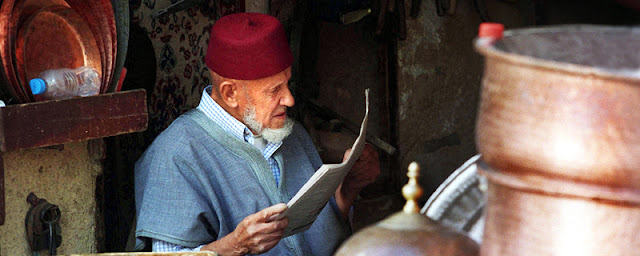
A zellij craftsman at work in Fez
Good articles about Fez are few and far between, but the team are happy to say that MARLISE SIMONS correspondent in the Paris bureau of The NY Times is on the money! You will find a complete list of our travel writing series below.
Fez Reveals Morocco's Soul
BEHOLD the city of Fez as it looked in the year 1000.
Nestled in a high valley, it was resplendent with its domes and minarets. Smoke rose from pottery kilns and public bath houses. There was the banging of the metalworkers, the whirr of the weavers, the wailing of the muezzins as they called for prayers and drowned out the shouts of the beggars and traders.
Along the narrow alleys, smells oozed from the wood-stoked bread ovens, from the pots of lamb stew and from the hair of the mules, lugging their loads. Down by the river, where the tanners worked, an overwhelming fetor surged from the pigeon dung and the fermented chaff that they used to treat goat and camel hides.
There were some quiet spots, to be sure: the spaces around the sacred fountains and the halls of the mosque-university, which was famous for its wise men, with students flocking here from afar.
That was Fez 10 centuries ago. Remarkably, it is a description that remains valid today. The city's astonishing chemistry of the medina is still intact.
Over the ages, Fez has sprawled outward, far beyond the great walls that secured it, and in the alleys, the mules now also lug plastic buckets and television sets. Still, the old Fez survives, battered and declining, but by many accounts the most complete medieval city of the Arab world.
Now Morocco's third largest city, Fez is no longer the capital, but it still lays claim to being the country's cultural, intellectual and religious heart. Its medina is the most complex, with more ancient monuments, more mosques, Koranic schools, inns and souks than any Moroccan city. The beauty of its woodcarvings, tiles and pottery remain unmatched. Other towns may be selling a rich choice of crafts, but chances are that many come from Fez -- and better still, in this city, you can watch the artisans make them.
Moroccans say that Marrakesh, Rabat and Casablanca live in the present, but that Fez lives in the past. It comes as no surprise. European chroniclers of the Middle Ages wrote with awe of the city that for several centuries was the most civilized Western outpost of the Semitic world. Its scholars introduced astronomy and medicine to the West via Spain when it was under Moorish rule. Historians of the time said that Plato and Aristotle first reached Western Europe in Arabic translations, from Fez.
I wanted to find out why some insiders spoke of Fez as an addiction, why they called it not a place, but a state of mind. Driss Laraichi, a guide and more than that, a skilled historian and poet, said that discovering Fez would take patience, but that even an outsider could catch a glimpse of its soul.
One fine place to start, Driss said, was the Hotel Les Merinides. It rises above the northern edge of the city, near the tombs of the Merinid rulers. Though ugly and modern, the hotel has a great terrace overlooking the city, with a stone map from 1935, which by local standards is contemporary.
The medina, which is where you want to be, is too tightly packed to offer perspective. But from the terrace, the old city reveals itself as an amphitheater, embraced by enormous walls. Opposite the main city gates, the hillsides are studded with the stones of age-old cemeteries and near them, crowned with white domes, the larger tombs of the city's numerous holy men. There is the sense of observing a North African Jerusalem.
From above, you can pick out the main mosques, the royal palace, the medersas or colleges, the old Jewish quarter and Fez's holiest building, the revered shrine of Moulay Idriss II. Forget the buildings for a moment to hear a fragment of history that is indispensable: the story of this holy man is part of the creation of Islamic Morocco. It was his father, Moulay Idriss I who arrived here around 787, possibly from Baghdad, to convert the region's Berber tribes. It is said that he was a great grandson of the prophet Muhammad. Idriss I founded Fez, which became the core of Arabic Morocco.
The way into the medina passes through a bab, one of its great gates. It can take hours to cross this great maze of more than 600 acres (about three-quarters the size of Central Park), packed with some 250,000 people. But the rewards are instant, for here an intricate and grand human engine is in perpetual motion.
Under the lattice mats that filter the sun are street stalls selling goats' feet, entrails, fresh cheese, quinces and piles and piles of mint. Workshops the size of walk-in closets hold tailors, woodcarvers, engravers, weavers, embroiderers, calligraphers and just about any other trade.
Professions usually cluster in the same alley. Here and there, weighers offer the services of their large iron scales. You are pressed against walls and stalls as porters and mule drivers shout, demanding the right of way.
Going deeper inside the labyrinth, Driss led the way into an even earlier world, a place of alchemists. There were men with bellows firing the hearths for the copper workers. A stream of blood gushed down one passage. It turned out to be the alley of the dyers who had just finished dunking big skeins of silk and wool into a deep wine color and were now emptying their vats.
We stopped at a cord maker, an acquaintance of Driss. His workshop was just a small wooden platform, three feet off the ground. He sat crosslegged and was tying strands of silk around his big toe. Then he turned and plaited these with extraordinary patience till they became cords for prayer beads or braids for a kaftan. He told Driss he had done this since he was 10; he was now 60. On a good day he could make roughly $5.
Above his head, next to a diploma with his name, Mohamed ben Ali Amrani, he had put up a sign in English: ''No photographs.'' I asked him why.
''I am here as God's guest on earth,'' he said. ''The tourists were taking pictures without even asking, as if I was an animal.''
The heart of the medina and its most important site is the great Karaouine Mosque, which is also the nation's oldest and one of its largest. A wealthy woman, Fatima Alfehri, who fled from Tunisia, founded it in 859. And it was here, where the mosque with its great library expanded into a center of learning, well before the universities of Bologna and Oxford, that the city's intellectual fame blossomed.
Non-Muslims may not enter this enormous building, whose 16 naves are said to accommodate 20,000 people. But from the alley that winds around it, they can glimpse past its mighty doors and see its courtyards, fountains and part of its halls.
Nearby, the shrine of Moulay Idriss II attracts pilgrims from all over the country and from across North and West Africa. Again, we could look only through the open gates at the stirring sight of supplicants arriving at the tomb, some blind or crippled, holding candles, delivering messages, some prostrate in prayer, some asleep on the floor of the mosque. From a side alley, a biblical image suddenly appeared: a man striding slowly with a lamb draped around his shoulders.
''A sacrifice,'' Driss whispered, and beckoned me to follow him. The man knocked at a small side door. As it opened, it briefly revealed a bloodied tile floor with other animals -- the slaughterhouse of the mosque, where supplicants left their gifts.
You can spend days in the medina because even the prepared mind cannot absorb all its scenes and the many tales that make up its history. There are numerous medieval foundouks -- the old caravansaries or inns -- that are now fraying bazaars and warehouses. There are the finely decorated medersas, or theological colleges, where young men have been staying since the Middle Ages.
The newly opened Nejjarine Museum of Wood and Carpentry, once an 18th-century foundouk, is now beautifully restored. Apart from its interesting collection, it shows the sophistication of a Fassi mansion, with its inner courtyard, its decor of intricate stucco, the finely carved panels of cedar and the mosaics and layouts of tiles.
The museum also offers one of the medina's few points of rest, a lovely rooftop cafe, with a view of the puzzle around you. In the Mellah, the old Jewish quarter, the Aban Danan synagogue, dating from the 17th century and newly restored, has a handsome cedar ceiling and handmade green and white tiles. The Royal Palace, on one side of the Mellah, is strictly off limits, but it is worth roaming around the elegant public square.
The second day, my guide in the medina was Fatima El Majdoubi, who offered a different perspective. She showed me a hammam, a public bath for women, a sure way to delve into the local life. This place of tepid and hot steam rooms was filled with the neighborhood's women and children. Upon request, hefty attendants rub you down with brown soap and administer sturdy massages. (Take towels.)
Fatima also decoded the spice market. It is spread out on a pretty square, before the Maristan, built in 1268. A plaque on its wall states that it probably served ''as a model for the first psychiatric hospital in the Western world, opened in Valencia, Spain, in 1410.'' Until the hospital closed half a century ago, Fatima said, musicians regularly came to play to calm the patients. A soothing thought, to be wrapped in music.
Outside, the stalls were loaded with pumice, kohl and tablets of ghasoul, a shampoo made of ground stone mixed with rose essence. We saw the spices for Morocco's extraordinary cuisine, for its tagines, or stews, and that great Fassi delicacy, the pastilla, or pigeon pie with almonds. Cinnamon bark is a key ingredient, and, so the story goes, harem women rubbed it on their bodies before visiting their master.
I have drawn some modest conclusions from this first visit to Fez: one is to waste no time on the nouvelle ville, the ''modern'' quarter that the French built early this century. It is a noisy jumble of fatigued cement, car exhaust, cafes, hotels and villas for the well to do. Another recommendation is to absorb as many layers as possible of the rich medina first and set aside separate time for shopping, perhaps at the potters' cooperatives on the edge of town, or the Centre Artisanal, where prices are fixed, unless you enjoy the ritual haggling that is required in the souk.
A lovely place to end the day is on the bar terrace of the Hotel Palais Jamai, a 19th-century mansion set above the medina. There, you can watch the evening settle over the medieval roofs and hear the chorus of muezzins calling for prayer.
Even in a short time, the magnetism of Fez becomes clear: Fez is not worried about being relevant to the modern world, or to visitors. The old city has its rhythms of work, food and prayer, of doors opening and closing. It is a way of life that, as in Venice, happens on foot.
The medina works because it exists for the local residents and Moroccans elsewhere who rely on the city's craftsmen. The tourist is tolerated, barely noticed. The medina is absorbed in its age-old work.
Into the medina, and the past
Getting There and Around
Royal Air Maroc, (800) 344-6726, flies from Paris to Fez on Monday and Friday and from Casablanca daily. Taxis will take you anywhere except into the medina; they will drop you at or near a main gate. The medina's network of alleyways can only be explored on foot.
Hotels will arrange for a qualified guide. Rates generally run about $25 a day or $15 a half day, at the rate of 9.7 dirham to the dollar.
What to See and Do
Batha Museum of Arts and Crafts, Place du Batha, exhibits a fine range of the region's pottery, carpets, calligraphy, embroidery and other crafts. It is open daily from 9 a.m. to noon and 2:30 to 6:30 p.m. Closed all day Tuesday and Friday morning; (212-5) 63 33 32.
Museum of Arms, Borj Nord, displays weapons from different centuries. Open daily 9 a.m. to noon and 2:30 to 6:30 p.m. Closed all day Tuesday and Friday morning; (212-5) 64 52 41.
Nejjarine Museum of Wood and Carpentry, Place Nejjarine, Medina, shows off Fez's renowned wood-carving tradition in fine antiques, including furniture, liturgical thrones and everyday objects. It is open daily 10 a.m. to 5 p.m.; (212-5) 74 05 80.
Check out our earlier travel writing stories:
Travel Writing Twenty
Travel Writing Nineteen
Travel Writing Eighteen
Travel Writing Seventeen
Travel writing Sixteen.
Travel Writing Fifteen.
Travel Writing Fourteen.
Travel Writing Thirteen.
Travel Writing Twelve.
Travel Writing Eleven.
Travel Writing Ten.
Travel Writing Nine
Travel writing eight
Travel writing Seven
Travel Writing Six
Travel Writing Five
Travel Writing Four
Travel Writing Three
Travel Writing Two
Travel Writing One
Tags: Moroccan Morocco Fes, Maghreb news