Sunday, April 30, 2017

Moroccan Photo of the Day


Today's photo of a beach scene in Essaouira was submitted by Paul Menconi
"Lawrence of Essaouira"

(See more delightful photographs by Paul on his blog: Luckydog Adventures!)


See more in our series Photo of the Day 

The View from Fez welcomes contributions to our Photo of the Day Series

SHARE THIS!

Saturday, April 29, 2017

Morocco's Plastic Bag Ban - a Year On

It has been almost a year since Morocco formally prohibited the manufacture, import, export, sale and use of plastic bags. The law was published in the Official Bulletin of December 14th 2015 and came into force in 2016 with a national campaign entitled Zero Mika - No Plastic

Zero Mika applied to all plastic bags except those for agricultural and industrial sectors as well as household waste collection. Isothermal bags and those intended for refrigeration and freezing were also exempt.

Despite scepticism in some quarters, the result exceeded expectations. Within a week of the ban being announced, shoppers had taken to carrying basket and using paper bags instead of plastic. Since that time there has been general acceptance of the policy.

Sadly, the plastic bag ban has resulted in a blackmarket in plastic bags with Moroccan authorities seizing more than 420 tonnes of plastic bags in the year since the entry into force of a law prohibiting their use,  According to the Ministry of the Interior they have also intercepted more than 421 tonnes of plastic bags, 70 manufacturing machines, 16 vehicles and arrested 55 people.

With the legislation dubbed "zero mika", or zero plastic in Arabic, Morocco became one of the first countries in Africa to impose a total ban on plastic bags, along with Rwanda.

Since the law took effect, the authorities have been strict to ensure its application, especially in shops and supermarkets in larger cities and towns. The government has described as "encouraging" the results of the ban, saying it had virtually eradicated the use of plastic bags in the country.

Moroccans have instead taken to using fabric bags

The ministry of industry has set up a 20 million euro ($21.8 million) fund to help companies affected by the law.

The government has described as "encouraging" the results of the ban, saying it had virtually eradicated the use of plastic bags in the country.

SHARE THIS!

Storytelling Festival in Fez


The 2nd edition of the storytelling festival in Fez ~ Nozhat Al Hakawati ~ will take place from the 2nd to the 4th of May. The festival will be held in Recif Square, Bab Boujloud Square and Cinema Boujloud


Programme

Tuesday 2nd May:
20h00 - 22h00 - Opening ceremony - Storytellers from Marrakech, Essaouira, Fez and Sefrou will perform in Recif square next Cinema Al Amal, the show will include Fusion music with ZAHIO band and Traditinal music Abidat r'ma from Kenitra.

Wednesday 3rd May:
10h to 11h00A debate about traditional storytelling between the past and present and how to preserve this heritage at IPDF Centre in Batha
14h00 - 17h00 open storytelling workshops at IPDF Center in Batha

Thursday 4th May:
17h00 - 18h00 Storytellers will do (Halqa) Circles at Bab Boujloud Square.
20h00 - 22h00 The closing of the festival. Storytellers from France, Marrakech, Essaouira, Fez and Sefrou will perform at Cinema Bab Boujloud, the show will also include Melhoun Music.


SHARE THIS!

Friday, April 28, 2017

Fes Festival Publicity Backfire


Readers of the respected Morocco World News have expressed astonishment in one of their latest stories, in which they expose the treatment they received from a supposedly professional marketing organisation in charge of publicity for the Fes Festival of World Sacred Music

The story pulled no punches and stated that "journalists and staff of Morocco World News express their strong condemnation of the insults, defamation, and humiliation directed at them by Publikart and its director, Mrs. Sanaa Smiyej."

As shown in the screenshot posted below, during a professional communication, Mrs. Smiyej called the journalists of Morocco World News “fake journalists,” even going as far as to characterise them as “vermin” and “scumbags.” See the full story here.

"The festival belongs to Morocco as a whole and does not belong to a person or a company. I won't keep quiet in front of disrespect - and this company has disrespected Moroccan media and international media." - Adnane Bennis
The View From Fez (which is an accredited Festival Media Partner) can report that this is not the first time that Mrs. Sanaa Smiyej has showed a lack of understanding of the importance of social media outlets. Despite our many attempts to contact her to arrange interviews ahead of this year's Festival, The View From Fez has been ignored. This, despite Mrs Smiyej receiving a direct instruction from the Festival director.  As a social media outlet, The View from Fez has been read by over 4 million visitors, plus many more on Twitter and our Facebook pages. 


Mrs. Sanaa Smiyej  failed to see the importance of social media

To put things in context, social media play an equally, if not more important role in covering the festival than do traditional media outlets. Most visitors to the Festival access information online prior to their arrival and during their stay. 


The View From Fez has been covering the festival for more than a decade and is the only media organisation to publish reviews of all the events and concerts. Our team are all professional reviewers and our photo-journalists, responsible for our hundreds of photographs, are respected, award winning professionals.

In contrast, the so-called mainstream media publish few reviews and often no more than four or five stories. In some cases, feature articles come out after the festival has concluded. 

It should be pointed out that neither Morocco World News or The View From Fez is criticising the Fes Festival team, from whom we have always received courteous attention.
We are disappointed that what should be an essential component in assisting journalists to get the news out about the wonders of the Festival has been so poorly handled.

SHARE THIS!

Important International Forum: Women's Voices

Women’s Voices in the Mediterranean and Africa: Movements, Feminisms, and Resistance to Extremism

Under His Majesty the king Royal Patronage, ISIS Centre for Women and Development and Konrad Adenauer Foundation organise the 8th edition of the Mediterranean Women Forum on the theme “Women’s Voices in the Mediterranean and Africa: Movements, Feminisms, and Resistance to Extremisms” on May 5, 6, and 7-10, 2017 at les Mérinides Hotel, Fez, Morocco. This event is organised in partnership with Sidi Mohamed Ben Abdellah University and Penn State University (USA). The main aim of the conference is to fight radicalisation and extremism, build-up peace initiatives, protect women’s rights, and enhance women’s empowerment.

An increasing number of women’s voices in the Mediterranean and Africa is rising against mounting gender-based violence in the name of radical Islam and the instrumentalisation of religion to exacerbate Islamophobia and attain power. These voices range from academics, to activists, and policy-makers, and suggest new ways of looking at the concepts of Mediterranean and African “women’s rights”, “Islamic feminisms”, Muslim African feminisms, and “resistance, as well as exploring theoretical and methodological tools. Trough feminist discourses, activisms, and movements, the voices are denouncing biases, asking for justice, reclaiming rights in public spaces, and reconciling older and newer generations of feminists in the Mediterranean and Africa.

In retrospective, women in the Mediterranean and Africa have always been sensitive to radicalised discourses as they are often used as scapegoats in such discourses. Although the two regions are seen as distinct spaces, women in them are increasingly facing the same ordeal. The Forum is multi-disciplinary and seeks to develop innovative and insightful ways of unpacking and accounting for these resistances.

Main Topics:

*The contextualisation of extremisms and women’s resistances
*Radicalised ideologies in the Maghrib
*Radicalised ideologies in Africa
*Islam and feminism/Islamic feminisms – Strategies of resistance

The keynote address on Friday May 5 (9.30am), will be Women’s Fight Against Extremisms: From Resistance to Bold Action delivered by Assia BENSALAH ALAOUI, Ambassador at large for His Majesty Mohamed VI, King of Morocco.


DETAILS
Venue: Hôtel Les Mérinides, Fès
Dates: 5,6,7 May, 2017
Contacts:
Dr Fatima Sadiqi, Director of the Forum
sadiqi_fatima@yahoo.fr
Ms Abir Ibourk (KAS), Director of Logistics
Abir.Ibourl@kas.de

SHARE THIS!

Tuesday, April 25, 2017

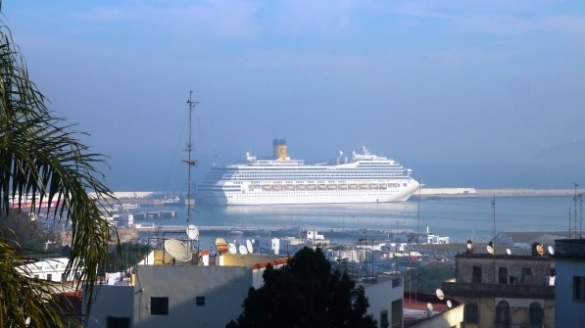
Tangier ~ A Boost in Tourist Numbers


According to a report of the provincial delegation of Tourism in Tangier, tourist establishments classified in Tangier recorded 75,904 arrivals at the end of February compared to 62,347 during the same period a year earlier, a rise of 22%


The number of international visitors to Tangier reached 36,263 tourists during the first two months of 2017 (+ 42% year-on-year), while domestic tourists totalled 39,641, up 7% compared to the end of February 2016, with an average stay of 2 days.

Over the period, the various classified hotel units in the city recorded 141,715 overnight stays, compared to 113,306 at the end of February 2016, an increase of 25%, with an occupancy rate of 34% compared to 31% at the end of February 2016 .

Spaniards are at the top of the list of foreign tourists who visited the city of Tangier during this period (7,593), followed by the French (4,982),  Arabs (1,886),  Americans (1,677), Germans (710), Belgians (652), Scandinavians (645) and Dutch (598).

Four-star tourist establishments welcomed 24,780 tourists, followed by 3 stars (19,399), 2 stars (11,893), 5 stars (11,072) and one star (5,394), as well as hotel residences guest houses (1,499).

In February alone, some 36,486 tourists visited Tangier compared to 30,324 in February 2016, a 20% increase, the same source said, noting that the number of tourist nights was 68,258, up 23% (55,532), with an occupancy rate of 36%, compared with 33% year-on-year.

SHARE THIS!

Sunday, April 23, 2017

Smartphone App to Help Preserve the City of Fez


The city of Fes has just launched a new application for smartphones intended for all its inhabitants. Called "I preserve my city" (je préserve ma ville), it allows its users to report any problems observed in the streets of Fez


If, during a trip, people find lighting that does not work, garbage cans overflowing or a hole in a sidewalk, they send a photo and a comment with their smartphone .

The city services receive the message and launch a team to intervene on the premises . When the problem is resolved, the person who reported it is kept informed ... and warmly thanked.


Thanks to this new mobile phone service, the inhabitants of Fez can all be involved in the cleanliness and good condition of their city . This is a citizen application that we would like to see developed in all the major cities of Morocco. It would allow every city dweller to live in a cleaner and well-maintained environment.

Check it out here: http://www.jepreservemaville.ma/

Je Préserve ma Ville - أحافظ على مدينتي


SHARE THIS!

Earth Day Morocco

Morocco Celebrates Earth Day Every Day!  Morocco has long been a climate advocate, becoming the first African and Arab country to host a Conference of the Parties to the UN Framework Convention on Climate Change (COP) in 2001. In November 2016, the country—dubbed a “perfect place for the world’s biggest climate change conference,” —again hosted world leaders in Marrakesh for COP 22, this time with the task of implementing the historic Paris Agreement from the year before


Morocco’s King Mohammed VI urged participants at COP 22 to move beyond promises to “tangible initiatives and practical steps,” and to respect and support the priorities and resources of developing countries.

“Holding this conference in Africa,” he said, “is an incentive for us to give priority to tackling the adverse repercussions of climate change, which are growing worse and worse in the countries of the South and in insular states whose very existence is in jeopardy.”

Since November, Morocco has ensured that the climate action agenda moves forward as COP 22 President, hosting a number of events and workshops with members of Moroccan civil society as well as international stakeholders on capacity building, sustainable industrial areas, and more. Morocco sent a delegation to the World Bank/International Monetary Fund Spring Meetings in Washington, DC this month to address issues of climate finance, and is working closely with the incoming Fiji COP 23 Presidency in advance of the Bonn Climate Change Conference in May.


Meanwhile, Morocco continues leading the way on sustainability and renewable energy at home:

1. Morocco has enshrined environmentalism in its governing documents. Article 31 of the country’s 2011 Constitution guarantees citizens’ right to “the access of water and to a healthy environment”; while Articles 71 and 152 address the government’s responsibility for environmental protection and oversight.

2. Morocco has set ambitious energy goals. Morocco has committed to generating 42% of the country’s energy needs from renewable sources by 2020, and 52% by 2030.

3. Morocco is a world leader in solar energy production. The country’s NOOR solar power complex is the largest in the world – so large it is visible from space; and by completion, will be capable of producing 2,000 megawatts of energy. In addition, Morocco currently maintains 13 wind farms and plans to build at least six more before 2020, capable of producing a total of 2,000 megawatts of energy.

4. Morocco is serious about waste reduction. The Moroccan Parliament signed a bill into law on July 1, 2016 banning the use, production, or import of plastic bags; and Rabat hosts an active recycling and waste-management centre that employs disadvantaged people to sort through waste for reusable, recyclable and saleable material.

5. Morocco understands the importance of raising public awareness on climate change issues. That’s why Morocco’s Association of Teachers of Life and Earth Sciences works with the Ministry of Education to promote awareness.

SHARE THIS!

Saturday, April 22, 2017

Street Art in Morocco ~ More Than Graffiti

Yesterday we asked where this street was. Nobody was able to pinpoint it exactly, but several of our readers guessed it was in Fez. The correct answer is Derb Lmzd Tahti in the Fez Medina

Mohssine and his friend, painted Derb Lmzd in 7 days and then discovered that the paint they had chosen was less than perfect - it came off very quickly!

Once they found the right paint the street was transformed. It was an exciting new look for what had been one of the dirtiest narrow streets in the Medina


There has been a change of attitude towards street art. For a long time considered vandalism, it was only during the last decade that graffiti began to be seen as a pictorial work in its own right, where it was grouped with stencil, collage, posters and mosaics, in what has been called "Street Art".

Street Art, which embellishes public spaces and reflects the know-how and undoubted talent of the artists, is a concept that has just emerged in Western societies. Yet, in Morocco, the notion of urban art has been present since the dawn of time. Arabic calligraphy, zellige and arabesques, as well as the carved wood is undoubtedly art and adorns the alleys of the ancient medinas.


In order to celebrate this art and allow it to occupy its place within the Moroccan artistic and cultural landscape, the festival "Jidar, Toiles de Rue" was created in 2015, inviting artists to decorate public spaces with gigantic frescoes.

Initiated by the association EAC-L'Boulvart, the third edition of the festival "Jidar, Toiles de Rue", will take place from 21 to 30 April in Rabat, and will feature 20 street artists from Morocco, Spain, Germany, Italy, Colombia, Romania, Ukraine, Egypt and Mexico, who will work on ten walls in the city and will "bring back to life the patrimony of yesterday, today ".


This initiative enabled Rabat to be featured on "Artsy", a site specialising in artistic news, among the cities where it is all well and good to be a street artist, and to rub shoulders with some of the largest Cities, including Hong Kong, Los Angeles, and Melbourne.

See our earlier story about street art in Rabat
Thanks to Begoña Parajón Robles for the photographs of Derb Lmzd

SHARE THIS!

Friday, April 21, 2017

Air Arabia Announces New Routes

On Thursday, Air Arabia Maroc announced the launch of a new line connecting Fez and Amsterdam, starting on 14 June

The new link, which will run twice a week, will allow Dutch passengers to explore several regions of Morocco, Air Arabia said in a statement, noting that the company is already running flights to Amsterdam from Tangier and Nador.

From June 14th Air Arabia Morocco will also be serving the cities of Strasbourg, Rome, Barcelona, ​​Lyon, London and Brussels, Montpellier, Toulouse, Bordeaux and Paris.

Adel Ali, president and CEO of the Air Arabia group, said that he was pleased with the expansion of his company's network from Fez, underlining that this new link "confirms our commitment to develop air traffic at Morocco and to contribute to the development of the tourism sector in Morocco".

"Thanks to the support of the Office of National Tourism we will be able to achieve our objective of connecting all Moroccan airports to several European countries," he added. Air Arabia Maroc now operates flights to 48 European destinations from 5 cities of the Kingdom: Casablanca, Fez, Tangier, Marrakech and Nador.

SHARE THIS!

How Well Do You Know Morocco?


A quick test! Can you name this street, or even the city where it can be found?

The answer will be posted tomorrow.

SHARE THIS!

Wednesday, April 19, 2017

Photography ~ Free Trip to Mount Zalagh


  APR 22
FREE Photography Trip - Mount Zalagh
Hosted by Omar Chennafi

SHARE THIS!

Morocco Moves Closer to Australia

Foreign Editor for The Australian newspaper, Greg Sheridan, was recently a guest of the Moroccan Government and wrote a very positive picture of the Kingdom. The piece is interesting in light of the announcement that Australia is to open an Embassy in Rabat. Observers hope that having a direct diplomatic connection will be of benefit, not only to trade and tourism, but also expats. At present Australians and New Zealanders applying for residence permits are only able to gain a one year term. This is in contrast to French and American nationals, who can be granted residence permits of up to 10 years

Here is an edited version of Sheridan's article.

Of all the Arab states of North Africa and the Persian Gulf, none has a serious case for emerging from the Arab Spring in better shape than Morocco. Its economic growth rate is better than 4.5 per cent; it has had two democratic elections ultimately producing stable governments; it has free trade agreements with the US and Europe; its society is functioning; it is a stable military ally of the US; its last significant terrorist attack was in 2011 (in Marrakesh). And it wants a new and more intimate relationship with Australia.

How did all this come about? I ask this of Nasser Bourita, Morocco’s foreign minister, a man of singular charm and urbanity. A career diplomat, he has just been appointed foreign minister by the newly formed coalition government, dominated by a notionally Islamist, though certainly moderate, party.

I am the first journalist to interview him as foreign minister and we meet in his vast office in Morocco’s capital, Rabat, overlooking the green fields and surviving walls of the ancient Chellah site, first a city under the Phoenicians, long before the birth of Christ, then settled by the Romans and later the Berbers and Arabs and all who prospered under them.

“I think there were many reasons,” Bourita says. “Many observers from Australia or the West tend to think of the Arab world as a single bloc. But it’s not the case. Every country is different. Morocco is not Libya, which is not Yemen, which is not Saudi Arabia. Morocco was a state for more than 13 centuries.

“This dynasty (of His Majesty King Mohammed VI) has been here for more than three centuries. Morocco for all this time was a sovereign state and a monarchy except for 40 years of the French presence.”

The contrast, though the minister doesn’t draw it, is with most of the rest of the Arab world, which had centuries of Ottoman dominance followed by European colonisation. When Mohammed VI ascended the throne, says Bourita, he explicitly sought to modernise Morocco with a new vision of a developed, modern and moderate nation.

“For Arab countries, the question was whether historical legitimacy was enough for the future. His Majesty brought a new social contract,” Bourita continues. “He chose stability through reform.

“There were some (in the region) who believed stability could be achieved through the status quo, through freezing everything. Our stability was achieved through a new constitution, through transitional justice, through improvement in the status of women, through big projects for human development.”

Taken together with the calming influence of a popular monarchy over a republic in the Middle East, these factors do offer a persuasive explanation for Morocco’s relative success and peace. They do not, however, necessarily offer that much guidance for nations that may not have the benefits of 13 centuries of sovereignty and a prestigious monarchy.

Nor has everything been perfect in Morocco. Not far short of 3000 Moroccans found their way to Syria to fight for Islamic State.

Morocco is neither complacent about its own problems with Islamist extremism, nor indifferent to the problems of its regional neighbours.

The same day I meet the foreign minister I spend the morning at the Mohammed VI Institute for the Training of Imams, also in Rabat. This large, white, elegant campus was built in direct response to the rise of the terrorist movement and a number of terror bombings in Morocco more than a decade ago.

I am taken on a tour by the institute’s director, Abdesselam Lazaar, a sprightly, genial man of 70 summers.

The first things I notice about this commodious campus is that it is international and coeducational. The institute caters to students from Morocco, Nigeria, Senegal, Ivory Coast, Chad, Mali, Guinea and France. And while there are more young men than young women, there are plenty of young women. It seems that while women do not become imams in the sense of leading formal prayers in the mosque, they do many other jobs associated with the mosque.

Moroccan women training to become Imams

The institute, which has been going only a couple of years, has graduated 1800 men and 700 women.

Lazaar is softly spoken, quietly proud of his students. “One of the main objects of this institute is to correct the extremist reasoning and understanding of religion,” he explains. “The extremists misuse religious reasoning for extremist purposes. This institute corrects the reasoning of extremists. Then the extremists can talk only with weapons. One day the extremists will understand they have nowhere left to work because this institute has filled their space.”

The state is heavily involved in religion in Morocco. Anyone who wants to become an imam in the future in Morocco will need to go through Lazaar’s institute. Imams are paid a salary by the state and there are limits on what they can say. His institute has taken international students at the request of neighbouring governments.

A day or two later, across the street from Rabat’s magnificent, ancient Medina, which sits watchfully, timelessly, over the sea, I meet Ahmed Abbadi, from the League of Religious Scholars. Like many Moroccan intellectuals, he criticises the West for its failure to regulate, or at least involve itself, in religious practice.

Bourita, the foreign minister, refers me to men such as Lazaar when I inquire about extremism.

He thinks counter-terrorism and security is one area where Australia and Morocco could co-operate even more closely than they already do.

Canberra has recently announced it will soon open a resident embassy in Morocco, which will go some way to filling the gaping hole of our representation in this part of the world.

But Bourita envisages a much broader partnership. He thinks the relationship has a substantial unrealised potential.

“We have very good relations already but we are not maximising our potential. There is much more we could do together on investment and people to people exchanges.

“We agree on many things but there is a lot still to share in political dialogue, in sharing our assessments of our region and your assessments of your region.”

As Humphrey Bogart once remarked in a famous Moroccan scene: “This could be the start of a beautiful friendship.”
Greg Sheridan first worked at The Bulletin magazine in 1979. His reporting on the Vietnamese boat people, subsequent to the end of the Vietnam War, sparked a lifelong interest in Asian politics. Sheridan joined The Australian in 1984. He worked in Beijing, Washington, and Canberra before starting his tenure as foreign editor in 1992. Writing on and from the Asian region since the 1980s, he specialises on Asian politics, and has written four books on the topic, plus a book on Australia-U.S. relationships. He is a Distinguished Fellow of the Australia India Institute at the University of Melbourne.
SHARE THIS!
Tuesday, April 18, 2017

Russia Drops Far East (Дальний Восток) Visas for Moroccans

Moroccans will no longer be required to get visa to travel to the region usually referred to as just "Far East" (Дальний Восток)

Russian Prime Minister, Dmitry Medvedev, this week announced that businessmen and tourists from 18 countries, including Morocco, can travel to the Far East Russia without visas.

“I have recently approved the list of countries, whose nationals can take advantage of the preferential regime. Businessmen and tourists will not need to undergo the traditional procedure of Russian visas receipt,” said Medvedev.  Moscow is hoping that the cancellation of visa procedures “will promote growth of investment and tourist attractiveness of the Far East,” said Medvedev.

The Russian PM added all that is required from foreigners willing to visit the region is “to enter their data on a special website in the Internet.”


The decision is expected to boost tourist traffic. The selection of the 18 countries was based on bilateral agreements “on visa-free travel for those ready to use such an approach for us,” explained the Russian PM.

The 18 countries are Algeria, Bahrain, Brunei, India, Iran, Qatar, China, North Korea, Kuwait, Morocco, Mexico, UAE, Oman, Saudi Arabia, Singapore, Tunisia, Turkey and Japan.


The Russian Far East (Russian: Дальний Восток России, tr. Dal’niy Vostok Rossii; ) is the the extreme east parts of Russia, between Lake Baikal in Eastern Siberia and the Pacific Ocean. The Far Eastern Federal District, which covers this area, borders with the Siberian Federal District to the west. The Far Eastern Federal District has land borders with the People's Republic of China and North Korea to the south west and maritime borders with Japan and the American state of Alaska.

According to the 2010 Census, Far Eastern Federal District had a population of 6,293,129. Most of it is concentrated in the southern parts. Given the vast territory of the Russian Far East, 6.3 million people translates to slightly less than one person per square kilometre, making the Russian Far East one of the most sparsely populated areas in the world.

Kamchatka is spectacular 

The Russian Far East is extraordinarily far from Russia's major population centres. The largest city in the region, Vladivostok, is a full seven time zones away from Moscow, with 9,300 km of railroad between them. The Far East is very different from popular conceptions of Russia—it is very mountainous and has an often spectacular Pacific coastline.

If time and money are not constraints, the highlights of this massive region include the city of Vladivostok, the beautiful Kuril Islands, the otherworldly National Parks of Kamchatka, cruising along the coast of Chukotka, and big game hunting in the wildlife paradise of Yakutia.

SHARE THIS!

Monday, April 17, 2017

Date of Ramadan 2017 Announced


In Morocco, the holy month of Ramadan is expected to begin on Saturday, May 27, and the day before in France

According to increasingly precise astronomical calculations that have not been wrong in recent years, the observation of the lunar crescent should be done the day before on Friday May 26th in the southern half of the country while for the northern half it will depend on the degree of clarity of the sky.

Moroccans will be called to fast for a last time in Ramadan on June 24th, just before the full summer season and possibly suffocating heat.

Unfortunately this year again, the baccalaureate exams in Moroccan public education will take place during the sacred month of Ramadan, on the 6th and 7th of June, as well as the catch-up sessions scheduled during the same period due to the difficulties of concentration for candidates. Last year, the exams also took place in the middle of Ramadan. It is to be hoped that the weather will be mild and that scorching heat will not come have a detrimental effect on students.


Ramadan has little impact on tourists in Morocco. The main changes are in bank hours and the early closing of some shops so that the staff have time to get home and prepare their evening meal.

Food and drink (alcoholic or otherwise) is available throughout daylight hours in hotels and tourist restaurants. As a matter of respect, you should not walk in the streets eating or drinking and if you are in a shop, you should try not to smoke. In many ways, Ramadan is a good time to visit Morocco as it is less crowded and less busy and some hotels reduce their rates during Ramadan.

Following Ramadan is Ede, a three-day celebration. During this holiday it is more likely that shops (including the souks, but not restaurants) will be closed, and other services may be disrupted.

SHARE THIS!

Friday, April 14, 2017

Fes Festival of Culinary Diplomacy

The Fes Festival of Culinary Diplomacy is set to return after the success of its previous edition. The event, which will take place from 27 to 30 April, will highlight the Moroccan gastronomic heritage with its three components: Arab-Andalusian, Amazigh and Judaic, at the crossroads of culinary traditions in three countries: France, Spain and Italy
Each dinner, prepared in cooperation with the representatives of each community, will be an opportunity to highlight the Arab-Andalusian, Amazigh and Hebrew traditions of Fez and Morocco. The main theme of these exchanges will be expressed by the journey of the great Ziryab, the founder of Andalusian music and the creator of a gourmet tradition still alive today. Hence the choice of the theme of this edition: "Culinary Diplomacy in the Mediterranean World".

Najat Kaanache

In this spirit, Moroccan chef Najat Kaanache will meet this year with personalities as diverse as Christian Têtedoie,  a French chef, Stefania Barzini, culinary leader and Italian journalist, Oliel Makhlouf, a Hebrew chef, and Fernando Pérez Fernández, a Spanish chef at the head of the "9 balcones" establishment in Huelva.

Dinner debates are organised each evening and preceded by an original, artistic and musical creation inspired by the Ziryâb repertoire. The public is also invited to film screenings, exhibitions and tastings of local products that will be held each day for free. Every day the public will be able to discover the artistic creation of the second edition of the Festival "La quête de Ziryâb"

In addition to the artistic performances and evenings (dinners-debates) organised during the Festival,  every day, a Mediterranean country and a Moroccan tradition will be honoured. The national and international chefs will be invited to make their market purchases in the Medina. Cooking workshops in public hotel training establishments will also be held under the supervision of renowned chefs.

SHARE THIS!

On the Lighter side - Anything is Possible in Morocco

Recently a tourist guide in Fez was overheard saying "Anything is possible in Morocco." Generally, we would agree with that. However, a recent email asking where to get food for a pet snake, had our colleagues flummoxed!

So, the challenge is on to see if such a request can be met in Morocco.

Which brings us to another story about Sidi Hamza, a Moroccan from Fez, who went to the US embassy in Rabat to get a visa for a visit to his friends in America.

When asked where he was going, Hamza replied,"San Jose".

The embassy official frowned and then corrected Hamza, informing him that San Jose is pronounced "San Hose" and that the "J" is pronounced as "H" in the States...

"So how long is your stay in San Jose?"

Hamza didn't miss a beat: "Six months; from Hanuary to Hune."


SHARE THIS!

Wednesday, April 12, 2017

Museum of History and Civilisation in Rabat Reopens


After a year of renovation, the Museum of History and Civilisation in Rabat will reopen its doors to the general public today (Wednesday 12 April)


The new scenography of the museum combines two paths; a chronological journey that tells the history of Morocco from prehistory to the Islamic period, and a thematic route offering the visitor a specific focus dedicated to marble and antique bronze

The thematic route includes marble statues, mainly from Volubilis and Banasa.


On the upper level, the visitor discover Morocco under different dynasties, including the Idrissides, Almoravides, Almohades, Merinides and Alawites, through archaeological remains unearthed in the sites of Belyounech, Sijilmassa and Koutoubia.

The director of the museum Mohammed VI of Modern and Contemporary Arts and commissioner of the renovation of the museum, Abdelaziz El Idrissi, indicated that the objective of the renovation of the museum is to enrich the cultural offer of the city of Rabat.

"The museum will become a true cultural destination, which will contribute to meet the demand, with the setting up of an exhibition retracing the history of Morocco and the various periods that the country has known, allowing visitors to feel the peculiarity of our heritage," says El Idrissi.


The curator of the Museum of History and Civilisation and curator of the permanent exhibition, Fatima Zohra Chbihi, emphasised that the renovation reflects the museum's vocation to trace the history of the different civilisations of Morocco.

"Different civilisations have crossed our country that constitute the diversity and cultural richness of the Kingdom. The new exhibition was designed primarily to translate the genius of the human spirit and its evolution on Moroccan territory, "says Chbihi.

The restoration of the museum is part of the strategy of the National Museum Foundation, which aims to enhance museums in order to make them more welcoming and attractive and to bring them up to modern standards of conservation and preservation of heritage.

Located in El Brihi street, right in the centre of Rabat, the museum was built under the French protectorate in the 1920s to house the antiquities department of the protectorate.


DETAILS
Museum of History and Civilisations, El Brihi Street, Rabat. Open every day except Tuesdays, from 10am to 6pm. Rates vary from 20 dirhams for adults, 10 dirhams for children between 15 and 18 and 5 dirhams for children under 14 or school groups. A 50% discount is provided for students upon presentation of their card.

SHARE THIS!

Tuesday, April 11, 2017

Morocco - A Birder's and Twitcher's Paradise

Eleonora’s falcon

"The term twitcher, sometimes misapplied as a synonym for birder, is reserved for those who travel long distances to see a rare bird that would then be ticked, or counted on a list. The term originated in the 1950s, when it was used for the nervous behaviour of Howard Medhurst, a British birdwatcher"

For a majority of people Morocco is a destination for exciting culture, history, music, great cuisine and spectacular scenery. However, for a special group of people, Morocco has another lure - birds. Most people don’t envision Morocco as being one of the world's top birding spots, yet, according to Bergier & Thévenot (2006), there are 454 species of birds in Morocco. Research indicates that of these, only five have been introduced to the country by humans. Of the bird species that occur in Morocco, 449 are indigenous to the country. Of these, 156 are considered to be rare or accidental and fifteen are globally threatened.

Talk to a birder about the chance to see a a Waldrapp, and their eyes glaze over - mention the bone-crushing Lammergeier, and they foam at the mouth! Yet both are possible to find in Morocco.

Another factor that makes Morocco a great birding destination is the range of habitats, that vary from the spectacular Atlas Mountains, to stoney desert, coastal wetlands and the dunes of the Sahara.

In 2018, Victor Emanuel Nature Tours (VENT) is organising a tour: Culture and North African Endemics in the Atlas Mountains and Sahara Desert. The tour will  leave from Marrakech and run from March 1st to 16th.  Lead by Machiel Valkenburg, the tour is limited to 10.

The Northern Bald Ibis or Waldrapp, Geronticus eremita, 

The tour will kick off along the Atlantic coast at Agadir where the nearby Souss Massa National Park is home to the endangered Waldrapp. The wetlands of Oued Souss will be scoured for Marbled Teal; Audouin’s, Slender-billed, and Mediterranean gulls; and Squacco and Purple herons, as well as dozens of other marsh dwellers.

Then from Marrakech the tour will head up to Oukaimeden in the High Atlas to look for Crimson-winged Finch, “Seebohm’s” Northern Wheatear, and Moussier’s Redstart. It is here that it is just possible the group will see the bone-crusher, Lammergeier, the bearded vulture that is the only known animal whose diet is almost exclusively bone.

The Lammergeier or Bearded Vulture; Gypaetus Barbatus 

The desert birding will begin in the stony desert of the Tagdilt Track looking for Thick-billed and Hoopoe larks. Cream-colored Courser, Crowned and Spotted sandgrouse, Red-rumped Wheatear, and more larks will hopefully be found among the rocks. On the way to the Sahara there will be a chance to explore the Dades Gorge, the realm of Bonelli’s Eagles and Long-legged Buzzards.

A full day exploring the Erg Chebbi dunes by 4×4 will be the highlight of the trip for those wanting to see the famous dunes of the Sahara. In this desolate landscape are myriad birds: Barbary and Lanner falcons, two species of sandgrouse, Desert Warbler, Desert Sparrow, Pharaoh Eagle-Owl, Egyptian Nightjar, and Brown-necked Raven.

Tour leader Machiel Valkenburg

For more information visit VENT BIRDING

SHARE THIS!

Monday, April 10, 2017

Free Brit-Pop Concert in Fez

We Used to Make Things in Concert! Thursday, April 13 at 7 PM at the ALIF Riad, 6 Derb Drissi, Batha


"We Used to Make Things" are a North London 8 piece pop-group that make a grand noise. A patchwork of different people bonded through their music with spell-binding 4-part vocal harmonies, soaring melodies, brash horn sections and a satisfying respect for a good pop hook. Spearheaded by intensely smart lyrics about dissatisfaction, personal-politics, isolation and the kind of characters Mike Leigh and Harold Pinter would be proud of.

The band deliver an electrifying and entertaining full live show as well as unadorned a cappella pop that has enthralled audiences of all ages. We Used to Make Things’ journey is in turn funny, poignant and also very good to dance to. They are proudly indie, and 100 per cent D.I.Y. They have played festivals including Larmer Tree, Secret Garden Party, Standon Calling, Independent Music Day and more locally at venues including the Union Chapel, St. Pancras Old Church and Ronnie Scotts."

You can check the group out here:
https://youtu.be/2QtcAXBjSeM
https://youtu.be/zAlaEEl6quo
https://youtu.be/bm1q8WK-GMM

This concert, organised by the ALC-ALIF Music Club, is free and open to the general public.

SHARE THIS!

Sunday, April 09, 2017

ALERT ~ MOROCCAN MOTORWAY DISRUPTION


Notice to motorists: a 48-hour strike will disrupt traffic on the Kingdom's highways from Sunday to Tuesday


Some motorway employees will be on strike from Sunday 9 April at 14:00 and until Tuesday 11 April at 14:00. The news came in a press release published late Saturday evening. As this strike coincides with the school holiday period, the statement recommends that motorists "avoid traveling during busy hours" and says .... "With the aim of preserving the safety and comfort of road users, Morocco will do everything possible to allow a return from holidays in good driving conditions."

There press release contained no further details.

Morocco's network of Motorways is administered by the state-owned company Autoroutes du Maroc (ADM), which runs the network on a pay-per-use basis, with toll stations placed along its length. The general speed-limit is 120 km/h.

SHARE THIS!