Showing posts with label Design. Show all posts

Monday, November 11, 2013

Public Talk on Art and Design in the Fez Medina


Join The View From Fez's Features Editor, Suzanna Clarke, author of A House in Fez, as she shares her experiences of living and exploring the Fez Medina – where art, design, architecture, music and ceremony are an integral part of everyday life

Suzanna has amusing stories to share about her experience of renovating a 300 year old house, as well as offering insights into the history and culture of this rich and vibrant city through words and photographs.


Details: 
When: Tuesday, November 12 at 6.15 pm

Where: ALIF Annex Auditorium 
(Opposite the ALC Villa at 2 Rue Ahmed Hiba, Ville Nouvelle, Fez. Ask security to direct you.) 
Cost: Free

SHARE THIS!
Print Friendly and PDF

Tuesday, September 24, 2013

Casablanca Market Design Competition Winner


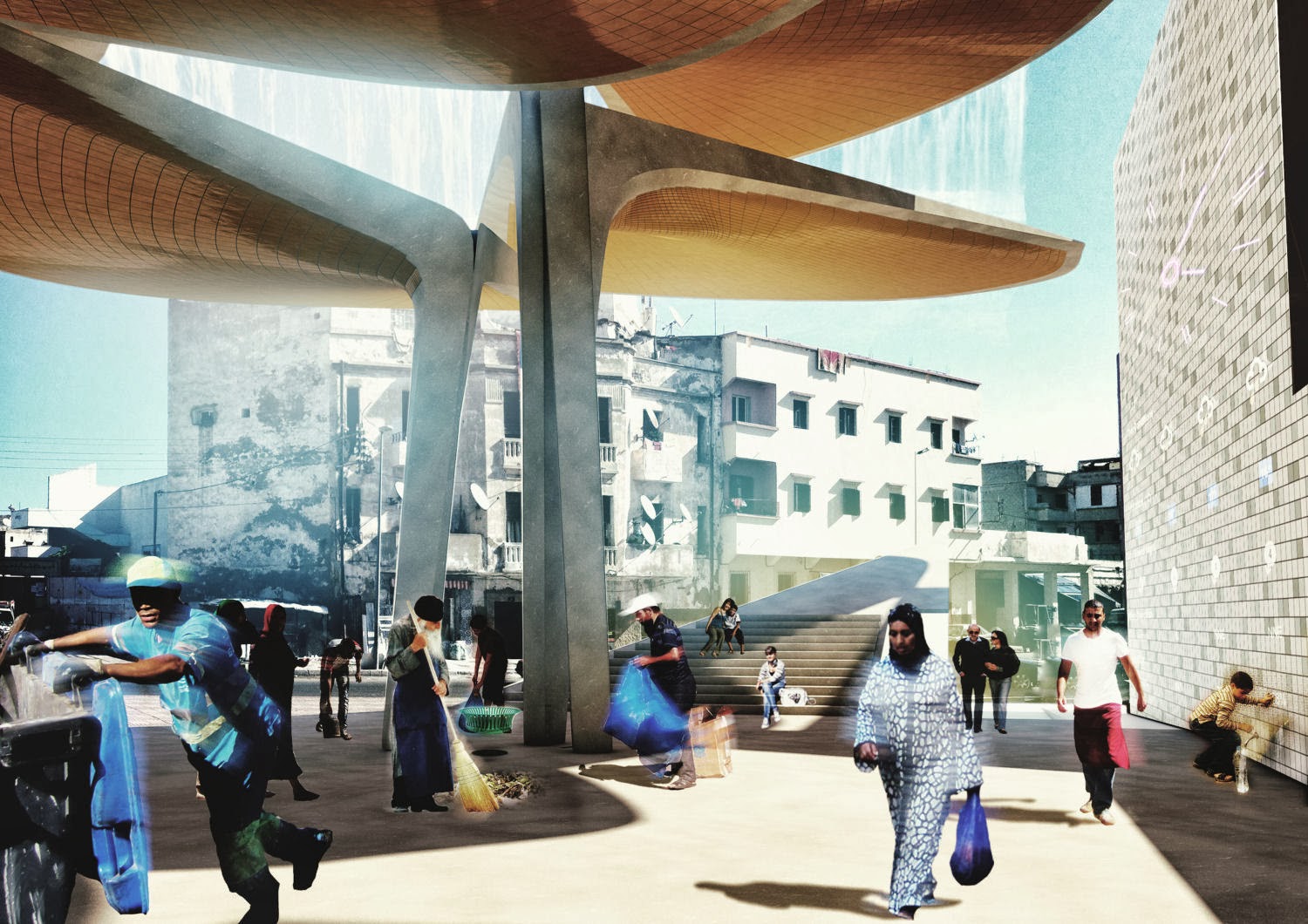
Dutch architects TomDavid have designed an interesting covered market for Casablanca - the design team comprised Tom Van Odijk, Alexine Sammut and David Baars

"The curved concrete forms of the design are both a tribute to modern Casablanca architecture from the 50s as an endorsement of the beauty of the female form, as a nod to the dominant male culture on the street." - The design team

At first glance the design appears to be simply mushroom shaped sunshades. However, it is far more than that. The design of the upper structure allows for the harvesting of rain, and transforming the panels into a water feature. There is no mention of alternate water sources if their is no rainfall. When rain does fall it will act as a coolant, evaporating from the concrete and so lowering the market's temperature, while also flowing into a tank that feeds standpipes within the market. Meanwhile, below street level, the market's waste is also gathered and recycled, keeping refuse and smells away from fresh goods.


SHARE THIS!
Print Friendly and PDF

Sunday, September 15, 2013

Designer with a Difference Visits Fez


World famous textile designer Kaffe Fassett finds inspiration in the everyday objects of the Fez Medina

Kaffe Fassett unfurls a quilt that is a multitude of colours; reds, purples, oranges and pinks. It is a vivid contrast to the lush green and muted tones of the tiles and broken walls of Fez’s Ruined Garden restaurant.

The world renowned textile designer is in Fez with his team to shoot his latest book of quilt patterns.

Kaffe Fassett with one of his latest quilt designs

“We are always looking for (places) with colour”, he explains. “I have been to Fez several times and really loved it.” Fassett, a Californian whose adopted home is London, creates a book every year with fellow designers Brandon Mably and Philip Jacobs.

“We did one in a wonderful cranky old house in Cornwall for our last book and then we’ve done ones in Portugal and in Wales and Bulgaria,” he says. “This year it’s Fez’s turn.”

As well as the Ruined Garden, quilts have been photographed at Jardin des Biehn and director of the American Language Center David Amster’s house in the Fez Medina.

Ruined Garden manager Robert Johnstone says, “It was so great seeing patchwork quilts laying on 300 year old mosaic tiles…the many small tessellating pieces forming a floor or a quilt much greater than the sum of their parts."


In the art and craft world, Fassett’s name is synonymous with bold and gorgeous creations in tapestry, needlepoint, yarns and fabrics, costumes and sets, knitting, mosaic and quilt designs. His more than 40 books and numerous television programs, such as the six part series Glorious Colour, have inspired thousands to get stitching or knitting. In 1988, he was the first living textile designer to get a show at the Victoria and Albert Museum, which went on to tour nine countries.

Fassett has designed costumes and sets for the Royal Shakespeare Company and for the Northern Ballet Theatre. His one-off pieces have been collected by the likes of Barbra Streisand, Lauren Bacall and Princess Michael of Kent. As well as continuing to exhibit in countries such as Canada, Japan, Sweden and Australia, he tours the world, giving entertaining and enthusiastic talks that encourage people to express themselves through the act of creating.

In Morocco, Fassett sees inspiration everywhere, from the age-old drape and swing of a man’s djellaba, “that makes any man look amazing” to the eclectic way in which local women assemble their outfits. “They are so fabulous. You see the way a woman will put a lavender scarf on pink. She was thrilled with the way she looked, and I was thrilled. And I love the fact they are still making buildings here like they were hundreds of years ago. If it ain’t broke, why fix it?”

The handmade tiles that are ubiquitous in Morocco are another source of Fassett’s infectious enthusiasm. “It’s something pretty that you walk through every day. You get a little lift every time you look at the corner of a room.” In comparison, he says, the use of concrete that is so popular in the West has “no finesse, no fantasy”.

He adores the everyday creativity he sees on display in places like the local markets. “The way a stall-holder will put a doily under a coke bottle, or take a stack of soda cans and make it look pretty. I love the little bits of decoration, how there is a sense of enjoyment about their lives…There are a million things that appeal to me. It’s being inventive with very little.”


When The View From Fez meets him at the Ruined Garden, Fassett is busy doing his own version of an Elizabethan tapestry. “I don’t drive, I don’t own a mobile phone. I don’t type. I don’t do anything mechanical. The only mechanical thing I do is to make textiles. I love it. It’s the way I can think about colour."

Fassett says he has no colour theory. The way he works is “totally intuitive.”


Born in 1937, Fassett was brought up Big Sur, California. His parents bought a run down house from Orson Wells and turned it into the famous Nepenthe restaurant, which became a gathering place for artists and bohemians.

After attending a boarding school run by the disciples of Krishnamurti, he won a scholarship to study painting at the School of the Museum of Fine Arts in Boston. However he dropped out after a few months and headed for England.

“What I loved about England was that I went straight into the aristocratic world. I had a couple of friends, and I didn’t realise they were incredibly well connected. The thing about England is that you just have to know three key people and you know everybody. I was in and out of these amazing houses and I loved the old antique textiles and the mix of Oriental, Arab, English French and Italian - these amazing textiles – the wonderful mix you get in aristocratic houses.

"I stayed because because the people I met liked what I liked. I loved it that the houses were falling to pieces and nobody cared. Those drapes are so beautiful, they are falling to pieces,” he gestures, as if to an imaginary room. “I loved the patina of age.”

“I come from the land where if anything is broken, you throw it out.”


Fassett reflects on a heady time in the hippy era. “When would sit around in front of a fireplace - somebody would be making leather, someone else writing songs, and I would be sitting doing needlepoint. We were keeping each other company and listening to great music. You could explore things and have the time to do it.”

When he stitches in public, which he is wont to do on train and plane journeys or sitting through speeches, Fassett says it’s mostly women who comment, saying things like “I have never seen a man do that”.

He’s often surprised by the positive reaction from males. “Even football hooligan types have said, “I would like to do that”.

“I was flying to America, stuck in the middle of some huge 727 and there was an older butch guy, with big strapping arms, who was watching me. Eventually he said, “You are a real professional at that…It’s something I could take up with my job. He was a train driver. I thought, great, that’s something to think about next time I am on a train.”

“I have heard of quite a few pilots who knit. And when I had my TV series, I always had guys calling, saying they wanted to do it.”

“I went into Wormwood Scrubs prison, as I was the only man doing this kind of work and they wanted to get the prisoners doing it. They would do tapestry, but when I asked, does anybody knit, they said, “We have our image to think about.” Fassett smiles wryly, pointing out they were thieves and murderers.

“But there was one guy who would do it, who used to steal Missoni sweaters.”

Fassett designed for Missoni at one stage and is now the leading designer for Rowan Yarns in Yorkshire, Erhman Tapestries, and he has designed a range for the charity Oxfam.

He specialises in coming up with new designs and lets others who are experts in the field of construction complete the vision. For many years he has worked with Liza Prior Lucy.


So what would be Fassett’s advice to someone wanting to start any kind of textile project?

“When in doubt use 20 more colours," he says. "People say 'I am afraid to - I’ll only use six.' But I tell them to use more colour. If you use 20, then it becomes a statement of your own.”

As far as quilting is concerned, Fassett advises, “Don’t be afraid to use absolutely trashy fabrics. Go to charity shops and buy a Hawaiian shirt or Japanese kimono and add it to your quilts. I like mixing it up.”


When Fassett began knitting he had a lucky break with “the first place I went to buy yarn. I walked into an end of line yarn shop, which had the ends of the making of carpets - silk and wool and cotton things. I wanted two ounces of this, and two ounces of that. It was the end of the day, and the guy who was serving just shoved into a bag and said get out of here. There was about 500 pounds worth of stuff, so I could play to my hearts content.”

“I work totally intuitively – I just play. I want to give people the courage to take a lot of stuff and respond to it.”

Kaffe Fassett’s latest book of quilt designs set in Fez will be out in a few months. Keep an eye on his website www.kaffefassett.com

Text: Suzanna Clarke
Photographs: Suzanna Clarke and Sandy McCutcheon


SHARE THIS!
Print Friendly and PDF

Friday, July 05, 2013

Creative Director for the Jardin Majorelle in Marrakech ~ Stephen di Renza


Stephen di Renza is a man described as having "feline chic". While that may be true, there is a lot more to the man who has just been appointed Creative Director of one of Marrakech's main attractions - the Jardin Majorelle.

Stephen di Renza in Fez

Like most New York intellectuals of his generation, Stephen di Renza studied Derrida and Lyotard as well as Warhol and the punk bands playing at Max’s Kansas City. After a B.A. in film study at NYU, the Philadelphia-born di Renza started out as a photo stylist for Interview magazine, did a stint as an industrial designer, and acted as fashion director for Neiman Marcus and Bergdorf Goodman.

In Paris he made his name as the Artistic Director for Dunhill where his style was described as "chic by subtraction". In Dunhill's Heritage Store di Renza mixed vintage pieces, modern re-editions and contemporary art.

Stephen in Paris   Photo : Vincent Lappartient

A long sojourn in Paris was followed by a move to Fez and the creation of Riad 9 and Resto 7.

Last year Di Renza met entrepreneur Pierre Bergé. "I really respect the people behind the Jardin Majorelle," Stephen says. The respect was obviously mutual and he clearly left a favourable impression with Bergé, who revived the fortunes of the Jardin Majorelle with his late partner Yves St Laurent. Recently di Renza received the job offer as Creative Director of what is one of the top attractions in Marrakech.

For a man with Stephen's considerable talents, it is, as he describes it. "a dream role". "I'm going to be creating all new products made in Morocco," he told The View from Fez. "I'm looking to combine modern Morocco with international savoir faire."

The Majorelle Garden

Majorelle is a twelve-acre botanical garden and artist's landscape garden in Marrakech. It was designed by the expatriate French artist Jacques Majorelle in the 1920s and 1930s, during the colonial period when Morocco was a protectorate of France.

Majorelle Gardens - photo: Suzanna Clarke

Majorelle was the son of the Art Nouveau ébéniste of Nancy, Louis Majorelle. Though Majorelle's gentlemanly Orientalist watercolors are largely forgotten today (many are preserved in the villa's collection), the two and a half acre garden he created is his creative masterpiece. The special shade of bold cobalt blue which he used extensively in the garden and its buildings is named after him, bleu Majorelle — Majorelle Blue.

The garden hosts more than 15 bird species that are endemic to North Africa. It has many fountains, and a notable collection of cacti. It has been open to the public since 1947. Since 1980 the garden has been owned by the late Yves Saint-Laurent and his partner, Pierre Bergé.

After Yves Saint Laurent died in 2008 his ashes were scattered in the Majorelle Garden.

The garden also houses the Islamic Art Museum of Marrakech, whose collection includes North African textiles from Saint-Laurent's personal collection as well as ceramics, jewelry, and paintings by Majorelle.

SHARE THIS!
Print Friendly and PDF

Wednesday, June 12, 2013

Festival Fringe: Six Designers Exhibit in Fez


There’s a lovely sense of whimsy about this tiny exhibition at the Jardin des Biehn, writes Stephanie Clifford-Smith. Six artists from Morocco and Europe are represented with pieces ranging from jewellery to textiles, clothes and accessories.

Jewellery by Lilou Jouve
The whimsy lies in the way the pieces are displayed as much as their designs and is perhaps most apparent in the jewellery of Lilou Jouve, (Fez, Aix en Provence) immediately to the right of the entrance. Bracelets and rings feature knitted silk beads on rubber tubing while necklaces alternate those same coloured beads with glass and ceramic ones. Bracelets are displayed on aged wooden mannequin arms or suspended from the ceiling on invisible fishing line, appearing to float.

Bags by Catherine Gaillard
Catherine Gaillard (Fes, Paris) focuses on statement totes in metallic animal skin finishes. Tie belts/necklaces with soft, strokable leather tassels in muted turquoise and teal hang from a dowel like horsetails in repose.

An artist whose name suggests a single minded determination to be listed first in the phone book, AAA Alfred (Fez, Berlin), works in supple punched suede stitched in geometric patterns. Some pieces are functional – bags, wallets – while others such as flat sheets of worked leather are either objects in their own right or await some higher purpose.

A cluster of calico dressmaker’s dummies is the perfect, plain foil for Michel Biehn’s (Fez)
quirky necklaces. They’re all long, asymmetrical assemblies of mixed media beads and tassles of varying ages and finishes, many parts appearing repurposed.


Works in leather by Alfred Berlin

What appear to be straightforward garments by Moi Anaan (Bangkok) all sharing a sunburst feature on their silky fabrics warrant closer inspection. These ostensibly simple shapes all have unusual dart placements adding interest.

Dress designed by Moi Anan
Nina Gilbert (Fez) may be a local but this sunny corner of the exhibition seems heavily influenced by the south of France or maybe the women's costumes of the Rif Mountains. There’s a striped theme running through her collection which includes espadrilles, kilims and outsized cushions. The predominantly fluoro palette really amps up the wattage.


Three photos above: textiles by Nina Galbert

Text: Stephanie Clifford-Smith
Photos: Suzanna Clarke

Fez Fabrik exhibition at Gallery Jardin des Biehn, 13, Akbat Sbaa, Douh 30100, Fez Médina until June 16. 

Fes Festival Fringe program
Fes Festival Medina Map
Fes Festival Food! 
Fes Festival Site

SHARE THIS!
Print Friendly and PDF

Friday, May 31, 2013

Veils and Turbans Exhibition in Fez


Tomorrow is the last day of the exhibition Veils and Turbans at the French Institute's Dar Batha. It's a must see for anyone who appreciates design, texture, fabric and cultural history writes Natasha Christov. 

Two words: dramatic and delicate. Michel Biehn’s latest exhibition, Veils and Turbans, unravels this seemingly dichotomous union within Islamic headdress and outerwear.

Soft, gauze-like fabrics in delicate cottons and silks drape from the 40-foot ceilings of the French Institute’s Dar Batha exhibition space, and the intricate designs and dye patterns transport visitors to a world of hidden identities, mysticism and exotic charm.


Featuring veils and turbans from Afghanistan, Azerbaijan, India, Pakistan, Tajikistan and Morocco, Biehn’s exhibition celebrates Islamic dress by dissecting its layers to reveal the fine artistic detail. Here, whisper-thin veils fringed with colourful beadwork and complex embroidery hang like t-shirts on a washing line, hinting at the utilitarian nature of these pieces.


Each item in Biehn’s exhibition is an artwork, and many have been painstakingly stitched, then layered to provide – in some instances – total coverage. Biehn’s selection of veils and turbans also gives visitors an insight into countries’ cultural nuances: for example, the niqab exhibited from Afghanistan in a beautiful cornflower blue leaves nothing uncovered – only a wide lattice-like stitch allows the wearer to see. Conversely, the women’s outerwear on display from Pakistan is made up of several different pieces in bold colours and embroidered designs that meet around the eyes.


Kelly-green and burnt orange fabrics with striking patterns separate the veils from the turbans, as if protecting the original wearers’ modesties. Biehn explains that the veil “protects the mystery of a woman ... whereas the turban is worn very differently. It symbolises potency”.


Turbans, including the classic Berber headdress seen in Morocco’s Saharan regions, can reach beyond six meters of fabric. Mohammed Khrou, 23, of Rissani, explains that these turbans provide respite from the harsh conditions of the Sahara, acting “like air-conditioning for your head and protecting your eyes from sandstorms”. Other turbans on display at Biehn’s exhibition are more ceremonial, featuring a taqiyah detailed with geometric embroidery, with a long cotton scarf sweeping dramatically around the head.

Michel Biehn’s exhibition is enlightening, and showcases how different Islamic cultures combine the beautiful intricacies of their countries’ designs and traditions to create their veils and turbans.

Veils and Turbans is on display at the French Institute’s Dar Batha tomorrow from 10 AM to 5 PM. Info: http://www.institutfrancaisfes.com

SHARE THIS!
Print Friendly and PDF

Moroccan News Briefs #98

In this edition:
Airline News
France and Morocco to bolster cyber security cooperation
Design Study Trip to Fez this September
Discovery of Moroccan Plesiosaur Zarafasaura oceanis
Archaeological-Tourism?
Morocco and the question of "kif"
Morocco's economic growth set to rise
Two Moroccan police officers sentenced
More Art on Fes Festival Fringe
The Little Prince - a new museum


Airline News

Qatar Airways is increasing its capacity between Qatar and North Africa with its flights to Tripoli and Casablanca going non-stop, from this weekend. Effective 1 June 2013, scheduled services to the Libyan capital Tripoli will be de-linked from the Egyptian city of Alexandria ,offering additional seats to both cities.


On the same day, Morocco’s biggest city Casablanca will have direct non-stop services from the airline’s Doha hub. Currently the route is served via the Tunisian capital of Tunis. With the de-linking and re-introduction of non-stop flights, Qatar Airways is giving passengers travelling to the four North African cities with more choice and flexibility when planning their travels.

Passengers from the Asia Pacific, South Asia and Middle East and can now take advantage of a seamless one-stop connection to Tripoli and Casablanca via Doha. The Casablanca route is operated with an Airbus A330 in a two-class configuration of up to 248 seats in Economy and up to 36 seats in Business Class.

The Ukranians are coming - to Agadir

Another new airline route is causing a few concerns over visa requirements. Morocco has been asked to cancel visas for Ukrainian tourists. The Ukrainian Ambassador to Morocco, Yaroslav Koval, appealed to the Moroccan authorities with a request to optimize the procedure for issuing tourist visas to citizens of Ukraine in connection with the opening in June of direct charter air flights from Kyiv to Agadir.

During the meeting of the ambassador with the director of the consular department of the Moroccan Foreign Minister, the parties also noted the desirability of the abolition of visas for Ukrainian tourists.

The Ukrainian ambassador also expressed his gratitude for the decision of the Moroccan authorities to simplify the procedure for issuing residence permits to citizens of Ukraine, who permanently reside in Morocco.


Cyber attacks on the rise - France and Morocco to bolster cyber security cooperation.

At a time cyber attacks and cyber-spying are making the headlines almost every day and at a time cyber theft is rampant, France and Morocco have agreed to bolster their cooperation in cyber security matters and to enhance the capacity of national authorities in charge of information systems security.

The broad lines of this enhanced cooperation were set in a Memorandum of Understanding that was signed earlier this week not by the officials in charge of new information technologies but by the Moroccan junior Minister in charge of the national defense administration, Abdeltif Loudyi, and the Secretary General of France’s Defense and National Security, Francis Delon.

The MoU provides, in the context of a long-term cooperation, for the exchange of experiences, information and expertise and will also contribute to enhance the capacity building of the department in charge of the security of the State’s information systems and vital infrastructures. This department is under the tutorship of the national defense department.

The provisions of the agreement will be implemented on the basis of annual action plans convened by the two sides.

While France and Morocco were signing their agreement, press reports incidentally disclosed that Chinese cyber-spies have reportedly laid hands on designs of more than two dozen US major weapons systems, including advanced technology and programs critical to U.S. missile defenses and combat aircraft and ships. The Chinese cyber-thieves are also said to have stolen the plans of a new building designed to house Australia’s top counterintelligence organization.


Design Study Trip to Fez this September

Art of Islamic Pattern’s 2013 study trip is to Fez, and will comprise a four day intensive. Classes will take place in Dar Seffarine in the Medina.  Dar Seffarine has splendid examples of carved plaster, woodwork, zellij and zouaq (painted wood).

This study trip will include visits to some of the most remarkable architectural masterpieces in the Islamic world: the Bou Inania Madrasa (1356) and the Al-Attarine Madrasa (1331) and to other important hidden gems.

The course offers the opportunity to experience making geometric and biomorphic designs using traditional methods, on-site. There will also be a zellij (mosaic tiles) class at a local workshop in-which participants can produce their own pieces.

This is a mixed level course and open to both beginners and returning students. The venue is also booked for participants to lodge, although places are strictly limited and will be allocated on a first-come-first-serve basis. Participants should plan to arrive by Tuesday evening 17th September for a Wednesday 18th September morning start. The course ends on evening of Saturday 21st.

Details and info: http://artofislamicpattern.com/study-trips/fez-morocco/


Discovery of Moroccan Plesiosaur Zarafasaura oceanis

Sergio Prostak writing in Sci News says that paleontologists writing in the journal Paludicola report the discovery of exceptionally well-preserved skull and skeletal remains of the elasmosaurid plesiosaur Zarafasaura oceanis, the most complete specimen of this species ever described.

This is a life reconstruction of the elasmosaurid plesiosaur Zarafasaura oceanis (© Nobumichi Tamura

Plesiosaurs (‘near to lizard’ in Greek) are an intriguing group of extinct marine reptiles that roamed the vast seas of the Triassic, Jurassic and Cretaceous periods from 235 to 66 million years ago. Their fossils have been found on every continent on Earth, with key discoveries made in Australia, Europe and North America. There are several different families of plesiosaurs, including the Elasmosauridae, Microcleididae and Plesiosauridae.

Zarafasaura oceanis belongs to the family Elasmosauridae. The generic name Zarafasaura derives from zarafa, an Arabic word for ‘giraffe,’ and saurus, Greek for ‘lizard.’ The specific name means ‘daughter of the sea’ in Latin. Paleontologist Dr Peggy Vincent from the National Museum of Natural History in Paris, and her colleagues first described the species in 2011 from incomplete skull remains found in Morocco.

Zarafasaura oceanis was approximately 23 feet (7 meters) long and lived around 72 to 66 million years ago.

The new, well-preserved specimen of Zarafasaura oceanis was unearthed in a phosphate mine near the Moroccan city of Oued-Zem. But the specimen did not remain in Morocco and is now mounted on display at the Wyoming Dinosaur Centre in the USA.


Archaeological-Tourism?

Is the development of archaeological discoveries, a way to boost tourism? Moroccan archaeologists think so according to a report in The Economist - "a country like Morocco, which offers a variety of tourism products, can also benefit from cultural tourism mainly around archaeological sites some of which are internationally renowned." Indeed, important discoveries of human remains have been made ​​in the country. Last September, archaeologists discovered two human skeletons, aged between 6 000 and 14 000 years in the cave "El Kehf Hallouf 2" near Ain Taoujdate.

Such discoveries may attract tourists with an interest in science to Morocco . At the same time many "archaeologists and paleoanthropologists who wish to better understand some of the history of the direct ancestors of the North African population could possibly favour Morocco for their research," says Abdeljalil Bouzzougar, archaeologist and specialist in cave Pigeons.

For its part, the Ministry of Tourism seems to seriously consider this approach. The department headed by Lahcen Haddad is also in the process of integrating cultural and archaeological options in its Vision 2020. Mr. Haddad has placed particular emphasis on the importance of valuing archaeological assets of the region as a way of promoting Morocco. Currently, Moroccan and foreign anthropologists are working to make the Cave of Pigeons, located Tafouralt, a global benchmark. This is one of the most valuable archaeological discoveries. It contains prehistoric ornaments among the oldest in the world (more than 82 000 years) that make it a must for a better understanding of human history in general and North Africa in particular. Its development could attract many tourists.


Morocco and the question of "kif".

"If you try to grow other crops here they will fail," says Ahmed, surrounded by lush green fields of cannabis, the illegal plant he and thousands of other poor farmers in Morocco's Rif Mountains depend on.

90,000 households depend on the crop

The country's cannabis export has been cultivated in the traditionally rebellious northern region for centuries, where the climate for growing cannabis, or "kif", is considered ideal.

Along the stunning valley that runs between the towns of Taounate and Issaguen, women work in the fields tending this year's emerging crop, while young dealers ply the 70km road in their cars looking for customers. But after a massive bust in Spain this month, the attention of European drug agencies is likely to focus again on the continent's main source of hashish - and on Moroccan efforts to stem the supply.

Spanish police found 32 tons of the drug in a truck carrying melons from Morocco at the end of last month, and this month they discovered 52 tons at a warehouse in the southern Spanish city of Cordoba, setting a European record.

Morocco's interior ministry insists it has spent heavily on tightening border controls and combating trafficking, while deploying "enormous human and material resources" to eliminating cannabis cultivation.

The International Narcotics Control Board said in its latest report that 72% of cannabis resin seized by customs authorities worldwide in 2011 originated in Morocco.

"Implementing a policy of alternative development is the cornerstone of our strategy in the fight against the supply of drugs," the ministry said.

But an estimated 90000 households depend on kif production. Cannabis advocate Aberrahmane Hamoudani quips: "Kif doesn't kill you, but hunger does."


Morocco's economic growth set to rise.

Morocco’s economic growth may accelerate to about 5 percent this year, driven by a bumper harvest, Finance Minister Nizar Baraka said.

“Since the cereals harvest exceeded our initial forecast by 50 percent, this should reflect positively on overall economic growth that should hover around 5 percent this year,” Baraka said in an interview at an African Development Bank meeting in Marrakesh.

The economy grew 2.4 percent last year, Baraka said last month, and the government had earlier projected growth of 4.5 percent for 2013. Morocco has escaped the uprisings that swept across North Africa in 2011. The government last year negotiated a $6.2 billion credit line from the International Monetary Fund, and it’s seeking to reduce subsidies in order to rein in a widening budget deficit.


Two Moroccan police officers sentenced to 10 years in prison for forgery

According to a report by Youssef Sourgo in Morocco World News, on My 28th the Court of Appeal in Kenitra sentenced two police officers to 10 years in prison for the forgery of an official report. The two officers were mainly accused of being illegally acquainted with a suspicious person, for whom they forged fake testimonies and altered official reports.

Accordingly to daily Aujourd’hui Le Maroc, the two convicted police officers were prosecuted after numerous complaints from several residents of a village adjacent to the area where they both work.

Last year the criminal division of the same court sentenced the head of the brigade of the Royal Moroccan Gendarmerie and his deputy, in the area of Lalla Maimouna (Province of Kenitra), to ten years in prison.


More Art on Fes Festival Fringe

According to Jess Stephens from Culture Vultures (see our story here) Palais Mokri will be featuring an exhibition and show by Michel D'yve. The venture will present a collaborative mural and "the Muzoo". The Muzoo (a contraction of ‘museum’ and ‘zoo’) is a travelling museum presented by a group of artists called Sinéangulo. It was initiated by the Caza de Oro artist’s residence in Ariege, in the French Pyrenees. Le Muzoo moves between the UK and Morocco, and will be pitching its tent at the Palais Mokri during the Sacred Music Festival.

The Sinéangulo artists group was founded some time ago on the banks of the Niger, the product of a meeting between travellers from Gibraltar, Morocco and Mali. As they describe it, "Sinéangulo is made up of about sixty artists both professional and amateur (with no distinction between them), musicians and fine artists from Africa, Europe and elsewhere. Sinéangulo is not an artists’ collective and in fact has no definite programme or manifesto; it’s more of a spiritual state that invites creators with diverse artistic talents to return to experimentation; a spiritual state arising out of a mélange of the curiosity, research and cross-disciplinary experience of each person. The objective is to master the contingencies of today’s innovations. A new generation of artists has begun to re-think our world, allowing us to rediscover the physical world and analogue creation. The purpose of Sinéangulo is to integrate with, to graft onto and to fuse with complementary entities to allow the creation of simple art".

The Mural

The mural will be created on the arcade wall of Palais Mokri and throughout the festival, the public will be able to watch the development of a mural created in the spirit of Sinéangulo.

Artists invited to contribute to the mural include Youssef el Yedidi, fine artist known for his murals (for example, at Asilah) who regularly exhibits in Europe. He says that he comes from the strait, a nod to his dual nationality of Moroccan/Spanish. His work is tinged with humanism and wavers between graphic and organic.

Aziz Amrani , art teacher from Chefchaouen. In his painting, Amrani retraces the roots of calligraphy. This action translates into immediate action, making us oscillate between a state of contemplation and that of primordial energy. Amrani believes that the experience of painting is just as important as the physical work.

Charley Case, rambling artist from Brussels, sings of his connection to the world through his drawings. We recognise the characters from his brush strokes that he develops with a tree-like structure. His work materials are simply a brush and a pot of Chinese ink.


The Little Prince - a new museum

Battling the wind in his World War I biplane, a French pilot landed on a sandy Moroccan airstrip. Nearly 90 years on, a museum honours his stay and the world-renowned book it inspired.


"Antoine de Saint-Exupery the writer was partly born here, in Tarfaya, where he spent two years as station manager of Aeropostale," says Sadat Shaibat Mrabihrabou, opening the doors to the small museum in Morocco's far south, where the sea and the desert meet. "It's here that he began writing his books, under the stars," he says. "We're at the birthplace of a writer known worldwide."

Saint-Exupery is a name inseparable from his book "The Little Prince", a series of self-illustrated parables in which a boy prince from a tiny asteroid recounts his adventures among the stars to a pilot who has crash landed in the desert.

First published almost exactly 70 years ago in New York, in English and French, it became one of the best-selling books of all time with more than 140 million copies sold, and has been translated into 270 languages and dialects.

Prior to his stellar literary achievements, Saint-Exupery was a pioneer aviator posted to Tarfaya in 1927, a wind-swept outpost that served as an important refuelling station for the Aeropostale aviation company linking France to its colonies in Africa.

Today, even with new building projects rising from the sands, this sleepy port town formerly known as Cape Juby gives the impression that it's hardly changed. In front of Tarfaya stands a derelict fortress built by the British in the late 19th century, and the Atlantic Ocean stretching to the horizon. Behind it lies the Sahara desert.

Saint-Exupery packed his bags and flew his World War I-era Breguet 14 biplane to the Moroccan coast to take up his new job, whose duties included negotiating for the release of downed pilots captured by hostile local tribes.

During his 18-month posting in the dramatic isolation of Tarfaya, he wrote his first novel "Southern Mail", "whose title was suggested by another pioneering French airman, Jean Mermoz," according to the museum's curator.


There too was suggested the desert landscape that the Little Prince discovers when he falls to Earth, although that book was written more than a decade later.

In 2004, the Tarfaya museum opened, dedicated to preserving this key episode in the life of one of France's best-loved writers, whose Little Prince also has a museum in Japan.

"This patrimony represents an oral culture that risks disappearing with time. Saint-Exupery's last mechanic-caretaker died two years ago," says the museum's Mrabihrabou. "It was at this man's home that I heard for the first time the name of Saint-Exupery, when I was five to six years old," he adds.

The life of the celebrated aviator-author is told on the walls of the museum, from his birth in Lyon in 1900 to his mysterious death in 1944 during a reconnaissance mission in the Mediterranean, after having survived a Sahara desert crash in 1935.


"I really loved the Sahara. I spent nights in total seclusion. I woke up in this yellow expanse blown by gusts of wind as if at sea," Antoine de Saint-Exupery.
In the corner hangs an original picture of the Little Prince scribbled by its author.


SHARE THIS!

Print Friendly and PDF

Sunday, May 26, 2013

Fine Fashion in Fez


A vibrant garment from Alfred Berlin's collection
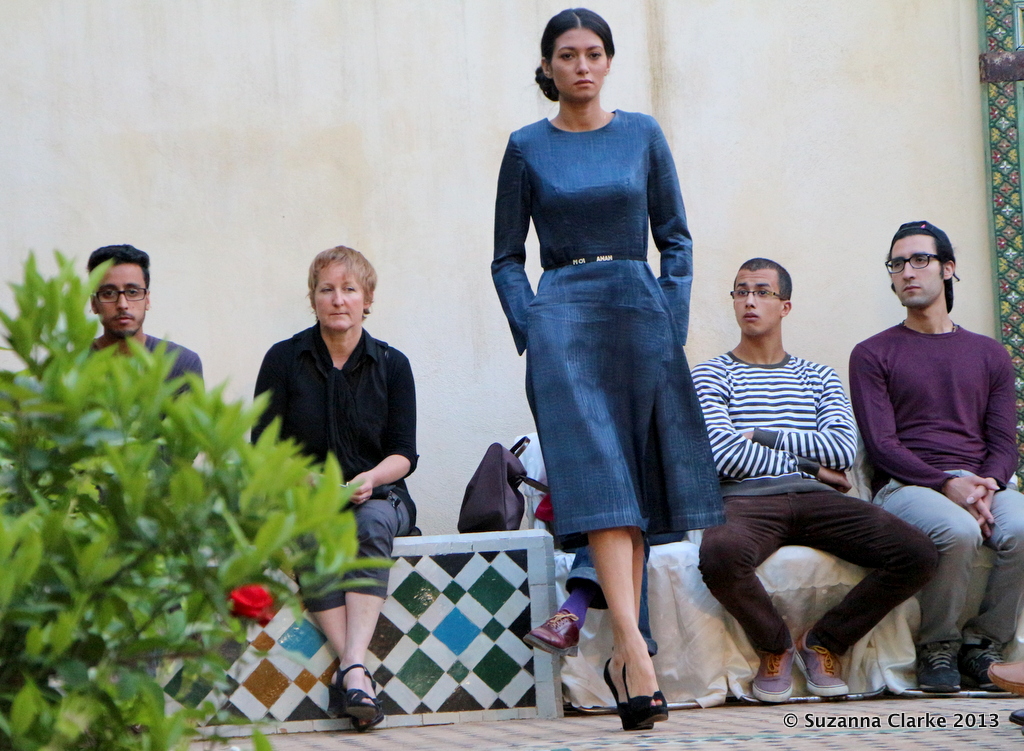
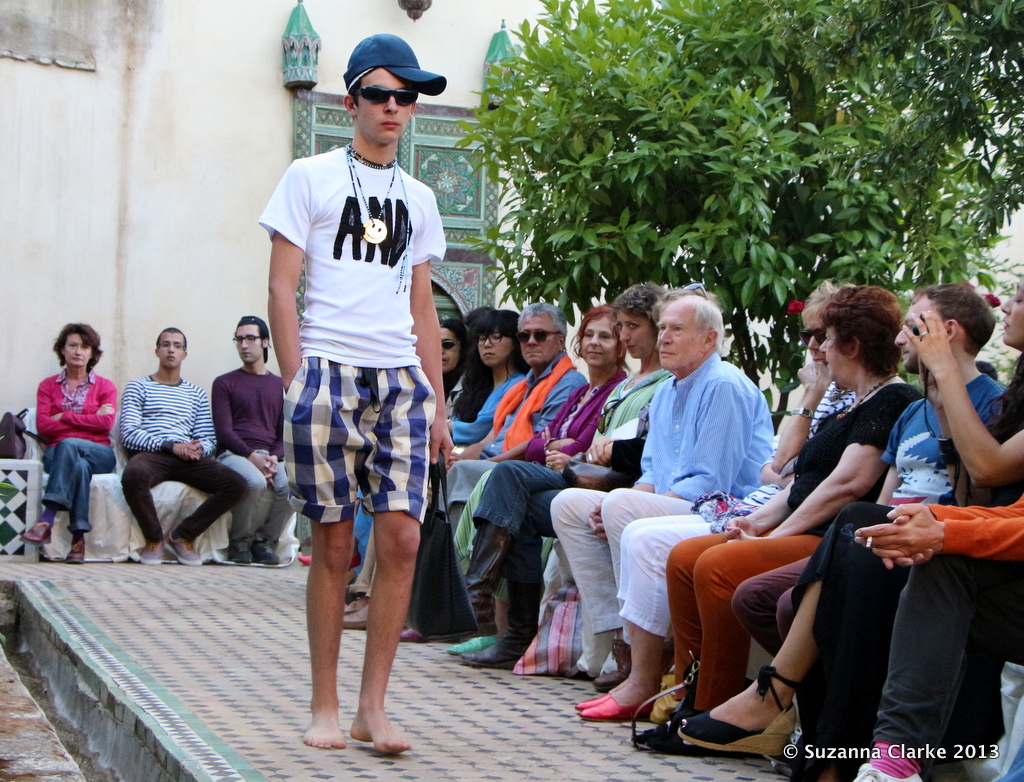
Fez Fashion Day 2013 on May 25 was a treat. Held at the beautiful Jardin des Biehn and sponsored by the French Institute Fes, two designers showed off their extensive collections at the well attended show. 
Moi Anan, from Thailand, who works between Bangkok and Fez, and Alfred Berlin from Italy who is based in Berlin and Fez, had very different collections. Anan's work was beautifully tailored and constructed, using exquisite fabrics, while Alfred's was more casual and playful, with an emphasis on accessories. See our previous story on them HERE.


Collection Moi Anan


Moi Anan's carefully tailored styling spans Thai tradition and Western modernity. His work has been shown at Paris Fashion Week. 


This new collection consists of more of thirty pieces, offering a sophisticated approach where traditional fabrics and materials are given a contemporary twist.


Thai designer Moi Anan is happy with the reception for his new collection
A young audience member is inspired to make a record what he sees

Collection Alfred Berlin


Alfred Berlin describes his collection as "a funky mix of past and present". 


"Inspirations came from how, in the old Medina of Fez, people mix traditional Moroccan clothes, such as kaftans, jellabas and babouches with contemporary street-style looks like Nike and Adidas," says Alfred Berlin.


Accessories feature strongly. "I'm trying to establish my brand based on recycling left over leather from Italian factories. It is about using hand made products, done by the young artisan generation."


Alfred Berlin, right, with one of the models sporting a look from the collection

SHARE THIS!
Print Friendly and PDF