Sunday, September 30, 2012

Ancient Souk Destroyed By Fire

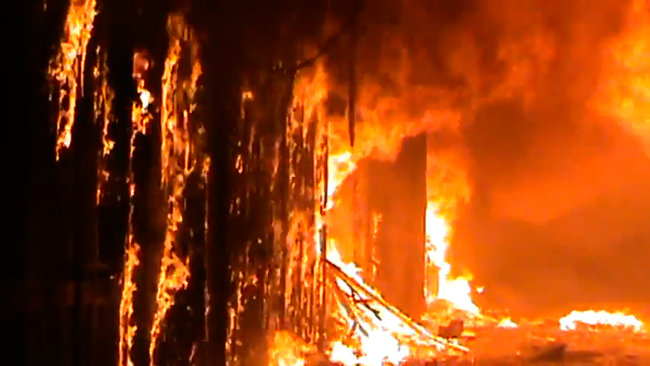
Sad news from Syria on Saturday. A fire has swept through the old central souk (marketplace), of Aleppo,  damaging the World Heritage area with its well-preserved labyrinth of medieval storehouses, shops, schools and ornate courtyards.

Shaam News Network SNN, via Associated Press


“Our hearts and minds have been burned in this fire. It’s not just a souk and shops, but it’s our soul, too.” - Dima, a doctor in Aleppo

One video shot by antigovernment activists showed a curtain of dark smoke hanging over the center of Aleppo near the old city, a Unesco World Heritage site. Another showed intense, crackling orange flames engulfing heavy wooden doors in what appeared to be one of the market’s arched stone passageways. The activists said they believed that the fire, whose origins were unclear, had destroyed a large portion of the market’s shops overnight, though the claim could not be immediately verified.

For many residents, the old city, with the souk at its center, is the soul of Aleppo, one of the world’s oldest continuously inhabited cities and Syria’s largest. Aleppo has been staggering for months under a bloody battle that has reduced some residential areas to rubble, and with no deaths immediately reported from the blaze, the damage to the souk pales compared with the recent human toll.

Yet serious damage to an area that Syrians widely consider one of their greatest treasures is likely to stir anger at both sides — each of which blames the other for the destruction in the city — in a conflict that seems mired in stalemate. It could also make the rebels’ latest push in Aleppo backfire politically: Some opponents of President Bashar al-Assad were already incensed on Saturday at insurgents they said had operated conspicuously near the old city.

SHARE THIS!


Saturday, September 29, 2012

The End of Daylight Saving in Morocco


A "timely" reminder that daylight saving ends on Sunday (30th) at 3 am.

To mark the event we have organised a pleasant sunny day with a high of around 23 degrees Celsius - enjoy!


Heure. Retour à l'heure légale (GMT) dimanche prochain. Le Ministère de la fonction publique et de la modernisation de l'administration a annoncé que le retour à l'heure légale (GMT) se fera à partir de dimanche 30 septembre 2012 à 3h00. Les Marocains retarderont leur montre d'une heure à partir de dimanche, en vertu du décret N.2-12-126 du 18 avril 2012 (26 Joumada I-er 1433).

SHARE THIS!

Friday, September 28, 2012

A Musical Mélange at Dar Batha in Fez


The French Institute is working overtime presenting cultural events in Fez. Tomorrow they are holding a concert by the group Mazij as part of the France-Morocco Cultural Season 2012.


Driss El Maloumi (Oud), Thierry Roques (accordion), Karima El Maloumi (vocals), Saïd El Maloumi (percussion), and Houcin BAQUIR (percussion)

The group MAZIJ which means "mixture" in classical Arabic is composed of four major Moroccan interpreters: Maloumi Driss El Said El Maloumi, Karima El Maloumi and Houcine Baquir and a French musician Thierry Roques.

On the Moroccan side, Driss El Maloumi, virtuoso, is considered one of the best oud players of his generation. Musical and literary culture, combined with a rare instrumental mastery allows him to tackle different musical styles. It perfectly combines Moroccan heritage Sufi with other musical genres such as baroque music and jazz. Karima El Maloumi is a young singer who is inspired by the Arab-Andalusian music and Berber. She began singing at the age of six and joined the Conservatory Agadir at the age of twelve years. Internationally renowned virtuoso darbuka Houcin Baquir renewed the genre and rhythm of the percussion instrument.

On the French side, Thierry Rocques comes from a family "Accordion and Music". His father instilled in him the rudiments of music theory, the accordion lessons soon become moments. He won several prizes (First Prize at the International Competition of Toulouse in 1977, First Prize in Excellence UNAF national finals in 1979). In 1980, he turned to the French variety and began a career in coaching various stars of French song.

DETAILS
Saturday, September 29, 19h Dar Batha
Members and students 10 dh - Non members: 20 dh


MAZIJ est présent dans le cadre de la Saison Culturelle France-Maroc 2012.
Driss EL MALOUMI (Oud), Thierry ROQUES (accordéon), Karima EL MALOUMI (chant), Saïd EL MALOUMI (percussion), Et Houcin BAQUIR (percussion)

Le groupe MAZIJ qui signifie « mélange » en arabe classique est composé de quatre grands interprètes marocains : Driss El Maloumi, Saïd El Maloumi, Karima El Maloumi et Houcine Baquir et d’un musicien français, Thierry Roques.

Ils sont invités à une création commune : une rencontre entre l’oud, les percussions et l’accordéon. Véritables virtuoses de la musique, ils s’attachent à donner au patrimoine des musiques traditionnelles du Maroc des sonorités métissées.

Côté marocain, Driss El Maloumi, véritable virtuose, est considéré comme l'un des meilleurs joueurs de oud de sa génération. Sa culture musicale et littéraire, alliée à une rare maîtrise instrumentale, lui permet d'aborder différents styles musicaux. Il marie à la perfection le patrimoine marocain soufi avec d’autres genres musicaux comme la musique baroque et le jazz. Karima El Maloumi, est une jeune chanteuse qui s’inspire de la musique arabo-andalouse et berbère. Elle a commencé à chanter dès l’âge de six ans et a intégré le conservatoire d’Agadir à l’âge de douze ans. De renommée internationale et virtuose de la darbouka, Houcin Baquir a renouvelé le genre et la rythmique de cet instrument de percussion.

Côté français, Thierry Rocques est issu d'une famille " Accordéon et Musique". Son père lui inculque les premiers rudiments du solfège, les cours d'accordéon deviennent très vite des moments privilégiés. Il obtient plusieurs prix (Premier prix au Concours international de Toulouse en 1977, Premier prix Excellence U.N.A.F lors des finales nationales en 1979). Dès 1980, il se tourne vers la variété française et débute une carrière dans l'accompagnement de différentes vedettes de la chanson française.

Driss El Maloumi, à l’initiative de cette rencontre, résume ce projet par la devise « prendre l’oud et aller vers l’autre ». Cette création est une présentation exceptionnelle où l'esthétique sonore transporte le public à travers le temps et lui fait redécouvrir une musique traditionnelle aux multiples apparences, riche en modes mélodiques, se forgeant une identité culturelle particulière au gré de chaque note.

Samedi 29 septembre, 19h Dar Batha - Adhérents et étudiants 10 dh - non adhérents : 20 dh
En concert dans les Instituts français et Alliances franco-marocaines

SHARE THIS!

Les Mystères de l'Ouest - Concert Review


Last night Dar Batha, a part of the French Institute here in Fez, was animated by Collectif 47's cinema/music project, "Les Mystères de l'Ouest." The piece, written for 9 musicians and "un écran géant," combined funky musical arrangements laced with innumerable textures and harmonies from across the (groovy parts of) the world and video, which was a narrative mashup of spliced Moroccan films and cartoons, mostly from the 1940s and 1950s. Our resident musicologist, Chris Witulski, reports...


Our story, a loose tale of a boy traveling west in search of freedom, began with a fingerpicked banjo/whistling take on everyone's favorite stock "Wild West" song, "The House of the Rising Sun." (If you need a tune to stick in your head, here's the classic by the Animals:  (Link)

With clips of windy sand dunes draped from the video screen, the audience is lulled by elegant French poetic spoken verse, learning our hero's narrative. Within minutes, however, the vast empty space of the desert is replaced by writhing Brazilian carnival led, dixieland marching band tinged, Balkan wedding music. The sousaphone and surdo, a Brazilian bass drum used in the samba processions of Carnival, interject - and the evening refuses to settle down from that point on.

As we move from French to Moroccan Arabic, the subject changes. No longer is this the sweet poetry of French, but the abrupt and energetic start to our story. (The sweet poetry in Moroccan Arabic is there too, just a little bit later.) Dark harmonies between dark timbres of dark instruments float across grooves that coalesce between the funk beats of the drum set and the Arab dance rhythms of the darbouka. All this, of course, punctuated by that large Brazilian surdo.

Hajar Chargui

Two singers, Ghassan El-Hakim and Hajar Chargui, gave very different edges to Singhkeo Panya's musical compositions and arrangements. El-Hakim's performances on the harder tunes (and his slam poetry-style hip hop recitation) contrasted perfectly with Chargui's beautiful throaty alto sound. Her range in both pitch and timbre brought both the "oriental" wisp to some tunes while she effectively summoned the Cairene Golden Age sound of performers like Um Kulthum in many others.

Ghassan El-Hakim

The real center of attention, however, was how Panya's arranging animated the film. The songs carried simple lines through a depth of colors, all while effectively narrating the spliced romp through old black and white video, telling a story that was far more interesting than the tale of our boy hero. At one point, for example, in a segment entitled "Intersections," music reminiscent of Mingus at his best animated visuals of confused road signs and overactive, white gloved, Moroccan police officers directing traffic. Elsewhere, a 3- to 4- second clip of an old man making sfinj (fried donuts) was spliced into a dance of sorts that consumed the better part of a minute (a long time, considering the aggressively manic nature of the editing).

The project has been traveling across Morocco, with Fez as the penultimate stop. It will be in Tangier on Saturday (the 29th) at the French Institute. (Information) Those who are interested should be forewarned that there is no real interest in subtitles, but that ends up being mostly unimportant. There are a few bits of entertainment that come from the group's toying with language, however. For example, after a conversation between two of the musician/actors that rags on rural Moroccan Arabic, a subsequent segment is entitled "Les Pecheurs" in French and "The Fish of the Sea Are Free," a phrase from the dialogue, in Moroccan Arabic. Playful turns of language and rhyme abound in all three languages.

A short video of one song from this project, as performed during a previous visit to Dar Batha:  (Link)


SHARE THIS!

Free Course for English Teachers on American Culture


If you are a Moroccan teacher of English in a junior high or high school, here is a free course to help you with your language skills, while providing engaging lessons on American Culture.

Run at the American Language Center on Wednesday nights, the popular course on Advanced American Cultural Studies will explore literature, film, art, music and architecture and give teachers a chance to practice and extend their English skills.

Director of the American Language Center, David Amster, says that the course is based on one he taught in Egypt about 15 times. “The reality for Moroccan English teachers is that while studying at University, their English is at a high level. Then when teaching students, they don’t have the opportunity to converse with native speakers, so their skills sometimes decline. The idea is to offer a special class to help English teachers practice at a high level with a native speaker on a regular basis.”

As well as covering contemporary culture and some classic aspects of American culture in the fields of music, cinema, literature, art and architecture, the two hour course will be different each time, so students can repeat it.

The teacher of the course, Jamal Morelli is well qualified, being a teacher of English at the ALC. He has also taught documentary film making at Sidi Mohamed Ben Abdellah University, and is a former professional musician. "I am going to start with with best-selling literature to look at the impact of America and the way we experience art," he says.

Amster says that the American Language Center is holding this course “as part of an effort to support the public school system. When we give out scholarships, it benefits just a few students. But it has a far greater impact if we can help English teachers improve their skills.”

Who: Teachers of English at Junior High and High Schools
When: Fall Term, October 3rd to December 9th, Wednesday from 6:40 – 8:50 PM
Where: American Language Center, Fez
Cost: FREE (with a 600 DH deposit to be refunded upon completion of the course)
Contact: Tel – 0535.62.48.50 or email- jamalmorelli@me.com


SHARE THIS!

Tuesday, September 25, 2012

Tangier Jazz Festival, TanJazz - Wide Definitions


The 2012 TanJazz Festival is over - The View from Fez's resident musicologist Chris Witulski reports from Tangier.


As we walked from the Tangier train station to the medina, along a beached lined with dance club advertisements and children playing in the sand, we crossed a group of men in ties holding dixieland brass band instruments. The sousaphone stood out as an anomaly in the Moroccan sun, and when I heard the banjo strummed, the electric guitar sound that came out of the attached speaker was startling.

This was Friday afternoon at the Tangier Jazz Festival, TanJazz. Batunga and the Subprimes  spent much of the time wandering the streets in old New Orleans style, but these Parisians kicked out some Afro-Cuban sounds that sat perfectly alongside the rest of the festival's entertainment. They deserve a listen.

Gnawa Express
Saturday night, we settled into a spot on the port stage, situated on the long coast, with the old medina perched high above us. The Gnawa Express opened the free concert evening, performing barely-stylized music from the Afro-Moroccan ritual. The now famous Gnawa tradition's music animates ritual evenings that last until the following morning's sunrise, but this group led us through what can be considered the "greatest hits." These songs have become widely know across Morocco's population, symbolizing the dramatic rise in stature for this music and religious practice. What was once confined to heavy private evenings now makes up a repertoire that simply cannot be ignored in Moroccan music festivals. Gnawa Express, led by Maalem Abdelmajid Domnati, is based out of Tangier and their sound lacked the jazz fusion embedded into the music of other Gnawa groups throughout the weekend, but the group's grooves and the music's popularity alone were enough to get them an invite to the jazz festival. (For an example of another group from the weekend's events that features heavy jazz fusion with Gnawa music, see Majid Bekkas's "African Blues")

Keeping the focus on groove instead of esoteric harmonic exploration, Bebey Prince Bissongo and his ensemble took the stage. A native of Burkino Faso, Bissongo's set was tight and simple. The music, perhaps, could best be described as fun. His palm-muted guitar sound, the tasty trumpet, and the thick African hand drumming sat atop a tight and percussive organ and an infallible electric bass/drum set team to drive the energy from start to finish.


These types of groups, charged to perform at the large public (read: free) outdoor venues, demonstrate just how widely the net of "jazz" can be cast. Nowhere to be found was the 1950s Manhattan sound, let alone the quartet-driven melodic explorations of the 60s and 70s. Gnawa music, lifted straight from the ritual and placed on a stage sat alongside some contemporary Afrobeat funk inspired by hot nights of dancing with a beer in hand to represent two distant (yet surprisingly complimentary) ends of a spectrum. The TanJazz festival had much more to offer, of course, with club-like intimacy in small venues for 200-300dh per night. But for the majority of people in Tangier during these evenings, the jazz that animated their evenings was diverse, accessible, and unbelievably... well... fun.

Photos: Tyler Martinson

SHARE THIS!

Morocco Wine ~ Forbidden Fruit

Writing for the San Francisco Chronicle, Christina Ammon goes exploring one of Morocco's lesser known delights - fine wine.

Winemaker Christophe Gribelin  “It's a different country so you have to adapt,” 
Photo: Christina Ammon
,


After three sober months in Morocco, my liver was healthy - but my teeth were in trouble. The country's beverage of choice - a gunpowder tea jammed with mint - comes sans alcohol, but is spiked with a minimum of six sugar cubes. No sooner had I made peace with this Berber whiskey (as the locals call it), than a longtime expat told me about a winery just a 40-minute drive or train ride from my base in the Fez Medina. I was dubious. "They make wine," he assured me. "Good wine."

If the grape moonshine usually associated with Morocco's back alleys hasn't earned column inches in Wine Spectator, it's understandable: Sommeliers don't exactly flourish in Islamic countries, where alcohol is ummul-khabaith - the root of all evil. But in the past 15 years, two progressive kings have invited French winemakers to lease prime land, and a wine industry has begun to flourish.

Wine tours are not touted like camel trips in the Sahara or Berber village treks. Though the wineries are within easy reach of the major cities such as Marrakech, Casablanca and Fez, an informal ban on advertising means that tour operators must peddle wine trips discreetly.

Volubilis - Photo Suzanna Clarke 

"If we openly advertised the tours within Morocco, our business would be seen to be as disrespectful," said Michele Reeves, who runs a tour company called Plan-It Fez. Guides often pair visits to the wineries with other adventures, such as tours of the historic city of Moulay Idriss or the Roman ruins of Volubilis, a UNESCO World Heritage Site.

"We try to remain low-key about wine," Reeves said. "But in reality we are excited to be a part of this burgeoning industry that offers an interesting insight into the contradictions that take place in the country."

Like so many of Morocco's splendors, the country's wine industry is dressed in plain clothes. You've got to know where to look.

Read the full article here San Francisco Chronicle


SHARE THIS!

Sunday, September 23, 2012

A Facebook Call For Fez to be Morocco's Capital


Last week, Hespress reported on a Facebook group that's calling for Fes to be made Morocco's capital city in place of Rabat, the current capital. Matt Schumann, writing on the Armchair Arabist blog reports.

Cover photo for the Facebook group "All for Returning Fes to its Status as Capital of Morocco". 


According to the Hespress article, the group wants Fes to be restored to the glory it enjoyed as Morocco's political, religious and cultural capital in the centuries leading up to the French Protectorate. As the article states, once the French took control of the country in 1912, they made Rabat their capital to, "distance themselves from the Nationalist Resistance's center and to remove the Sultan from the religious scholars at Al-Qarawiyine mosque." Rabat remained Morocco's capital after Independence in 1956.

Hespress reports the group considers this change illegitimate because it came under French colonial rule and asserts that Fes has suffered from its diminished importance in Moroccan politics and society. To the group's founders, a city with such a long, storied tradition should not be banished to social, cultural and political irrelevance.

The article articulates the group's demands, or "solutions", which include "recognizing Fes as Morocco's symbolic capital and empowering it as the nation's cultural and intellectual capital by bringing to it national institutes and universities, and by establishing scholarly research centers in the city." They go on to say that, "Rabat should remain the administrative and political capital as is done in Holland. There, Amsterdam is the official and symbolic capital while The Hague is the administrative capital."

The article concludes by articulating the group's alternative solution, which is "to recognize both Fes and Rabat as co-capitals of Morocco, officially and constitutionally, dividing administration between the two. Either Fes could be the administrative and political capital, and Rabat the judicial and legislative capital, or vice versa, as is done in many countries around the world."

These are interesting ideas, but you don't have to be an expert to recognize that these demands are far from realistic.

Nonetheless, underneath this group's fantasy, lies a true and acute frustration that anyone who has gotten to now Fes to a certain degree can relate to. Yes, the city possesses one of the world's grandest and most magnificent artifacts: the Old Medina. But that's exactly what it is: a relic, and a testament to all that the city has lost in the last 100 years.

Both French and Moroccan alike sought to marginalize Fes over the past century. In 1956, the newly independent Monarchy settled in Rabat for precisely the same reasons the French did so 44 years prior. Morocco's new, centralized government, supported by a legion of Modernist politicians, was eager to step forward and forget about its former self. The times called for a strong, absolute monarchy, not the feeble sultanate that had been held at bay by Fessi religious scholars and businessmen.

So Rabat remained the capital, and the families who built the Fes Medina and made it a center of the pre-Modern Muslim abandoned the city. Names like Bennani, Al-Fassi, and Al-Idrissi left for Casablanca or Rabat, following money and political power.

Today, it's hard to find a 'real' Fessi living in the Medina. Most of the current residents moved there in the 1980s from the countryside seeking a better life in the city. This lead to overcrowding, poverty and crime and turned the Old Medina into a slum. It remained home to exquisite artistic, architectural and cultural artifacts, but a slum nonetheless.

Now Fes feels alienated, cut off from the development that has struck Morocco's coastal cities. Casablanca, Rabat and Tangier possess a degree of cosmopolitanism and refinement lacking in the country's traditional cultural capital. Fessis complain of being overlooked by the government when it comes to education and urban development. Most of all, the city's artists and literati exude desperation. They, more than others, recognize that Fes is a backwater.

That said, noticeable developments occurred in recent years. The World Sacred Music Festival, which began in the mid-1990s, has grown into one of the best festivals in a country known for its festivals. It regularly attracts internationally renowned artists and intellectuals - Tariq Ramadan, Bjork and Joan Baez all made appearances this past year - to say nothing of the 1000s of attendees from around the world.

Additionally, the Medina itself has been improved. Many historical buildings have been restored, either by UNESCO or ADER, a Moroccan civil society organization dedicated to restoring the Medina. Dilapidated houses have been bought and renovated by Moroccans and foreigners alike. Even signs have been installed to direct visitors through the Medina's labyrinthine streets and passageways.

But too often are these improvements aimed at attracting tourists and not at improving the daily lives of Medina residents. A restored fountain makes a great photograph for a tourist, but has no value to the community if residents can't use it to get water. This is why many beautifully restored fountains quickly become glorified garbage bins.

Additionally, the attention Fes gains from its festivals is better than nothing, but it is a paltry replacement for actual sustained respect and admiration by Moroccans and foreigners. Fes would certainly benefit from such appreciation, and in fact it needs it, lest the Medina continue to deteriorate both structurally and in its spirt.

Being named Morocco's capital would certainly help elevate Fes to the heights it once occupied, but this is merely a fantasy. However, the fact that an idea like this would gain such attention indicates how it reflects Fes' true desperation.

Clearly, the situation must change if Fes is to once again receive the appreciation and attention it deserves. But that change won't occur over night, and is unlikely to come from the government. It's in the hands of the city's residents to change their fate.

How that will happen is unclear. But there is no doubt that if Fes remains neglected, its best days are long gone.

SHARE THIS!
Tuesday, September 18, 2012

Want to Learn Moroccan Arabic in Fez?


ALIF Riad - photo Suzanna Clarke

A new series of Darija classes are starting soon courtesy of the Arabic Language Institute Fes, (part of the American Language Center), at the beautiful ALIF riad near Batha.

The level of the classes can be adjusted to suit the participants.

They will be held on Mondays and Wednesdays from 6 to 7.30pm for five weeks. The cost of the course is 1,500 dh. Classes will commence when there is a minimum of three students.

For further information and enrolment please contact:

Linda Bouchard
Assistant to the Director, ALIF
Arabic Language Institute in Fez, Morocco
Phone: 212-535-62 48 50
info@alif-fes.com

ALIF Riad, 6 Derb Drissi, Batha, Fez Medina.

SHARE THIS!