Showing posts sorted by relevance for query American Fondouk. Sort by date Show all posts

Tuesday, November 15, 2011

The American Fondouk ~ Healing Animals in Fez


The American Fondouk, an animal hospital specialising in horses, mules and donkeys, has operated in Fez since 1927. A new director, Dr Gigi Kay, took over in August and renovations have begun. Suzanna Clarke visits and gets more up close and personal than she bargained for.

The huge, work-worn mule was laid out on the vinyl cushions, which are the Fondouk’s temporary operating table, until the new renovations are complete. Its owner had brought it in a short time before, with a large piece of what looked like meat hanging beneath its belly – muscles and fat held by a thread. While it was gruesome to look at, it must have been excruciatingly painful for the animal. “An accident with farm machinery,” the owner explained.


“We need to get this out of the way,” said Dr Gigi Kay, the dynamic new director of the Fondouk, and its chief vet. “Can you do it?” she asked me. She was referring to the animal’s penis, which was dangling into the wound. “Okay,” I gulped, and put on sterile gloves, wrapped a towel around the mule’s member and pulled it out of the way, trying not to feel faint at the sight of the gaping hole in its flesh. I maintained this intimate contact for the next hour.

“I hope you aren’t squeamish,” Gigi said, as she began delicately snipping away at the hanging bits of muscle and dead skin.

The wound was flushed with saline solution and then the other vet, Dr Mohamed Bourassi, assisted to suture the muscle together. Stretching the skin across looked like an impossible task, but with some firm persuasion, it was pulled across like a satin sheet, hiding the bloody mass beneath. I was impressed at how neatly and quickly the two vets worked, using thin plastic tubing to take some of the strain off the skin and making small incisions on the taut skin on either side, to prevent tearing.

Their task was made all the more difficult by the fact that, despite more than the usual dose of anaesthetic, the mule wasn’t fully asleep. It kept jerking and twitching and had to be constantly topped up with ketamine. There were seven of us involved in the operation and each person was doing an essential job; from the man who held the animal’s leg to stop it kicking the vets' faces, through to my own, more humble, contribution.

Finally, the operation was finished and I was relieved to release my grip. Where the gaping hole had been was a neat row of stitching and the prospect that the animal might survive and, after recovery, continue its working life.

“But doesn’t it hurt you to patch them up and then return them back to such difficult conditions?” I asked Gigi later. “They are not my animals,” she said simply. “We are only here to make them better. We give them the best quality care they have ever had in their lives. They are fed and cared for as if they were in horse equivalent of a five star hotel. We are happy if they are well enough to go back out there.”

After seeing suppurating wounds and injuries caused by hobbles, or carrying carts or heavy loads, how did she feel about the owners of the animals? “ I am never judgemental,” she says. “I was brought up with these people and I know what hard lives they have.”

Instead, Gigi bargains for each day. “Recently we had a mule which had been hit by a car. Its owner said it had to start ploughing on Monday. I said it needed more time, and he kept coming back, asking when it would be ready, and I would ask for another day or two. I’m constantly bargaining.”

For a mule or donkey owner who depends on the animal for his family’s livelihood, the loss of it can be devastating. So the role the Fondouk plays is an essential one of making sure that the animals can continue. And, on a larger scale, the Fez Medina would not be what it was without them.

Started in 1927 by American tourist Amy Bend Bishop, the American Fondouk is the only American equine hospital operating in Morocco. There are ten others, run by the British organisation Spana. The American Fondouk is overseen by a board and relies for its funds on private donations. As running costs are around $25,000 per month, this is a considerable commitment.

Dr Gigi Kay
“When I came here, the Fondouk had recently stopped treating dogs and cats,” says Gigi. Now the focus is entirely on equids. “We have to work in the Moroccan environment, and we were undermining the local vets by treating dogs and cats. Really, if you own a pet, then you should be prepared to pay for treatment. Whereas equid owners will always be too poor to take them to a local vet.”

Judging by the number of well-heeled types still coming to the clinic with their pets, word hasn’t yet got around. “We still euthanize animals if it’s medically essential,” she says.

The Fondouk treats around 20 animals a day that come through its doors and another 20 which are held in recovery stalls. The two vets and eleven other staff are constantly busy. “It should really be a three vet practice,” she says.

Lots of injuries they attend to are mules and donkeys that have run-ins with cars; abscesses and wounds caused by hobbles and inappropriate harnesses and colic from animals eating plastic bags. The clinic’s resources are modest, but Gigi has plans to make the stalls bigger and to have a proper operating area. The clinic will shortly get a weighing machine so they can better judge the amount of anesthetic to administer.

Before beginning at the American Fondouk in August, Dr Gigi Kay was the Veterinary Director for a working equid hospital in Luxor, Egypt and before that, Veterinary Director of Spana in Morocco. Originally from England, she was brought up in the Middle East. Her family was constantly on the move, with her diplomat father and archaeologist mother. “I always wanted to be with horses, even before I could walk,” she says.

Gigi was 17 when she first came to Morocco for three years, then spent five years living here when she was with Spana. She is married to an English doctor, Dick Hooper, and has recently returned from a stint in Sydney.

She enjoys the personal care she is able to give her patients at The American Fondouk.
“This is an ideal job for me,” Gigi says. “I like making broken animals better.”

Dr Gigi Kay wants to encourage tourists to visit, with the aim that the Fondouk can generate some of its own money through donations.

The American Fondouk is open from 8am to 4pm. Anyone, including tour groups, is welcome to visit, but be prepared to give a donation. The animals of Fez depend upon your generosity. 


 See the American Fondouk Website here. or phone them on 066 5794400.


Photos and story: Suzanna Clarke

SHARE THIS!

Monday, December 07, 2015

Dar Zerhoune Donkey Project ~ Education Day


Last Sunday the formidable Rose Button - the woman behind the Dar Zerhoune Donkey Project - experienced "a surge of delight, pride and awe and knowing that I had been part of a day that changed lives. I now know there is never a greater feeling than the gift of learning to people who are keen, and do not normally have the opportunity." Rose reports from Moulay Idriss

A month ago a donkey owner brought a donkey to my door and needed help. The donkey had a deep cut on its neck and they had used traditional methods to stop the bleeding. We called the American Fondouk for the next steps of wound care and each day I would treat the donkey on the street to clean the wound and allow it to heal successfully. It was during these sessions that I realised the benefit of teaching the donkey owners wound care and taking care of their donkeys and so the Dar Zerhoune Donkey Project Educational Day was planned.

Thanks to generous donations we were able to bring 15 of our donkey owners, including children, from the town of Moulay Idriss, to Fes, to spend the day learning, observing and experiencing the work at the American Fondouk, a working hospital providing free veterinary care for the hard working donkeys, mules, and horses of Morocco. The American Fondouk believe that treating working animals offers a significant contribution towards safeguarding the livelihoods of the poorest and most vulnerable members of the community, both in the towns and in the countryside. And offering education in horse care and nutrition is also critical to improving the welfare not only of these animals but also the welfare of the owners and their families who depend on them.


The Dar Zerhoune Donkey Project started in July this year with the original intention of providing veterinary care once a month to take care of the donkey’s of Moulay Idriss, a country town 25km from Meknes and 5km from the roman ruins of Volubilis, that relies on donkeys for all activities each day. The project has captured the attention of guests, friends and family of Dar Zerhoune and from whose donations we are able to host our educational day. The donkey owners have taken ownership of the project, and donkey care, even bringing donkeys to the door of Dar Zerhoune for after care. This is what triggered the idea of an educational day – to give the owners a chance to learn about the best donkey care and share this with each other. Often they use traditional methods of using faraan (bakery )ash on cuts and oil on wounds when this can easily be replaced with cost effective use of salty water and honey.

At the American Fondouk the owners had demonstrations of feeding, wound care, foot-care and general donkey maintenance. Along with demonstration the use of the diagnostic machines, like the Xray.


The best words to describe the day are from the attendees themselves.

Youseff aged 8 ‘I learnt how to clean the wound and know now to clean with salt water and if it is a big wound you can put honey on it’.

Donkey man Safi Ali ‘I enjoyed meeting everyone at the fondouk, thank you for organising it. He learned about how to mix the food for the animals and how to tie the animals from the head and not the legs.’

Another donkey man:  ‘I want to say thank you (to the fondouk) for the reception and the way you are taking care of the animals and the first time I have seen how they treat wounds, and all the machines used for diagnostics’.

Aziz – ‘I now knows what to do if something happens to my donkey. I also learned to always put water with the food instead of just once a day’.

Reda aged 12 – ‘I learnt that I shouldn’t tie a donkey from its leg and should treat them with love and not hit them.'

Dr Hicham El Koutbi ‘I was surprised that Rose insisted on bringing the donkey owners to the American Fondouk and surprised that the owners were so very interested.’

Dr Gigi Kay, the director of the American Fondouk said ‘ it was lovely to see so many owners learning how to improve and being so keen to learn so much more about how to care for their animals’. And her goal is to provide an excellent standard of clinical care to the donkeys, mules, and horses of vulnerable owners. At the same time she aims to provide a facility for young veterinarians and students to engage in a busy equine hospital so that they in turn can go on to provide excellence in clinical care for many years to come.’

Plan-it Fez generously sponsored the transportation for the day and commented ‘Delighted to have sponsored an educational Donkey Day bringing the donkey owners from Moulay Idriss to meet the vets at the American Fondouk donkey, mule and horse hospital in Fez. Enabling learning is a privilege and a joy’


Thank you to all our guests, friends and family of Dar Zerhoune who kindly donated to support our project. Please see http://www.darzerhoune.com/donkeys for more information and contact Rose on info@darzerhoune.com if you would like to donate to the project and support the donkeys of Moulay Idriss.

Text & photos: Rose Button

SHARE THIS!
Print Friendly and PDF

Friday, March 17, 2017

Equid Opening - a Great Success


Thursday night's opening of the works by Australian artist Natalie Scholtz was held at the American Language Center Riad at Batha in Fez


The exhibition opening was well attended by a wide cross section of visitors and locals. Amongst them His Excellency François-Xavier Tilliette, the French Consul General, the highly respected Caida of Batha, Mme Ilham, Police Colonel Abdullah, Dr Gigi Kay from the American Fondouk and M. El Cohen chef des scouts de Fez.

Dr Gigi Kay (American Fondouk) chats with François-Xavier Tilliette and Caida Mme Ilham

Natalie Scholtz is a visual artist from Western Australia. As a drawer and painter Scholtz depicts the gesture and emotion of objects in her immediate environment. Scholtz's works range between bold and colourful representation of form, to subtle suggestions of shape through sketchy line.

Natalie Scholtz was thrilled by the exhibition reception

Special mention should be made of Natalie's artist residency at the American Fondouk, the free animal hospital in Fez, which was made possible due to the generous sponsorship of the American Fondouk, ALIF, and the American Language Centre in Fez. The Fondouk also contributed a unique publicity event for the opening - stationing donkeys and mules at various points of the Medina with signs advertising the exhibition - a nice touch!

It pays to advertise!

From the last week of January through February 2017 Natalie was given the opportunity to paint, draw and document the work, ethics, and equids of the American Fondouk and broader Fez community. The full-time work that goes on behind the closed doors of the Fondouk, is one of restoration and the nurturing of life. Scholtz explores the physicality of the working horses, mules and donkeys. The angular and sometimes fragmented character of the working animals from Fez tells a story of livelihood, community and culture. Scholtz enjoyed making aggressive charcoal lines that follow the strong skeletal shapes of mules and playing with sandstone colours found in both the coat of a horse and walls of the Medina.


The work on display in the exhibition was as varied as it was excellent. Depicting horses, donkeys and mules in postures of work and relaxation, the works on paper in water colour and acrylic paint showed their angular forms, expressions and personalities. Some of the works were more traditional in their use of colour and style, while in others a multitude of colours had been used, giving a more impressionistic feel. One of the paintings had mules and donkeys amid a jumble of traditional buildings, and gave a sense of the organised chaos of Medina life.


The Study of the Equid Exhibition continues at the ALIF Riad, 6 Derb Drissi, Batha, Fez Medina, daily (4-6pm) through until March 26th. It is highly recommended.

SHARE THIS!

Sunday, October 10, 2021

New Home for Medina Mules

New stables have been built with the aim of protecting the remaining working mules, donkeys and horses of the Fez Medina. As Suzanna Clarke reports, the public are encouraged to visit and support this innovative project 


Dr Gigi Kay, director of the American Fondouk, estimates that only about 40 mules and 100 donkeys are still working in the Fez Medina. Whereas, once hundreds clip-clopped along the streets and alleys, carrying goods from leather to handicrafts to food to furniture. 

"The mules are part of the patrimony of Fez and they are disappearing fast," says Dr Kay. "And those that are left, we need to value them more. We need to put them in the front of our campaigns to keep Fez alive. They are part of Fez, and have always been part of Fez. The association of mule owners goes back to the time of Leo the African in the 15th century. So I think it would be a great shame to lose them."

Some of the 30 new stables

The Mules of the Medina project, (called Dar el Brell in Arabic), comprises 30 new stables, and a paddock filled with sand, located near Oued Zhoune at the bottom of the Fez Medina. It's near where tourist buses stop. It's hoped there will eventually also be a cafe there. 

When I arrived at the new stables a mule was happily rolling in the sand paddock, which looks onto a stunning view of Mt Zalagh. 

Dr Kay explains how the idea for the new stables came about: "When I first came here in 2011, I realised that a lot of our animals were coughing. I was quite surprised about this, as it’s not really something you’d expect. So I decided to look at their stabling. I was taken to places in the Medina where they’re stabled, and realised straightaway that it was very dangerous, depressing and dark. The animals were always hobbled or tied up and there was no ventilation. Horses and mules, need ventilation. 

"So I struggled with this situation for a year or two, before coming up with this idea of making a project with beautiful stabling, where we can keep an eye on the animals. Where maybe the tourists could come and have a ride on the mules."


Architect Meriem Ghandi, project founder Dr Gigi Kay, and Mr Cohen from Scouts of Fez 

The cost of the project was around US$300, 000, with the retaining wall alone costing over $100, 000. Dr Kay explains: "The money is a co-operation between the national scouting organisations of Morocco and  the American Fondouk. The President of the American Fondouk is the grandson of the person who set it up in 1927. He’s had a long history with the American Fondouk. He used to come here to Fez as a child. He gave a large sum of money to the Scouting Organisation of Morocco to come up with ideas that would improve the environment, or would improve animal welfare. And with the Scouts of Fez, we came up with this idea. 

"Now that it's finished, the scouts are becoming involved with the running of it; with the cleanliness and maybe helping to feed the animals. And they will use it as an agreeable place for the scouts to meet once a week."

Architect Meriem Ghandi, responsible for the design of the project, says that the architecture is influenced by the vernacular style of the region. "But it's combined with standards of today, where the animals can be kept in clean conditions and can stay in good health. Now that the project is finished, I am very happy to see that the animals here are putting on weight. Because it’s the proof that the animals are being well provided for and the aims of the project are being realised."


A mule enjoys a roll in the new sand paddock

However, there are further plans for the project. It is hoped that an old building on the site will become a cafe to welcome international visitors and locals. The Mules of the Medina is seeking a partner with vision, hospitality experience and capital to make this a reality. There is a staircase down from the road where many tourist buses park, so it would be an excellent spot for a cafe/restaurant. 

"It's an enchanting location," says Dr Kay. "It's open to public. In the evening, it's covered in thousands and thousands of birds, all nesting in these big eucalyptus trees. It's right under the wall of the Medina, but when you look out, you just see the countryside. You could be miles away in the country, yet we are only 5 minutes away from the Medina."

The 22 donkeys and mules - the first residents of the new stables - are very fortunate. "They will have been tied up all their lives," says Dr Kay. "So this is the first time they will have been let loose, ever. All the mule owners come and they let their animals loose in the paddock, and they roll. Horses and mules love to roll. Then they go straight back into their stable - they know which is their stable."

The pandemic has been a particularly difficult time for the muleteers who own and work with the animals. Pre-pandemic, their average income was 50 dirhams per day. With many shops and businesses closed in the past 20 months, this has declined steeply. Caroussa (hand-carts) have also taken over much of the work traditionally done by the mules. 

As a result, some muleteers are unable to continue to feed their mules. One of them is Abdelhak, below, who last week surrendered his mule to the Fondouk. He said he was sad to do so, as the mule had worked with him for many years. 

It is hoped that the new stables, and the public interest they will attract, will make a difference to the lives of the muleteers and their animals. 

Abdelhak, with the mule he surrendered to the American Fondouk


If you wish to visit, there will soon be signage and the Mules of the Medina location shown on Google maps.

The View From Fez congratulates everyone behind the innovative Mules of the Medina project, which is an excellent initiative towards protecting the heritage of the Fez Medina. 

Story and photos by Suzanna Clarke. 


SHARE THIS!


Monday, March 13, 2017

Australian Artist Exhibits in Fez

Art Exhibition: "Study of the Equid" by Natalie Scholtz. An exploration through paint and pencil of horses, mules and donkeys in Fez


Natalie Scholtz is a visual artist from Western Australia. As a drawer and painter Scholtz depicts the gesture and emotion of objects in her immediate environment. Scholtz's works range between bold and colorful representation of form, to subtle suggestions of shape through sketchy line.


From the last week of January through February 2017 Natalie Scholtz was given the opportunity to paint, draw and document the work, ethics, and equids of the American Fondouk and broader Fez community. The full-time work that goes on behind the closed doors of the American Fondouk, a free animal hospital in Fez, is one of restoration and the nurturing of life. Scholtz explores the physicality of the working horses, mules and donkeys. The angular and sometimes fragmented character of the working animals from Fez tells a story of livelihood, community and culture. Scholtz enjoyed making aggressive charcoal lines that follow the strong skeletal shapes of mules and playing with sandstone colors found in both the coat of a horse and walls of the medina.


Alongside the artist residency there was space for art sessions at the local Girls' Center in Ziat. Scholtz delivered introductory skills in drawing, pattern making and color mixing to a select group of girls. The workshops aimed to encourage the arts in young people, but more importantly offered respite and a space for creative conversation with the disadvantaged youth of Fez.

The artist residency at the American Fondouk was possible due to the generous sponsorship of the American Fondouk, ALIF, and the American Language Centre in Fez.

The Study of the Equid Exhibition
Exhibition opening: Thursday, March 16 at 6:30 PM
ALIF Riad, 6 Derb Drissi, Batha, Fez Medina
Continues daily through March 26, 4-6 PM

SHARE THIS!

Sunday, August 31, 2014

Moroccan Puppy ~ Cute and Available from the American Fondouk in Fez


A young puppy was recently given to the American Fondouk in Fez. It was rescued from being tormented by children and has now recovered. The puppy is available to someone looking for a cute and affectionate pet


The puppy has been vaccinated (given all its inoculations), wormed and generally looked after. It is now in perfect health. Anyone interested in adopting the puppy should contact the American Fondouk or email theviewfromfez@gmail.com and we will put you in touch with the Fondouk. It is suggested that the new owner should make a small donation to the valuable work (with Medina donkeys and horses) done by the Fondouk.

To find out more about the work of the Fondouk, CLICK HERE

SHARE THIS!
Print Friendly and PDF

Saturday, October 11, 2014

Animal Rescue Fez Style

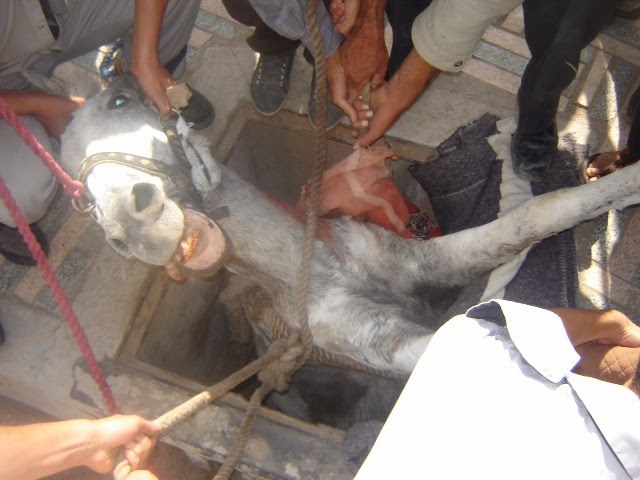
A mule had a lucky escape last week when it fell down a manhole in Fez. The cover had been removed, and the animal backed into it without seeing the hole


Fortunately, rescuers from the American Fondouk, aided by onlookers, were quickly on hand to extract the poor creature. Firstly it was given a tranquilliser, then a man was lowered head down into the hole, to the side of the animal, to pass two ropes around its hind quarters. A carpet was put as protective padding between the flanks of the mule and the rope.

It took considerable strength, and eight people, for the 400 kg animal to be extracted. Despite a few leg injuries, the mule is recovering well at the American Fondouk.


Photos and story courtesy of American Fondouk director Gigi Kay. 

The American Fondouk is open daily for visits from 8 am to noon. For more information CLICK HERE. 

SHARE THIS!
Print Friendly and PDF

Friday, November 09, 2012

Moroccan Fantasia Horses Run Laminitis Risk


Most of the work at the American Fondouk in Fes is concentrated on the donkeys and mules of the Fez Medina, and `the problems they develop from overwork and underfeeding. However, about twice a week they see horses from the other end of the equine spectrum that have the easily preventable hoof disease laminitis – a painful condition which can lead to founder. Suzanna Clarke reports for The View from Fez


Recently a magnificent Barb stallion arrived at the American Fondouk, referred by a local vet who was not able to provide the intensive 24 hr care the horse needed to survive.

“He is one of the best Fantasia horses in the country,” says Fondouk director Dr Gigi Kay (pictured above). Fantasia is a traditional equestrian performance practiced during cultural festivals in Morocco, and originates from the wartime practices of the Berber and desert tribes. These days it is a cultural art form; intended to show the strong relationship between man and horse. In a spectacular display, a group of riders and their mounts will charge in a line and, stopping suddenly, fire a volley of gunpowder from old-fashioned muskets.

Moroccan Fantasia horses in action

“He came in with laminitis and colitis - a direct result of totally inappropriate feeding practices,” says Dr Kay. “It is horrendously painful, in fact torturous, and lasts for months. This is why he spends all day lying down, as to be on his feet hurts too much.”

Laminitis results from the disruption of blood flow to the laminae of a horse´s hoof. The laminae structure secures the coffin bone (the wedge-shaped bone within the foot) to the hoof wall. Inflammation often permanently weakens the laminae and interferes with the wall/bone bond. In severe cases, the bone and the hoof wall can separate. In these situations, the coffin bone may rotate within the foot, be displaced downward ("sink") and eventually penetrate the sole. Laminitis can affect one or all feet, but it is usually seen in the front feet.

Photo via Alanna Colleen Snyder

Yet it is not from lack of care this situation arises, but from ignorance. The Barb stallion at the Fondouk receives about 10 visitors from his owner´s tribe at least twice a week, concerned about his welfare.

“The laminitis colitis complex is caused by overfeeding barley,” explains Dr Kay. “ A normal safe amount for this size horse is 5 kilograms of barley a day. This horse was receiving 20 kilograms of barley a day. The owners, along with all other Fantasia horse owners, know there is a link between barley and this disease, but they don´t know what the link is. They really don´t know that overfeeding is so dangerous. Most horses with laminitis colitis complex die or have to be euthanized.”

If a horse is given excess grain, it may be unable to digest all of the carbohydrate in the foregut. This excess then moves on and ferments, causing a proliferation of lactic acid bacteria and an increase in acidity. Endotoxins and exotoxins may then be absorbed into the bloodstream, and the result is body-wide inflammation – particularly in the laminae of the feet, where swelling tissues have no place to expand. Laminitis can also develop after a serious case of colic, due to the release of endotoxins in the blood stream. Releasing horses into lush pasture after a period inside can have a similar effect.

To assist Moroccan horse owners to understand how to prevent this condition, on November 26 the American Fondouk is holding a conference to explain the link between barley and this disease. Two specialists, one from Glasgow and the other from the United States, have been invited to help pass the message.

“Laminitis is completely and easily preventable - simply don't feed so much barley,” says Dr Kay.

Story: Suzanna Clarke
Fantasia photographs: Abdelmajid Nassih


SHARE THIS!

Thursday, October 10, 2013

German Shepherds for Adoption in Fez


We don't usually run ads like this, but these little guys were hard to resist. Three pure-bred German Shepherd puppies are available to good homes through the American Fondouk in Fez 

The puppies are two months old and ready to go to their new home. So if you have the space and time in your life for a dog, these good-natured little creatures will repay you many times over.

The Fondouk has spent quite a bit on their care and getting them immunised, so would appreciate a donation in return. 


American Fondouk Fez

Contact: +212 (0) 614 995 457 american.fondouk@gmail.com


SHARE THIS!
Print Friendly and PDF

Thursday, March 23, 2017

Moroccan Photo of the Day ~ Dick Hooper


A wonderful action shot by Dick Hooper of Sadek El-Bahjaoui training a horse (named Chenel) at the American Fondouk in Fez.

The Fondouk is a charity that provides valuable veterinary assistance for the working horses, mules and donkeys of the Fez Medina as well as advice for their owners. It has been doing great work since it was founded in 1927. Read more about the Fondouk here - American Fondouk

See more in our series Photo of the Day 

The View from Fez welcomes contributions to our Photo of the Day Series

SHARE THIS!

Sunday, June 28, 2015

Ramadan Diary ~ 2015 ~ Day Eleven

Ibn Warraq continues his Ramadan musings...

Back on Day Eight, I talked about the concept of Sadaqah, or voluntary giving. The Qur'an emphasises the importance of charity, particularly during the holy month of Ramadan. 

Probably the biggest example of Sadaqah in Morocco is Operation Ramadan, an initiative of the Mohammed V Foundation for Solidarity. This national food support operation has been in operation every Ramadan since 1999.

King Mohammed VI, accompanied by Prince Moulay El Hassan, launch "Ramadan 1436"

The Foundation undertakes to help the poorest in the community. This includes the elderly, disabled, widows, and those from rural areas. It is estimated that this year "Ramadan 1436" will benefit 2.37 million people  from 473,900 households. The beneficiaries include  403,000 households in rural areas.

The operation "Ramadan 1436", has a budget of 55 million dirhams, but the success of the initiative is not about money but rather the efforts of thousands of people, social workers, students and volunteers, who assist in the massive operation.

This week "Ramadan 1436" arrived in the M'diq-Fnideq region. where the program was launched by Abdelkrim Hamdi, the governor of the prefecture of M'diq-Fnideq.

In M'diq-Fnideq region the initiative has benefited 329 families in need. Between them the families received around 9,690 kilograms of flour, 3,876 kg of sugar, 4,845 litres of oil and  242 kg of tea.

Meanwhile...

At the other end of the scale, this week I witnessed three great examples of events which made a positive contribution to their communities. Sadaqah in action...


Blash Mika! No Plastic!

This week visiting a supermarket brought a surprise. At certain hours, there were no plastic bags to be seen. Instead, young people, such as Ikram (pictured below), helped customers pack their groceries into reusable canvas bags, which had the slogan in Arabic, "We have to change our habits and use these bags."


Every year more than 5 million tons of waste is generated in Morocco, and that is growing annually by 3%. A significant proportion of this is plastic bags. So this year, over nine days during Ramadan, there is an initiative by the Moroccan Ministry of the Environment to give away canvas bags at the major supermarkets, including Carrefour, Acima and Marjane. It's hoped that the customers who receive them will get the message and take them when they shop in future.

Fez Medina Children's Library - Charity dinner

Friday night in Fez was the second last for chefs-in-residence, Canadians Oliver Truesdale-Jutras and Phoebe Oviedo (pictured below), at the renowned Resto 7. Wanting to give back to the community, the chefs contributed the proceeds from the evening's meal towards the Fez Medina Children's Library. 1,500 dirhams was raised.

"We've had an amazing time in Fez, and we'd like to contribute to the local community," said Oliver. "The library is just up the street, and it's a great opportunity for local kids to improve their reading skills."

Phoebe Oviedo and  Oliver Truesdale-Jutras


Donkey Clinic


I have mentioned this before, but it certainly deserves to be included in the list of Sadaqah in action.

Last Sunday, the first donkey clinic was held in Moulay Idriss. Twenty-five owners of donkeys and mules brought their animals to be treated for aliments such as flesh wounds, hoof and teeth problems. Considering there are only around 60 working equids in the whole town of Moulay Idriss, the owners were making the most of the opportunity.

The clinic was organised by local resident and owner of guesthouse Dar Zerhoune, Rose Button (pictured below). "My guests and I are always using donkeys. I have a great relationship with the drivers - they take care of us, and I want to take care of them."

Rose collaborated with the American Fondouk in Fez. She paid for the vet, Hamid and his assistant Ali to attend, while the American Fondouk paid for the medical supplies.

"It's taken a year to set up," she said. "But this is intended to be the first of the clinics to be held every month."


What is this obsession with the time?
Maghrib ~ is the name of the call to prayer that announces the end of the day's fasting. The most common sight in the ten minutes before the call comes is that of people checking their wristwatch - every thirty seconds.


A heatwave reminder

With temperatures on the rise around Morocco it is essential to avoid heat exhaustion and collapse. Remember, people do die of overheating.

This week will see temperatures oscillate between 31 and 36 degrees Celsius in Casablanca, Rabat, Tangier and Agadir. In Marrakech, Fez and Meknes, the mercury will hit 43 degrees.

Many Moroccan know the dangers and do take discrete sips of water during the day. To prevent you from finishing his day totally dehydrated, the nutritionist Salma Ibn Khayat gives these tips:

This goes without saying, but we often forget to hydrate: so do not hesitate to drink plenty of water.

In the hour of Ftour, avoid salty food, and especially not add salt.
Eat vegetables like cucumber, tomatoes, fennel, lettuce.
Eat melon and watermelon which are rich in water, vitamins and minerals.
Each hour top up with water.

Expats and tourists respecting the fast

It has been particularly heartwarming to see the number of visitors who sit patiently in cafés awaiting the cannon and the call to prayer before eating and drinking.


Another of Hamid's moderately funny jokes...

A company, feeling it was time for a shake-up, hires Rachid as its new manager.

Rachid is determined to rid the company of all slackers, and, on a tour of the facilities just before Ftour,  notices a young man leaning on a wall.

The room is full of workers and Rachid decides it is the moment to let them know he means business! He walks up to the man and asks, "And how much money do you make a week?"

A little surprised, the young fellow looks at him and replies, "I make 1,000 dirhams a week. Why?"

Rachid then hands the lad 4,000 dirhams in cash and screams, "Here's four weeks pay, now GO and don't come back!"

Feeling pretty good about his first firing, Rachid looks around the room and asks, "Does anyone want to tell me what job that boy was doing here?"

With a sheepish grin, one of the workers mutters, "He came to deliver the pizza for breaking the fast. He's the pizza delivery guy from the pizza shop..."

Saha Ftourkoum!

See Ibn's Ramadan Dairy
DAY ONE          DAY FIVE             DAY NINE   
DAY TWO         DAY SIX                 DAY TEN
DAY THREE    DAY SEVEN          DAY ELEVEN
DAY FOUR      DAY EIGHT        

SHARE THIS!
Print Friendly and PDF

Sunday, March 22, 2015

Horse Whispering in Fez

A recent visit to Fez by famed French horse whisperer Jean-Francois Pignon offered local mule owners a different way of working with their animals

Brought to Morocco by the American Fondouk, Mr Pignon has an extraordinary reputation for communicating with the most difficult of horses. Since 1991, he has held spectaculars in arenas worldwide, featuring horses guided by him using a silent language of trust.

For Director of the American Fondouk, Dr Gigi Kay, the hospital for working equids in the Fez Medina, seeing Mr Pignon's methods changed the way she worked with horses, mules and donkeys. "I saw Jean-Francois a few years ago and his show was so amazing, I realised I had been working with horses all my life, and I hadn't understood how fully you can communicate with them."

"Then in May 2014, I did a workshop with him, and he showed us his technique."


Usually Mr Pignon is highly paid to perform and teach, however, he offered to come to Morocco free of charge to assist local mule owners.

The mules and donkeys of the Fez Medina are a hardworking bunch of older animals, that can be relied upon not to kick fellow pedestrians. The source of their owners' very modest income, they spend their days labouring up and down the narrow alleys carrying large loads. They are generally unused to kindness, as they are not pets.


"I don't expect them to take on Jean-Francois's techniques, but I do want owners to see their mules more as a partner and less as a machine...to inject a little love into the partnership," said Dr Kay.

When one work-worn mule met Mr Pignon, it first ignored him. "The mule seemed zoned out. It had obviously worked so hard and it was old, used to a difficult life. But the animal was still able to respond to him."


After twenty minutes of guidance and kindness, the aged mule followed him around. The mule owners were astonished and, as one giving voice to all their thoughts said, "Look, it's following him like a dog'."

After the demonstration, Dr Gigi Kay overheard more than one mule owner saying, "He's so soft; we are too hard on our mules."

The mule owners had plenty to think and talk about

Visitors are welcome at the Fondouq. 

See the animals and have a close look at the interactions between the team of vets, technicians and the owners of the animals. Drop-in visitors are always welcome as well. We suggest you arrive in the morning. Also visit their website HERE


SHARE THIS!
Print Friendly and PDF