Wednesday, November 30, 2005

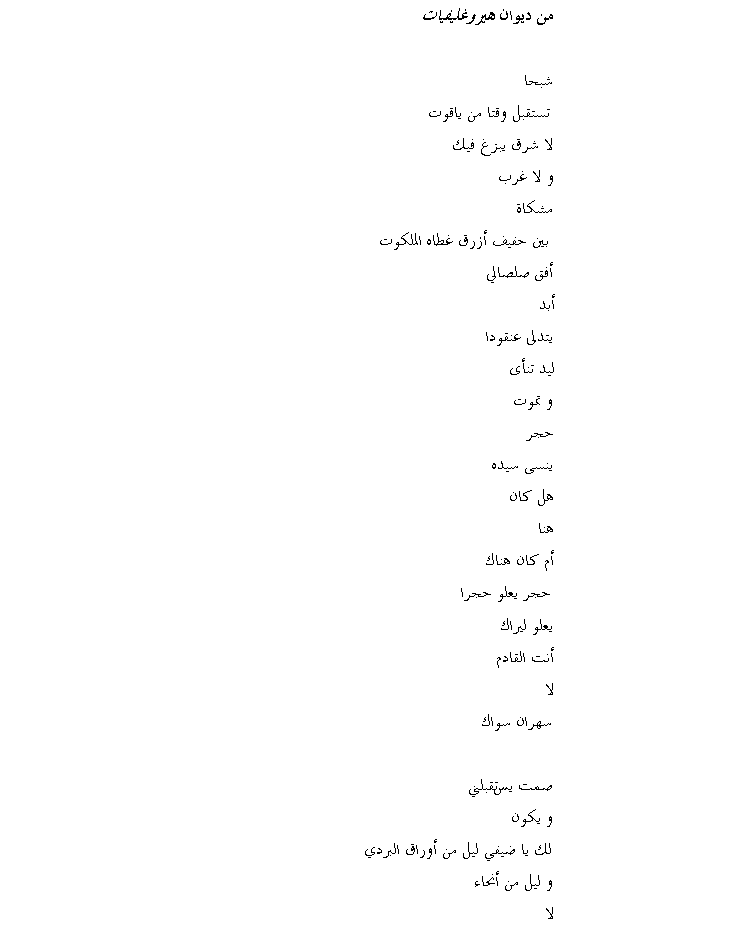
Mohammed Bennis (Moroccan Poets #2)


Born in Fès, Morocco in 1948. A major figure in Modern Moroccan poetry. Ph.D holder, and professor of Arab poetry at the faculty of letters, Rabat. In 1971 he founded the literary review Attakafa Aljadida which was decisive in the creation of a Modernist sensitivity in Morocco during the seventies. He is president of the House of Poetry in Morocco, and one of its founders.

His poetical works include: Before Speech, Towards Your Vertical Voice, Leaf of Splendor and The River between Two Funerals.

LINK:Moroccan Poets 1

Tags:

Tel Quel Campaign Gains Momentum


Tel Quel is one of Morocco's outstanding magazines. Published weekly, it regularly breaks taboos in its open coverage of all aspects of Moroccan society. The magazine made international headlines with a cover story on King Muhammad VI's salary, and has also published progressive stories on sexuality, religion, and the conflict with the Western Sahara. Tel Quel's editor Ahmed Benchemsi has been recognized with fellowships at the Los Angeles Times and Newsweek.

But while Benchemsi was in the US on a recent fellowship in August, the Moroccan authorities used a novel technique to shut down Tel Quel: a civil case of defamation where the presiding judge did not even allow Tel Quel's lawyer to speak before pronouncing a fine of 1,000,000 dirham ($112,000). The judge declared that Benchemsi would have to go to jail for two months if he fails to pay the fine. 10,000 people from around the world signed a petition supporting Tel Quel in response.

Bloggers around the world have taken up the case and you can find the online petition here: Tel Quel Petition


Tags:

Polisario torture decribed.


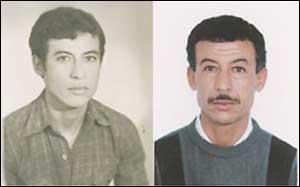
I have posted before about the Polisario and the way they have kept their own people as virtual hostages by demanding autonomy for a region that according to every credible expert has no future as an economic entity. Today the Morocco Times has a lengthy article about the fate of Lamani Abdellah a prisoner of the Polisario for twenty-three years.

Lamani Abdellah before he was kidnapped (1980) and after he was released (2003)

Lamani is one of the many prisoners who were either caught up or kidnapped during the Sahara war opposing Morocco to the Algeria-backed Polisario Front. He says in the Morocco Times interview that the Polisario has committed the most horrific kinds of violations of human rights against the Moroccan prisoners in the Tindouf camps, southern Algeria. This, of course is not new information as there have been frequent reports of Polisario attroicities - but it is worth reading.

You will find the full article here: Horrors of Tindouf camps

Tags:

Anger at Euromed failure.


Europe's mostly Muslim southern neighbours will be left angry and frustrated after a summit ended Monday with the EU hailing a pact to fight terror but failing to broach their basic concerns, analysts said.

The two-day Euromed summit in Barcelona was supposed to mark a revitalization of a 10-year-old partnership between the European Union and 10 Mediterranean-rim countries, stretching from Morocco to Israel.

But lingering tension was palpable after the gathering in the Spanish city, where the so-called Barcelona Process was launched in 1995 by the EU and its southern partners.

"It's a big disappointment for the Arabs," said Mohamed Sabreen, political analyst and columnist at the Cairo-based al-Ahram newspaper.

The Euromed partnership brings together the 25-nation EU with Algeria, Egypt, Israel, Jordan, Lebanon, Morocco, the Palestinian Authority, Syria, Tunisia and Turkey.

The Barcelona meeting, co-chaired by British Prime Minister Tony Blair and his Spanish counterpart Jose Luis Rodriguez Zapatero, notably agreed on a Code of Conduct on fighting terrorism.

It also reiterated plans to set up a Euro-Mediterranean free trade zone by the end of the decade, agreed initiatives to clamp down on immigration and launched a five-year work plan for bolstering ties between the two regions.

But even before the summit opened the Arab states' attitute towards it was clear: only two bothered to send their leaders to Barcelona, Palestinian chief Mahmud Abbas and Turkish Prime Minister Recep Tayyip Erdogan.

"It's a message of frustration," Sabreen said.

"The intentions were noble but the results are very modest," said Algerian Foreign Minister Abdelaziz Belkhadem, who on Sunday said it was "humiliating that the Europeans demand reforms from us in exchange for a few euros."

Europe, which Arab leaders have long counted on as a counter-weight to the United States' support for Israel in the Middle East, "didn't put enough pressure on Israel," the Algerian minister added.

The main sticking point at the talks was the Israel-Palestinian conflict: the anti-terror pact was agreed only after intense wrangling over Arab demands for recognition of the right of "resistance" against occupation.

"We shouldn't mix things up: resistance is a legitimate right recognized by the international community," said Egyptian Ahmed Abul Gheit.

"Wherever there is occupation there is resistance," added Arab League chief Amr Mussa.

Ahead of the Barcelona summit, European Commission head Jose Manuel Barroso had called on Muslim leaders to do more to distance themselves from Islamist terrorism.

Although they all signed up to the anti-terror pact, Algeria's Belkhadem voiced concern that anti-Muslim sentiment lingers in Europe due to the growing terrorist threat since the September 11, 2001, attacks in the United States.

"You have to make the distinction between terrorism and Islamophobia or Arabophobia," he said.

Tags:

Why restore a house in Fès?


O Fès! In you are gathered all the beauties of the world. How many are the blessings and riches that you bestow on your inhabitants. The challenge will tax man's capacities and imagination to the full. —Amadou-Mahtar M'Bow

Recently, Hujaina wrote: "What the west likes about the orient is not what the orient likes about the west. we like what is modern in your countries. You like the archive in our countries". And of course she is right. But it made me stop and think about why Westerners would bother to spend so much time and money restoring a dar or riad in the old medina.

Of course there is no single simple answer, but rather a range of answers. Let's start with the historical perspective:

As Geoff Porter once wrote:

Upon Independence from the French in 1956, Moroccans rejected imposed traditionalism. The 1960s saw the destruction of large swathes of the medinas, the installation of electric lines, the ripping up of paving stones in medina alleys for new sewers, and the demolition of centuries-old homes to make way for new roads wide enough for cars. The 1960s were a decade of frenetic catching-up. In the rush to put Morocco on par with the other industrial economies of the 20th century and in reaction to the paternalistic ghettoization that the medinas had undergone during the colonial period, Morocco's architectural heritage was relegated to a secondary status.

But by the late 1970s and then especially in the 1980s, upper-class Moroccans began to realize that this architectural legacy of monuments and cities had value. It had value as reminders of Morocco's illustrious past, as markers of what Morocco had achieved, and hopefully, what Morocco could achieve again. The buildings, the mosques, the homes, the palaces, the entire cities were hallmarks of a great civilization. They were evidence of this admirable past and they were indications that Morocco could again achieve cultural distinction on the global stage.

Porter is right, but he misses one critical point. Architectural legacy is also important for tourism and it is tourism that can be an ongoing force for increasing the wealth of the society.

The massive public projects are being run by
Abdellatif El Hajjami, director general of the restoration project, known officially as the Agence pour la Dédensification et la Réhabilitation de la Médina de Fès. As the New York journalist Josh White wrote back in 1993... An architect by profession and a native of Fès, El Hajjami has served in his post since it was created almost 10 years ago.

Using two main offices, one in a restored merchant's home near the Palais Jamaï in Fès El Bali - Old Fez - and the other in a discreet villa in the French-built Ville Nouvelle, El Hajjami frequently works 18-hour days. "To know something like this, you must live with it," he says. His duties go far beyond those of an architect: He directs a staff of 160 workers and artisans, including an engineer, three architects, an archeologist, a geologist, a lawyer and various computer and documentation specialists.

The restoration project has already identified 11 madrasahs, 320 mosques, 270 funduqs and over 200 hammams (public baths), houses or public ovens worthy of preservation. Some structures are famous: The Karaouine Mosque, the Bou Anania madrasah, the Horlogerie (a clepsydra, or water clock), the Nejjarine Fountain and the Funduq Nejjarine are but a few. Others are only known to locals, who feel they nonetheless represent key aspects of the city's cultural heritage.

The question arises as to how individuals restoring riads or dars assists this process. Simply put, apart from the money they contribute to the economy of the medina, they are also employing traditional artisans whose skills must be preserved in order that the grand buildings of public significance can also be restored in the correct way. However, money itself is not the answer, as we saw recently with the attempts to restore public fountains in Fès. Much of the work was second class, the zellij work was not up to an acceptable standard.


The individual Westerners have not only the money to restore buildings and employ craftsmen, but also the time to devote to research the best ways of restoring. The buzz words are "conservation restoration"... in otherwords, not simply pulling "old stuff' down and building new, but keep what is worthwhile and restore around it. A fine example of this was some work being done by David, a friend of mine who was working on restoring an old medersa and found he needed hand-made nails. It took him weeks to find a craftsman (in Meknes) who could produce the nails, but David's sense of "conservation restoration" was such that he insisted that the nails be made in a slightly different size from the originals so that an expert could tell what was genuinely old and what was restoration. Such is the task at hand for those wishing to restore the grand riads and exquisite dars of Fès.

Of course man of the local inhabitants want to get out into the "modern world" and even if the did not they could not afford the cost of restoration. The Westerners can and should. And, in my experience, the local people appreciate that someone cares enough to restore the old houses to their former glory.

Link: : Everything you need to know about Fès

Tags:

The Expanding Jihadi Nexus


The Jamestown Foundation often has very fine analysis and this piece by Stephen Ulf is no exception.

Arrests in Morocco Highlight the Expanding Jihadi Nexus -By Stephen Ulph

A wave of arrests that took place in early November in Morocco is illuminating for two reasons: the expansion of al-Zarqawi's influence outside Iraq, and the interconnection between jihadist activities on both shores of the Mediterranean. The series of arrests, beginning on November 11 in the cities of Rabat and Casablanca, has netted 17 Islamists suspected of links to al-Qaeda. Official sources claim that they have "dismantled a terrorist structure as it was being formed."

According to the Moroccan Arabic daily al-Alam, the terrorist network uncovered by the 17 arrests, Jama'at al-Tawhid wal-Jihad fil-Maghrib (‘the Monotheism and Jihad group in Morocco'), has connections with small groups operating near the Iraqi border that maintain close ties with senior members of the al-Qaeda. A security source quoted by the paper indicated the existence of a secret organization outside Morocco headed by an Iraqi and made up of 20 members, which entertained a plan to attack a Dutch intelligence HQ. Their plans were subsequently altered by the addition of a new Mor

occan member to the group who planned a larger operation in his home country: the targeting of a casino in Tangiers, the U.S. consulate in Casablanca and a number of Jewish synagogues. Others arrestees spoke of the production of poisons and explosives for subsequent use in Morocco. An interesting detail from the arrests was the indication of the al-Qaeda "radicalization course" undertaken by the new members, which included viewing jihadi films such as Jahim al-Rus, Badr al-Riyadh and Jahim al-Murtaddeen ("The Russian Inferno" the "Battle of Badr at Riyadh" and "the Apostates' Inferno"), as well as the productions of Iraqi networks on the Internet, such as Ansar al-Sunna, the Islamic Army and (al-Zarqawi's) al-Tawhid wal-Jihad (www.alalam.ma).

One of the fundamental activists behind the group's planned campaign in Morocco, according to al-Alam, is an Algerian national named Abu Baseer. He is considered to be an ‘emir' (commander) of al-Qaeda in Europe working under the authority of al-Zarqawi. One of the 17 arrestees is believed to have handed over letters addressed to Osama bin Laden "focusing on the mujahideen in Saudi Arabia and Algeria and on the creation of an al-Qaeda organization in the North African states." (www.alalam.ma).

In this sense, the pattern follows closely what is known from strategy documents concerning the next stages of the development of jihad: the preparation of support bases for al-Qaeda in Algeria and Morocco through the joining of forces of the mujahideen following their recruitment. Following this is their dispatch to military camps run by the Algerian Groupe Salafiste pour la Prédication et le Combat (GSPC), and then their training in the first phase for jihad in Iraq (or Syria in the event of American strikes). The second phase consists of their repatriation to Morocco in order to create sleeper cells, "to await the formation of a strong base from which to strike at economic and tourism targets, and Western institutions" (www.alalam.ma).

Funding and logistical support comes from Europe, as the Moroccan arrests demonstrated, mostly from channels in Spain and the United Kingdom, which funnel money acquired through voluntary contributions or petty crime. The current Moroccan investigations focused in particular on the role of Belgium. One of the leaders of the arrested group is considered to be Mohamed R'ha, a Belgian national of Moroccan ancestry, one of the operatives who had returned from ideological training in Syria to recruit members. On November 17 the trial in Brussels opened of Belgian and Moroccan nationals accused of belonging to a terrorist organization and providing logistical support to the Moroccan Islamic Combatant Group (Groupe islamique combattant marocain—GICM). This group was founded in 1997 by Moroccan veterans of the jihad training camps in Afghanistan and is held responsible for recruiting the dozen suicide bombers who carried out the multiple bombings at Casablanca in May 2003, which left 44 dead. The GICM is also suspected of carrying out the Madrid train explosions that killed 191 people in March 2004.

This second atrocity prompted Belgian police to close in on a GICM network based in the provincial town of Maaseik, which served as a logistics center and meeting place for the group's European leadership, where, according to the Flemish daily Het Nieuwsblad, discussions on the GICM organization took place on three occasions [www.nieuwsblad.be]. According to the prosecution case, as reported by De Standaard, one of the prominent members of this group, the Moroccan Abdelkader Hakimi, was designated by a fellow member imprisoned in France as the leader of the GICM. The 19-year old Hakimi is believed to have spent half his life on the run, spending ten years in Algeria, journeying with false papers to Libya, Turkey, Saudi Arabia and Malaysia, producing false identity papers for himself and for Afghan militant veterans and to have fought in Bosnia during the civil war [www.standaard.be].

The activities of Hakimi illustrate the skills and strengths of North African militant groups in Europe. The GICM is believed to number some few hundred committed radicals, supported by 1,000 to 2,000 sympathizers operating on both shores of the Mediterranean. Cells have operated in Italy, the United Kingdom, the Netherlands and Spain, the last of which announced on November 23 the arrest of 10 Moroccans and Algerians suspected of financing and giving logistical support to counterparts from the Algerian GSPC resident in Germany, the Netherlands, Britain, Belgium and Denmark.

The revelation of the ideological training of Moroccans taking place on the borders with Iraq has added urgency to Moroccan security concerns since the November 9 bombings in the Jordanian capital Amman. Following the arrests of the 17 Moroccans, one Abu Mus'ab al-Iraqi (styling himself as the "al-Qaeda correspondent") denounced on November 23 the events on the al-Firdaws jihadi forum and at the same time deplored the activities of Morocco's "secular" Channel Two TV broadcaster. His objection was to the vox pop interviews in the wake of the Amman bombings, addressed to "the ignorant, weak and base people … who spoke of Zarqawi inventing a new religion, and referred to his ‘bankrupt mind' " [http://alfirdaws.org/forums]. According to al-Alam, Moroccan intelligence is convinced that their country lies third on al-Qaeda's list of targets, after Saudi Arabia and Jordan, and remain on the lookout for al-Qaeda operatives crossing over from Algeria, and for senior members entering the country from Belgium [www.alalam.ma].

The Jamestown Foundation

Tags:

Call for Dialogue with Political Islam


"Terrorism must end for peace to reign worlwide" - Director of Al-Andalus Studies Center

According to Abdeluajed Akmir after the attacks happened in Casablanca in May 16th 2003 Moroccans realized that the only way to finish with religious fanaticism is through a responsible dialogue among all those engaged in political Islam.

Abdeluajed Akmir, History professor at Mohammed V University in Rabat, who will be one of the participants at the forthcoming International Congress on Intercultural and Interreligious Dialogue in Bilbao, affirms that government, civil society and intellectual reformers in Morocco are aware that peace cannot reign worldwide unless terrorism is finished as well as without assuring a good communication with the West.

In related news: Euromed: Agreement in Barcelona on an Anti-Terrorist Code of Conduct

"Inequality is greater between the two shores of the Mediterranean than anywhere else in the world,” so said Josep Borrell, President of the European Parliament, who did not hide his disappointment when making a critical assessment of 10 years of the Barcelona Process. Monday’s mixed outcome of the Euro-Mediterranean Summit, held in the Catalan capital, means that there is still some limited hope for closing the economic and social divide between both sides.

Ten years after its launch as the Barcelona Process, co-operation between the EU and its Mediterranean partners needed a new impetus. The Euromed discussions, held between the 24 and 28 November, should have marked the relaunch of the partnership which brings together EU member states and 10 Mediterranean countries (Algeria, the Palestinian Authority, Egypt, Israel, Jordan, Lebanon, Morocco, Syria, Tunisia and Turkey).

Josep Borrell, who took part in the Summit of Heads of State and Government in his role as both President of the European Parliament and of the Euro-Mediterranean Parliamentary Assembly (EMPA), acknowledged the lack of “any significant progress on the road to shared peace and prosperity.” The priority of the co-operation process remains the strengthening of trade relations and the gradual levelling of social inequalities between partners. However, if it is to succeed, both parties need to show real commitment. Political conditions, in the form of stability and democracy, also have to be present so that economic co-operation can bear fruit. The President of the Parliament emphasised that “economic and political objectives are indivisible.”

Euromed is one of the few forums for potential dialogue for some of the Middle Eastern countries involved in Euro-Mediterranean co-operation. However, several Mediterranean countries attending the Barcelona Summit were not represented at the highest level (namely Head of State or Head of Government). Nevertheless, the two meetings of the Euro-Mediterranean partnership in Rabat and Barcelona enabled bilateral talks and exchanges of views on partnership relations to take place. The issue of immigration was also an important part of the discussions.

But it was concerted action against terrorism which occupied participants during Sunday and Monday. It was particularly difficult to reach agreement on the anti-terrorist “code of conduct” which formed an important part of the final agreement. In the end, a solution was found that was acceptable to all parties. It can only be hoped that this conclusion to the Summit augurs well for continued Euro-Mediterranean co-operation.


Tags:

Tuesday, November 29, 2005

The Maghreb Union - dream or reality?


Unions are very fashionable these days... Just ask Venezuelan President Hugo Chavez he's keen on a South American Union. Asia is organising itself and of course every country in Europe wants to be part of the European Union. So, what about the Maghreb Union? - Despite ringing appeals for unity, the North African nations known as the Maghreb - "the place where the sun seats" - seem to be drifting apart. Others have described it as "a paper camel".

Ethnic and religious bonds notwithstanding, their planned union is plagued by such strong divisive factors as different ideologies, political cultures and attitudes toward Islamic fundamentalism, as well as frontier disputes.

Initially, Maghreb was a term used to describe the former French protectorates of Tunisia, Morocco and Algeria - the latter was considered to be part of France until its 1962 independence. Now, the organisation, which was stablished in 1989, the Arab Maghreb Union (AMU), includes Mauritania, Morocco, Tunisia, Algeria and Libya

Building the Maghreb Union is not only a choice but also a strategic necessity for the development of our countries, according to the Chair of the Economic and Finance Committee of the Moroccan parliament, Mustapha Hanine, at the opening session of the IMF Microeconomic Policy Seminar for Parliamentarians from the Maghreb Region.


Chair of the Economic and Finance Committee of the Moroccan parliament, Mustapha Hanine.

Organised by the International monetary fund (IMF) in the Moroccan House of Representatives, the seminar gathered parliamentarians from Morocco, Algeria, Tunisia and Libya, along with IMF officials.

This seminar is “an important opportunity for exchanging views and expertise of the macroeconomic policies, economic development and the current reform programmes in the Maghreb countries,” said Hanine.

Tags:

Poverty and Terrorism.


British-based North Africa analyst George Joffe has his say about the links between fundamentalism and poverty:

Aware of the risk of a violent backlash to tough security measures, Moroccan authorities have tried to improve conditions in the state of 30 million people where nearly 14 percent live below the poverty line and over 40 percent are illiterate.

In May, around the second anniversary of the Casablanca bombings, King Mohammed unveiled a national development plan expected to cost 1.0 billion dirhams ($114.3 million) a year, which initially targets the worst slums and is to extend to hundreds of rural councils and dilapidated urban areas.

"Morocco's problems relate to global poverty, not to global terrorism," said Joffe.

The main source of popular opposition in the kingdom, the Islamist group al-Adl wal-Ihsane (Justice and Charity), which shuns violence and has a strong following in universities and poor districts, is banned from politics but allowed to carry out charity and other work linked mainly to education.

Morocco's moderate Justice and Development Party, the only Islamist political grouping allowed to operate legally, surged in 2002 parliamentary polls to become the biggest opposition group in the assembly, trebling its seats.

Attending a European-Mediterranean summit in Barcelona this week on countering terrorism, Rabat's Minister-delegate for Foreign Affairs Taieb Fassi Fihri insisted each country should go at its own pace on democratic reforms.

"We are doing it for ourselves, by ourselves and because it matches a uniquely Moroccan vision," he told France's Liberation newspaper on Monday. "But in this area, just as with terrorism, we have a dialogue (with Europe). And it stops there."

The full article can be found here: Morocco sees poverty at root of Islamist militancy

Tags:

Morocco's King Mohammed VI meets Koizumi


Morocco's King Mohammed VI meets Koizumi and wins Japanese development aid!

Morocco's King Mohammed VI met Prime Minister Junichiro Koizumi on Tuesday and won pledges from the Japanese government for 10 billion yen in development loans and grants.

The aid includes 9.46 billion in loans for sewage and rural power projects as well as a 500 million yen grant not tied to any project, Japan's Foreign Ministry said in a statement.

Japan is also committing up to 46.1 million yen for sound, lighting and audiovisual equipment for Morocco's National Library, the ministry said.

King Mohammed VI arrived in Japan on Saturday and met Emperor Akihito on Monday. He leaves Japan on Wednesday.

Tags:

Monday, November 28, 2005

Positive moves on human rights in Morocco


While much of the media attention paid to the Human Rights Watch report Morocco's Truth Commission Honoring Past Victims during an Uncertain Present has concentrated on negative aspects, it is important to record that the report also has some positive things to say. While not disregarding the important findings of the report, which will be handed to the King, the following section has received little coverage. At the International Union of Lawyers 49th Congress on August 31 2005, King Mohamed VI pointed to the Commission as "a major achievement for the consolidation of the democratic transition".

Positive steps

Authorities have taken some steps in response to criticism of its recent human rights record. On December 28, 2004, the government council, headed by the prime minister, approved a law defining torture as a criminal offense. Parliament approved the measure on October 21, 2005. This law, which is pending publication in the official bulletin, makes it easier to prosecute acts of torture. It also subjects torturers to long prison terms and stiff fines.

In a related step, Prime Minister Driss Jettou indicated on February 22, 2005, that Morocco would withdraw its declaration relating to the U.N. Convention against Torture, where it stated that it does not recognize the competence of the Committee against Torture. He also said that Morocco would become a party to the optional protocol to the International Covenant on Civil and Political Rights (ICCPR), and withdraw its declaration on Article 14 of the International Convention for the Elimination of All Forms of Racial Discrimination (CERD). Jettou also announced plans to lift Morocco’s reservation to Article 14 of the CRC, and its replacement by a declarative explanation, to be followed by an inquiry into the possible lifting of Morocco’s substantial reservations to the CEDAW.18

Some of these pledges had been filled by the time this report went to press. Morocco has recognized the competence of the U.N. Committee against Torture under Article 22 of the CAT but not under Article 20. The former allows the committee to investigate complaints of torture that are submitted by individuals; the latter allows the committee to launch an inquiry upon receiving information that torture is being practiced systematically. Morocco lifted its reservation to Article 14 of the CERD, but not yet its reservations to the CRC or the CEDAW. Nor has it yet joined the optional protocol of the ICCPR.

In contrast to some countries where state agents have carried out “disappearances,” Morocco played a constructive role in the U.N.-sponsored committee that drafted the International Convention on the Protection of all Persons from Enforced Disappearance, approved by the United Nations (U.N.) on September 23, 2005.19 The draft convention, which applies to future cases of disappearance but not past ones, will be opened for ratification by countries once it is approved by the U.N. General Assembly. It requires states to make forced disappearances a crime in their legislation (Article 7) and to pursue the suspected perpetrators, as well as any superiors who ordered or knew about the commission of “disappearances” (Article 6). It enumerates safeguards for those being held in detention (Article 17) and establishes a “right to know” for relatives of persons in detention (Article 24.2).

LINKS:
  • See related story: A mass grave in Fès?

  • HRW Report in Arabic

  • HRW Rapport en Francais (PDF)

  • HRW Report in English (PDF)


  • Tags:

    Abdel-ilah Salhi. (Moroccan poets #1)


    LOVE FRONT


    What we learnt of love was from novels, stories, and poems.With poverty, frustration, and narrow horizons we began to fall in love at dreadful ease, and suffer much more easily. Despite that we clung to that love which has no life and existence outside books.

    Defeats in love destroyed many of us, dispersed a lot into vagabondage, and caused many others to disappear. Despite that, from time to time some warrior appears; a young man in most cases, waving a tattered flag, mocking the crushing weight of reality, and its bloody grinding mill. He seems sure that his anguish is more valuable than the Mercedes cars which besiege his poor girlfriend, and that true feelings are a mortal weapon which it suffices to draw for the battle to be settled.

    We are the disabled victims of this war, feeling for our scars, meanwhile drinking cheap wine with anonymous prostitutes in dark pubs, and pitying every young man who surges from the suburbs of towns riding a gifted poem, and entering the front defenceless.

    Abdel-ilah Salhi was born in 1968 in Beni Mellal, Morocco, but spent most of his childhood and adolescence in El Jadida where he completed his education in 1990. He began writing and publishing poetry when he was still a university student, and managed at that early age to tie strong relations with most of the representatives of the “new poetry” generation in Morocco.

    Tags:


    A mass grave in Fès? Updated


    FRENCH INVESTIGATOR IN MOROCCO OVER BEN BARKA

    At the same time as the French judge Patrick Ramael met his Moroccan judicial counterpart in Casablanca on Monday probing the 1965 disappearance and suspected murder of opposition leader Mehdi Ben Barka, a Moroccan panel, which is due this week to publish the findings of an enquiry into rights violations in the north African kingdom before 1999, announced it had found the bodies of 106 more victims of repression.


    Ben Barka, a charismatic foe of Morocco's late king Hassan II, vanished after being kidnapped outside a Paris restaurant in 1965. The affair remained shrouded in secrecy for 40 years despite appeals launched in both countries.

    Under the current monarch Mohammed VI, Hassan's son, the Moroccan and French justice ministries reopened the case, while an Equity and Reconciliation Panel (IER) has been amassing details of other disappearances, killings and torture during the so-called "leaden years", 1956-99.

    Ramael declined to make any comment upon his arrival earlier Monday, but sources close to the case in France said he plans to question several people whom his predecessors were unable to interrogate before Mohammed VI began political reforms.

    The Equity and Reconciliation Panel said that it had found 99 people buried in a cemetery in the the southern town of Fès and seven others in a different graveyard, known to have been victims of a 1990 crackdown after labour activists called a strike. The 99 of were found in Bab el Guissa cemetery and 7 others in the Abi Bakr cemetery, but the victims' identities were not revealed.

    "We can't, however, identify the bodies," said an Equity and Reconciliation Panel statement, adding they had been buried in secret in isolated parts of the cemeteries.

    During the unrest in December 1990, officials said five people were killed, though press reports put the toll at 49. A total of 150 people were charged and many were convicted of criminal offences.

    Hassan II then spoke of trouble caused by "criminal bands and thieves, drug traffickers and deliquents who took advantage of the strike."

    The Ben Barka affair has been raised many times as one of the most prominent of the "leaden years". Ramael's probes have allegedly implicated key former government members and top security officials amid claims of a joint cover-up by Rabat and Paris. The Moroccan monarch was an ally not only of France but of the United States during the Cold War and its aftermath, and though Morocco is not among the oil-rich nations of north Africa, its regime was considered staunch, stable and important to Western interests in the Arab world and Africa.

    In 2003, the Socialist Union of Popular Forces (USFP) party founded by Ben Barka filed a civil suit for justice. Then in October 2004, French's national defence authorities declassified secret files the French judiciary had been seeking in the case.

    The Equity and Reconciliation Panel is expected to release its findings on Wednesday in the capital Rabat after 18 months of hearings and collecting evidence from the "leaden years" from plaintiffs, victims of torture and the families of political activists.

    A Moroccan legal source said Ramael had arrived for "a first contact to get the process going in cooperation with the Moroccan judiciary". A French lawyer for Ben Barka's family, Maurice Buttin, is due in Rabat on Tuesday.

    The New York-based Human Rights Watch has issued a statement urging Moroccan authorities "to bring to justice the people (the Equity and Reconciliation Panel ) has identified as having committed serious human rights violations when there is enough proof".

    The international watchdog appealed to Morocco's rulers "to asbtain from decreeing any amnesty ... that would exempt from legal proceedings people implicated in 'disappearances' or other serious rights violations. Any measure of clemency should be made once individual responsibilities are clear."

    HRW called for the punishment or sacking of anyone implicated by the IER who is still in a position to violate human rights.

    LINKS: See related story: Positive moves on human rights in Morocco

    Tags:

    Rami Ayash to tour Morocco


    Lebanese singer Rami Ayash will begin a Moroccan concert tour in December. The singer will hold performances in Marrakech, Casablanca and Fes with possibly some other cities.

    The only album I have heard is DIWAN AL HOB which isn't too bad. The singer is tremendously popular among his Moroccan fans.

    In the meantime, Rami is preparing for his upcoming album produced by ‘Rotana.’ The album will feature a variety of songs composed by Rami, and he is scheduled to film a music video for the song “Mabrook” (Congratulation) under the direction of Saeed Al Marouq.

    Rami has released his latest music video "Khalini Ma’ak" (Keep me with you), directed by Saeed Al Marouq. The video includes graphic scenes, such as Rami being executed in an electric chair that have given rise to much criticism.

    Director Saeed explained that images of death and torture were used in the clip to reflect a person’s inner pain, and to reflect the chaos that the singer is experiencing from the desertion of his love. Portraying Rami in a destroyed home, seated on an electric chair, and running as if someone is following him, are images created to translate the words and emotions of the song into actual events.

    At the end of the clip Rami returns to his home, but this time it is not destroyed, to show that despite all of his pain, he can still find comfort in life and time will make him forget his heartache.

    In no way did Saeed intend on portraying Rami as a criminal running from the law and hence being punished in an electric chair, as many critics wrongly concluded.

    Tags:

    Fulla the Barbie!


    In her 45 years, Barbie has been a doctor, pilot and figure skater, to name just a few accomplishments of this busty vinyl overachiever. But some in the Muslim world also consider her a decadent symbol of the West - hence Saudi Arabia's recent decision to ban Barbie along with her "revealing clothes and shameful postures."

    Like Barbie, she is about 11½ inches tall, but unlike Mattel's product, she is noticeably less bosomy. Fulla's creators have gone to great lengths to make her modest and conservative.

    "Arab" is the key – if not always specifically defined – sales point.

    Fulla's face has a "kind look, the Arab look," said Fawaz Abidin, head of marketing for Fulla at Damascus-based NewBoy, the doll's maker. She has Arab values, not those of Barbie the American, he added.

    NewBoy Design Studio, based in Syria, introduced her in November 2003 and now in 2005 she has taken off and become a best seller all over the region. It is nearly impossible to walk into a corner shop in Morocco, Syria or Egypt or Jordan or Qatar without encountering Fulla breakfast cereal or Fulla chewing gum or not to see little girls pedaling down the street on their Fulla bicycles, all in trademark "Fulla pink."

    Young girls here are obsessed with Fulla, and conservative parents who would not dream of buying Barbies for their daughters seem happy to pay for a modest doll who has her own tiny prayer rug, in pink felt. Children who want to dress like their dolls can buy a matching, girl-size prayer rug and cotton scarf set, all in pink.
    Fulla is not the first doll to wear the hijab. Mattel markets a group of collectors' dolls that include a Moroccan Barbie and a doll called Leila, intended to represent a Muslim slave girl in an Ottoman court.

    In Iran, toy shops sell a veiled doll called Sara. A Michigan-based company markets a veiled doll called Razanne, selling primarily to Muslims in the United States and Britain. But none of those dolls have enjoyed anything approaching Fulla's wide popularity. Fawaz Abidin says that is because NewBoy understood the Arab market in a way that its competitors had not.

    "This isn't just about putting the hijab on a Barbie doll," Mr. Abidin said. "You have to create a character that parents and children will want to relate to. Our advertising is full of positive messages about Fulla's character. She's honest, loving, and caring, and she respects her father and mother."

    Fans of Barbie, though, would probably take issue with his characterization of what separates Fulla from the American doll: "She's loving. She respects her mother and father. She's good to her friends. She's honest and doesn't lie. She likes reading. She likes, rather, she loves fashion."

    Despite the effort to create an Islamic fashion doll, Fulla and Barbie are more closely related than the Saudis and others might like to admit. Fulla may frequent the souks of the Mideast and Barbie may hang out in the malls of America, but they were "born" in the same place - China.

    Tags:

    Human rights defenders on trial


    Morocco/Western Sahara: Human rights defenders on trial

    Amnesty International announced today that it is sending a delegate to observe the trial this week of seven human rights defenders from Western Sahara who the organization believes may be prisoners of conscience. They are standing trial together with seven other accused who are being prosecuted for participating in demonstrations against Moroccan rule.

    Tunisian lawyer Samir Ben Amor will be representing Amnesty International at the trial proceedings, which are due to begin at the Court of Appeal in Laayoune on 30 November 2005. He is an experienced human rights advocate who previously was Amnesty International’s observer at the October 2003 trial of Algerian human rights activist Salaheddine Sidhoum in Algiers.

    Currently detained in Laayoune Civil Prison, the seven human rights defenders – Aminatou Haidar, Ali-Salem Tamek, Mohamed El-Moutaouakil, Houssein Lidri, Brahim Noumria, Larbi Messaoud and H’mad Hammad – were arrested between June and August 2005. They face charges of participating in and inciting violent protest activities and belonging to an unauthorized association, charges which they deny. Two of them allege that they were tortured during questioning.

    Amnesty International is concerned that the seven and an eighth activist, Brahim Dahane, appear to have been targeted because of their leading roles as human rights defenders, as well as their public advocacy of self-determination for the people of Western Sahara. Most recently, all eight have been instrumental in collecting and disseminating information about human rights violations committed by Moroccan forces against Sahrawi protesters in the context of demonstrations in Laayoune and other towns and cities in Morocco and Western Sahara since May 2005.

    Brahim Dahane, who was arrested on 30 October 2005, is also facing charges related to his human rights activities but his case remains under judicial investigation and he is expected to be brought to trial separately. Amnesty International believes he too may be a prisoner of conscience.

    Amnesty International’s concerns and recommendations regarding these cases are the focus of a newly released report Morocco/Western Sahara: Sahrawi human rights defenders under attack (AI Index: MDE 29/008/2005), which can be consulted on Amnesty International’s website at the following address: http://web.amnesty.org/library/Index/ENGMDE290082005

    The report also details cases of other Sahrawi human rights defenders who have been subject to harassment and intimidation by Moroccan security forces in recent months and allegations of human rights violations against demonstrators, including the death in suspicious circumstances of a protester in October 2005.

    Background
    Human rights activists in Western Sahara have repeatedly been targeted for their human rights work in recent years. Some have been prevented from travelling abroad to report on human rights violations, while others have been arbitrarily imprisoned.

    Since May 2005, the territory of Western Sahara, particularly the town of Laayoune, has been rocked by a series of demonstrations. In many of them, demonstrators have expressed their support for the Polisario Front, which calls for an independent state in the territory and has set up a self-proclaimed government-in-exile in refugee camps in south-western Algeria, or called for independence from Morocco. These views are anathema to the Moroccan authorities, who have responded in a heavy-handed manner to the protests, exacerbating tensions.

    Western Sahara is the subject of a territorial dispute between Morocco, which controversially annexed the territory in 1975 and claims sovereignty there, and the Polisario Front. Both parties have agreed that a referendum on the future status of Western Sahara should be organized under UN auspices, but this has been repeatedly postponed and is yet to be held.

    Tags:

    Sunday, November 27, 2005

    Study Arabic in Morocco!


    The Arabic Language Institute in Fès (ALIF) offers three and six-week courses in all levels of Modern Standard Arabic and Colloquial Moroccan Arabic throughout the year.

    ALIF also has an excellent reputation as the preeminent institution in the Maghreb for the teaching of Arabic as a foreign language. Housed in a large, shady villa, ALIF provides an ideal setting for studying in Morocco's "intellectual capital", and for exploring the historic medina of Fès, one of the world's few remaining medieval cities.

    The Institute's teachers are highly qualified native speakers with years of experience instructing both independent students and study abroad groups from major universities. Former students include translators, Fulbright, FLAS, NSEP, and SSRC grantees, company representatives, and graduate students from major universities in the US and Europe.

    ALIF resources include an extensive library collection focusing on Arabic linguistics, the Maghreb, Islamic Art and Architecture, and Islam. In addition to language courses, ALIF offers cultural tours, lectures, and classes on Maghrebi literature, media and Islam. Private courses in any number of subject areas can be arranged. The modest ALIF tuition, low cost of living in Morocco, and widely available discount air fares, also render ALIF a cost-effective alternative for the study of Arabic abroad or domestically.

    If you would like to contact them for more information you will find them extremely helpful and (as I found out) very friendly! The View From Fès weblog highly recomends ALIF!

    The Arabic Language Institute in Fez, B.P. 2136, Fez 30000, Morocco
    Tel: (212/55) 62 48 50 Fax: (212/55) 93 16 08
    email: alifez@menara.ma


    Tags:

    22 refugees feared dead in Spanish tragedy


    As many as 22 Africans are feared dead off Spain's southern coast in the latest tragedy involving refugees trying to reach Spain by boat.

    The victims were tossed into rough seas during a storm, according to coast guards who found the boat off the coast of Almeria province, Spanish radio reported.

    Two maritime rescue ships were searching for missing passengers today, although the chances of survival in the icy waters were said to be slim.

    The wooden boat, which set out from Morocco with about 44 African nationals, 36 men and eight women, was sighted by a freighter yesterday after the passengers used a mobile phone to call for help.

    Survivors said the boat was hit by a giant wave which washed 22 people overboard. The body of one man has been found.

    About 19 African would-be migrants drowned in a similar incident off the Canary island of Fuertevenura in October.

    Tags:

    Terror cell was to target American, Jewish interests in Morocco


    The seventeen islamists that were arrested mid-November were planning to bomb American and Jewish interests in Morocco, according to police sources.


    Mohamed Mazouz and Brahim Benchekroun while leaving the prison of Salé in March.


    One of the main suspects, Moroccan-born Belgian national, Mohamed Reha, 18, told the police that some Moroccans and Algerians, linked to al Qaeda, were planning to "bomb American and Jewish interests especially in Tangier (northern Morocco) and south-west city of Essaouira," as well as "representatives of the impious and infidel Moroccan authorities," said the same source.

    He revealed that the group had intentions to "lead the jihad war against the regime in order to establish the Islamic Caliphate" in Morocco.

    Police said the group, “shouldered by Algerian nationals who sneaked into Morocco,” was planning to perpetrate bombings “against hotels especially in Essaouira, where there is a big flow of Jewish tourists, and in Agadir (south-west), as well as against the casino in Tangier and the parliament in Rabat.”

    Ships that transport Americans were also listed as targets, said the same source.

    The police said Reha also revealed during the interrogation that some young people were being recruited to be sent to Algeria to be trained on “handling weapons and manufacturing explosives,” as a “first step” in the “Jihad project in Morocco and in the region.”

    The suspect has also confessed he had come to Morocco “to conduct the terror operations” and admitted having “recruited some young people, who were arrested at the same time as himself, in Tangier, Agadir and Casablanca.”

    Mohamed Reha, considered as one of the “masterminds of the terrorist cell,” told authorities he had discussed with his uncle, Ahmed Zemmouri, also a Moroccan-born Belgian islamist who was arrested, the need to “create a secret organisation.”

    According to him, Algerian Khalid Abou Bassir, one of al Qaeda leaders in Europe, was to “contact our brothers of the Salafist Group for Preaching and Combat (SGPC) to take charge of the training the Moroccan recruits.”

    According to the police, Abou Bassir would have revealed to Reha his intention to create a “jihadist movement in the Arab Maghreb under the management of al Qaeda with a joint organization for Morocco and Algeria.” The group was to be named “al Qaeda Organisation in Arab Maghreb Countries.”

    Tags:

    Moroccan intellectuals to strengthen their presence in society


    As a novelist I was interested to read the views of Abdelhamid Akkar. The president of the Union of Moroccan writers (UEM), Abdelhamid Akkar, considered that Moroccan intellectuals are called to strengthen their presence in society and express their opinions about the social changes that are taking place.

    In an interview published on Sunday by the Moroccan daily Al Ahdath Al Maghribia, Akkar indicated that Moroccan intellectuals have to “search for an added value in the field of their speciality and be interested in analysing and treating the diverse social issues”.

    The president of the UEM emphasised the importance of respecting the freedom of expression within the limits of the acceptance of the other, adding that the intellectual cannot develop this added value in the absence of creation and innovation.

    In this context, he stressed that the UEM, as space of dialogue, will pursue its mission which consists in setting up a cultural approach aiming to contribute to solving the social conflicts, defending the plurality and the presence of social issues in the cultural programme of the UEM in this season.

    Abdelhamid Akkar became president of the Union of Moroccan Writers at the 16th congress when the replaced the poet Hassan Nejmi who had run the Union for six years. Akkar is a little known 59-year old literature critic who spent thirteen years within the union's central bureau, from 1983 to 1996.

    Born in the 1940s, Akkar wrote mainly in the 70s and the 80s, and published several articles in magazines such as “Tarbaouia” or “Anfi.” From 1981 to 1984, Akkar directed the Arabic language magazine “Jossour.” He also used to publish articles in dailies such as “Anoual”, “Al Bayane”, “Al Quds Al Arabi” and “Asharq Al Awssat.” A literature critic and a researcher, Akkar is now a university professor in Rabat.

    Tags:

    Luxury Golfing Community for Morocco.


    In my last post I mentioned that the Brits were expected to flood into Morocco along with the Russians who can now enjoy visa-free travel to Morocco. Now I am not too certain about the Russians, but I expect a few very wealthy Brits will be pleased to know their golfing game will be able to be honed in luxury surrounds.

    While the poor and homeless may find some employment as groundsmen, green-keepers and cleaning staff, they certainly won't have a chance to improve their golf handicap. Trickle-down economics may create a lot of benefits however and any investment in Morocco should be seen as a good thing.

    The unveiling today of Emaar Properties Bahia Bay development is the second in Morocco by the largest real estate developer in the world in terms of market capitalization. The partners in the venture will be the ONA Group, the leading Moroccan industrial and financial group. The US$1.2 billion project will see the joint venture develop a large scale residential golfing community along the picturesque Moroccan coast.

    In close proximity to Casablanca, the 530 hectare development will combine all the benefits of an Emaar golfing community along with the advantages of a coastal location. This announcement closely follows the ventures first project launch last month in Morocco - Amelkis II, the luxury residential golfing complex in Marrakech which allows individual buyers to purchase plots of land and design and build their ideal home.

    Mr Mohamed Ali Alabbar, Chairman Emaar Properties said: "Situated along the breathtaking Moroccan coast, Bahia Bay is a unique development in an idyllic setting. Following the success of our existing golfing communities in Dubai - Arabian Ranches and Emirates Hills - the Bahia Bay community will become a flagship development for Emaar's expansion in the North Africa region."

    Residential units in the Bahia Bay project will range from luxury villas and spacious semi-detached houses to townhouses and apartments with views overlooking the golf course and spectacular views of the Atlantic Ocean.

    The development will also feature a beach hotel, golf hotel, beach clubs, equestrian facilities, retail and entertainment and a community and recreation centre making Bahia Bay an ideal location for residents and visitors alike. The development is expected to be completed in five years.

    This latest announcement sees the continuation of Emaar's roll out strategy of undertaking prestigious master-planned residential developments in strategic locations - whether in the heart of the city or coastal picturesque locations. As it bids to consolidate its position as the world's premier property developer, Emaar continues to provide buyers with quality lifestyle projects and shareholders with value.

    Added Alabbar: "Morocco is a significant part of Emaar's international expansion plans. Already we have seen the great potential in the Moroccan market with our Amelkis II development. Not only will this project benefit the people of Morocco, but it will also boost tourism within the area. Our mission is to offer our customers world class communities - constantly integrating parks, landscaped areas and retail centres into master-planned themed lifestyles."

    With rock pools and breakwaters to help create sandy white beaches and an array of water sports and leisure options provided by the beach clubs, the latest Emaar offering in Morocco makes the most of the beautiful coastal views and surrounding natural beauty. Golfing facilities provide residents with the perfect opportunity to improve their golf as well as making the most of the relaxed and friendly clubhouse.

    Located in close proximity to the Casablanca/Rabat coastal freeway, Bahia Bay is within easy reach of both major cities and is the ideal getaway for those in search of a premier luxurious lifestyle. Extensively landscaped with an array of indigenous plants and featuring picturesque water features, expansive open parks and a world-class golf course, the lifestyle offering is beyond compare.

    Tags:

    Saturday, November 26, 2005

    The Brits are coming...


    The other day wrote posted about the new visa-free status for Russians that is expected to raise the number of Russians coming to Morocco for holidays.... well, news from the Association of British Travel Agents (ABTA) says Britons also think Morocco a great destination and the numbers are up.

    Around two million UK travellers are set to holiday abroad this festive season, with Turkey and Middle East destinations among the most popular.

    So far this year there has been a 54% increase in UK visitors to Egypt, a 27% increase to Turkey, around a 25% increase to Morocco and a 15% increase to Jordan, according to latest figures from travel agents.

    While the backbone of winter holiday destinations remains the Canary Islands and the USA, but medium and long-haul trips had become much more popular.
    Other hot destinations this year include Dubai and Oman, with the top winter locations for 2005/06 being Spain, France, Cyprus, Turkey, the USA and the Caribbean.

    Morocco, currently hosting around 1,600 delegates at the ABTA annual convention, is set to welcome around 215,000 Britons this year as more tour operators begin programmes to the country.

    ABTA's Martin Wellings said: "Everyone knows that tourism is a great way to broaden horizons, break down barriers and is the enemy of narrow-mindedness and bigotry.

    "It's fantastic that the travel industry is bucking the political trend and that the Middle East is the new hot destination to be seen in.''

    Tags:

    Friday, November 25, 2005

    Everything you need to know about Fès


    If you are keen to find out more about Fès, here is a list of great links that will allow you an insight into everything from conservation issues to history and beyond.

    Geoffrey Porter has a great article on the Historic Preservation of Fès,

    Josh Martin on Preserving the city of Fès

    Stefano Bianca's has three worthwhile articles:

  • Fès: Toward the Rehabilitation of a Great City

  • Conservation and Rehabilitation Projects for the Old City of Fès

  • Fès:The Ideal and the Reality of the Islamic City


  • Bonnie Kaplan takes a little inspiration from Paul Bowles...Sweeping Out the Spiders: Restoring Morocco’s Medersas

    Alessandra Grillo on Traditional building Techniques in Fès

    Catherine Cambazard-Amaham is a prolific writer on things Moroccan and here is a selection of her work:
  • Woodworking in Fès
  • Moroccan Bronzework in Fès
  • Moroccan Rugs
  • Craft Heritage of the Atlas Mountains
  • Historical essay on Fès

  • And last but not least! Where to stay in Fès? A beautiful house in the historic Old Medina. A million times better than a hotel! Dar Bennis is a small 18th century traditional Moroccan house in the heart of the Fès Medina, on a small street just off Talaa Sghira, the main business street of the medieval quarter of Fès. The house has been carefully restored over the past four years, using only traditional craftsmanship and materials. TO FIND OUT MORE CLICK HERE!

    Tags:

    Plan for "Bloody December" Terror Attacks.


    In a follow up to the arrests we commented on in an earlier post, seventeen suspected members of an Islamic terrorist group appeared before an examining magistrate court in Sale, across the river from Rabat and were charged with "criminal conspiracy for terrorist attacks and breach of the peace".

    The court was told that the men allegedly planned a "bloody December" that would have attacked tourist sites and public institutions in the kingdom.

    They are also being accused of belonging to a "terrorist organisation linked to small groups operating on the Iraqi border, and having close connections with some leaders of the Al-Qaeda network".

    Moroccan security forces have recently broken up what was described as a "terrorist cell on the make," consisting of elements affiliated to an extremist Islamic movement connected to small groups supervised by Al Qaeda.

    According to security forces, Khalid Azig (a student in Syria), who entered Morocco last June was on 29 September joined by another suspected militant, Mohamed R`ha, a Belgian citizen of Moroccan descent.

    The latter is known to have lived in Syria and maintained close ties with "former Moroccan Afghans" Brahim Benchekroun and Mohamed Mazouz, two former detainees at the U.S.-run Guantanamo detention camp, who were released temporarily.

    Other charges accuse the men of "belonging to a criminal group, non- denunciation of terrorism and breach of national security. The charges also include giving support to a criminal group (Al Qaeda) through the transfer and distribution of funds to Moroccan citizens working against the country`s interests, forgery and use of a forged passport," the sources added.

    In August 2004, the USA handed over to Moroccan officials five Moroccan nationals who had been captured in Afghanistan and detained in Guantanamo.

    It would be interesting to know what sites the men were planning to attack and why December was chosen. If the aim was to create havoc amongst tourists like the attacks in Bali, then December is an odd choice as it is not a high season for tourists.


    Morocco's Arabic-language daily Al Ahdath al Maghribia, widely seen as well-informed in security matters, quoted security sources as saying the plot included bombing two hotels and a "big company" in Casablanca, and unspecified government buildings in Rabat.

    Al Ahdath al Maghribia said security forces arrested Azig, R'ha and 15 others early this month and recovered pictures they had taken of their intended targets.

    "Morocco is one the first countries at the forefront of the global fight against terrorism. That is why it is targeted by al Qaeda," Maroc Hebdo quoted a police officer as saying

    Tags:

    Aljazeera protest Bush bombing threat.


    See the staff blog: Don't Bomb Us.

    See Channel 4 report: Officially secret

    Tags:

    A tunnel between Spain and Morocco?


    The Spanish government has earmarked, in next year's general budget, 4 million Euros for the construction of a tunnel linking Spain with Morocco. The decision was taken after technical studies confirmed the feasibility of the project which is estimated to cost around five billion Euros and be paid for by the EU, the private sector and Spain and Morocco.

    According to Hujaina's comment on this post it was first suggested a long time ago by King Hassan II.

    The studies, undertaken by the two public companies, the National Company of the Strait studies (SNED) and SECEGSA, concluded that a tunnel of 40 km should run between Tarifa in Spain and Malabata Region, near Tangier. About 28 km of the tunnel will be constructed under water, and the rest on each side of the Strait's ground.

    The Spanish government expects the launching of the project at 2008 and its final completion at 2020.

    Tags:

    Thursday, November 24, 2005

    Bahrain names street for King Mohammed VI


    Strong and historic relations between Bahrain and Morocco were hailed as His Majesty King Hamad held talks with King Mohammed VI at Al Bustan Palace last night where the two monarchs also discussed current Arab and regional issues, extending their support to peace efforts.

    Earlier, His Majesty ordered one of Seef's main streets to be named after the Moroccan monarch in appreciation "of his constant efforts, outstanding role and unflinching keenness to reinforce and consolidate bilateral relations".

    Minister of State for Cabinet Affairs, Central Informatics Organisation head and acting Municipality Affairs and Agriculture Minister Shaikh Ahmed bin Atiyatallah Al Khalifa unveiled the plaque. Present were Capital Governor Shaikh Humood bin Abdulla Al Khalifa, Capital Municipal Council chairman Mohammed Badr, works and housing under-secretary Naif Al Kilani, Bahrain's Ambassador to Rabat Shaikh Khalid bin Salman Al Khalifa and Morocco's Ambassador to Bahrain Yazeed Al Qadiri.

    "King Mohammed VI Avenue is one of the important streets in Bahrain, situated at the heart of the modern, throbbing Seef area which houses big firms, banks and financial establishments in addition to the largest departmental malls in the country," said a BNA statement.

    The monarch's visit reflects the strong ties bonding the two nations, it added.

    The signing of economic, investment, cultural and media agreements will further bolster these ties which have been distinguished since the era of the late Amir Shaikh Isa bin Salman Al Khalifa and the late Moroccan monarch King Hassan.

    His Majesty's visit to Morocco last August during which he held key talks with King Mohammed VI and Prime Minister Shaikh Khalifa bin Salman Al Khalifa's visit last March helped strengthen the relations.


    HM King Hamad bin Isa Al Khalifa was at the airport on Friday to bid good bye to the Moroccan Monarch, King Mohammed VI, on departure from Bahrain, following a brotherly visit to the Kingdom.

    Tags:

    Dubai and the UAE


    A writer on The View from Fez is planning to return to Morocco at the moment and have to stop in Dubai for a couple of nights for a meeting. Has anyone suggestions of good restaurants or things to do in Dubai? We have been there several times but usually only in transit to Casablanca.

    By the way: Morocco is keen on expanding its trade relations with the United Arab Emirates, according to the Minister delegate to the Prime Minister in Charge of General and Economic Affairs, Rachid Talbi Alami. The deputy minister is leading a delegation on an official visit to the UAE.

    Tags:

    Wednesday, November 23, 2005

    An American diplomat's view of Sebta and Melilia


    Dan Simpson, is a retired diplomat and a member of the editorial boards of The Blade and Pittsburgh Post-Gazette. He has just published an op-ed piece in the Toledoblade about Morocco. His article is an interesting perspective and worth a read. Of particular interest to THE VIEW FROM FÈS, in light of recent posts and comments by Foulla and Hujaina is his view on Sebta and Melilia.

    ... another odd phenomenon of Morocco, odd in the context of the 21st century.

    There are still Spanish colonial enclaves on the Mediterranean coast, including port cities, one named Ceuta and another, Melilla. They are relics of the period when Morocco had been sawed into colonial territories and spheres of foreign influence by France, Spain, Turkey, Germany, the United Kingdom and, to a lesser extent, the United States.

    The Spanish enclaves are small. If the Moroccans were to decide one fine day to walk into them as they did into the Spanish Sahara in 1975, the Spanish would be too embarrassed to fight, and, if they did fire on the Moroccans for their anti-colonial, liberating action, would be roundly condemned by virtually the whole world.

    But the Moroccans don't act. They seem in some ways comfortable with the presence of the Spaniards at these gateways to their country. Spain greases the wheels with substantial aid to Morocco, supplementing the country's earnings from agriculture, tourism, remittances from workers abroad, and mining. In the days of the Barbary coast, the Moroccans would have called it tribute.


    Tags:

    Bush planned to bomb Aljazeera. UPDATED


    According to a leaked transcript of talks at a White House summit on April 16 2004, between George Bush and Tony Blair, Bush told the British Prime Minister that he wanted to target Aljazeera even if it meant "military action" on the television channel's headquarters in Doha, Qatar. The summit took place as US forces in Iraq were launching a major assault on the insurgent stronghold of Fallujah that was later described as a massacre of civilians and involved the use of chemical weapons.

    LINK: See our report on Fallujah

    In a panic reaction, the UK government has ordered the British newspaper that disclosed the transcript to cease publishing further details from the allegedly top secret memo. Britain has also warned other media organizations they are breaking the law if they publish details of the document.

    Reporters' rights groups called on the United States and Britain to promptly give clarification of the report.

    "This is a very serious charge with grave implications for the safety of media professionals," said Ann Cooper, executive director of the Committee to Protect Journalists. "Refusing to address these reports in a substantive way only fuels suspicions."

    Reporters Without Borders said: "We find it hard to believe that
    President Bush really discussed this possibility. This would be extremely serious and would constitute a major and unprecedented violation of the right to information.

    "If this report turns out to be true, it offers a new insight into the motives of the U.S. forces, which have already bombed Al Jazeera offices twice, in Afghanistan and Iraq."

    Aljazeera "maintains a set of journalistic practices built on being fair, impartial, and balanced, and as is the standard practice with every story, Aljazeera is going through a due diligence process of verifying the details of the Daily Mirror report," the Doha-based network said.

    It added: "Before making any conclusions Aljazeera needs to be absolutely sure regarding the authenticity of the memo and would hope for a confirmation from Downing Street as soon as possible.

    "If the report is correct then this would be both shocking and worrisome not only to Aljazeera but to media organisations across the world."

    In 2001, the station's Kabul office was hit by U.S. bombs and in 2003 Al Jazeera reporter Tareq Ayyoub was killed in a U.S. strike on its Baghdad office. The United States has denied deliberately targeting the station.

    The Mirror said Bush told the British Premier Tony Blair, at a White House summit on April 16 last year, that he wanted to target Aljazeera. The summit took place as US. forces in Iraq were launching a major assault on the insurgent stronghold of Fallujah.

    The paper quoted an unnamed government official suggesting Bush's threat was a joke but added another unidentified source saying the US. president was serious.

    SO WHERE DID THE DOCUMENT COME FROM?

    The memo came from Blair's Downing Street office and turned up in May last year at the local office of Tony Clarke, then a member of parliament for the town of Northampton. Clarke handed the document back to the government.

    Leo O'Connor, who used to work for Clarke, and civil servant David Keogh were charged last Thursday under Britain's Official Secrets Act with making a "damaging disclosure of a document relating to international relations."

    Both Keogh and O'Connor are due to appear in court next week on charges under the Act. It will be interesting to see how far the legal action goes if both the US and UK want the entire story buried.

    Clarke, who opposed the invasion of Iraq and who lost his seat at the last election, returned the memo to Downing Street.

    AL JAZEERA staff have started an online photo album showing pictures of the staff protest at George Bush's desire to bomb them. See it here:

    LINKStaff photos.

    LINK: ALJAZEERA HAS ITS SAY

    Tags:

    Tuesday, November 22, 2005

    Morocco's rising Islamist challenge


    This is an interesting article from Geoff Pingree and Lisa Abend, correspondents of The Christian Science Monitor.

    They claim that reforms by the Moroccan King are being tested by moderate and radical Islamist groups.


    Photo Geoff Pingree

    A law allows Morocco to monitor some mosques.
    Men entered this one in Rabat in July.


    Like the US after 9/11, Morocco has waged a war on terror ever since bombers struck the city of Casablanca in May 2003.

    On Sunday, the country appeared to have won a minor battle: Its official press agency reported that Moroccan police arrested 17 men on Nov. 11 who may belong to Al Qaeda, including two who were previously imprisoned at Guantánamo Bay.

    The arrests coincided with reports published in the newspaper Al Ahdath Almaghribia that Morocco's intelligence services were concerned about a serious threat of new attacks.

    But in its struggle against Islamic extremism, Morocco faces challenges unknown in the US.

    To combat terrorism, the country not only risks endangering the fragile civil rights its government has begun to encourage, but it must contend with the uncertain effects of emerging moderate Islamist movements. Indeed, the rise of Islamism in politics and Moroccan society will be a difficult test of the nation's proclaimed dedication to democratic reform.

    For decades, Morocco has taken pride in its relatively liberal brand of Islam. Rather than an imam, King Mohammed VI is the chief spiritual leader here, and state law is influenced but not rooted in sharia, the Islamic code.

    Diversity characterizes Moroccan Islam. Women's fashions, for example, range from head scarves to miniskirts. According to a recent Pew Research Center global survey, 79 percent of Moroccans - compared with 11 percent of Jordanians and 43 percent of Pakistanis - believe violence against civilians in support of Islam is never justified.

    In the late 1990s, however, reports began to appear of Salafist radicals - many of them newly returned from the Afghan war - imposing a vigilante form of Islamic law in Morocco's shantytowns, stoning women who were "inappropriately" dressed, and throwing suspected drinkers and prostitutes into wells. The Casablanca bombings, which killed 45, awakened the country to an extremism within its own borders.

    "We had always told ourselves that Morocco's Islam was tolerant," says Fatiha Ladayi, Morocco's director of communications. "I was aware that fundamentalism existed here. But I didn't think that our fundamentalists were violent."

    The Casablanca attacks provoked fear among Moroccans that their homeland might succumb to the rigid Islamism that had overtaken neighboring Algeria. And the world at large noted the prominent role Moroccan-born men played in terrorist strikes in Madrid, Iraq, and elsewhere.

    For Mohammed Darif, a political scientist at Mohammedia's Hassan II University, the connection is clear. "There are strong ties between the attacks in Casablanca and Madrid," he writes. "They were carried out by the same organization, the [Al Qaeda-linked] Moroccan Islamic Combat Group."

    Radical Islam represents a double threat to the Moroccan state - undermining the government's image of moderation and challenging its control over the faith. In response, parliament approved in May 2003 the Ministry of Interior's wide-ranging Antiterrorism Law, which in its first five months permitted the arrests of 4,000 suspected extremists.

    Some believe Morocco is exploiting the terrorist threat to justify its increasing control of moderate Islamic parties. When first proposed in 2001, the antiterrorism legislation - which allows the government to monitor imams, mosques, and the religious content of textbooks, and which defines even "apologizing for terrorism" as a crime - was opposed by the Islamist Justice and Development Party (PJD). After the Casablanca bombings, however, the party backed away from its stance and the law passed.

    Such acquiescence, coupled with the PJD's agreement to run in just 20 percent of 2003's local electoral contests, prompted suspicion that the party is giving in to government pressure to protect its position as Morocco's only legal Islamist party. Tremendously popular, Justice and Development won 42 seats in 2002's parliamentary elections, and because all other major parties joined Prime Minister Driss Jettou's coalition government, the PJD now functions as the opposition. Yet as the government has cracked down on Islamist extremism, the party's moderate brand of religion-based politics has come under heavy scrutiny.

    In March, the government drafted a bill, the Law of Political Parties, that would ban religious (as well as regional and ethnic) references from party platforms. If it passes, the law will effectively dissolve the PJD and all other meaningful Islamist opposition.

    In June, the state arrested Nadia Yassine, spokeswoman for Islamic movement Al Adl Wal Ihsan, or Justice and Charity, when she expressed her belief that Morocco would be healthier as a republic than a monarchy. In many ways Yassine symbolizes the state's Islamist dilemma: while she's a devout Muslim, married with four children, she is also a highly educated women's rights advocate who once told the BBC she believed the Prophet Muhammad was a de facto feminist.

    If antagonism between the government and Islamist moderates continues, it may well cultivate further Islamic extremism. Increased political participation by moderate Islamist groups is the best way to curb the growth of extremism in Morocco, says Haizem Amirah, the senior North Africa analyst at the Royal Elcano Institute in Madrid.

    "The moderate Islamists need to compete more in the political game, and form alliances with the secular groups," he explains. "That would check the radical sectors, because they would start to feel that they had less popular support, less a sense of a mission."

    At PJD headquarters, vice-secretary Abdelah Baha maintains that his party can work within the existing system. "Islam and democracy can go together as global principle," he says. "Our party bases its objectives on religious principles, and then adapts them to political ends. We're like the American evangelicals."


    Tags:

    The Russians are coming!


    We have always been amazed at the way young Moroccans who work with tourists are able to muster a great number of words in half a dozen languages. Now they may need to add Russian to their repertoire. King Mohammed VI has sent a message via Foreign Minister Sergei Lavrov to the Russian President Vladimir Putin, offering Russian citizens visa-free entry. Putin responded by giving strong support to the move and issued a message which said in part..."The decision will definitely encourage tourism and business contacts between our nations."

    Morocco is Russia's leading trade partner in Africa and the move should further cement what appears to be a very healthy relationship. Lavrov on Tuesday met King Mohammed VI, before holding talks with Prime Minister Driss Jettou.

    In 2003, according to the latest full year figures issued by the Moroccan trade statistics office, the country imported 6.72 billion dirhams (615 million euros / 719 million dollars) worth of Russian goods, particularly clothing, other fabrics and paper and packaging materials.

    Its exports to Russia that year, worth 727 million dirhams (about 66 million euros / 78 million dollars), consisted mainly of fish and fisheries products, canned foods and textiles.

    And while we are on the diplomatic beat
    , Malaysia is also moving closer to Morocco through cooperation ties. The Moroccan Minister of Communication and Spokesperson of the Government, Nabil Benabdallah, has affirmed Morocco's keenness to establish closer cooperation ties with Malaysia in information communication technology. He is attending the Sixth Conference of the Ministers of Information of Non-Aligned Countries (Cominac) being held in the Malaysian capital Kuala Lumpur.

    The move has some interesting implications for the media. In particular participants have discussed a number of issues relating to ICT, mainly Malaysia's proposal to set up the NAM News Network (NNN),an Internet-based news exchange centre aimed at presenting accurate news on NAM and not biased news as portrayed by the western media. As one observer put it ...a move hailed as "a vital media platform for the NAM member countries to counter false news reports and allegations by foreign media."

    Some 160 senior officials from 82 countries of the 114 members in the Non-Aligned Movement (NAM) in addition to observer nations have attended the event.

    Tags:

    Morocco Times is one year old. Mabruk!


    Congratulations to The Morocco Times. The news website is celebrating today its first anniversary. The first Moroccan English-language electronic paper was inaugurated on Nov.22, 2004, alongside the preparatory meeting of the World Summit of Information Society held in Marrakech.

    The online news service is part of Group Maroc Soir, the leading press group in Morocco, which publishes, along with Morocco Times (English), Le Matin (French), Assahra al-Maghribia (Arabic), La Mañana (Spanish), and the newly born project Maroc Soir (French).

    Read the full story as they tell it: MOROCCO TIMES


    Tags:

    Iraqi Glass? UPDATED.


    On the second floor of our riad is this very pretty massreiya. Behind the carved plaster in our massreiya is some very beautiful coloured glass. The local people call it "Iraqi glass". Does anyone know the history behind this name?


    The makers of lanterns also describe the glass as "Iraqi". Maybe it is simply glass made in Iraq or the style of glass has than name, maybe?


    My thanks to Kalila for her comments to this post and the link to glass history.
    According to the ancient-Roman historian Pliny (AD 23-79), Phoenician merchants transporting stone actually discovered glass (or rather became aware of its existence accidentally) in the region of Syria around 5000 BC. Pliny tells how the merchants, after landing, rested cooking pots on blocks of nitrate placed by their fire. With the intense heat of the fire, the blocks eventually melted and mixed with the sand of the beach to form an opaque liquid.

    The earliest man-made glass objects, mainly non-transparent glass beads, are thought to date back to around 3500 BC, with finds in Egypt and Eastern Mesopotamia. In the third millennium, in central Mesopotamia, the basic raw materials of glass were being used principally to produce glazes on pots and vases. The discovery may have been coincidental, with calciferous sand finding its way into an overheated kiln and combining with soda to form a coloured glaze on the ceramics. It was then, above all, Phoenician merchants and sailors who spread this new art along the coasts of the Mediterranean.

    The oldest fragments of glass vases (evidence of the origins of the hollow glass industry), however, date back to the 16th century BC and were found in Mesopotamia.


    Tags:

    Thankfully, life goes on as normal


    Tags:

    Monday, November 21, 2005

    More on Sebta and Melilia (Updated)


    Ya Sidi Samir! Labas? Okay. I checked your riad today and all is well. Michelle has installed wireless internet! So you will be connected to the world when you return. She has the place looking wonderful but the work has not started on the woodwork yet... Soon, inshallah. This morning is very beautiful sunshine and twenty degrees. Best time of year. You should be here!

    I read your response to Foulla's interesting post (Salaam Foulla!). So I did as you asked and talked to Alaa, Karim and our other mad friends and called a few others in both Fès and Casa - and almost everyone of the younger people said they did not think about Sebta and Melilia. A couple of my older friends in Fès said they thought that it is a pity nothing is said in public and another said we needed a new Green March! Hard to imagine, non? Hundreds of thousands marching on Sebta? I don't think so. And as long as the English hold on to Gibraltar, Espania can laugh at Morocco. Is there a public interest? No, I must say not. Could there be? Mumkin. Should there be? Naam! Oui! Ja!


    May I change the subject? Just when you do not ever want to hear about terrorism any more ... You may remember that we talked about when Brahim Benchekroun and Mohammed Mazouz were released from Guantanamo? That was back in August last year. They were arrested in Pakistan and Afghanistan in October or November 2001 and among five Moroccans accused of taking training courses in how to handle firearms and make explosives. Well they have turned up again amongst the seventeen people arrested by the police as part of a terrorist network. The news came out yesterday (Sunday) I believe they have been arrested earlier on November 11. Others arrested as part of al-Qaida in Morocco may have been caught earlier.

    Others picked up are believed to be Khaled Azig and Mohamed R'ha, who were recruiters. The size of the network is unclear but it is believed to have links "with small groups on the Iraqi border and close ties to leading members of the al-Qaida."


    UPDATE: The prosecuting authorities in Rabat have authorised a 96-hour extension of the arrests after nine days of detention to allow the police to complete their inquiry. Defence lawyer, Mohamed Hilal, said police had released Redouane Chekkouri, one of five Moroccans formerly detained by the United States at Guantanamo Bay in Cuba, of whom there had been no news since November 11.

    His name was not on the list of 17 radicals whose arrests had been announced Sunday. Two other former detainees at Guantanamo -- Brahim Benchekroun and Mohamed Mazouz -- were among the 17.

    Tags:

    Sunday, November 20, 2005

    Sebta and Melilia


    THE PORT OF SEBTA


    Back in June 2003 the Arab Parliamentary Union, holding its 43rd session in Beirut, backed Morocco's claim to Sebta and Melilia

    The Arab Parliamentary Union's council, raised the issue of Morocco's occupied cities of Sebta and Melilia, and stressed that it backs Morocco's standpoint concerning the two northern cities, reiterating its utter support to the kingdom's efforts to get back the two cities.

    In this connection, the council urged the Spanish government to conduct direct negotiations with Morocco to address the problem peacefully.

    I did a search for further developments but could find very little except for a few postings in blogs that called for the areas to be returned.

    The areas have also been in the news over the years, including having been used by terrorists according to a report I found from back in 2003.

    During Operation Enduring Freedom, the US led coalition forces captured several Taliban fighters in Afghanistan including 17 Moroccans. During their interrogation at Guantanamo Bay, it was revealed that a Saudi recruiter working for Osama bin Laden was located in Morocco, and had established a three-man Al Qaeda cell of Saudi nationals. The Moroccan wives of two of the men were also involved. The cell had plans to launch suicide bomb attacks on American warships transiting through the Gibraltar Strait and on the British naval repair and logistics facility at Gibraltar, some 19 kilometres off the northern city of Tangier at the mouth of the Mediterranean. Their plan was to reenact the USS Cole incident; allegedly, they had been preparing to pack inflatable rubber speedboats with explosives and crash them against naval assets. The women were allegedly to act as couriers for these operations.

    Moroccan police arrested the three Saudi nationals who were planning suicide operations against American and British warships in the strait of Gibraltar. The three men, between the ages of 25 and 35 claimed to belong to Osama bin Laden’s Al-Qaida network. Reportedly, the suspects said that they planned to sail an inflatable dinghy loaded with explosives from Sebta and Melilia into the Strait to blow up warships on patrol.

    Check Foulla's blog for her comments and a map showing the location of the two occupied areas.


    Tags:

    refusenik: Is it really about Islam?


    Foulla has another wonderful post that looks at the heart of what troubles many of us who care about tolerance and understanding.

    It is worth a read as are the comments section that follows.

    My own feelings were in an earlier post: Terrorism. A world gone mad?

    Tags:

    Saturday, November 19, 2005

    Jihadist video issues warning for its supporters in Morocco.


    A message posted to jihadist websites on Wednesday warned its members that Morocco's intelligence services are carrying out a major crackdown against suspected Islamic militants. Headed 'Latest News from Morocco' it tells the "mujahadeen" to be "very careful".

    According to the message, "The biggest US secret services operation in Africa has long been stationed in the city of Tangiers. In Morocco, people are happy to accept religious observance, especially young men and women, who have recently begun to wear the veil. Victory is close at hand if God wills it."

    The message, signed by a certain Abu Musab al-Iraqi, is apparently targeted at jihadists abroad who may be planning terrorist attacks in Morocco - a NATO partner country and one of the United States' allies in its war on terror, as well as an exponent of moderate Islam.

    According to Abu Musab al-Iraqi, young Moroccans are favourably disposed to radical Islam and al-Qaeda leader Osama bin Laden's jihadist message. The message is likely to increase Moroccan intelligence services' already heightened state of alert.

    Analysts believe Morocco is third on al-Qaeda's list of target countries, after Saudi Arabia and Jordan, according to Moroccan daily al-Alam, which quotes unnamed Moroccan secret service sources.

    Since last week's triple hotel bombings in the Jordanian capital, Amman, which killed at least 57 people and injured nearly 100, intelligence services have warned that al-Qaeda operatives in Europe, may reach Morocco via Algeria, and that a senior al-Qaeda member in Belgium may enter the country using a false passport and carry out attacks.

    Earlier this month, immediately after the end of the fasting month of Ramadan, a number of messages, signed by the Moroccan Armed Islamic group, which threatened the 'apostate' government of Morocco, appeared on Islamist websites.

    It is also interesting to note that Jihad Unspun website has announced its closing.

    Tags:

    Sarah skis for Morocco!


    When it comes to Alpine skiing, Morocco's Sarah Ben Mansour

    trains on little more than a mound. In February, though, she will be amid the Italian peaks, hoping to become the first African woman to ski at the Olympics.

    In the flattest of fields in Flanders stands a tiny artificial slope where the Belgian-born Ben Mansour swishes down for 10 seconds before she has to brake sharply and be pulled up again - 100 metres to the top of the hill, ready for another frustratingly short run.

    At 18, she can only dream about training on real snow, real slopes. Yet she also knows many talented European and American skiers will never make it to the Olympics because their qualifying standards and competition are much tougher.

    "I do realize I am lucky," she said.

    The daughter of a Moroccan mother and Belgian father, she was born just outside the international port of Antwerp but always held the Moroccan nationality and family name of her mother, belying the clear Antwerp twang in her soft-spoken Dutch.

    Despite the possibilities it has given her at the Winter Games, her nationality has taken away opportunities. While promising Belgian athletes can be given a sports-oriented education at special schools, she cannot. Instead, she has left school and is studying on her own to get a high school degree, adding that lonely pursuit to her daily training regimen.

    >In that sense, she shares some of the identity problems of millions of youngsters of African heritage in Europe and she, too, complains of the uneasy feeling of never fully fitting in.

    "For the Belgians, I am Moroccan. For the Moroccans, I am Belgian," she said.

    At home, she speaks Arabic with her mother and enjoys Muslim traditions and celebrations. When she is in full training though, she applies the Ramadan rules liberally, arguing the religion does not force you to go against your body. On the streets, she looks like any other western European teenager.

    "It is always different. People in skiing consider me Belgian because I live there, even though I tell them I ski for Morocco," she said.

    Skiing for Morocco, alas, is no badge of honour.

    At the Albertville Winter Games in 1992, a Moroccan skier was so inept during the super G that he fell several times, but got up each time, determined to complete his Olympic run. It was a national embarrassment.

    "It caused a scandal. Even now he is still shown on 'funniest video' shows in Europe," said Derek Giroulle, her father and coach. His performance helped persuade the IOC to toughen the entry requirements for athletes, seeking to keep "Eddie the Eagle" lookalikes at home.

    Ben Mansour had to pass tougher requirements before qualifying for Turin last year, but feels a skiing stigma still sticks to her country.

    "I know how it goes - they see 'Morocco' and they already start giggling. People look at you and they don't say anything, but you can see what they are thinking," she said.

    One thing is clear: She will not be going for medals in the slalom and giant slalom - an honourable finish will do.

    "I have to project a better image for Morocco. If I crash, I will not climb back up. It can happen to everyone, even Bode Miller. I won't be able to keep up with the best, but I will not look like a fool," she said.

    Watching her swoosh down the tiny training slope, sometimes running gates to prepare for her slalom competitions, she looks anything but foolish. She started skiing as a kid when her parents went on a winter holiday, and was smitten.

    Belgium is a country where it almost never snows and where the highest point stands at less than 690 metres (2,300 feet). The closest place for real skiing is in France's Vosges region, almost 480 kilometres (300 miles) away. Nevertheless, she made her way through the youth ranks and last season finished 35th in the slalom at the world junior championships.

    Her African skiing experience is limited to two outings in the Moroccan Atlas mountains, where she gave demonstrations to local skiers.

    Money is in short supply, and she sometimes has had to skip races to save money. Even now, Giroulle is negotiating with the Moroccan federation for subsidies to send Ben Mansour to the French Alps just ahead of the Olympics. The Moroccan team also will include a Paris-based male skier.

    Her training now is done on the 100-metre hill at the Casablanca ski centre - the name is purely coincidental, and has nothing to do with the Moroccan seaport - where the Olympic rings are painted against a white background. The black ring, symbolizing Africa, holds all of Ben Mansour's attention.

    There's even the chance Ben Mansour will not be the first African woman to ski in an Olympics. Algeria, too, might send a woman skier to Turin. The International Skiing Federation said it knows of no African woman in Olympic Alpine skiing up to now.

    "After all these years of having no one, somebody will be there," Ben Mansour said. "It fills me with pride."

    See our update: THE VIEW FROM FEZ: Sarah Ben Mansour Injured


    Tags:

    Lack of intelligence?


    The Economist Intelligence Unit (EIU) ranked 20 countries on 15 indicators of political and civil liberty.

    The Index of Political Freedom lists Israel, Lebanon, Morocco, Iraq and the Palestinian Territories as the most democratic parts of the region.

    Libya received the lowest rating, below Syria and Saudi Arabia. The EIU scored each country on a 10-point scale, awarding one point for the least political freedom and 10 for the most.

    Now, I have no problem with the top three, but who was the clown responsible for including Iraq? That is simply insane. Or else it is the EIU pandering to Washington by trying to prove that there has been a positive outcome for their illegal war. It would be interesting to know what links there are between the EIU and the American administration. Anyway... believe it or not, here is the list.


    INDEX OF POLITICAL FREEDOM
    Israel: 8.20
    Lebanon: 6.55
    Morocco: 5.20
    Iraq: 5.05
    Palestine: 5.05
    Kuwait: 4.90
    Tunisia: 4.60
    Jordan: 4.45
    Qatar: 4.45
    Egypt: 4.30
    Sudan: 4.30
    Yemen: 4.30
    Algeria: 4.15
    Oman: 4.00
    Bahrain: 3.85
    Iran: 3.85
    UAE: 3.70
    Saudi Arabia: 2.80
    Syria: 2.80
    Libya: 2.05

    Tags:

    Friday, November 18, 2005

    Samir Azzouz acquited in Dutch court


    Samir Azzouz, a young Dutch-Moroccan accused of plotting attacks on government buildings, Amsterdam's Schiphol airport and a nuclear reactor was acquitted by the Dutch court of appeals on Friday

    Rene van Boven, the magistrate in charge of the case said, "The court does not doubt the terrorist intentions of the defendant but that that does pose a real threat of an attack."

    Azzouz, 19, was arrested last year. He was accused of for illegal possession of weapons, namely machine-gun ammunition, a bullet-proof vest, two mock explosive devices, a silencer, maps and sketches of prominent buildings at his home.

    Azzouz' arrest - and particularly the discovery at his house of plans, maps and other detailed information of concrete targets, including the nuclear reactor at the south-western town of Borssele, Parliament House, and the headquarters of the AIVD secret service at Leidschendam - prompted the Dutch government to issue a heightened security alert.

    In detail he was found with:• Maps and/or pictures and/or drawings of several government buildings, including Parliament, nuclear power plant Borssele, the ministry of Defence, Schiphol Airport, Dutch Intelligence Agency (AIVD), Dutch Special Forces HQ
    • Notes describing necessities which would be needed to carry out these (terrorist attacks, AD) crime/crimes
    • Notes describing routes to these buildings and/or circumvention of the security facilities around these buildings.
    • Document entitled 'Advice for those who refrain from strife on the way to Allah', encompassing an explanation of the call for Jihad and martyrhood
    • A memorandum containing the address of a website, namely www.geocities.com/m_13dad, which contained a 'Manual for preparation' for the Jihadi ranks, illustrating the use of (amongst others) weapons and/or night vision goggles and/or silencers and/or the fabrication of such and/or guerrila warfare and/or military operations.
    • A diary containing the address of a website, www.geocities.com/sluitjeaan (sluitjeaan is Dutch for 'join up with us', AD)
    • Notes describing the chemical formula of RDX, an explosive compound
    • Discs containing 'video testaments' which rally for the Jihad, the murder of Americans, Jews and non-Arabs
    • Files explaing how a Muslim should enter the battlefield
    • Two clip holders for automatic firearms
    • A silencer for an automatic firearm
    • One or more soldered electrical circuits
    • A bulletproof vest
    • Night vision goggles
    • Ammonia
    • Hydrochloric acid

    Also, Azzouz had travelled to Chechnya before to join up with Islamic militants there. On top of that, the judges were presented with loads of phone taps in which Azzouz spouted Jihadi texts. Nevertheless, the court concluded that 'apparently was more interested in religous extremism' than most people.

    Azzouz was jailed for three months, but on April 6, he was acquitted. Rotterdam court said there was not enough evidence to convict him.

    However, he was rearrested in October, along with six other suspected Islamic militants. They were suspected of planning to attack politicians and government buildings. Samir Azzouz appeared to be only a cog in the wheel of a much larger international terrorist ring, which includes the names of key figures of the Moroccan Islamic Combatant Group (GICM) and its off-shoot Martyrs for Morocco, both affiliated with al-Qaeda.

    In related news: The trial of 13 Belgian terror suspects linked to bomb attacks in Morocco and Madrid officially started in Brussels Court on Wednesday.

    The men were accused of links to the terror network Moroccan Islamic Combatant Group (GICM) which is suspected of being responsible for the Casablanca bomb attacks in Morocco in May 2003 and the Madrid train bombings in Spain in March 2004. The suspects were arrested in Maaseik and Brussels between March and July last year on allegations they provided logistical support to the GICM.

    One of the Belgian suspects is accused of assisting the Casablanca bombers, while the group is accused of providing logistical support for the Madrid bombings.

    Some 17 suspects faced legal proceedings in August, 13 of whom were ordered to stand trial. A total of 11 suspects appeared at the procedural hearing at the start of this month.

    Defense lawyers claimed two weeks ago that while the men sympathize with the GICM, they are not active members of the organization and are certainly not terrorists.

    The trial represents the first time that a special terrorism law enacted in 2003 will be applied. The new law could result in the men being jailed for up to 10 years if convicted of belonging to a terrorist organization. Tight security will be in force around Brussels Court for the duration of proceedings. The trial will involve four days of hearings each week, with a fifth day reserved to clarify matters if needed.

    The trial is scheduled to continue until 13 December, but may extend beyond that date.

    Tags:

    Thursday, November 17, 2005

    The Price of Petrol in Morocco


    "Because of the rise in petrol prices, I leave the big mule at home and only drive the donkey," says Abdul Latif.

    Tags:

    Moroccan King Pardons 10,000!


    King Mohammed VI of Morocco has pardoned or reduced the prison sentences of 10,000 people to mark the 50th anniversary of independence, Justice Ministry officials said on Thursday.

    It was the largest ever number of prisoners involved in a royal pardon, which is customary in the North African kingdom to mark national and religious holidays.

    Local media said the widely expected move was also aimed at relieving the country's overcrowded prisons.

    A total of 5,000 prisoners will be released immediately and a further 5,000 will have their sentences reduced said a statement from the Justice Ministry.

    They included 336 foreigners and 25 detainees who had their death sentences commuted to life imprisonment.

    A senior ministry official said there were no Islamic militants jailed on terrorism charges among those pardoned. He had no details on the nationalities of foreigners affected.

    "The list is drafted by the royal palace, it did not include any Islamists this time," he said.

    Earlier this month, more than 100 Islamic militants, most of them jailed after suicide attacks in Casablanca two years ago, were released as part of a pardon to mark the end of Ramadan.


    Tags:

    New Documentary on Casa


    Photo credit: Zany


    Belgian director Sebastien Verkinder has made a film documentary on the city of Casablanca.

    The documentary, entitled “Casablanca, a modern city
    ,” displays the city's history through its architecture. The show was screened at the Belgian capital's International Centre for Urbanism, Architecture and Landscape.

    The documentary takes up the challenge to display Casablanca's history through its architecture.

    “In Casablanca, a city which was entirely built on the 20th century, the architecture is the witness of the country's transition to modernity,” said Verkinder.

    Through the architecture, the Belgian director tries to overcome the clichés of Casablanca, as an economic capital with a five million population and one of the biggest African ports. The grey city, which is crossed only to visit more exotic places in Morocco like
    and Marrakech, proves to have a memorable history.

    The documentary shows the city's port, where the French army arrived in 1907, the big buildings of the 1920s, the shantytowns and the gigantic quarters of the 1950s.

    A documentary on
    Fès is long overdue! Fès, la ville la plus prestigieuse du Maroc, une véritable fenêtre de l’histoire et un centre spirituel et culturel du Maroc traditionnel .


    Tags:

    CIA Terror flights with "ghost" prisoners. UPDATED


    NEWS JUST IN FROM SWEDEN - Sweden launched an investigation after reports that planes used by the US spy agency CIA landed at Swedish airports, the latest in a series of such probes by concerned European nations.

    The government said it had opened a probe into a number of flights to and from several airports in the country since 2002.

    The decision follows a report by the Swedish news agency TT on Monday that several presumed CIA planes had secretly touched down here. Similar reports have surfaced across Europe including Germany, Hungary, Italy, Morocco, Poland, Portugal, Romania and Spain.

    A number of those countries have opened inquiries into whether the planes may have been used for the transit of terror suspects allegedly subjected to extra-judicial detention and torture.

    In Iceland, where media has claimed CIA planes had landed at least 67 times since 2001, Foreign Minister Geir Haarde said the US response to the allegations had been 'unsatisfactory'.

    Swedish Prime Minister Goeran Persson's office said in a statement it had 'asked the Civil Aviation Administration and the Civil Aviation Authority to investigate the circumstances around flights to and from Swedish airports conducted with aircraft registered in the US.'

    The government requested the probe be completed by Dec 8 at the latest, but sources within the two aviation agencies said they expected to finish earlier. Below is one of the suspect planes


    An interesting investigative piece is explored by blogger Nur al-cubicle. It looks at the CIA flights that have been transporting prisoners around the world to keep them out of any legal jurisdiction. The investigation relates that on least ten occasions between 22 January 2004 and November 2005 four aircraft, two Boeing 747’s bearing registration numbers N313P and N4476S and two Gulfstream planes with tail numbers N8068 and N85VM had made a stopover at Palma de Majorca airport. These planes have also been reported in many other countries.

    The report on http://nuralcubicle.blogspot.com/ is in several parts but worth reading.


    Tags:

    Thami el Glaoui


    The popular history will tell you the following: Thami el Glaoui, Lord of the Atlas - was a Berber from the Atlas, a warlord, a mountain chieftain. To understand El Glaoui, you must go to the great kasbah at Telouet, to his mountain stronghold. Thami el Glaoui was the chief of the Glaoua tribe in Upper-Atlas mountains and Pasha of Marrakesh. During the French Protectorate (1912-1956), he supported France and opposed to Sultan Mohammed V (1927-1962), who supported Moroccan nationalism and independence. El Glaoui contributed to the overthrow and exile of Mohammed V in 1953. When the Sultan was reestablished in 1955, it was with the help of El Glaoui although he had to present a very humiliating public apology for his earlier actions.

    For a long time historians have treated him as a black character and made much of his excesses "Si Hadj Thami el Glaoui, pasha of Marrakesh, caid of Telouet, Berber chief of the Merouara tribe, lord of the Atlas, viceroy of southern Morocco — lived in parallel universes. In 1953, he arrived in London on the boat train from Paris to attend the Queen’s coronation. He had been invited by a man with a weakness for tribal chieftains: Winston Churchill. Just months before, El Glaoui had ordered the severed heads of his enemies mounted atop the gates of his palace in Marrakesh."

    Yet it was not black and white. El Glaoui used the French, and was used by the French, for most of El Glaoui's years in power; however, El Glaoui's primary motive was neither radical nor conservative, neither pro-European nor anti-European, neither a modernizer nor a foot-dragger. El Glaoui's overriding motive was to keep the Berber tribes of Central and Southern Morocco united enough, under his control, to prevent them from being completely subjugated by the French, the Arabs, or anybody else.

    Yet a more subtle reading of history would suggest there was more to this man. Berber historians will no doubt review the complex role and personality of this towering figure of the twentieth century. He was no man of straw, by any standard, before, after, or during his planned and public submission to the throne. His powerful alliances and astute politics need to be weighed far more subtlety in the context of the French colonization period. This formidable Berber warrior, politician, and leader, who steered the politics of Morocco for over half a century, consciously made a decision for the benefit of all Moroccans as a very old man on the brink of death. Morocco and its freedom from the yoke of Europe was his goal. He knew that by asking the French allies to return the Sultan from exile, this Sultan would follow age-old practices of eliminating him, the Glaoui, and his family from positions of power in Morocco, and that his vast holdings would be confiscated. Yet, for the good of Morocco he did this.

    Tags:

    Wednesday, November 16, 2005

    November 16th Celebrations


    Morocco is celebrating today as the 50th anniversary of the return of late King Mohammed V from exile and the Declaration of Independence.

    The son of Sultan Moulay Youssef, Sultan Mohammed Ben Youssef was born on August 10, 1909 in Fès. He ascended to the throne on November 18, 1927.

    He proclaimed the North African country's independence from France and publicly cooperated with the nationalists, which gave birth to the Independence Manifesto on January 11, 1944.

    His political sympathy with the nationalists disturbed the French authorities, notably when he paid a historic visit to Tangier on April 10, 1947. Here he delivered the famous Tangier Speech, that denounced the colonial policy.

    Angered by the Sultan's political action, the French Resident General forced King Mohammed V into exile on Corsica on August 20, 1953, then to Madagascar on January 2, 1954.

    In protest against the exile of their political and religious leader, Moroccans took to the streets in bloody riots throughout the Kingdom, calling for the immediate return of the Sultan.

    In parallel to the political action conducted by the nationalists, the Liberation Army was created and launched several attacks against the colonizer's interests.

    People were more than ever attached to their King. The nationalists' claim that the reflection of King Mohammed V's face could be seen in the moon spread throughout the Moroccan territory. This myth consolidated the legitimacy of the Sultan even in the farthest regions of the Kingdom. The Sultan became the epitome of Moroccan nationalism.

    French authorities attempted to force the Sultan to leave office. They even threatened him: to either quit and go and live in France, or to be subject to harder exile conditions. Their efforts were in vain.

    At the international level, the USA and Great Britain had started opposing the political decisions of General Juin from 1951 and their diplomats did not recognize the petition signed by some notables, which recognized Ben Arafa as their Sultan.

    After August 21, 1953, representatives of 15 Arab-Asian states in the United Nations highlighted the fragility of the political stability in North Africa because of the exile of King Mohammed V.

    Spain, for its part, supervised the signing of a petition by 430 notables in the regions it controlled, stressing that the Sultan's exile was the plot of the French Resident General.

    Internal political vacuum resulted from the Moroccan people's refusal to recognize Ben Arafa as a Sultan, international sympathy with Sultan Mohammed V and popular support for him. This forced the colonial authorities to hold a meeting in the French region of Aix-Les-Bains, with Moroccan officials representing various political factions to discuss the return of Mohammed V. On September 5, 1955, King Mohammed V accepted the Aix-Les-Bains accord.

    On November 16, 1955, Sultan Mohammed V returned home to mark the end of the colonial era and the dawn of independence.

    M'Bark Bekka, under the instructions of Sultan Mohammed V, formed the first Moroccan government on November 16, 1955. The main aim of the new government was to pursue negotiations with France to get independence, which became a reality when the Independence Act was signed on March 2, 1956.

    Mohammed V died on February 26, 1961 and his son, Hassan II succeeded him to the throne.


    Tags:

    Tuesday, November 15, 2005

    "Move away from the bomber"


    According to a new study of perceptions of Islam,the portrayal of Arab and Muslim people in the Western media is "typically stereotypical and negative". The study, commissioned by the Kuwaiti government, claims that terrorism, anti-Americanism and the Iraq occupation dominate TV news coverage of the Middle East.

    And while stereotypes in print media are not usually "so obvious, except in cartoon caricatures," anti-Muslim bias is "more insidious," says the study. "The terms Islamic or Muslim are linked to extremism, militant, jihads, as if they belonged together inextricably and naturally (Muslim extremist, Islamic terror, Islamic war, Muslim time bomb)."

    And this is worldwide. Below is an story from an Australian newspaper. I should say that while I think the story is sympathetic, the newspaper front page is guilty of exploiting the very fears that the story argues against. When will they ever learn?


    How it feels to be an outsider
    By LOUISE PEMBLE

    13 Nov 2005

    TO walk around Perth dressed as a Muslim is to be treated as an outsider in your own town.

    In a week of allegations that Muslims were plotting a terrorist attack in Australia, I donned full Islamic garb and walked through the city to gauge public reaction.
    Would people see me as a harmless shopper, or would they suspect I was hiding a bomb under my clothes? My mission was to test tolerance towards Muslims by dressing as one for the day.

    I had the full support of the Australian Federation of Islamic Councils, whose president, Ameer Ali, viewed it as a chance to highlight some of the issues faced by Australia's Muslims. I visited shops and cafes in Forrest Chase, Northbridge and Hay St Mall, before catching a bus and train.I was surprised at how accepting younger people were, suggesting that Perth may be able to shrug off racism.

    But I wasn't prepared for the hostility from older Australians. The first cheap shot came from an elderly woman walking through Forrest Chase. "Stupid woman," she hissed at her mate as they passed me.

    Later, as I was waiting at the crosswalk outside Perth railway station, a woman in her 60s saw me standing beside her and said to her companion: "Move away from the bomber."

    With the help of Perth's Muslim community, I was fitted in black trousers, a long black dress called an abya, a headscarf (hijab) and a facepiece (niqab).

    My eyes were the only visible part of my body. I chose the facepiece because I wanted to test its impact on others, but my Muslim adviser told me it was up to individuals to decide whether they wore just a headscarf or covered their entire face. My senses were on high alert the minute I stepped out of The Sunday Times building.

    Most people did a double take on seeing me and then either gave me a hostile stare or – in the case of several young women – smiled encouragingly. It soon became obvious that many people thought I was dressed this way as an act of defiance. In their view, I was snubbing my nose at the anti-Muslim feeling said to be running high in the Australian community.

    I had heard of Muslim women being spat at and abused. One woman even had her headscarf torn from her head at Carousel Shopping Centre.

    In the morning, I was accompanied by a Muslim woman wearing the headscarf, but not the facepiece that I wore. In our two hours of walking around the city we were twice subjected to vilification.

    "Imagine how this must affect you if it happened every time you left your house," she said.

    It was then I realised how much we take for granted our right to feel safe in our own community and how people take only seconds to decide if you are friend or enemy.

    But for every snide remark and hostile stare, I was surprised by the extra respect I was shown by young men and women. Every shopkeeper I approached was much more polite than I had experienced when dressed in my usual clothes. And on a train, where I feared I might be regarded as a suicide bomber, I was twice offered a seat. It was a similar story on a bus, which was standing-room only. By this stage I had removed the niqab so that my face was showing – but nothing else. This seemed to ease some of the tension I had sensed earlier in the day.

    Back at the office, workmates asked me how uncomfortable I had been walking around Perth in my Muslim clothes. The icy stares on the street had forced me for the first time in my life to be wary of anyone who came near me. Of all the garments I wore, the facepiece caused the most discomfort. With it positioned just under my eyes, I found it difficult to look straight down. It also made drinking a juice in a city cafe a challenge.

    On the plus side, I found being hidden under all those garments surprisingly liberating. For the first time I was able to walk down the street without the usual scrutiny of my figure, face and hair.

    On the downside, dressing as a Muslim woman showed me how it feels to leave home every day unsure of your own safety.

    Tags:

    Monday, November 14, 2005

    Child labour kills


    The Moroccan National Institution for Solidarity with Women in Crisis, known by its French acronym INSAF, has launched a campaign against child labour. The slogan is CHILD LABOUR KILLS - IT KILLS THEIR CHILDHOOD

    “We would like to paste our posters on the M'dina buses. The Casablanca bus company has given us its assent; we are just waiting for sponsors,” said Meriem Othmani, the president of the INSAF.

    Set up in 1999, INSAF is a non profit association, comprising doctors, lawyers, architects, and other professionals.

    So far, INSAF has circularised 70,000 posters denouncing child labour, and more than two million others will be distributed later in different cities.

    The Ministry of Education's delegates in Casablanca have also joined the effort to ensure the operation is a success. The first step in this cooperation has been registered in Sidi Bernoussi, Casablanca, where schools have set up vigilance cells to report any case of a child taken from school to work.

    “Our campaign comes as part of our fight against child labour. But, we are aware that we have to save child by child if we want to eradicate this phenomenon,” admits Othmani.


    Through this campaign INSAF intends to save exploited children, especially little girls, who are being increasingly used as maids and ill-treated. The starkest example is little Halima who, as Moroccan newspapers reported, was about to throw herself from the third flour to escape torture.


    Earlier this year, the Moroccan Ministry of employment estimated that the number of children working throughout the kingdom at about 600,000, representing 11% of the country's children.

    A recent study jointly carried out by the Moroccan ministry of employment, the International Programme on the Elimination of Child Labour (Ipec), Unicef and the World Bank indicated that the age of working children varied between 7 and 14.

    Tags:

    Internet cafe keyboards...


    The courtyard at Riad Zany

    My friends who are visiting Fes have just discovered that the keyboards in the internet cafes are not English keyboards...


    Deqr Samir and Zany;
    Qs you zill see I a, using a ,orrocqn keyboqrd: so zill keep it brief:::have just arrived at Fez and the riad seferin! Pure bliss: Fez everything and ,ore you have described: Pouring with rain so everyone happy exce^pt for the leaking ceilings: will e,ail again when get a keyboard that does not spit out gobbledegook: thanks for all the info: zhat q fqbulous dcountry:
    love

    Davig & Shu


    Tags:

    Missing Morocco


    Sometimes it is the little things that make you miss Morocco...


    Tags:

    Woman "Bomber" Caught


    Sajida al-Rishawi confessed on Jordanian television on Sunday that she had tried to blow herself up alongside her husband in an Amman hotel last week in one of three attacks that killed more than 50 people.

    "We went into the hotel. My husband took a corner and I took another. There was a wedding in the hotel. There were women and children. My husband executed the attack. I tried to detonate and it failed. People started running and I ran with them."

    "My husband organized everything. I don't know anything. He had two explosive belts. He wore one and he made me wear the other one and taught me how to handle it.
    "

    Residents of Iraq's Anbar province said al-Rishawi comes from a clan living mostly in Ramadi, an insurgent stronghold about 70 miles west of Baghdad.

    The clan, known variously as the Burishas and the Rishawis, is known for its good ties with the Americans. Its members include Iraq's defense minister, Saadoun al-Dulaimi, who visited Jordan on Sunday.

    Tags:

    Sunday, November 13, 2005

    La Vie Volée

    La Vie Volée is Mamoun Lahbabi's fifth novel. It examines the life of house maids, both young and old, and their life in the houses of Casablanca's wealthy.


    Here is the review from The Morocco Times by Houda Filali-Ansary.

    La Vie Volée is about the unlikely friendship of Nahdi Alam, a man belonging to Casablanca's upper class and Dorha, a maid who had been working in houses since she was a child.

    Despite belonging to different social classes, the solitary writer and the traumatized woman end up trusting each other, and she accepts to tell him her story.

    Soon afterwards, her words start influencing her friend's writing. They eventually fall in love, only to start living with the fear that people around them discover their ‘crime.'

    Beyond the love story, this novella is about the hidden reality of life within the homes of Casablanca's bourgeoisie where the two extremes of the Moroccan social ladder share the same roof.

    It draws an uncompromising portrait of the privileged, especially upper class women of which several harsh portraits can be found, such as the “good” family housewife who married, at 16, a rich man twenty years her elder or the lawyer and well renowned human right militant.

    The book throws an uncompromising look at the extreme luxury in which they live and the frustrations they all too often take out on their dehumanized employees.

    It also presents a detailed image of the life of servants in such houses, the networks employing them and the excesses they are subjected to, like that old “Dada,” the descendant of a Sudanese slave, transmitted like a family possession until her death, or that 8-year-old who becomes the toy of her mistress's three-year old son.

    Despite a rather complicated style that can make the book and a conclusion obvious right from the first pages, this novel remains worth reading as it gives a quite realistic overview of the Moroccan social reality.

    It is a pity though that the author chose to present caricature-like characters: one can understand that maids are shown as victims, and even that the main character, Nahdi Alam is a personification of Mr. Nice guy, but presenting all the house mistresses as cynical, devious, even sadistic characters, all their husbands as corrupt and their children as psychologically destroyed since early childhood does no feel really realistic.

    But then, sometimes, reality can be much harsher than in novels. Just think of the story of Halima, the 12-year-old who, a few weeks ago, threw herself from a balcony in fear of her mistress's anger. He crime? She had broken a bowl.


    Tags:

    Thursday, November 10, 2005

    Terrorism - A world gone mad?

    Yet more madness as three suspected suicide bombings killed 57 people in Amman late on Wednesday and another took the lives of 35 people in a Baghdad restaurant on Thursday. This kind of attack has become the most deadly weapon of Islamist militants, killing many thousands of people, since September 11, 2001 when nearly 3,000 people died after hijackers crashed planes into U.S. targets.

    But the greatest losers in this madness are innocent civilians. In Iraq, at least 30,000 civilians have died since the U.S. invasion in 2003, relatively few of them in suicide bombings. American, Britain and its allies have been reluctant to release details of how so many have died in places such as Fallujah where what happened is considered a war crime. But you can view the best estimates at the link below.

    The other civilians hurt by this madness are ordinary moslems. Moslems who may or may not be devout, women who may or may not wear the hijab, or attend mosques. Ordinary human beings who have grown up in Islamic countries and are now vilified, stereotyped and denegrated in the media and on the street. No country is immune from this. In Australia there have been threats against even the most innocent - children at school. And it is up to everyone in the community, Moslem or not, to stand beside them and speak up for tolerance. Some of my Moslem friends are very religious, others will drink a beer or glass of wine from time to time - and yet all of them report being muttered at in public or being called names. This is a madness we all can help stop.


    Civilian casualties in Iraq

    Sabbah's Blog post on Fallujah

    Yet, governments seem to be using the anti=Muslem feelings to increase the sense of danger in the so called "war on terror". In Australia the government security agencies are claiming they have stopped a major terrorist attack.

    Australian police arrested an 18th man over alleged terrorism offences three days after detaining members of suspected terrorist cells in Sydney and Melbourne.

    A 25-year-old man was charged with belonging to a terrorist group after he was detained late yesterday in Guilford, a southern Sydney suburb. The man will appear court today, along with eight other people arrested in Sydney on Nov. 8 and 9 in an operation that involved helicopters and four hundred police. They have been charged with stockpiling explosive chemicals and being members of a terrorist group.

    Members of the Melbourne group downloaded an al-Qaeda document that called on Muslims to commit the ``heroic act of jihad'' against the West, the Australian newspaper reported today. Australia has supported the U.S.-led war on terrorism and has soldiers serving in Iraq and Afghanistan.
    Prime Minister John Howard said offenders with dual citizenship may be deported if they are found guilty.

    It is claimed one of the men said he wanted to become as suicide bomber.

    Here is a chronology of some of the biggest suicide attacks around the world since 2001.

    Sept 11, 2001 - Two hijacked planes destroy New York's World Trade Center twin towers and another plunges into the Pentagon in the worst such attacks. A fourth hijacked plane crashed in Pennsylvania. A total of 2,973 people were killed.

    March 27, 2002 - A suicide bomber blows himself up in Netanya's Park Hotel in Israel, killing 29 people.

    May 12, 2003 - Suicide bombers attack housing compounds for expatriates in the Saudi Arabian capital, Riyadh, killing 35.

    May 16, 2003 - Suicide bombers using cars or explosive belts set off at least five blasts in Morocco's biggest city Casablanca. Forty-five people were killed including 12 bombers.

    Feb 1, 2004 - In northern Iraq, 117 people are killed when two suicide bombers blow themselves up in Arbil, at the offices of the two main Kurdish factions.

    March 2, 2004 - In Iraq, 171 people are killed in twin attacks, involving suicide bombers in Baghdad and Kerbala.

    Feb 28, 2005 - A suicide car bomb attack in Hilla, south of the Iraqi capital, Baghdad, kills 125 people. It was post-war Iraq's worst single blast.

    July 7, 2005 - Explosions rip through London's transport system, killing 52 people and the four suicide bombers.

    July 23, 2005 - In Egypt three suicide bombers, two in cars, attack hotels and shopping areas in Sharm el-Sheikh killing 64.

    Oct 1, 2005 - Three suicide bombers strike restaurants in Bali in Indonesia, killing 20.

    Nov 9, 2005 - Bombers strike three luxury hotels in the Jordanian capital Amman. Iraq's al Qaeda group claimed responsibility for the attacks which killed at least 57.

    At times I think the world has gone mad. Bombings in Jordan, England, Indonesia and Bali, massacres in Fallujah, ongoing heartbreak in Palestine, Iraq in a quagmire, and so-called "terror cells" in Australia. Now, however, I think that the world has been driven mad. The "war on terror" is an insanity that is causing more problems than it is solving. Countries around the world are reacting to terrorism by bringing in new laws; laws that clamp down on human rights and civil liberties, laws that do nothing to solve the issue of terrorism, and in fact create conditions for it to flourish. Instead of dealing with the causes of terrorism, countries are only facing up to the effects. A long time ago the US President called it "a crusade" - although he retracted, the slip was telling and we have all witnessed the vilification of Islam, an upsurge in abusive behaviour towards Moslems and an absolute blindness to the issues at the core of the problems.

    Instead of distorting the truth in order to attack Iraq, instead of the use of torture and secret prisons, of ignoring international conventions and the UN, the West should have looked at oppressive governments who deny their citizens freedom, equality and a share of the wealth generated by their resources. Most of all they should talk to the disaffected. At the end of the day our problems will be solved by dialogue and understanding, not bombs, bullets, torture and hatred. Peace is possible. We can make it happen. Inshallah.


    Our thoughts go out to the people of Aman, to
    Abdel Rahim Boualam and Abdel Karim el-Mouhafidi and their families and to all those who have suffered because of the war on terror and whose names will never be known.

    LINK TO FALLUJAH VIDEO.

    Dar Al Hayat has a good article on the Moroccan hostages in Iraq.

    Morocco and al-Qaida - Dar Al Hayat comment


    A sign of hope? Noam Chomsky has been named Prospect magazine's "world's greatest intellectual." The huge vote for Noam Chomsky as the world's leading "public intellectual" should be no surprise at all. Who could match him for sheer intellectual achievement and political courage? Chomsky is a Jewish-American linguistics professor who supports the Palestinian cause. Chomsky believes that every US president after World War II has committed war crimes. It is no wonder that intellectuals of the far right are not impressed with the award.

    Prospect Article

    Tags:

    Fes today 4 - 17 degrees C.

    Wednesday, November 09, 2005

    Finding El Debbaghin (Les Tanneurs)


    I received a question about the 1000 year old tanneries in the Medina. So here is a quick answer on how to find the tanneries.

    Maybe the easiest route is to enter the Medina through the Bab Guissa and follow the blue signs. There is a special sign telling you about the tanneries so you can not miss it.

    If you enter through the Bab Bou Jeloud Turn to your right and then first left. This is the beginning of the Talaa Sghira. Continue all the way down until you come to the end and turn right towards the Mausaleum of Moulay Idriss and al-Qaraouiyin Mosque. Go around the left side of the mosque and then straight ahead. On the other side of the mosque you will find El-Debbaghin (Les Tanneurs). Ask anyone and they will help you.


    Bab al-Guissa


    Built in the 12th century during Almohad rule, the Bab al-Guissa carries the name of the governor of the city at the time. It is one of the five gates of the old Qayrawan section of the city, and one of the three central gates of the city.

    The arched stone gate is topped with a narrow green tile cornice on the city side. The angular shape and the upper level terrace were designed for defense, providing those within the city with space from which to fend off enemy forces before they penetrated the city.

    The current fortifications of the city date to the Almoravid era in which the old fortifications that divided Fez into two sections (Qarawiyah and Andalusiyya) were destroyed. Instead, the Almoravids united the two sections within a single fortification. The Marinid sultans completed the fortification and restored the gate after creating the new section of the city, Fez al-Jadid.

    Tags:


    Tuesday, November 08, 2005

    Visiting Fès? Stay in a riad!


    If you have the good fortune to visit Fès, then don't waste the opportunity. Instead of staying in a large Western hotel, enjoy the real Medina by staying in a riad.

    A good friend of mine has spent over four years restoring a beautiful riad called Dar Bennis. He has used only traditional craftsmanship and materials so this is not a "fake". Dar Bennis is a small 18th century traditional Moroccan house in the heart of the Fès Medina, on a small street just off the Talaa Sghira, the main business street of the medieval quarter of Fès. And of course my friend will organise to have you met and guided to the house, so, no problems!

    Although a modest house by Fès standards, it features hand-painted and natural cedar ceilings, windows and doors, carved plasterwork, stained glass windows, decorative ironwork, handmade zellij mosaic floors, and a rooftop terrace with an amazing panoramic view of the Fès Medina and surrounding mountains. The house is simply decorated, to accent the beauty of the architecture, with antique and handmade furniture and textiles. I have visited it several times and just love the atmosphere.

    One of the main advantages of Dar Bennis as a holiday rental property, compared to a bed and breakfast, maison d'hotes (guest house), or larger riad, is having the complete house to yourself. This is a real advantage! Dar Bennis is also older than most riads and traditional hotels available in Fès, which date to the early 20th century and are located on the outskirts of the Medina. Because Dar Bennis is deeper in the Medina, the guest gets a real sense of what it's like living in the Medina, with its joys and challenges.

    Anyway - check it out at the link below.

    Link:Dar Bennis

    Tags:

    Monday, November 07, 2005

    Top Blogs that mention Morocco

    There are so few very good blogs about Morocco.
    Why not bookmark and visit them?


  • The World from Rabat

  • Refusenik

  • Morocco Time

  • Hujaina's Blog

  • The a la Menthe

  • Sabbah's Blog


  • Tags:

    Two Different Tales From the Medina.

     
     Posted by Picasa


    The first tale.
    A few months back I was in my favourite café in Fès and noticed that one of the young waiters was missing. The whispered story was that he had been arrested. My friend David who knew the teenage boy, did some digging around and discovered what had happened.

    The boy and a friend had finished work and gone into the souq and purchased a Bollywood DVD – a thriller. They then went to another café to watch it on the TV there. Now, as in most Bollywood thrillers these days there was a scene with terrorists. The language of the film was Hindi, the subtitles in English. An American tourist and his wife happened to be in the same café and, after reading some of the subtitles, decided that the waiter and his friend were potential terrorists watching jihadi propaganda. They phoned the American Embassy on Avenue de Mohamed El Fassi in Rabat. The Embassy rang the police and other officials in Fès and the boys were arrested.

    Fortunately David followed up on the story, saw the police and eventually a judge and got the boys out – but not until they had spent four days in prison.

    Now, we are always being told to be alert in the so called "War on Terror", but being paranoid can cause others problems.

    The second tale. A few months after September 11, I met a middle-aged American couple in the Hotel Batha in the Medina. We had a drink together and they told me they had come to Morocco because they thought that in the wake of the events at the Twin Towers, that it would be a wise thing to try and understand Islam. Morocco, being stable and moderate, seemed the best place to visit. These two retired teacher-librarians had hired a car and driver and were going to spend three months travelling and learning. Having been horrified at the American Government response to September 11 (invading Afghanistan and then the illegal occupation of Iraq), I was delighted to meet Americans with such open minds, warm hearts and a delightful sense of curiosity. Bless them.

    Tags:

    Sunday, November 06, 2005

    refusenik: Free them now!

    Foulla has another great post on the plight of the two Moroccans and the reaction in Casa.


    refusenik: Free them now!

    TAGS:


    Saturday, November 05, 2005

    Call for abducted Moroccans' release

    From the Moroccan Times an article by Karima Rhanem

    Political parties, trade unions and the civil society will hold on Sunday a national march in Casablanca to call for the release of the two kidnapped Moroccan employees of Rabat's embassy in Baghdad, reported MAP news agency.

    Abderrahim Boualam and Abdelkrim El Mouhafidi, the two Moroccans kidnapped in Iraq.

    The march is designed to denounce the decision of al-Qaida's branch in Iraq to kill the two Moroccan embassy employees abducted last October in the war-torn country.

    Al-Zarqawi's militant group said on Thursday it had sentenced the two Moroccan embassy employees to death, after they had been put on trial. The al-Qaida cell accuses the two men of being followers of the US, which it often refers to as a ‘despot' country.

    The Moroccan government has denounced with the utmost vehemence their barbaric behaviour, which is contrary to the noble precepts of Islam and the fundamental values of humanity

    A release of the Moroccan Ministry of Foreign Affairs and Cooperation said that “the Moroccan people, in all its components, strongly stand against this explicit intention to execute the two Moroccan citizens, and it reiterates its appeal for their unconditional release.”

    The two men, driver Abderrahim Boualem, 55, and maintenance employee Abdelkrim el-Mouhafidi, 49, are married to Iraqi women and have been living in Iraq for over 20 years, working at the Moroccan Embassy in Baghdad. They were abducted by the Iraq-based terrorist group steered by Jordanian-born Abou Moussab al-Zarqawi on Oct. 20, as they were on their way back from the Moroccan Embassy in Jordan, where they had picked up their salaries.

    Morocco sent a mission to Amman on Oct. 25 “to contribute to the research efforts to find the two embassy employees”. The three-member delegation was headed by Mohamed Azeroual, director of Arab and Islamic Affairs at the Moroccan foreign ministry.

    In a phone conversation with the Qatar-based al-Jazeera channel, el-Mouhafidi's blind and pregnant wife, Liqaa Abbas Mirza, begged al-Qaida group to free her husband before breaking into tears.

    “I beg our mujahedeen brothers in Iraq, who are Muslims by the Islamic law and justice they live by, to release my husband and his friend. They haven't done anything. I am Iraqi,” she said.

    The men's relatives, Moroccan politicians and newspapers have begged the group to spare their lives ahead of the Eid al-Fitr celebrated today in Morocco.

    France also voiced on Thursday its total sympathy and solidarity with Morocco following al-Qaida's announcement.
    .
    On Monday, the Iraqi Sunni Council of the Ulemas (religious scholars), made an appeal for the release of the two Moroccan employees. Earlier, a solidarity demonstration was organised in Rabat by the Istiqlal political party to call for their liberation.

    In addition, Tayssir Alluni, al-Jazeera journalist imprisoned in Spain for alleged “cooperation” with al-Qaida, along with Haitam Manaa, a member of the International Committee for Defending Tayssir Alluni, have also called for the release of the two Moroccans.

    Al-Qaeda tells foreign diplomats in Iraq to leave or face death

    Al-Qaida renewed on Friday its threat to kill foreign envoys in Baghdad, a day after it said it would kill two Moroccan embassy hostages. It called on diplomats in the war-torn country to "pack their bags and leave" or face certain death, according to an Internet statement.

    "We reiterate our warning to those who insist on maintaining the so-called diplomatic missions in Baghdad," said the statement, the authenticity of which could not be independently verified.

    "Let them pack their bags and leave," said the statement signed by "the military wing of the al-Qaida Organisation in the Land of the Two Rivers," headed by Abu Musab al-Zarqawi.

    Baghdad's US-backed government has asked other Arab countries to restore full diplomatic relations with Iraq and said it would set up a protected zone for diplomats to live and work in safety. However, al-Qaida has repeatedly said it would treat these envoys as collaborators with "an infidel government".

    The statement accused Washington's "small agents in the region," including the "treacherous Moroccan government" of maintaining diplomatic missions in Baghdad in order "to grant political and security backing that would provide legitimacy" to the Iraqi government.

    The new warning was addressed "to those who still do not understand and challenge the will of the mujahedeen (fighters), and especially the missions of countries which have pledged to cooperate with the (Iraqi) apostate government installed by the invading Crusaders (US-led forces)," said the statement.

    "We will not spare any effort in tracking them down and punishing them, whoever they are and wherever they are, just as we have done with their predecessors," it added.

    The group stressed that they “do not make any difference between the head of the mission and the smallest employee as long as they have agreed to back the criminal government of the (Shiites) and their American master."

    So far, over 200 foreigners and thousands of Iraqis have been kidnapped since the start of the US-led invasion of Iraq in 2003. Last summer, al-Zarqawi's group abducted and killed two Algerian diplomats, as well as the Egyptian chargé d'affaires in Baghdad.

    The Iraqi government has said the abduction and killing of foreign envoys was aimed at undermining its legitimacy and has urged world governments to remain resolute in the face of the dangers of being posted in Baghdad.

    TAGS:


    Sad story of Moroccan stowaways.


    Two Moroccan stowaways have been found dead on a bulk fertiliser (phosphate) carrier Furness Karumba on its way from the Moroccan port of Laayoune to the port of Kwinana in Western Australia where it will arrive on November 14.

    The town of Laayounne was founded in 1930 by the Spanish, but there were settlements in the area long time before that. A town grew up along the southern shores of the wadi (seasonal river) Seguiat al Hamra. Laayoune's importance came principally of being the administrative centre of the phosphate industry. In 1975 Morocco annexed Laayoune and a second town centre grew up on the hills over old Laayoune. The town has today more than 200,000 inhabitants (due to the undecided status of Western Sahara, population size is a political question), and is the town in Morocco that survives most on governmental subsidies.

    It is understood four men had stowed away on the Panamanian registered ship before it left Morocco on Africa's north-west coast on October 7.

    Police are unsure how two of the men died. According to one story I read the crew on the ship heard noises coming from a container and found only two of the men alive but in a very distressed state. According to some news stories the cargo hold was air-tight. It seems that the men stowed away thinking that the voyage would be a short one - certainly not as far away as Australia. The Australian immigration authorities, DIMIA, have been criticised around the world for their draconian approach to asylum seekers, but in the face of criticism from within Australia and other countries have softened their stance in the last few months.

    Officers from the state and federal police will meet the ship when it docks at Kwinana on Monday night. DIMIA staff will also board the ship to place the survivors in detention. Some people have been in isolated detention centres in Australia for years before being granted visas..


    Tags:

    Friday, November 04, 2005

    How not to enjoy Fès!

    I came across this article today, which made me wonder if this is how most Americans who come in to Fès for a couple of days experience the city. She is also wrong about Fès being the commercial capital - it is not! Here's a sample of what she had to say:

    "In the city of Fes, the commercial capitol of Morocco, we wandered (with a tourguide) through the medina, which is a maze of more than 9,000 streets.

    We entered the walls and immediately heard Arab men leading donkeys and yelling what sounded like, "Barak! Barak!," which roughly means "Get the hell out of my way before my donkey steps on your toes and craps on you!" The streets in the medina are too narrow for motos or cars, so donkeys and mules are the preferred method of transporation. They are also a common source of stink.

    I decided that a day in this third-world city would be an experience even for a blind person because of the overwhelming odors. We tucked our jacket sleeves under our noses as we endured the smells of dead fish layed out on cardboard being sold on the streets, chickens crammed in little crates and turkeys waiting to be slaughtered, freshly skinned lambs hanging without refrigeration, leather being dried and dyed with the help of camel urine, and the bodies of robed men who have not yet discovered deodorant.

    Our first stop in the city was a visit to a rug store, where we were glad to sit, not run out of the way of donkeys and not feel the filth of the city on us. The robed, turbaned men brought us Morrocon whiskey, which disappointingly was not whiskey at all but mint tea; it was actually quite good.

    We braved the streets once again and arrived at a traditional pharmacy, which is a room with jars of spices, teas, herbal remedies and natural mascara. The strong smells of myrrh, frankincense, rose, safron, curry and Moroccon whiskey were welcomed.

    The food during the trip was delicous. We plopped down on couches or on the floor. The Muslims that served us platters of food were fasting for Ramadan, which made us feel kind of guilty, but we would never let the eggplant salad, couscous, chicken, lamb, fresh vegetables, dates and tiny oranges go to waste.

    It was unnerving to constantly worry if the skin on the fruit was washed with contaminated water and having to monitor my toothbrush to make sure I didn't accidently put it under the faucet and contaminate it.


    The original is here: Travel Article

    Tags:

    Aid Fitr Pardons

    On Friday Morocco celebrated Aid Fitr and Morocco's King Mohammed VI used the occasion to grant pardons or reduced sentences to 1,111 inmates, condemned to various lengths of time in prison.

    Pardons were granted to 280 prisoners, while another 696 others saw their prison sentence reduced. Five inmates serving life prison terms had their sentence cut down to a determined prison term. The other detainees have benefited of various measures reducing their sentences or annulling the payment of their fines.

    In other parts of the world not every prisoner was as lucky The jailed Indonesian cleric, Abu Bakar Ba'asyir, will not benefit from a reduction in his sentence to mark the Muslim holiday On major holidays, Indonesia normally reduces the sentences of prisoners who have shown good behaviour. Ba'asyir, who is serving 30 months for his involvement in a criminal conspiracy that led to the the 2002 Bali bombings, has benefited from such remissions in the past.

    However, Australia protested strongly about the sentence cuts for the Muslim cleric, and had warned Jakarta not to make another reduction to mark Aid Fitr. Eighty-eight of the more than 200 people to die in the 2002 nightclub attacks on Bali were Australian. Ba'asyir has condemned what he says is interference by the Australian regime in Indonesian laws.

    The 67-year-old cleric was sentenced in March 2005 for his role in the Bali bombings and then on August 17, 2005 his sentence was cut by more than four months to mark Independence Day.

    Tags:

    Gulags - Update

    Breaking news: FLIGHT records and other evidence points to Poland and Romania as countries that allowed their territory to be used by the CIA to hold top suspected al-Qaeda captives, Human Rights Watch said overnight.
    Tom Malinowski, the Washington director of the human rights group, said the evidence, though circumstantial, strongly pointed to Poland and Romania as being among the unidentified eastern European countries referred to in a Washington Post report yesterday on secret CIA-run prisons.

    Mr Malinowski said sources in Afghanistan told the New York-based rights organisation that top al-Qaeda suspects, including Khalid Sheikh Mohammed, were moved out of Afghanistan in September 2003.

    The same month, a Boeing 737 leased by the CIA to transport prisoners departed from Kabul and made stops at remote airfields in Poland and Romania before continuing on to Morocco and then to Guantanamo Bay, Cuba, he said.

    "It's a large aircraft so one could imagine a large group of detainees flying on this plane, as against some other smaller executive jets that they used," he said.

    "The fact that it stops in eastern Europe, then Morocco and then Guantanamo suggests different classes of prisoners being deposited in different places," he said.

    TAGS:

    More Moroccan Film Industry News

    Eight emerging Moroccan directors will be joined by eight New York Film students for two weeks of intensive filmmaking coursework in Marrakech between Nov. 6-20, in conjunction with the fifth annual Marrakech and Tribeca Film Festivals. The New York students and Moroccans will work together to create a synergetic moviemaking alliance. The courses are designed to produce a learning environment for students first grasping the intricacies of filmmaking. The eight Americans will have the rare opportunity to participate in the Marrakech International Film Festival, attending screenings and other festival events.

    The coursework includes master classes offered by critically acclaimed directors, including Martin Scorsese (Taxi Driver, Raging Bull), and Abbas Kiarostami of Iran (Close-Up, The Taste of Cherry).


    "We're especially happy that two of the most influential filmmakers of our time have chosen to lend their efforts to this fledgling enterprise," remarked Peter Scarlet, executive director of the Tribeca Film Festival, "They're united by a deep affection and respect for each other's work -- and they've both been honored with the prestigious Golden Palm at Cannes."

    Jane Rosenthal, co-chair of the Tribeca Film Festival Institute along with Robert De Niro, remarked that the purpose of the program is to bridge an international gap in film. His Royal Highness, Prince Moulay Rachid, President of the Marrakech International Film Festival Foundation, agreed that this unique program will foster an international partnership, and lead to greater unity and respect for filmmakers and audiences worldwide.

    Spokespersons for the Tribeca Film Festival and the Marrakech International Film Festival note that each festival intends to promote tolerance and global awareness through the power of film.


    Links:
  • THE VIEW FROM FES: Al Malaika la tuhaliq fi al-dar albayda

  • Festival site


  • Tags:

    Thursday, November 03, 2005

    CIA Prisons - "A gulag of our times"?

    In the face of outrage from around the globe, the White House has gone into damage control mode while still refusing to confirm or deny that the CIA operates secret prisons, known as "black sites" or "ghost houses", in Eastern Europe and other places around the world.

    In the past few years American intelligence agencies have used several methods to keep prisoners away from the eyes of the International Red Cross and other human rights bodies. It has long been known that rendering and torturing of prisoners has taken place "off-shore" at Baghram Base in Pakistan and also in Afghanistan. Others have been held on ships and then delivered by helicopter to intelligence services in Egypt, Jordan and Morocco. But the report that eastern European countries were among the locations is new. The chain of illegal prisons has been denounced by Amnesty International as a "gulag of our times."

    Now at least ten countries have rushed to deny they are involved. The Czech Republic was one country that was approached and refused. The Czech Republic's Interior Minister Frantisek Bublan said the government refused a request from the United States that it site a detention centre for prisoners from the Guantanamo Bay military base on its territory.

    At least ten countries are denying involvement in secret CIA prisons. Romania's prime minister said his country doesn't have CIA bases, while an aide to Poland's president said authorities had "no information" of such facilities existing there. Bulgaria, Hungary, Latvia, Georgia and Armenia also issued denials. Thailand, which was mentioned in the initial reports, has also claimed they were not involved.

    European Union officials, Europe's top human rights organization and the international Red Cross say they'll investigate whether the reports are true. An EU spokesman says such prisons would violate EU human rights laws.


    TAGS:

    A visit to the hammam

    I receive numerous emails from people about how to behave in the hammam. As a foreigner you will normally find Moroccans very welcoming and helpful, but as many people are hesitant about visiting a hammam for the first time, here are a few tips. With an understanding of the unwritten rules of the hammam you should be fine.

    First of all ask around and find a hammam near you. Check out the times for men and women. Often the day is divided between women in the morning and men in the evening. The cost is usually around five dirhams. Having decided on the place and time you need to get a few things.
    1. Buckets. The hammams normally have a supply of black buckets but I have found it best to take my own as they can be in short supply. So purchase a couple of plastic buckets in the local souq.

    2. Scoop. You will need to bring a small plastic bowl to mix your water with. The place you buy your buckets from will normally have white ones with no handle.

    3. Soap. Shampoo, and a razor if you want to shave. Don’t forget your towel and hairbrush.

    4. A plastic bag to hold your clothes while you wash.

    5. Scrubbing glove or mitt. The Moroccans seem to prefer a black mitt.

    6. Underwear. Preferably dark boxer shorts for men and underpants for women. Women remove their bras when washing. Bring clean underwear to put on afterwards.
    When you arrive, pay, get a ticket and go to the dressing area. Undress down to your underwear and put your clothes and towel in the bag – you don’t take the towel into the hammam. Take your bag and ticket back to the counter and give the attendant a couple of dirhams to look after it for you. They don’t give you a bag check, so relax, they will certainly remember you.

    Next, take your buckets and soap etc and check out the rooms of the hammam and decide where you will feel most comfortable. Be careful to sit where there is good drainage and not downhill from someone.

    Take your buckets and fill one with hot and one with cold water, leaving enough room to do a bit of mixing to get the best temperature for your needs. Remember the hot is usually very hot, so take care. Go back to your spot and use your scoop to mix the water.

    When you have the right temperature, wet yourself all over and relax for a few minutes while you start to sweat and your skin softens. Then it is time for a scrub with your black glove. Moroccans don’t usually use soap yet. It is quite common among women for other women to offer to do your back for you and you should return the favour. Be aware that if an attendant offers it will cost you a few dirhams and the scrubbing will be pretty hard! If it gets too much for you simply say shuya (a little).

    After you have scrubbed every inch of yourself and the dead skin is coming off, rinse yourself. Only then is it time for the soap, the shampoo or the shave. When you are done, rinse and relax for a few minutes.

    When you are ready to leave, return to the counter with your buckets and collect your bag. The attendant will usually wish you good health as you leave by saying bisaha and it is polite to reply allah stik saha.


    Tags:

    Wednesday, November 02, 2005

    New Religious Television for Morocco

    On Wednesday King Mohammed VI launched a new religious television channel aimed at countering the influence of Islamic extremists who are seen to be tarnishing the image of Islam in Morocco

    The channel, to be named after the king, will (according to the Communications Ministry) propagate a "message of tolerance and open-mindedness inspired by the Koran and the words and actions of the Prophet Mohammed".

    The programs would highlight Morocco's religious values based on the uniqueness of the faith and the Malekite rite which is one of four Sunni schools of religion founded by the Imam Malek who died in AD 795.

    A statement issued by the Moroccan press agency MAP said that the new channel's programs would be devoted to the reading and explanation of the Koran and to debates for young people with celebrated Muslim scholars.

    The Arab-language service will also have slots in the Berber language of North Africa as well as in French.

    During the festival of Ramadan last year King Mohammed VI launched a radio station likewise dedicated to Islam.

    Also today:

    Israel has invited Morocco's King Mohammed VI to visit the Jewish state.
    Israeli President Moshe Katsav issued the invitation at a meeting with an adviser of the Moroccan leader who is in Jerusalem for a conference on Moroccan Jewry.

    Morocco was one of three countries, including Tunisia and Oman, that suspended low-level ties with the Jewish state after the outbreak of a Palestinian uprising in 2000. The ties had been launched after an Israeli-Palestinian peace deal reached in 1993.

    TAGS:


    Salafiyah Jihadiya- News Update.

    A Moroccan, Muhsen Khayber, also known as Abdul Rahim, has been named by the government in Iraq for a deadly car bomb attack and as a top recruiter of foreign fighters, sending militants across the border from Syria and acting as a liaison with European extremists.

    Muhsen Khayber is said to have moved to Syria from Morocco after allegedly being involved in coordinated suicide bombings in Casablanca on May 16, 2003, that killed thirty-two people.

    The Iraqi government statement said Khayber was arrested in Syria in May 2004 and handed over to the Moroccans. There is some doubt as to the truth of the statement as Khayber is said to be still sending money to his two wives in the Moroccan city of Larache, where he was born in 1970. Khayber is reported to have became attracted to the strict Islamic Salafiyah Jihadiya during the 1991 Gulf War and made contact with the Moroccan cleric Mohammed El Fazazi who is reported to have called for jihad against the West. Moroccan intelligience accuse El Fazazi of inspiring the suicide bombers that carried out the Casablanca blasts. He is serving a 30-year sentence in Morocco.

    According to some press reports a Moroccan government spokesman, Nabil Benabdallah, claimed he has never heard of Khayber or Abdul Rahim.

    Other al-Qaida and Islamic extremists were attracted to El Fazazi's preachings, including Mohamed Atta, leader of the Sept. 11 attacks, and Jamal Zougam, the prime suspect in the 2004 train attacks that killed 191 people in Madrid.

    It is claimed that Khayber was also influenced by the taped speeches of Abu Qatada, a Jordanian-Palestinian cleric once described by a Spanish judge as Osama bin Laden's "spiritual ambassador in Europe."

    Following the 2001 attacks on the United States, Khayber established contacts with militant Moroccan immigrants in Spain. There's no evidence he had any part in the Madrid bombings.

    In Syria, Khayber allegedly played a significant role in the Islamic extremist network, acting as a master recruiter and liaison with European militants.


    TAGS: