Wednesday, November 30, 2016

Morocco's New Second Language - English - Gains Ground

During a recent speech, Rachid Belmokhtar, the Moroccan Minister of Education and Vocational Training, declared that the Ministry has taken serious procedures to expand and improve the use of the English language among students in the Kingdom

Minister of Education and Vocational Training, Rachid Belmokhtar

The critical success of the expansion and improvement of the use of the English language in the country is indisputable as Morocco has recently ranked first in the MENA region for English proficiency. Education First, a world leader in international education ranked Morocco as the top MENA country with the best English proficiency and 44th in the world. The ranking sorts out countries in zones according to their mastery of English skills, ranging from very high to very low.

The index also indicated that Moroccan women are more proficient in English (52.52 percent) than their male counterparts (48.06 percent).

This ranking confirms Moroccans’ improvement in English proficiency. Another ranking published by the same index showed that Morocco has recorded the second highest rate of improvement in English proficiency worldwide.

This improvement was achieved due to the widespread use of the Internet, which 56.8 percent of Moroccans have access to, according to 2013 World Bank statistics. Moroccans are quickly becoming more aware of the importance of English in giving access to better job opportunities.


Writing for Morocco World News, Soumaya El Filali reports that Minister Belmokhtar stated that in response and accordance with the reform project called for by King Mohammed VI, the Ministry of Education had adopted new approaches and methods to expand the teaching of the country’s newly adopted second foreign language.

“We’ve tried to encourage the creation of English clubs in all high-schools to encourage students to be able to speak it,” Belmokhtar said, adding that this step has achieved great success, as reflected by the students’ performance in the language.

The growth of the English language cannot be attributed to the Ministry’s initiatives alone, as Moroccans themselves have shown great interest in learning what is now considered most influential language in the world, knowing that it can open doors to new experiences and better job opportunities.

SHARE THIS!

Tuesday, November 29, 2016

Remote Families Get Aid During Cold Weather


Every year, between December and January, Morocco experiences very low temperatures in some regions of the country.  And although we are still in November the country is suffering from a sudden onset of extreme cold weather.  In response, considerable human and logistical support has been mobilised to alleviate the impact of the cold wave 

Yesterday the Mohammed V Foundation for Solidarity came to the aid of communities facing the harsh cold wave plaguing the mountainous and remote areas of the province of Azilal.

The Foundation undertook the distribution of aid to 2,379 families in the rural commune of Zaouiat Ahansal. This is only the first phase of an operation to mitigate the impact of the cold snap on the population. The initiative focused on the distribution of blankets and food (sugar, oil, tea, milk, and legumes) from three distribution points in the town.


This humanitarian action, for a total of 5646 families in 78 communities spread over the entire territory of the province, was conducted in coordination between the Mohammed V Foundation for Solidarity, as well as provincial, local and security authorities.

SHARE THIS!

Friday, November 25, 2016

Hamadcha Tariqa in Fine Form


Ten members of the Hamadcha Tariqa (Sufi Brotherhood) performed a free concert tonight at the ALIF Riad in Batha. The Moroccan audience was delighted with the performance as were the foreign students who attended
The Hamadcha entered by candlelight

The Tariqa, with leader Abderrahim Amrani, made their traditional Hamadcha entrance by candlelight and after a gentle beginning added drums to their lineup and within minutes had many of the younger people in the crowd on their feet dancing.

The Hamadcha with Abderrahim Amrani centre
A hi-octane performance

As usual the tempo increased as the performance built up to the hadra and the hi-octane crescendo of the performance.  The crowd, and the Sufi group, were justifiably ecstatic. Although the group comprised only a small number of the Hamadcha, they showed once again why they are considered one of Morocco's national treasures.


Photographs: Sandy McCutcheon

SHARE THIS!

Thursday, November 24, 2016

A Luxury Yoga Retreat in Fez


SHARE THIS!

Free Photo Editing Workshop in Fez


Photo Editing Workshop  
Photoshop & Lightroom  
W i t h   Ch a k i b   Z i n e 

Sunday, November 27, 10:30 AM at the ALIF Riad
(Meet in front of the Batha Fountain if you don't know the way)


SHARE THIS!

Tuesday, November 22, 2016

Flooding in Tangier


With the onset of a week of wet and cold weather across Morocco, there was major flooding this morning in Tangier


Heavy rains flooded the city, causing some traffic disruption at the main road arteries.

According Tanja24 information site, many drivers struggled to circulate in some streets of the city of Tangier due to heavy rains in mid-day.


Tanja24 reports that the city drainpipes were not sufficient to contain the amount of water and overflowed  to the inconvenience of traffic, especially at the Beni Makada bridge. The intense rains have also caused flooding in several neighbourhoods.

SHARE THIS!

Monday, November 21, 2016

Morocco Turns Cold and Wet with Mountain Snow


From today, and for the next week,  Morocco can expect a significant drop in temperatures, according to the National Directorate of Meteorology (DMN)


Lower temperatures will be accompanied by snowfall in the Atlas and an atmospheric depression will generate rain in the northwest before spreading over the Atlantic plains between Tangier and Laayoune.

The northwestern areas of Morocco, the Western Rif and Atlas may be affected by very heavy showers.

This instability is expected to last until the weekend, the DMN said, noting that snowfalls are expected in the High and Middle Atlas from 1500 m.

The next ten days in Fez will be very cool and wet. The details are shown below.


SHARE THIS!

Hamadcha Concert in Fez this Friday


Visitors to Fez can have a special treat this Friday when the Hamadcha Sufi Brotherhood will perform at the ALIF Riad in Batha

The Hamadcha performing in Australia in 2014

Along with the Gnawa and the Aïssawa, the Hamadcha are one of the three most important so-called ‘popular’ Sufi brotherhoods in Morocco. The Hamadcha brotherhood was founded by Saint Sidi Ali Ben Hamdouch in the seventeenth century, and has become famous through the originality of its repertoire, its spellbinding dances, and the trance-therapy skills of its members.

The Hamadcha’s rhythmic and melodic modes are extremely complex, and like their musical instruments, are found only within the brotherhood. A large part of the repertoire of the Gnawa and the Aïssawa is borrowed from the Hamadcha and is named “El Hamdouchiyya”. This amazing music is played during a ritual that dates back several centuries which mixes praise to the founding Saint and trance.

The Hamadcha ritual, like that of the Gnawa, has a therapeutic function. The Hamadcha were for a long time regarded as expert therapists, and Moroccans looked to them for help because of their knowledge of “medicine of the mind”.

Like all Muslim brotherhoods, the Hamadcha are subdivided into separate groups proper to each town or region. The groups are affiliated with Sidi Ali Ben Hamdouch and his descendants. During the moussem, which takes place every year, they gather at the tomb of the Saint in the region of Meknès.

The Hamadcha performing in Fez in 2016

The Fez Hamadcha

The Hamadcha of Fez, led by the master Abderrahim Amrani Marrakchi, distinguish themselves by their will to preserve the brotherhood from a possible disappearance. Their thorough knowledge of the repertoire and their remarkable musical skills make them the most renowned and valued Hamadcha group in Morocco. They have performed on many occasions, for recordings and at festivals of traditional music around Morocco as well as in Europe.

In 2014 the Fez Hamadcha became the first Sufi Brotherhood to tour Australia with a number of performances at the Sydney Festival and the Woodford Festival (See story and photographs here).

Abderrahim Amrani

Details
Hamadsha Concert: with Abderrahim Amrani
Friday Nov 25 @ 7:00 PM
ALIF Riad, 6 Derb Drissi, Batha, Fes Medina

SHARE THIS!

Sunday, November 20, 2016

International Photography Exhibition in Fez


The French Institute in Fez is hosting the 10th International Photo Exhibition. The full programme is available here in PDF form - Photography Programme


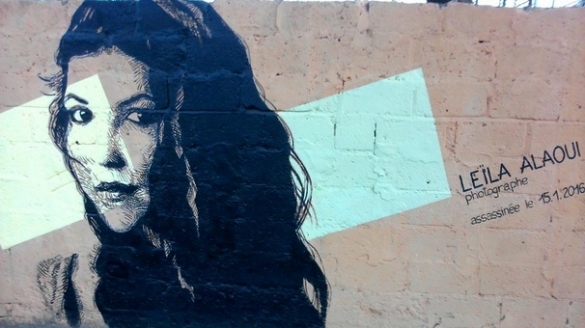
The 10th Rencontres Internationales de la Photo de Fès runs from from the 22nd November to the 19th of December 2016. It will be marked by several highlights, including the tribute to be paid to the great Franco-Moroccan photographer Leila Alaoui who died on January the 18th in a terrorist attack in Ouagadougou.

The late Leila Alaoui

The opening ceremony will take place on November 22 at the Gallery of the French Institute in the presence of Alaoui's family, friends, writers and photographers.

SHARE THIS!

Saturday, November 19, 2016

Slideluck Exhibition in Fez


Slideluck is a NYC-based non-profit organisation dedicated to building and strengthening community through food and art by producing multimedia slideshows combined with potluck dinners in over 75 cities worldwide. Once again it is returning to Fez

Photographers represented include: Suzanna Clarke, Rita Houari, Vanessa Bonnin, Evi Tabea, Tom Fakler, Daniel Donnelly, Omar Chennafi, Ahmed Bennani, Mohamed Thara, Cat Wilson, Antonio Jose Guzman and Anna Golubeva.

SHARE THIS!

Friday, November 18, 2016

Moroccan Photo of the Day - Bab Boujloud


The Bab Bou Jeloud (or Bab Boujeloud; English: The Blue Gate) is a gate that leads to the Old Medina of Fes el Bali, in Fez. These two old photographs are from the collection in the Fine Arts Library of the Harvard College Library

From the outside looking into the Medina
The view from the Medina looking out

Surrounded by high walls, the Pasha Baghdadi square connects the Medina with Fez el-Jedid. The Bab Bou Jeloud is a beautiful monumental gate built in 1913 and is now one of the main tourist entrances to Fez el-Bali.

See more in our series Photo of the Day 

The View from Fez welcomes contributions to our Photo of the Day Series

SHARE THIS!

Morocco's Eid Al Istiqulal (Independence Day)


November 18th in Morocco is known as Eid Al Istiqulal (Independence Day), and honours the return of King Mohammed V to Morocco from exile in Madagascar. On this day the king proclaimed the freedom of Morocco from France and Spain who had colonised the country for 44 years

On November 18, 1956 Morocco gained its independence from France in what became known as the Revolution of the King and the People. France had claimed Morocco as a French protectorate since 1912.

In 1944, Moroccan nationalists formed an independence party seeking an end to colonialism, and became known as the Istiqlals. In response, the French government arrested all the leaders of the group. Following riots in Casablanca in 1952, Istiqlal was banned. King Mohammad V was exiled to Madagascar, and Ben Aarafa took over, but he was not well-liked by Moroccans.

King Mohammad V returns to Morocco 

Nationalists and supporters of King Mohammad V, angered by the French decision, began revolting on the streets in the form of an armed movement. This forced the French government to bring back King Mohammad V. The return of the king culminated into Morocco’s independence.

On November 18, 1955, King Mohammad V returned to Morocco and negotiated for his country’s freedom through reforms that would transform it into a constitutional monarchy. In 1956, France officially relinquished its protectorate and Morocco gained its independence.


The View From Fez congratulates Morocco on Eid Al Istiqulal

SHARE THIS!

Thursday, November 17, 2016

Australia to Open Embassy in Rabat


Yesterday (Wednesday, November 16) in Marrakech, Australia’s top diplomat, Julie Bishop, announced that Australia will open an embassy in Rabat. This long awaited development is good news for both Australian expats and the thousands of tourists who visit the Kingdom each year
Salaheddine Mezouar and Julie Bishop

Australian Foreign minister Julie Bishop is in Morocco representing Australia at the 22nd UN conference climate conference (COP22) convening in Marrakech.

Following her meeting with Moroccan Foreign minister Salaheddine Mezouar, acting chairman of COP22, the Australian Foreign minister said her country has decided to open embassy in Morocco’s capital because the two countries share huge untapped potentials and bilateral cooperation prospects look promising.

“We hope the opening of the embassy will usher in a new era in Australian-Moroccan relations”, she said, expressing her country’s keen interest to foster further economic relations, especially in renewable energies.

About 30,000 Australian tourists visit Marrakech each year, added Mrs Julie Bishop, saying she is convinced that this number will keep growing in the coming years due to Morocco's political stability, tolerance and thriving tourism sector.

Morocco has a rapidly industrialising economy and there is significant opportunity to expand Australia’s trade and investment links, including in food and agriculture, infrastructure planning and sustainable development, mining, oil and gas, and health  as relations between the two countries are gaining momentum
Today I announce the Government’s intention to open an Australian Embassy in Rabat, Morocco, with the agreement from the Moroccan Government, as part of our commitment to expanding Australia’s diplomatic network. An embassy in Morocco is an important addition to Australia’s diplomatic network in Africa, a region of considerable commercial interest to Australia - Julie Bishop
It is believed that the new Embassy will also facilitate enhanced collaboration on counter-terrorism and other security issues.  Mrs Bishop pointed out that Australia values Morocco’s significant role in international efforts to fight international terrorism and extremism.

The two countries enjoy strong people-to-people links, with many thousands of Australians visiting Morocco each year.

The Australian Government hopes to open the Embassy in the 2017/2018 financial year contingent upon identifying a suitable location and office fit-out.

It is to be hoped that the new links mean that Australian residents in Morocco will also be able to gain residency permits for longer than one year.

Local Australians have welcomed the news while New Zealanders hope that their country will follow the Australian lead.

SHARE THIS!

Tuesday, November 15, 2016

Moroccan Photo of the Day ~ Djebel Zalagh


The ALC-ALIF Photography Club photography trip to Mt Zalagh on the weekend was a great success with twenty-six participants. The photograph above was taken by Mohammed Kadiri.

26 photographers took part

Thanks to club organiser Omar Chennafi

See more in our series Photo of the Day 

The View from Fez welcomes contributions to our Photo of the Day Series

SHARE THIS!

Monday, November 14, 2016

Moroccan Photo of the Day - Moon Over Tangier


This full moon last night was the closest and brightest "supermoon" of 2016 but also the largest since 1948. The full moon won't come this close to Earth again until Nov. 25, 2034.

See more in our series Photo of the Day 

The View from Fez welcomes contributions to our Photo of the Day Series

SHARE THIS!

Morocco's Million Trees in a Day Project


On Saturday, Morocco's High Commissioner for Water and Forests and the Fight Against Desertification (HCEFLCD), Abdeladim Lhafi, launched a national initiative to plant over one million trees in a single day, in over 210 areas across the country

"I plant a tree in my territory to develop the forest of my country

The project under the Patronage of HM King Mohammed VI, was announced in the town of Jbilat in the province of Rhamna (Azib Sidi Bouathmane) in the presence of the Governor of the province, Farid Chourak. The event was launched with the theme "I plant a tree in my territory to develop the forest of my country".

The national reforestation campaign 2016 will involve the planting of more than 40 million seedlings over an area of ​​45,000 to 50,000 ha. The previous reforestation program annually increased forest cover by 1% between 1990 and 2000 and by 2% between 2000 and 2010.

According to the Food and Agriculture Organisation of the United Nations (FAO) Morocco is among the 25 countries that have reversed the trend of degradation of their forest ecosystems.


SHARE THIS!

Friday, November 11, 2016

Djebel Zalagh Photography Trip on Sunday


The ALC-ALIF Photography Club has organised a photography trip to Mt Zalagh this Sunday - visitors to Fez are welcome

Djebel Zalagh (900 metres) is the impressive mountain backdrop to the old Medina of Fez. It is a favourite place for picnics, hiking, mountain biking and horse riding. The scenery is beautiful and includes forests of pine, cedar, fig, almond and olive orchards.

The view from the top looks out over the Sebou Valley and Sais Plain to the Rif Mountains..


Details:  Photography Trip - Mt Zalagh - Sunday, November 13, at 9.30am. Meet in front of the Batha fountain.

SHARE THIS!

Thursday, November 10, 2016

Moroccan Ingenuity - The World's First Electric Pickup


In just nine months and in time for the COP22 Summit in Marrakech, Morocco's National Transportation and Logistic Company (SNTL) has produced the world’s first electric pickup truck. The 100% electric vehicle is a 100% Moroccan, both in terms of concept and assembly


The prototype has been adapted for the Moroccan market in that does not require the creation of electric charging stations for a recharge. The pickup can be recharged in less than 7 hours at home using a 220V power outlet, or in as little as an hour if a supercharger is used.

The vehicle’s rechargeable batteries are placed in a balanced manner on the chassis allowing more stability and a range on a single charge of 180 to 200km. The designers of the vehicle claim that it is perfectly suited for urban journeys. On the highway it can reach 129km/h. Though small, the carrying capacity is impressive, with the rear bed able to carry a load of up to 800kg.

The most spectacular innovation is that the users of the electric pickup truck can upgrade their vehicles without having to purchase a new one. The modular design allows the owner to integrate a new version of a component on an earlier version of the vehicle, without it hindering any of its normal functions.


The electric pickup's features, such as temperature control, can be remotely controlled by the driver using a computer tablet.

Although designed, manufactured and assembled in Morocco, the electric pickup is intended to be primarily sold in the European market.

SHARE THIS!

Morocco's Sephardic Jews Can Gain Spanish Citizenship


Under a new law administered by the Spanish Ministry of Justice that recognises the expulsion of Jews during the period of 1492-98, the descendants of those families can qualify for full Spanish citizenship and apply for a Spanish passport

Spain's Federation of Jewish Communities praised the mass naturalisations, adding that most applicants were from Morocco, Turkey and Venezuela.

The new law gives Sephardic Jews and their descendants three years to seek a Spanish passport, with the right to work and live in the 28-nation European Union.

Like others seeking Spanish citizenship, applicants must be tested in basic Spanish and pass a current events and culture test about Spain.

They also must establish a modern-day link to Spain, which can be as simple as donating to a Spanish charity or as expensive as buying property.

The Spanish Jewish federation has received more than 5,000 requests for information about the Spanish law. No one knows how many people might be eligible, though some estimates run into the millions.

The applicants don’t have to be Jewish, but the process of tracing family history back to the group of Jews known as the Sephardim who lived in Spain at the time may not be easy. Applicants also need to pass an online test in basic Spanish language and civics. The period to apply is three years, ending Oct. 1, 2018. There is also a requirement for a criminal background check, and documents have to be submitted in a specific format. It allows you to live and work not only in Spain, but in any of the European Union countries, any place you choose. It’s a tremendous opportunity.

Spain also allows dual nationality for people born in countries that used to be Spanish colonies.

For further information please contact Pippa Smith at Carbray Law Firm Spain. Tel: 0034 934 880 972

Story thanks to Pippa Smith

Historical note


Moroccan Jews (Arabic: اليهود المغاربة‎‎ al-Yehud al-Magharibah, Hebrew: יהודים מרוקאים‎‎ Yehudim Maroka'im) are the Jews who live or lived in Morocco. The first Jews migrated to this area after the destruction of the First Temple in Jerusalem and settled among the Berbers. They were later met by a second wave of migration from the Iberian peninsula in the period immediately preceding and following the 1492 Alhambra Decree, when the Jews were expelled from kingdoms of Spain, and soon afterwards, from Portugal as well. This second immigration wave deeply modified Moroccan jewry, who largely embraced the Andalusian Sephardic liturgy, making the Moroccan Jews switch to a mostly Sephardic identity.

SHARE THIS!

Tuesday, November 08, 2016

What Moroccans Think of US Presidential Candidates


While the eyes of the world are on the American elections, the interest is particularly high in Morocco, especially in regard to the possible foreign policy differences of the candidates

In the latest survey Moroccans showed strong support for the Democratic candidate, Hillary Clinton. The survey result suggests that 78% of Moroccans prefer Clinton, whereas Republican candidate Donald Trump garnered only 4% support. Around 5% of respondents said they have no preference and 13% said that they simply didn't know.

The survey was conducted by the Arab Research and Centre for Policy Studies.

Of the Moroccans interviewed, 70% felt that the Democratic candidate will have the most positive impact on US foreign policy in the Arab world, against 13% who think that the election of Donald Trump will benefit the MENA region.

Also, in regard to US foreign policy, 30% of Moroccans consider the approach of the White House as very negative, 27% find it relatively negative, 7% consider it positive and 26% think successful.

Writing recently for Morocco World News, Ahmad Azizi, a Political Adviser in the United Nations in New York said... "Since the terrorist attacks of September 11, a pillar of U.S. foreign policy has been the fight against international terrorism. This, coupled with the (misguided) notion that arming rebels in Syria could put dangerous arms in the hands of terrorist, has lead to the U.S. shying away from providing more than symbolic support for the Syrian revolution. In addition, the fatigue that came about as a result of U.S. miscalculated intervention in Afghanistan and, particularly, Iraq, thereby over-stretching the U.S. military and budget, means only one thing: international intervention, regardless of whether it is warranted or not, would not be a popular proposition. Also, the arrival of conservative Islamists to the helm of power in Morocco, Tunisia, Egypt and Libya only makes matters worse for the U.S. president who faces the daunting dilemma of supporting Arab people’s democratic choice knowing that it would lead to support for none other than those who supposedly show enmity towards the U.S".

According to the daily newspaper Al Akhbar Yaoum the survey also reveals that Morocco is the Arab country most favourable to the Democratic candidate Hillary Clinton in the MENA region of the Middle East and North Africa. The recent opinion poll of citizens in nine Arab nations found a curious and dramatic range in support for Donald Trump’s candidacy. From a low of 4% (Morocco) to a relatively high 20% among Iraqi respondents. Almost 60% of all respondents said that they are following the US presidential election on a regular or occasional basis.

The survey was conducted among 3,600 people in Morocco, Algeria, Egypt, Iraq, Kuwait, Jordan, Palestine, Saudi Arabia and Tunisia, with 400 respondents per country.

SHARE THIS!

Saturday, November 05, 2016

41st Celebration of Morocco's Green March


The anniversary of the Green March on Sunday, November the 6th, is a special day for Moroccans. It is a day when the Kingdom unites are in stressing the renewed mobilisation of the King and people to not only defend but also continue the development of the Moroccan Sahara

The Green March was a popular march of enormous proportions. On November 6, 1975, approximately 350,000 unarmed Moroccans converged on the city of Tarfaya in southern Morocco and waited for a signal from King Hassan II to cross into the region of Sakiya Lhmra.
They brandished Moroccan flags and Qur'an as well as carrying banners calling for the return of the Moroccan Sahara, photographs of the King and the Qur'an; the colour green for the march's name was intended as a symbol of Islam. As the marchers reached the border, the Spanish Armed Forces backed down and Spanish troops also cleared some previously mined zones.


Last year King Mohammed VI visited the Sahara to mark the beginning of a new march for the development of the Saharan provinces.  Al Alam,  an Arabic-language paper, said at the time,"The country's advanced regionalisation is a democratic response from Morocco to the desperate attempts of those who want to challenge its historical and legitimate right to its southern provinces,"

This year is unusual in that King Mohammed VI is on a State visit to Senegal and a statement from the Ministry of the Royal Household, Protocol and Chancellery says that the Sovereign has decided to deliver his speech on the occasion of the celebration of the 41st anniversary of the Green March, from the city of Dakar.

"Having chosen a country other than Morocco, an African country, Senegal today, to give a traditional historical discourse is symbolic of the nature of the relationship between Morocco and Senegal, "said Senegalese President in a statement to the media, pointing out that this initiative shows "the choice of His Majesty to speak to Africa and Africans." President Macky Sall added: "His Majesty the King has a vision of Africa, and what should be the Africa of tomorrow. It also has ambitions for the continent."

The Moroccan media is united in reminding Moroccans that "there are very few events in the history of a country that transcend time and generations to remain vivid in the memory of all, old and young, there are few events that bear a historical grandeur and a sense of destiny and belonging. Morocco has such an event. That was the Green March, the unprecedented march, both symbolic and popular, of 350,000 Moroccans who walked hundreds of kilometres to peacefully recover a part of their country, the Western Sahara, which was under Spanish dominion."
No shots were fired, not a single drop of blood was shed and Morocco retrieved its Sahara. That was in 1975.
The North Africa Post concludes, "The centuries-old historical, geographical, and ethnical ties that existed between the Sahara and Northern Morocco that were broken by colonialism for decades were stitched again thanks to the genius idea of the late king Hassan II, the architect of the epic, who thought out and planned every detail of the March".


However, the Green March celebrations are not all about politics. The Royal Moroccan Football Federation (FRMF) is organising a “gala match” to celebrate the 41st anniversary. Festivities will take place at Sheikh Mohamed Laghdaf Stadium in Morocco’s Saharan Capital, Laayoune, with many legendary international footballers in attendance.

Maradona heads to Morocco for Green March match

Former Argentine football icon Diego Armando Maradona, Liberian George Weah, Ghanaian Abedi Pele, Brazilian Rivaldo, Italian Alessandro Altobelli, have announced as attending. Many former Moroccan footballers will also be participating.

SHARE THIS!

Official! Morocco's VoIP Ban Ends


Morocco's telecommunications operators have been instructed to proceed with the restoration of all VoIP services and telephony across their fixed and mobile networks

According to the National Telecommunications Regulatory Agency (ANRT), "this decision comes after the assessment by the ANRT of the  evolution, at both national and international levels, of the situation of the telecommunications markets and regulatory context, firstly, and, given the requirements of harmonious development of the sector, to the benefit of users on the other."

The ANRT says it will ensure consumers benefit from the best technological developments, in harmony with the requirements of development of the sector and Telcos in compliance with the regulations.

This is not only good news, but a win for commonsense and the people.

SHARE THIS!

Thursday, November 03, 2016

Morocco Urgently Needs Blood Donors


While there is a critical need for blood products in Morocco's hospitals, there is also the need to create in the population a culture of regular blood donation


Morocco's present dire need of blood is due to a decline in stocks and the scarcity of donations. The idea of being a regular blood donor is not even considered by a majority of citizens. The Kingdom lags behind many countries in falling below the donor level suggested by the World Health Organisation (WHO).

At present donor contributions in Morocco sit at around 3% of the entire population.

In the developed world a majority of blood donors are unpaid volunteers who donate blood for a community supply. In poorer countries, established supplies are limited and donors usually give blood when family or friends need a transfusion (directed donation). Many donors donate as an act of charity, but in countries that allow paid donation some donors are paid, and in some cases there are incentives other than money such as paid time off from work. Donors can also have blood drawn for their own future use (autologous donation). Donating is relatively safe, but some donors have bruising where the needle is inserted or may feel faint.


The WHO has developed a global framework for action to achieve 100% voluntary blood donation. The plan has been developed jointly by the WHO and the International Federation of Red Cross and Red Crescent Societies. It is designed to provide guidance and support to countries seeking to establish effective voluntary blood donor programmes, phase out family/replacement blood donation and eliminate paid donation.

The vision embodied in this framework is the achievement of 100% voluntary non-remunerated blood donation in every country of the world. It is based on the recognition that voluntary non-remunerated blood donors are the foundation of a safe, sustainable blood supply. Without a system based on voluntary unpaid blood donation, particularly regular voluntary donation, no country can provide sufficient blood for all patients who require transfusion.

At present the WHO statistics show a disparity between wealthy nations and low-income countries.

Of the 112.5 million blood donations collected globally, approximately half of these are collected in the high-income countries, home to 19% of the world’s population.

In low-income countries, up to 65% of blood transfusions are given to children under 5 years of age; whereas in high-income countries, the most frequently transfused patient group is over 65 years of age, accounting for up to 76% of all transfusions.

The blood donation rate in high-income countries is 33.1 donations per 1000 people; 11.7 donations in middle-income countries and 4.6 donations in low-income countries.

An increase of 10.7 million blood donations from voluntary unpaid donors has been reported from 2008 to 2013. In total, 74 countries collect over 90% of their blood supply from voluntary unpaid blood donors; however, 72 countries collect more than 50% of their blood supply from family/replacement or paid donors.

Only 43 of 175 reporting countries produce plasma-derived medicinal products (PDMP) through the fractionation of plasma collected in the country, whereas the majority of the other 132 countries import PDMP from abroad.


It is critical that Morocco promotes blood donation, retains donors, and most importantly, ensures a culture of voluntary and regular blood donation.

SHARE THIS!

Wednesday, November 02, 2016

"Premiers Pas" - Terril Murano Exhibition Coming to Fez


"Premiers Pas" or "First Steps" is the debut show of Terril Murano, an American ex-pat living in Morocco since 2014


This collection encapsulates Terril's first impressions of while traveling around this dynamic country from top to bottom and reflects her immediate and profound entrancement by it's people, culture and spirit. The opening is sure to be an evening of warmth and sharing.


The exhibition opening in Fez is at 6.30 pm on Saturday November 5th at Médin'ART (see map below) and is open to the public.


SHARE THIS!